Why Divo Botanical Reserve stands out
The reserve is best known as one of the oldest formally protected forest sites in Côte d'Ivoire and as a striking case study in tropical forest restoration. Its botanical importance rests on the presence of rare West African timber species such as Tieghemella heckelii, Khaya ivorensis, and Entandrophragma angolense, several of which survive in extremely low numbers. Equally, it is known for the dramatic transformation of its landscape, where centuries of agricultural expansion have reduced continuous forest to small, scattered remnants. The reserve's restoration program, led by international forestry and botanical organizations in partnership with the Ivorian government, makes it a flagship example of active forest recovery in West Africa.
Divo Botanical Reserve history and protected-area timeline
The Divo Botanical Reserve was established by decree on 26 October 1935, during the period of French colonial administration in West Africa. Its original purpose was to protect a representative area of the region's semi-sempervirent tropical forest, a habitat type that was already under pressure from agricultural expansion at the time. Over the following decades, the boundaries of the reserve were refined through administrative orders in 1954 and 1975, adjusting its limits to reflect evolving land use and management needs.
Throughout the twentieth century, the surrounding region of Lôh-Djiboua underwent significant transformation. The growth of cocoa, oil palm, and rubber cultivation gradually encroached on the edges of the reserve and reshaped its internal landscape as well. By the early twenty-first century, only a small fragment of what had originally been primary forest remained, with most of the reserve converted to cash-crop agriculture or lowland farming.
Recognition of this ecological decline eventually prompted a series of restoration actions. In 2022, an international partnership led by the Centre for International Forestry Research and World Agroforestry, together with the local NGO Génie Bio and the Ivorian government, undertook a 350-hectare reforestation effort within the reserve. Two years later, in 2024, a formal restoration plan was prepared, combining scientific institutions, conservation organizations, and national authorities, with the long-term goal of restoring biodiversity in the reserve by 2030.
Divo Botanical Reserve landscape and geographic character
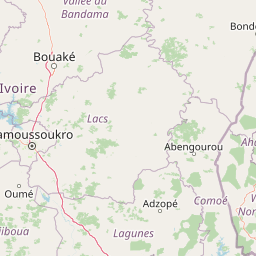
The Divo Botanical Reserve occupies a gently undulating section of southern Côte d'Ivoire within the broader Lôh-Djiboua region. Its topography is characterized by low-relief terrain typical of West African forest lowlands, intersected by small streams and lowland areas that contribute to seasonal inundation in some parts. The reserve sits along the road corridor between Divo and Tiassalé, near the villages of Blé and Kpacossou-Carrefour, giving it a clearly defined geographic position within the regional landscape.
What defines the present-day landcape is contrast. Once a continuous canopy of semi-sempervirent tropical forest, the area has been progressively opened up, leaving only a thin mosaic of secondary forest patches surrounded by cultivated plots. Approximately a third of the surface is now under cocoa cultivation, with smaller proportions devoted to oil palm, rubber, and lowland wet zones. The result is a patchwork of farmland, degraded forest fragments, and plantation species such as teak and Gmelina arborea, offering a visual reminder of how human land use can reshape even formally protected forest landscapes.
Divo Botanical Reserve ecosystems, habitats, and plant life
Ecologically, the Divo Botanical Reserve belongs to the Upper Guinean moist forest ecosystem, one of West Africa's most biodiverse but also most threatened forest types. Originally classified as semi-sempervirent tropical forest, the reserve still supports a meaningful botanical assemblage despite extensive historical deforestation. The vegetation is now a mosaic of secondary regrowth, plantation species, and agricultural land, but botanical surveys confirm that the surviving forest fragments host a wide variety of native trees and other plant species.
A 2023 inventory by the National Centre for Floristics of Félix Houphouët-Boigny University identified 595 plant species across the reserve and 213 tree species. Of the trees recorded, 52 occur within the remaining secondary forest patches, while a portion of the woody cover consists of planted teak and Gmelina arborea. The mix of native regrowth and introduced plantation species gives the reserve an unusual botanical character, blending ecological recovery potential with the legacy of forest management interventions.
Divo Botanical Reserve wildlife and species highlights
Although the available documentation for the Divo Botanical Reserve centers primarily on its flora rather than its fauna, the reserve's forest fragments are situated within the broader Lôh-Djiboua landscape, an area historically associated with West African forest wildlife. Surrounding forest and agricultural mosaic habitats typically support a range of mammals, birds, and insects typical of southern Côte d'Ivoire's forest zone, even when formal faunal inventories for the reserve itself are limited.
The most clearly documented biological significance of the reserve lies in its tree species, several of which are important forest wildlife resources in their own right, providing fruit, foliage, and habitat structure for birds, primates, and insects. The presence of mature individuals of species such as Tieghemella heckelii, Khaya ivorensis, and various Entandrophragma species is ecologically important beyond their timber value, as these trees anchor forest structure and support the wider food web of West African moist forest ecosystems.
Divo Botanical Reserve conservation status and protection priorities
The Divo Botanical Reserve holds considerable conservation value as one of the oldest formally protected forest areas in Côte d'Ivoire. Its importance was underscored by the 2023 botanical inventory, which confirmed the presence of sixteen IUCN Red List tree species within the reserve, the majority classified as Vulnerable and one, Tieghemella heckelii, classified as Endangered. The survival of these species within an actively managed reserve provides a foundation for both in-situ protection and future population recovery.
Beyond species preservation, the reserve represents a national and international model for restoring degraded tropical forest landscapes. The 2022 reforestation effort and the 2024 restoration plan jointly reflect a strategic shift toward active ecological recovery rather than passive protection. The involvement of organizations such as CIFOR-ICRAF, Botanic Gardens Conservation International, and Côte d'Ivoire's National Centre for Floristics brings scientific, technical, and institutional capacity to bear on issues such as native species reintroduction, habitat connectivity, and sustainable land use in surrounding communities. The reserve's 2030 biodiversity vision positions it as a long-term test case for restoring West African forest ecosystems under contemporary pressures.
Divo Botanical Reserve cultural meaning and human context
The Divo Botanical Reserve lies within the agricultural heartland of southern Côte d'Ivoire, a region whose identity has been shaped by generations of small-scale farming, particularly of cocoa, rubber, and oil palm. The reserve's transformation over the decades mirrors the broader social and economic trajectory of the Lôh-Djiboua region, where forest clearing has been closely tied to rural livelihoods and the cocoa economy. The villages of Blé and Kpacossou-Carrefour, located along the reserve's edge, reflect this long-standing relationship between local communities and the forest landscape.
From a national perspective, the reserve also carries a heritage dimension. As a colonial-era forest reserve that has been continuously administered through independence and into the modern restoration era, it represents a continuity of forest stewardship that links Côte d'Ivoire's colonial, post-independence, and contemporary conservation periods. The current restoration partnerships further emphasize the role of community engagement and traditional agricultural knowledge in shaping how the forest will be managed in the decades ahead.
Top sights and standout views in Divo Botanical Reserve
One of the oldest formally protected forest sites in Côte d'Ivoire, established in 1935 and located east of Divo in the Lôh-Djiboua region. Contains a documented flora of 595 plant species and 213 tree species, including sixteen IUCN Red List species and the Endangered Tieghemella heckelii. Represents a striking example of tropical forest pressure and recovery, with most of its original area converted to cocoa, oil palm, and rubber cultivation. At the center of an active international restoration effort involving CIFOR-ICRAF, Botanic Gardens Conservation International, and Côte d'Ivoire's Ministry of Waters and Forests, with the goal of restoring biodiversity by 2030.
Best time to visit Divo Botanical Reserve
Southern Côte d'Ivoire has a humid tropical climate marked by a clear contrast between a wet season and a drier season, and the Divo Botanical Reserve can be appreciated in either period, though with different atmospheres. The wet season, generally running from roughly April through October, brings heavy rainfall that supports the greenest forest conditions and most vigorous vegetation but also makes some low-lying areas of the reserve difficult to access. The drier months, from late November into March, offer more comfortable conditions for exploring the mosaic of forest fragments, teak and Gmelina plantations, and surrounding agricultural landscape. For visitors interested in viewing restoration plantings and forest regeneration, the months following the conclusion of seasonal rains tend to provide the clearest window for observation.