Why Jezioro Łyse Nature Reserve stands out
The reserve is particularly known for its compact, well-defined peatland complex that combines a dystrophic bog lake with bog pine forest and open peatland vegetation. Within this small area, several rare and protected species typical of undisturbed Polish peatlands coexist, including sphagnum mosses, intermediate sundew, and bog clubmoss, as well as the white beak-sedge community. Its core importance lies in preserving a coherent example of a lowland peatland ecosystem, rather than any single dominant species or landscape feature. The reserve's combination of open water, saturated peat substrate, and bog pine forest gives it strong conservation value as an integrated wetland habitat rather than a collection of isolated features.
Jezioro Łyse Nature Reserve history and protected-area timeline
The reserve was formally established on 29 March 2006 through Regulation No. 24/2006 of the Wojewoda (Governor) of the Kuyavian-Pomeranian Voivodeship. Its creation reflected growing recognition within Polish regional conservation policy of the importance of small, ecologically coherent peatland systems outside larger national parks.
The reserve was designed from the outset to protect an existing peatland mosaic around the lake rather than to be developed as a public recreation site. Its zoning, with strict protection on the lake area and active protection in the surrounding bog forest, was built into its founding legal framework, suggesting that management authorities viewed the site as requiring both preservation of natural hydrology and active measures to maintain surrounding peatland and bog forest communities.
Its establishment also connected it administratively to the Osie Forest District and placed it within an area considered for the expansion of the Wdecki Landscape Park, positioning the reserve as a complementary conservation node within the larger Tuchola Forest landscape planning framework.
Jezioro Łyse Nature Reserve landscape and geographic character
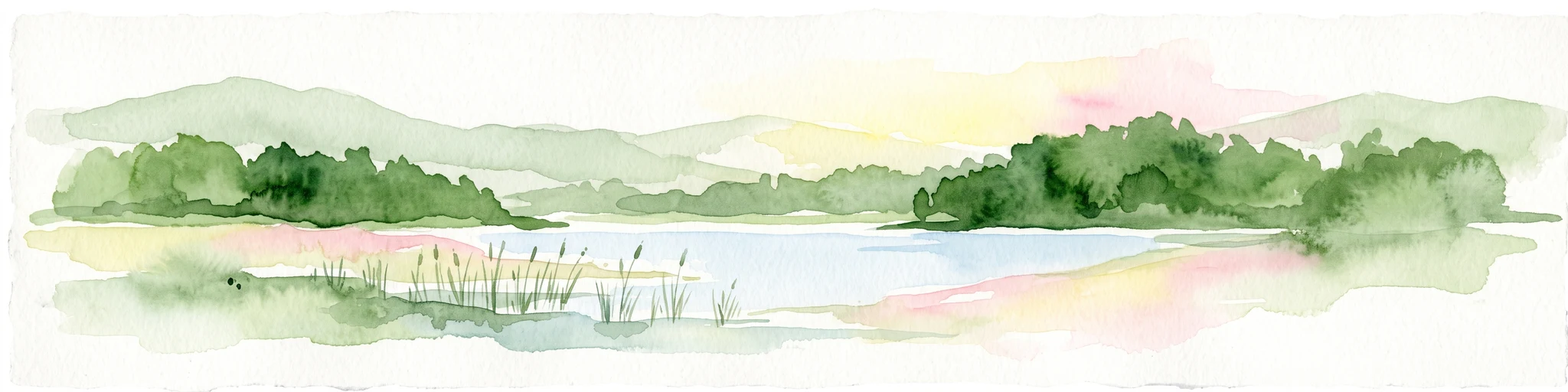
The landscape of the Jezioro Łyse reserve is shaped by the flat, sandy outwash terrain typical of the Bory Tucholskie region. Rather than dramatic relief, the reserve's character comes from subtle topographic and hydrological variation: a small dystrophic lake surrounded by saturated peat substrate, transitioning outward into bog pine forest on peat soils, with intervening areas of open, waterlogged peatland.
The lake itself is a quiet, nutrient-poor body of water with dark, acidic conditions typical of peatland lakes. The surrounding ground is low-lying, with limited elevation change, and is dominated by organic peat deposits rather than mineral soils. Vegetation patterns follow hydrological gradients, with floating mats, sedge and moss communities near the water, and stunted pine forest on the better-drained peat edges.
In the wider geographic setting, this small peatland basin sits within the extensive pine-dominated forests and lake-studded terrain of the Tuchola Forest. The result is a landscape defined less by elevation or dramatic landforms than by the interplay of water, peat, and trees, with the reserve representing a compact, well-preserved example of this regional character.
Jezioro Łyse Nature Reserve ecosystems, habitats, and plant life
The reserve's ecological identity is fundamentally that of an intact lowland peatland system. The primary ecosystem is the dystrophic bog lake, fed by rainwater and surrounded by peat deposits, with associated open peatland communities and bog pine forest (bór bagienny) on the margins. Together these form an interdependent complex in which hydrology, vegetation, and accumulating peat are tightly linked.
The vegetation reflects classic peatland zonation. In and around the lake, aquatic and semi-aquatic communities include mosses and sedges adapted to saturated, acidic conditions. Moving outward, open peatland transitions into bog pine forest, where pine grows on peat soils alongside a ground layer of sphagnum mosses and specialized bog plants. The mosaic of open water, open peatland, and forested peat is central to the reserve's ecological value, because each habitat supports a different subset of species while sharing the underlying peat-forming processes.
This combination of habitats makes the reserve a representative example of peatland ecology in the Polish lowlands. By protecting not just a single community but the transition between lake, open peatland, and bog forest, the reserve preserves the structural complexity that makes peatland ecosystems function and persist.
Jezioro Łyse Nature Reserve wildlife and species highlights
The reserve's most distinctive wildlife significance lies in its specialized plant communities rather than its larger fauna. The bog lake and surrounding peatland support a range of rare and legally protected plant species typical of undisturbed Polish lowland peatlands, including sphagnum mosses (torfowce) as the dominant peat-building group, intermediate sundew (rosiczka pośrednia), bog clubmoss (widłaczek torfowy), and the white beak-sedge (przygiełka biała) community, an assemblage characteristic of open, waterlogged peatland.
These species collectively reflect the presence of functioning peatland processes: acidic, nutrient-poor, waterlogged conditions maintained over long periods. Their co-occurrence is itself an ecological signal, indicating that the site's hydrology and chemistry have not been substantially disturbed. While the reserve is small, this concentration of protected peatland plant species within a single integrated system is a key aspect of its conservation relevance.
Information on larger fauna, such as birds, amphibians, or mammals, is not elaborated in the available source material, and any broader wildlife commentary would be speculative. The reserve's documented wildlife character is therefore primarily botanical and tightly tied to its peatland ecology.
Jezioro Łyse Nature Reserve conservation status and protection priorities
From a conservation perspective, Jezioro Łyse represents a compact but high-integrity example of a lowland peatland ecosystem, a habitat type that has been significantly reduced across much of northern and central Europe. By protecting an intact bog lake together with its surrounding peatland and bog forest in a single reserve, the site preserves not only individual species but the underlying hydrological and ecological processes that maintain the system.
The reserve's two-tier protection regime is a defining feature of its conservation value. Strict protection of the 5.58-hectare lake area emphasizes the preservation of undisturbed natural dynamics, while active protection of the surrounding 14.97 hectares acknowledges that maintaining peatland and bog forest communities in the long term may require management actions, such as controlling succession, stabilizing water levels, or preventing woody encroachment. This zoning reflects modern peatland conservation practice, which combines preservation of core areas with active management of buffer zones.
Its location within the Osie Forest District and in an area planned for expansion of the Wdecki Landscape Park additionally situates the reserve within a broader regional conservation framework. In this network, the reserve functions as a small but ecologically meaningful node contributing to the protection of forest and wetland complexes across the Tuchola Forest region, supporting landscape-scale connectivity that is increasingly recognized as essential for long-term peatland conservation.
Jezioro Łyse Nature Reserve cultural meaning and human context
The reserve does not have a strong documented cultural or historical dimension distinct from its ecological character. It is primarily a conservation-focused site established relatively recently, in 2006, and its significance is rooted in natural heritage rather than human history or traditional land use.
Its location within the Tuchola Forest region, one of Poland's largest historical forest complexes, places it within a landscape that has long been shaped by forestry and, in some periods, by peat harvesting, but the reserve itself was created specifically to halt or avoid such pressures on the targeted peatland. There is no source-supported tradition of indigenous or distinctive local cultural engagement with this particular site that would warrant a separate cultural section.
Top sights and standout views in Jezioro Łyse Nature Reserve
The reserve's strongest distinguishing features are its combination of a dystrophic bog lake, open peatland, and bog pine forest within a compact 20.55-hectare area, and the strict protection regime applied to the lake itself. It offers a representative cross-section of lowland peatland ecology in the Tuchola Forest region, with rare protected species such as sphagnum mosses, intermediate sundew, bog clubmoss, and the white beak-sedge community occurring within a single integrated system.
Its embedded position in the Osie Forest District and within a zone considered for the expansion of the Wdecki Landscape Park further enhances its significance, embedding a small but ecologically coherent reserve within one of Poland's most important forest and wetland landscapes.
Best time to visit Jezioro Łyse Nature Reserve
Because the reserve is primarily a conservation site rather than a developed visitor destination, the best times to consider a visit align with the natural rhythm of the peatland landscape. Late spring through early autumn is generally the most accessible period, when drier surface conditions and milder temperatures make the surrounding forest and protected area environment more comfortable for walking and observation, and when wetland vegetation and bog plant communities are most visibly active.
Winter and early spring bring higher water tables and softer ground around the peatland, while frozen conditions, where they occur, can offer a different perspective on the bog forest and lake edges. Visitors should be aware that strict protection rules around the lake itself generally limit direct access to the core zone, so any visit is best oriented toward the surrounding buffer area and adjacent forest roads, without entering the strictly protected lake area.