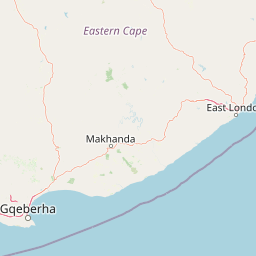
Why Shamwari Game Reserve stands out
Shamwari is best known for being one of South Africa's prominent private reclamation projects, where heavily farmed land has been systematically restored into wildlife habitat supporting Big Five game and a broad spectrum of African plains species. It is equally recognized for its animal welfare work, particularly through the Born Free Foundation sanctuaries that house lions and leopards rescued from captive situations such as circuses and substandard zoos. The reserve also has a strong public profile through its appearances on screen, having served as the filming location for international television series about African wildlife and conservation. Together, these three threads, ecological restoration, big cat welfare, and media visibility, define what makes Shamwari distinctive in the landscape of southern African conservation.
Shamwari Game Reserve history and protected-area timeline
Shamwari Game Reserve was established in 1992 on land in the Eastern Cape that had previously been used for farming. Rather than developing the property as a purely commercial hunting or tourism venture from scratch, the reserve's early model centered on ecological rehabilitation, with the goal of rebuilding natural habitat that had been altered by decades of agricultural activity.
Over time, the reserve's conservation profile expanded beyond habitat restoration. Partnerships with international animal welfare organizations brought additional responsibilities, most notably through collaboration with the Born Free Foundation, which jointly funds sanctuaries on the property. These centers care for big cats that have been discovered in poor conditions in circuses, zoos, or other captive situations elsewhere in the world, providing long-term refuge rather than release into the wild.
The reserve has also gained public recognition through several media productions. The British series Safari School and Animal Planet's Shamwari: A Wild Life were both filmed at the property, and in 2018 Netflix released Shamwari Untamed, a reality series centered on life and conservation work at the reserve. In 2005 Shamwari received the Global Nature Fund Award for Best Conservation Practice, reflecting its recognized standing in the conservation community.
Shamwari Game Reserve landscape and geographic character
Shamwari lies in a landscape shaped by the transition between the coastal belt of the Eastern Cape and the drier interior. The terrain combines open plains used historically for grazing with steeper vegetated zones and seasonal watercourses, producing the kind of mosaic habitat typical of the region's bushveld. The elevation is generally moderate, and the reserve's topography includes a mix of flatter grasslands and more broken, bushy areas along drainage lines.
One of the most distinctive landscape features of Shamwari is that it is not pristine wilderness in the traditional sense. Much of the property was formerly farmland, and the visible character of the land reflects deliberate restoration work. Fences and boundaries enclose the property, and internal management zones divide the area into different habitat and wildlife-use areas. This gives the landscape a managed but increasingly natural appearance, where pasture has gradually given way to thicker bush, more diverse vegetation, and a richer presence of wild animals.
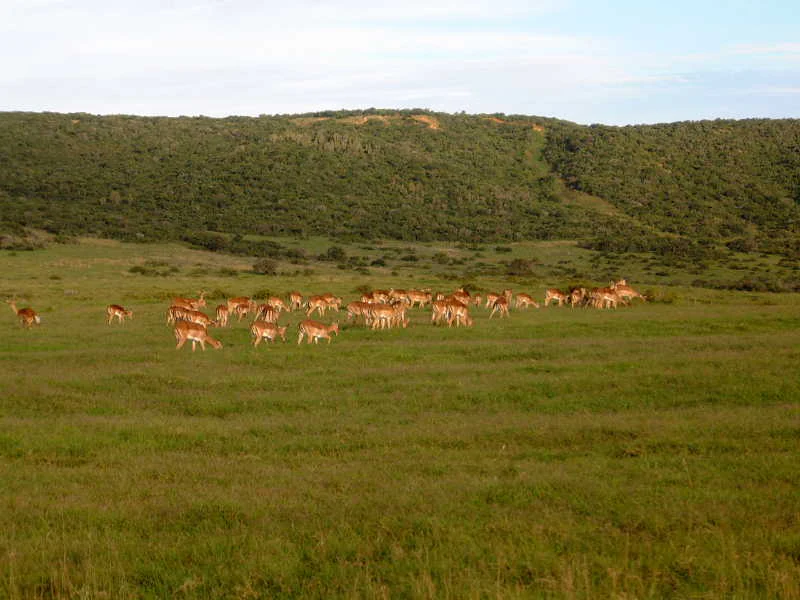
The result is a scenery that reads as distinctly African rather than purely rustic farmland, with wide skies, grassy plains, and stretches of denser vegetation that frame sightings of game. While the reserve does not have the dramatic mountain or coastal scenery of some other parts of South Africa, its visual identity is closely tied to this successful transformation of used land into habitat.
Shamwari Game Reserve ecosystems, habitats, and plant life
Ecologically, Shamwari sits within the Albany Thicket and Savanna bioregion, a transitional zone in the Eastern Cape where thicket vegetation, open grasslands, and more arid savanna elements meet. The reserve's mix of restored habitats supports a community of plants and animals characteristic of this transitional environment. Because the property was previously farmed, the habitats are not entirely self-willed; they reflect active choices about which species to encourage, how to manage browsing pressure, and how to shape water availability across the landscape.
The reserve's vegetation includes open grassy plains favored by grazers such as zebra, wildebeest, and various antelope species, alongside denser bush and woody cover used by browsers and ambush hunters. Riparian zones along rivers and other water sources add another layer of habitat, supporting taller vegetation and a different range of animal activity. This habitat complexity has been intentionally developed as part of the reserve's rehabilitation strategy, rather than being a purely inherited feature.
Climatically, the area falls within the Eastern Cape's relatively mild coastal-interior zone, with rainfall patterns that influence how green or brown the bushveld appears through the year. The combination of restored habitat variety and active management means that Shamwari functions less as a static wilderness block and more as a working example of how to rebuild African habitat on previously disturbed land.
Shamwari Game Reserve wildlife and species highlights
Shamwari is recognized for hosting a full Big Five complement, meaning lion, leopard, rhinoceros, elephant, and Cape buffalo are all present within the reserve. These species are joined by a wide range of other mammals that characterize southern African bushveld, including hippopotamus, South African giraffe, wildebeest, zebra, and various antelope species. Predators beyond the Big Five framework are also present, with cheetah and hyena recorded on the property.
The reserve's wildlife identity is shaped not just by the species present but by their origin. Many of the larger mammals have been introduced as part of the reserve's rebuilding process, and the current community reflects active management of carrying capacity, genetic diversity, and breeding programs. This means that wildlife viewing at Shamwari often feels less like observing a long-established natural system and more like witnessing an ongoing experiment in restoring African fauna to habitat that had lost it.
A separate but closely related thread is the reserve's role in big cat welfare. Through its partnership with the Born Free Foundation, Shamwari operates two sanctuary centers, one in the north and one in the south of the property. These facilities care for lions and leopards that have been removed from captive situations such as traveling circuses or inadequate zoos, providing them with permanent refuge rather than release back into the wild.
Shamwari Game Reserve conservation status and protection priorities
Conservation is central to Shamwari's identity and purpose. The reserve was established as a rehabilitation project on formerly farmed land, and its day-to-day work continues to focus on restoring ecological function, managing reintroduced wildlife populations, and demonstrating how an intensively used agricultural landscape can be returned to a more natural state. This model has positioned Shamwari as a case study in private conservation in the Eastern Cape.
The reserve's partnership with the Born Free Foundation extends its conservation role beyond its own fences. By jointly funding big cat sanctuaries on the property, Shamwari contributes to international efforts to address the consequences of the wildlife trade, poor captive care, and outdated zoo or circus practices. The sanctuaries provide long-term housing rather than attempting rewilding, reflecting a recognition that not every rescued animal can return to wild conditions.
Recognition of this work came in 2005 when Shamwari was awarded the Global Nature Fund Award for Best Conservation Practice. The reserve's location within the Indalo Protected Environment further embeds it in a landscape-scale conservation framework, giving its efforts a regional context rather than treating them as an isolated private project.
Shamwari Game Reserve cultural meaning and human context
Shamwari's cultural context is rooted in the broader transition of South Africa's Eastern Cape from a heavily agricultural and pastoral economy toward a more diversified model that includes private conservation, tourism, and wildlife-based land use. The reserve's origin on former farmland reflects this broader shift, where landowners have increasingly seen wildlife and conservation as a viable alternative to traditional agriculture.
The reserve has also become part of international popular culture through several television productions. The British series Safari School and Animal Planet's Shamwari: A Wild Life used Shamwari as a filming location, and the 2018 Netflix series Shamwari Untamed gave the reserve one of its broadest international audiences. These productions have contributed to a wider awareness of Eastern Cape conservation work and have positioned Shamwari as a recognizable name beyond specialist conservation circles.
In its immediate region, Shamwari operates within a network of private reserves that are increasingly connected through initiatives such as the Indalo Protected Environment, which encourages cooperation between landowners. This community of reserves, linked by shared conservation goals, forms the broader cultural and professional framework within which Shamwari operates today.
Top sights and standout views in Shamwari Game Reserve
Shamwari's strongest distinguishing features combine ecological restoration with high-profile animal welfare and broad public visibility. The reserve is notable for successfully translating formerly farmed Eastern Cape land into a functioning Big Five habitat, supporting a wide spectrum of plains wildlife while maintaining an active habitat management program.
Equally distinctive is its partnership with the Born Free Foundation, which has made Shamwari home to dedicated big cat sanctuaries for rescued lions and leopards. Layered on top of this is the reserve's media presence, with multiple internationally broadcast series filmed on the property, giving it a reach that extends well beyond its physical boundaries. Together, these elements define Shamwari as both a working conservation property and a recognizable name in global wildlife storytelling.
Best time to visit Shamwari Game Reserve
Like much of the Eastern Cape, Shamwari experiences a climate shaped by its position between the coast and the interior, with warmer, drier months and cooler, greener months. The dry winter periods tend to produce more open bush and more concentrated sightings around remaining water sources, which can favor concentrated game viewing. The summer months, in contrast, transform the reserve into a greener landscape with dramatic skies, denser vegetation, and more seasonal insect and bird activity.
Both seasons have their appeal, with cooler months often chosen by visitors looking for pleasant daytime conditions and easier game spotting, while warmer months offer a lusher, more vivid sense of the bushveld. Wildlife presence remains a constant across the year because the reserve's water and feeding management maintain animal activity through seasonal changes, and visiting can be rewarding whenever conditions allow.