
Why Sobědražský prales stands out
Sobědražský prales is best known for being one of the last surviving remnants of old, naturally developed oak, beech forest in the Táborská pahorkatina, an area of the South Bohemian highlands where most ancient woodland has long been replaced by managed spruce. The site's signature trait is its characterful stand of roughly two-hundred-year-old oaks and beeches, many of them gradually dying, with very little shrub layer and a sparse but characteristic acidophilous forest-floor flora. The presence of large old trees with cavities makes it an important local refuge for hole-nesting birds, including the strongly endangered red-breasted flycatcher, giving it a significance that far outweighs its very small footprint.
Sobědražský prales history and protected-area timeline
The forest history of the Sobědražský prales area reaches back to the early nineteenth century. Oak planting in the area began in 1809, and the trees that form the core of today's protected stand date from that era of early forestry in the region.
Legal protection came much later. The site was declared a protected natural creation (chráněný přírodní výtvor) on 4 December 1985, with effect from 1 February 1986, by decree of the District National Committee in Písek. The aim of the declaration was to safeguard a remnant of aged oak–beech forest within the larger Chlum forest complex.
In 1994, an inventory survey recorded the site's botanical and zoological features. Subsequent management planning produced care plans covering 2001 to 2010 and 2011 to 2020. Under modern classifications, the area was reclassified as a přírodní památka (nature monument) and assigned to IUCN Category IV, recognizing it as a managed habitat and species area rather than a strict reserve.
Sobědražský prales landscape and geographic character
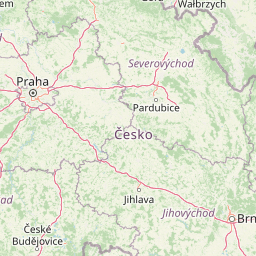
Sobědražský prales sits on the western slope of Chlum hill, whose summit reaches about 552 meters above sea level. The protected area itself lies between roughly 489 and 494 meters, an altitudinal range so narrow that the relief within the site is subtle, more readable in soil moisture patterns and microtopography than in dramatic elevation change. The western part of the reserve is slightly lower; the highest ground lies toward the southwest.
Geomorphologically, the site belongs to the Táborská pahorkatina, part of the broader Blatenská pahorkatina within the Středočeská pahorkatina and the Bohemian-Moravian subprovince of the Česká vysočina. Underlying bedrock is dominated by a dark, mafic-rich, porphyritic amphibole-biotite granite of the Čertovo břemeno-type, with a vein of biotitic gneiss entering the northern part of the area although not reaching the surface. Soils are mostly modal cambisols, with gleyed cambisols appearing in the northern section.
A forest road runs through the reserve, splitting it into a larger eastern portion and a smaller western portion. Surrounding the protected core is a 50-meter protective buffer as defined under §37 of Czech Act No. 114/1992. The wider forest is administered as production forest under the Orlík nad Vltavou forest management unit, on land historically owned by the Schwarzenberg family. Drainage from the area feeds an unnamed stream that joins the Jickovický potok and ultimately the Vltava river.
Sobědražský prales ecosystems, habitats, and plant life
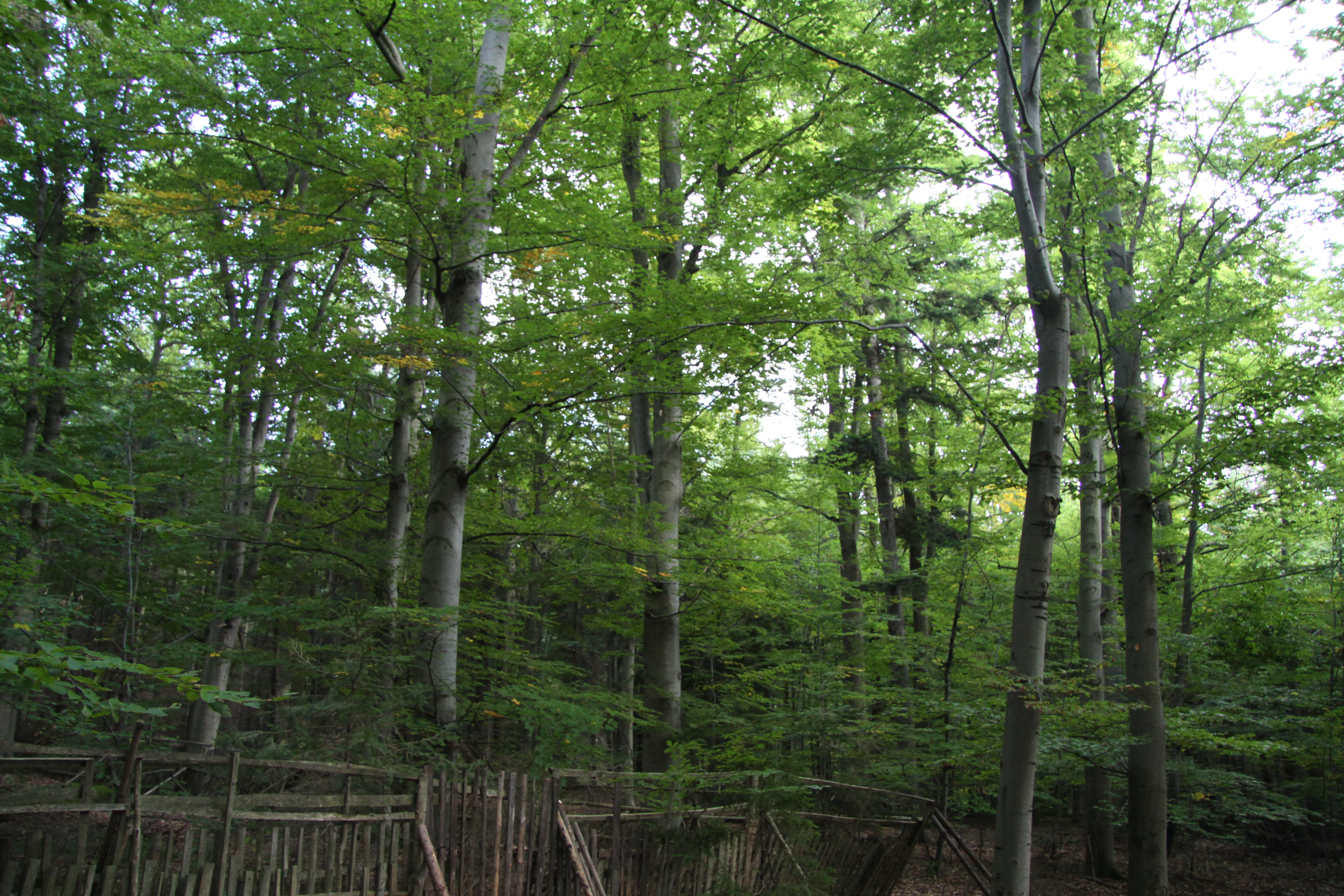
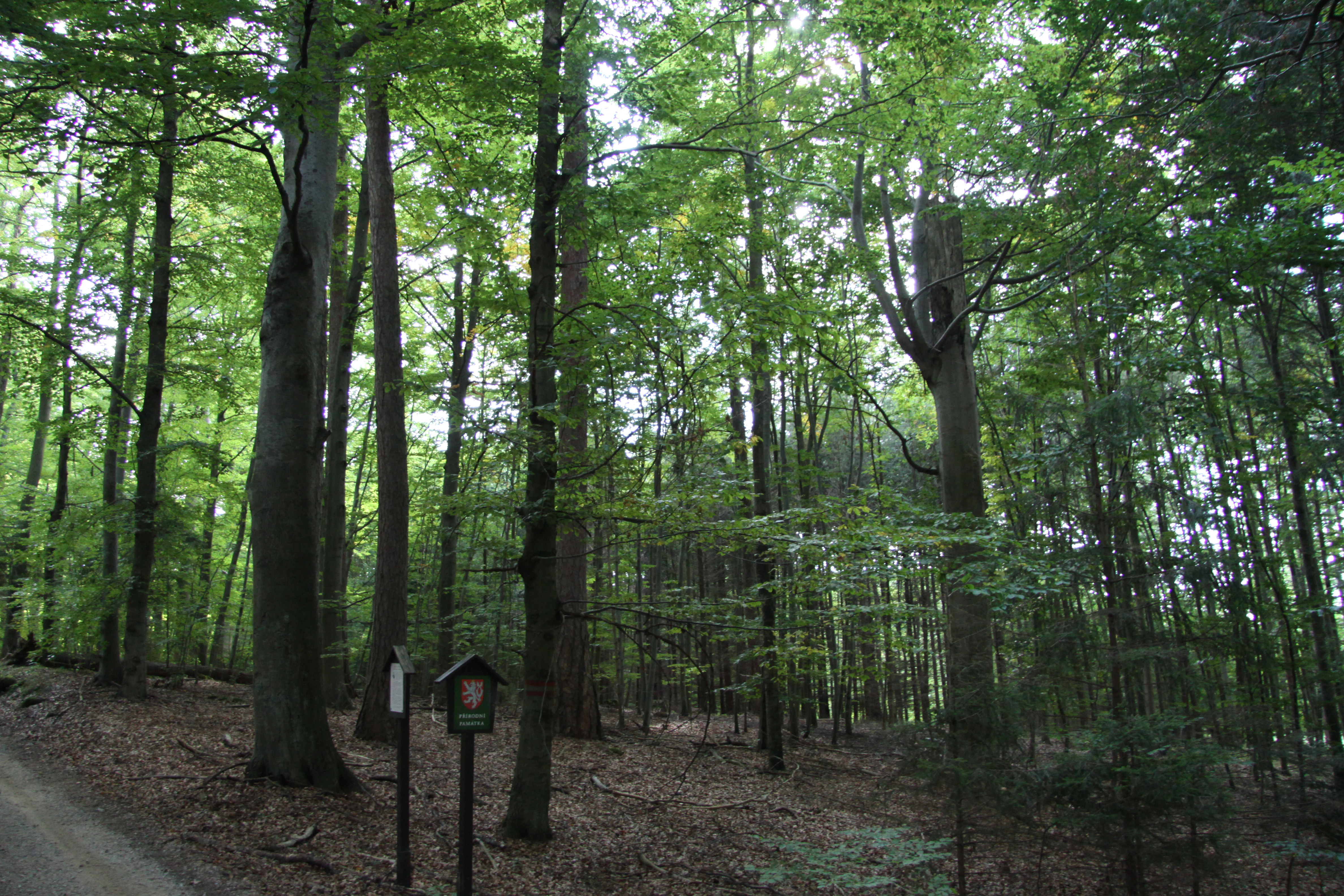
Ecologically, Sobědražský prales represents a remarkably preserved example of acidophilous beech woodland of the Luzulo-Fagion alliance. The canopy is dominated by pedunculate oak (Quercus robur), which makes up roughly 50 percent of the cover, and European beech (Fagus sylvatica), which contributes around 45 percent. Both species are estimated to be 180 to 200 years old, and the age structure of the stand is distinctly uneven, with many trees moving into senescence.
The site is unusual for the region because the shrub layer is largely absent; the canopy gives way almost directly to a sparse but characteristic herb layer typical of acidophilous beech forests. Lily of the valley (Convallaria majalis), wood sorrel (Oxalis acetosella), reed grass (Calamagrostis arundinacea), may lily (Maianthemum bifolium), spring vetchling (Lathyrus vernus), Solomon's seal (Polygonatum multiflorum), liverleaf (Hepatica nobilis), and woodruff (Galium odoratum) are typical ground flora. In small terrain depressions, the grass-like sedge Carex brizoides becomes established.
A secondary tree layer includes younger beeches and oaks along with spruce, while two fenced enclosures host silver fir (Abies alba). Surrounding forest stands, although outside the protected core, also include Douglas fir (Pseudotsuga menziesii), reflecting a long history of forestry introductions in the area.
Sobědražský prales wildlife and species highlights
Although small, Sobědražský prales supports a notable fauna thanks to the abundance of old trees, deadwood, and natural cavities. Invertebrate records from the site include the saproxylic beetles Rhizophagus nitidulus, the wood-boring Ceylon fagi, Cryptophagus ferrugineus, and the hide beetle Globicornis corticalis, all species tied to decaying wood and mature forest conditions.
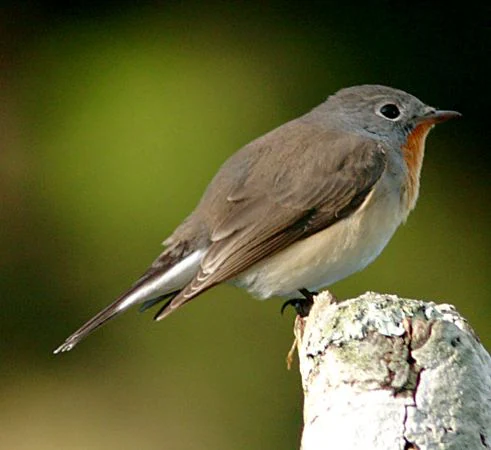
The bird fauna is the most highlighted element of the site's wildlife. The strongly endangered red-breasted flycatcher (Ficedula parva) has been documented breeding in the reserve, making use of cavities in old trees. Other recorded species include black woodpecker (Dryocopus martius), wood warbler (Phylloscopus sibilatrix), Eurasian nuthatch (Sitta europaea), Eurasian bullfinch (Pyrrhula pyrrhula), common chaffinch (Fringilla coelebs), crested tit (Lophophanes cristatus), European robin (Erithacus rubecula), and great spotted woodpecker (Dendrocopos major).
Mammals documented in the area include the red squirrel (Sciurus vulgaris), wild boar (Sus scrofa), roe deer (Capreolus capreolus), and fallow deer (Dama dama). Wild boar and deer are particularly significant in ecological terms because their browsing is currently the main factor limiting natural regeneration of the forest.
Sobědražský prales conservation status and protection priorities
Sobědražský prales falls under IUCN management category IV, classifying it as a Habitat/Species Management Area in which planned interventions into natural processes are permitted. In practice, however, the reserve has largely been left to natural development, with the original forest stand allowed to age and decay without active silvicultural intervention.
The stated conservation goals are to maintain and improve the condition of the acidophilous beech woodland, develop a more diverse age structure with both old and middle-aged or younger trees, gradually reduce the share of introduced conifers, and re-establish silver fir (Abies alba) and lime trees within the species composition.
The most pressing long-term challenge is browsing pressure from ungulate game (deer and wild boar), which prevents natural regeneration and threatens to leave the site dominated only by aging trees. The 2011–2020 management plan warns that the old tree layer will eventually collapse and that, without action, the stand will have to be artificially restocked. The recommended measures are either reducing local ungulate numbers or fencing the entire protected area; for now, only two small fenced enclosures are in place.
Top sights and standout views in Sobědražský prales
Sobědražský prales is a textbook example of how meaningful a small protected site can be. In just 1.70 hectares on the slope of Chlum hill, it preserves a roughly two-hundred-year-old oak–beech stand that illustrates the original character of woodland in a heavily altered agricultural and forestry landscape.
Its standout qualities include the unusually old age of the canopy, the natural absence of a shrub layer, the presence of cavity-nesting birds such as the red-breasted flycatcher, and the visible influence of ungulate browsing on forest regeneration. Together these features make the reserve both a place of conservation action and a small open-air reference for what South Bohemian forests once looked like.
Best time to visit Sobědražský prales
Sobědražský prales is best experienced during the warmer half of the year, when long days make it easier to walk the local forest paths and observe the structure of the woodland. The local climate is mild, with warm dry summers and short mild winters, so spring through early autumn offers comfortable conditions for examining the canopy, old trees, and ground flora typical of acidophilous beech forests.
Late spring and early summer are particularly rewarding for spotting the characteristic ground flora such as lily of the valley and woodruff, while the calmer leaf-on period also suits quiet birdwatching. Access is via a forest road that also crosses the reserve, but the site is small and best approached as a short, focused woodland stop rather than a destination in itself.