
Why Tatí Yupí Refuge stands out
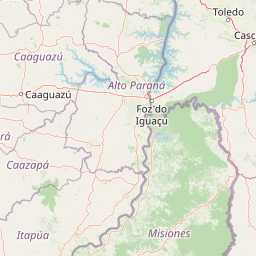
Tatí Yupí is best known for being one of the ecological reserves established by the Itaipu hydroelectric project, and for its position right on the banks of the Paraná River next to the vast reservoir lake created by the dam. Its combination of tall subtropical forest, yerba mate plantations, and small basaltic streams with waterfalls gives it a highly scenic character unusual for lowland Paraguay. The reserve is also recognized for its proximity to a major urban corridor, including Hernandarias, Ciudad del Este, and Presidente Franco, which makes it a notable example of a large forest reserve functioning as a regional green space. Educational trails, environmental interpretation programs, and ongoing forest restoration work further reinforce its identity as a working biological reserve rather than a purely passive protected zone.
Tatí Yupí Refuge history and protected-area timeline
Tatí Yupí came into being as part of the environmental mitigation strategy for the Itaipu hydroelectric dam, which began filling its reservoir in 1982. Itaipu Binational designated the refuge as one of eight ecological reserves along the Paraguayan side of the dam's influence area, framing the site as a long-term conservation counterweight to the transformation of the Paraná landscape.
Since that designation, the reserve has evolved into a working biological station rather than only a protected forest. It has hosted scientific research on indigenous flora and fauna, environmental education programs for schools and visitors, and ongoing restoration projects that include afforestation and enrichment planting in degraded forest patches. The combination of research, education, and active reforestation has shaped the refuge's identity as one of Itaipu's flagship conservation sites in Paraguay.
Tatí Yupí Refuge landscape and geographic character
The refuge occupies a stretch of the right bank of the Paraná River, where the topography is generally gentle but punctuated by undulations derived from underlying basaltic rocks. These low geological formations give rise to small streams such as Tati Yupi and Pira Pytâ, which form cascades and modest waterfalls as they move toward the river. The combination of rounded slopes, watercourses, and forest cover gives the reserve a layered visual profile despite its modest relief.
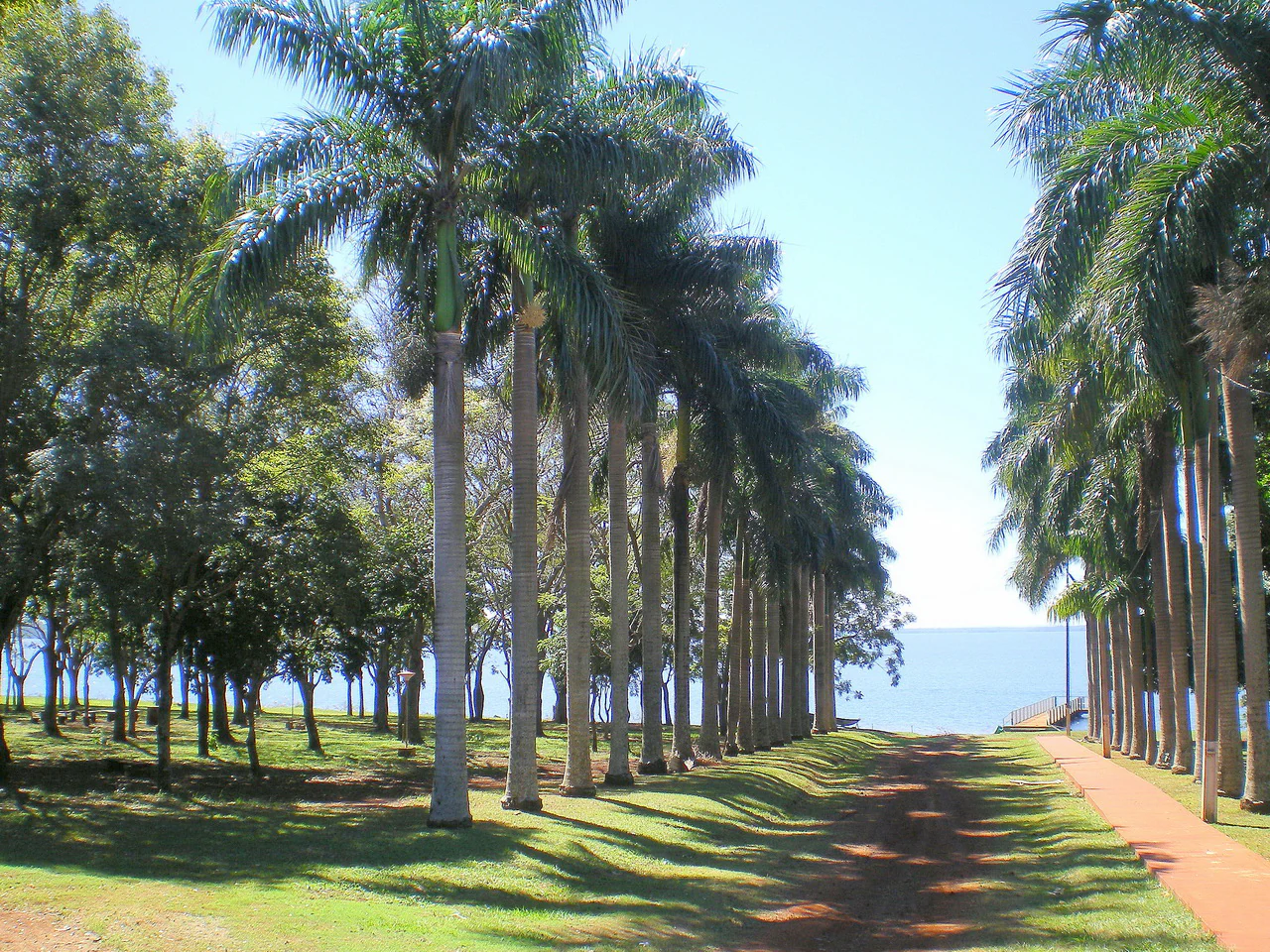
The most striking landscape feature is the long frontage onto the Itaipu reservoir. The artificial lake created when the dam was completed in 1982 meets the forested edge of the refuge, producing an unusual juxtaposition of dense subtropical forest with broad open water. Inland from the reservoir, the terrain continues as a mosaic of tall forest, lower canopy patches, yerba mate plantations, and narrow stream valleys that together create a sense of continuous, diverse forest habitat.
Tatí Yupí Refuge ecosystems, habitats, and plant life
Tatí Yupí preserves a representative slice of the forest ecosystems that once dominated the Paraná basin in this part of Paraguay. Its vegetation includes high forests that carry species such as cedro, lapacho, ybyrá pytá, and guatambú, some reaching heights above 30 meters. Beneath this upper stratum lies a dense secondary layer featuring myrtaceous species like ñangapiry, yva poroity, guava, kanelon, and ka'a vera, along with a wide assortment of continuous and shrubby trees averaging roughly three to seven meters in height.
The reserve also incorporates planted yerba mate stands (yerbales) alongside naturally regenerating forest, giving it a mixed landscape of native and cultivated vegetation. Epiphytes, tree ferns, palms, bromeliads, orchids, and piperaceae grow throughout the canopy, reflecting the high humidity and warmth of the local subtropical climate. The combination of mature forest, plantations, and restored patches makes the refuge a useful living laboratory for studying forest structure, succession, and habitat recovery in the Paraná watershed.
Tatí Yupí Refuge wildlife and species highlights
Although the source material emphasizes plant life more strongly than animal life, Tatí Yupí supports a forest fauna typical of the lower Paraná basin in Alto Paraná. The continuous canopy, layered vegetation, and streamside habitats provide shelter for a range of bird, mammal, reptile, and insect species adapted to subtropical forest conditions in eastern Paraguay.
The reserve's ecological diversity, including high forest, yerba mate plantations, wet low areas, and waterside environments along the Paraná, encourages a varied wildlife community. Itaipu's broader conservation program uses the refuge and its companion reserves as sites for faunal research, monitoring the relationships between native flora, fauna, and the local environment. This makes the park an important regional reference point for wildlife associated with interior Atlantic-style forests rather than open cerrado or Pantanal-type ecosystems.
Tatí Yupí Refuge conservation status and protection priorities
Tatí Yupí's principal conservation role is as one of the eight ecological reserves linked to the Itaipu hydroelectric project, designed to offset the environmental impact of the dam on the Paraná River landscape. Its 2,245 hectares of forest, situated directly alongside the reservoir, provide habitat continuity and refuge for species displaced or affected by the creation of the artificial lake.
Beyond passive protection, the reserve engages in active ecological management. Ongoing afforestation programs and forest enrichment planting aim to restore degraded areas and expand native forest cover. Continuous scientific research on indigenous flora and fauna, along with environmental education programs for schools and visitors, integrates the site into Itaipu's wider conservation and sustainability strategy. The reserve therefore functions as both a preserved forest patch and a working site for habitat recovery and ecological monitoring.
Top sights and standout views in Tatí Yupí Refuge
Tatí Yupí stands out as one of the eight Itaipu ecological reserves, a 2,245-hectare biological refuge on the right bank of the Paraná River. Its landscape blends high subtropical forest, yerba mate plantations, and small basaltic streams with cascades that drain toward the Itaipu reservoir. Interpretive trails such as Kañimby and Ka'i allow visitors and students to engage directly with the reserve's plants and wildlife, while reforestation and research programs keep the site ecologically active rather than purely passive.
Best time to visit Tatí Yupí Refuge
Tatí Yupí has a subtropical climate with abundant rainfall distributed throughout the year, between roughly 1,500 and 1,700 mm annually, so visitors should generally expect humid conditions regardless of season. Mean annual temperatures of about 21 to 22 °C keep the refuge warm overall, though winters bring larger differences between daytime and nighttime temperatures. Daytime visits are most comfortable when temperatures are milder and humidity is lower, and the well-distributed rainfall means that the forest scenery and stream flows remain attractive across much of the year.