
Mori Atlas logo
Natural monumentVeltrusy

Examining the ecological significance, designed vegetation patterns, and riverine geography of this Central Bohemian landmark.

Veltrusy Natural Monument: A Protected English Style Landscape Park in the Vltava River Valley

(Přírodní památka Veltrusy)

Veltrusy Natural Monument stands as a unique synthesis of 18th-century designed parkland and critical ecological conservation along the Vltava River. Situated within Středočeský kraj, the protected area maintains a diverse mosaic of avenues, veteran hardwood trees, and marshy channels that provide essential habitat for rare species. This site functions as an important refuge for saproxylic beetles within the floodplain, where historic architectural follies and meadow compositions intersect with managed forest corridors.

natural monumentprotected parklandenglish-style landscape parkbroadleaf woodlandhardwood floodplain forestveteran trees
A flat-style digital illustration depicting a mountain valley with steep cliffs, a central waterfall, a flowing stream, and evergreen trees under a bright sun.

Veltrusy

Natural monument

Park overview

Structured park overview, official facts, and landscape profile for Veltrusy Natural Monument

Veltrusy Natural Monument park facts, protected area profile, and essential visitor context

Review the core facts for Veltrusy Natural Monument, including designation, size, terrain, visitor scale, habitats, and operating context in one park-focused overview.

About Veltrusy Natural Monument

Veltrusy Natural Monument is a protected area in the Lower Vltava (Dolní Povltaví) region, between the town of Veltrusy and the village of Všestudy in the Mělník District of central Bohemia. Although it is formally classified as a nature monument rather than a large national park, the protected zone covers more than 250 hectares of parkland and is one of the larger small-scale protected areas in its district.

The park's core is the historic Veltrusy park, an English-style landscape garden originally laid out around Veltrusy Castle in the southern portion of the protected area. The park has a characteristic horseshoe shape, wrapping around open fields threaded by a central avenue and three small woodland thickets. Running through the entire site is the Mlýnský potok, also called the Všestudský náhon, which begins in the southwestern corner where it is fed by the Vltava, flows through the castle's game enclosure, and then splits into two branches. In its eastern reaches, the outer branch occasionally opens into small pools and marshy zones before the stream returns to the Vltava near a motorway bridge.

In ecological terms, Veltrusy is unusual because protection was triggered not by a single rare habitat type but by the presence of two species-rich veteran-tree beetle assemblages that are priorities under European nature legislation. The site forms part of the network supporting these species, and its designation is tied directly to maintaining the continuity of old trees, dead wood, and associated microhabitats within an actively managed park setting.

The site's broader identity is shaped by the surrounding cultural landscape. Veltrusy Castle and its former game park lie within or immediately adjacent to the monument, and a herd of European fallow deer is still kept in the enclosure, where it helps maintain the open character of the woodland by browsing young trees and natural regeneration. Ponds, channels, avenues, and a scattering of small pavilions and follies give the protected area a layered, park-like atmosphere even as it functions as a working conservation site.

Quick facts and research context for Veltrusy Natural Monument

Veltrusy Natural Monument covers around 255 hectares of parkland in the Mělník District of the Central Bohemian Region. It lies at elevations between roughly 165 and 171 meters, on the right bank of the Vltava.

The area was designated in 2013 by the Regional Authority of the Central Bohemian Region as a category III protected natural monument. Its formal purpose is to conserve a nationally registered European Important Site that supports rare beetle fauna, including the hermit beetle and the European stag beetle. Outside the strict protection perimeter, the park continues to function as an English-style landscape park with avenues, ponds, and a deer enclosure.

Protection and recognition

Documented terrestrial protection scope and Natura 2000 recognition records

Veltrusy Protection Status and Official Designation History

Veltrusy maintains documented terrestrial protection status established in 2013 alongside imported Natura 2000 designation records. Structured records outline official recognition history and management scope without implying conservation outcomes.

International recognition

Protection details

Protection scope
Terrestrial
Designated year
2013
Transboundary protection
No
Park context

Deeper park guide and search-rich context for Veltrusy Natural Monument

Veltrusy Natural Monument history, landscape, wildlife, and travel context

Explore Veltrusy Natural Monument through its history, landscape character, ecosystems, wildlife, conservation priorities, cultural context, and seasonal travel timing in a structured park guide built for atlas discovery and search intent.

Why Veltrusy Natural Monument stands out

Veltrusy is best known as a protected landscape park that combines cultural heritage with rare invertebrate conservation. Its defining feature is the presence of both the hermit beetle (Osmoderma eremita) and the stag beetle (Lucanus cervus), two saproxylic species that depend on veteran trees and hollows and that have driven the site's formal protection status as part of the European ecological network. The park is also distinctive for being a designed 18th- to 19th-century-style English park, with avenues of lime trees, oak-beech woodland, and managed meadows within a horseshoe-shaped layout. This combination of designed landscape and biologically valuable old-tree habitat is unusual, and it gives the site a dual identity as both a cultural landscape and a nature conservation area.
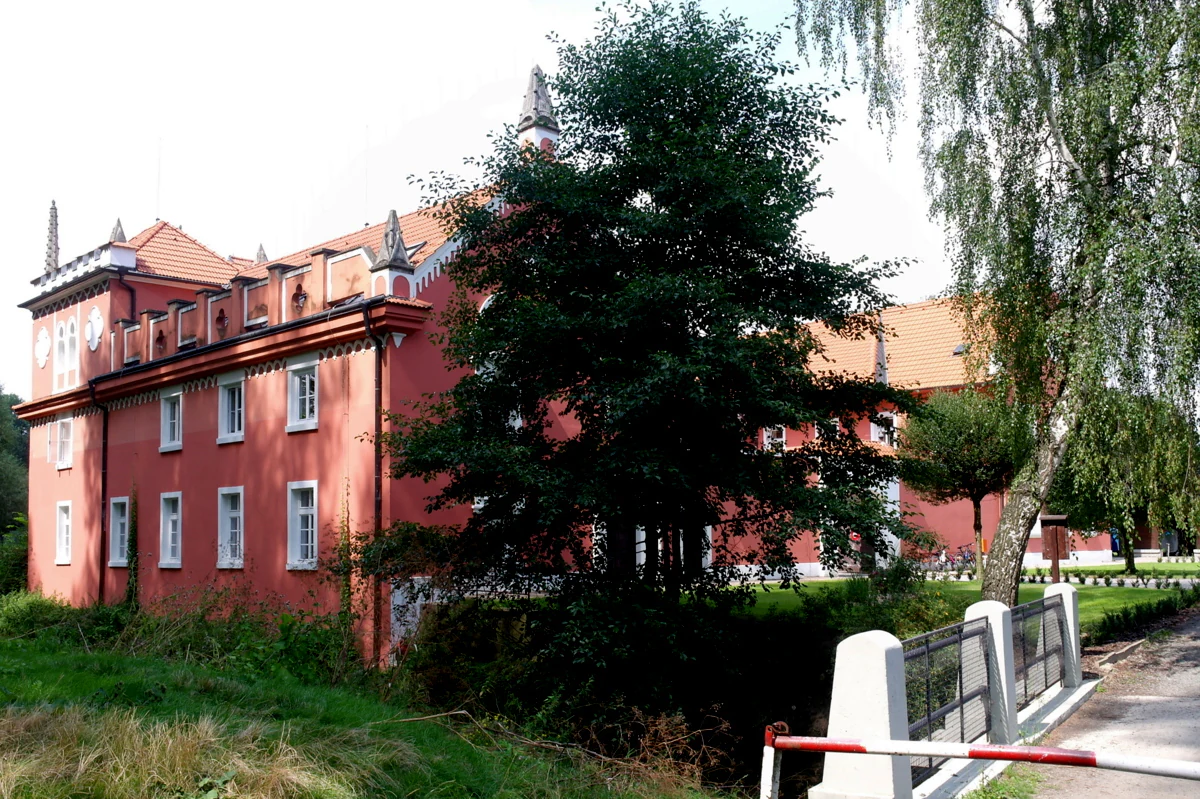
A two story red building with white window frames and a tiled roof, partially obscured by a large green tree in the foreground, situated near a small bridge.
The Red Mill building located within the grounds of the Veltrusy protected area.

Veltrusy Natural Monument history and protected-area timeline

The protected area is recent, having been formally declared as Přírodní památka Veltrusy on 22 June 2013 by the Regional Authority of the Central Bohemian Region. The designation was driven by the need to safeguard beetle populations associated with the park's veteran trees.

The landscape itself, however, has a much longer history. The Veltrusy park around the castle was laid out as an English-style landscape garden, and its avenues, ponds, and structured woodland composition reflect several phases of estate development. The surrounding land has been shaped for centuries by the chateau's game enclosure and by the management of the Mlýnský potok, which historically served both ornamental and mill-related purposes.

The park's recent history has been punctuated by flooding. Major inundations of the Vltava swept through the park in 2002 and again in 2013, the same year the natural monument was established. After both floods, large numbers of damaged and dying trees were removed as part of broad clearance efforts. While necessary for safety and park recovery, this loss of mature trees is recognized as a potential long-term pressure on the very beetle populations the new protection was meant to sustain, since stag beetles and hermit beetles depend on aging trunks and the slow development of tree hollows.

Veltrusy Natural Monument landscape and geographic character

The landscape at Veltrusy is shaped by the Vltava River and by deliberate human design. The protected area lies on a low terrace between roughly 165 and 171 meters in elevation, on the right bank of the Vltava, just north of the town of Veltrusy.

Geologically, the park sits on a substrate of Pliocene and Pleistocene river sands, clays, gravels, Proterozoic shales, and greywackes, capped by loess and overlain by fluvisols typical of floodplain settings. This foundation produces gently undulating terrain rather than dramatic relief, and the park's character comes mostly from its vegetation patterns and water features rather than from topography.

The most distinctive visual element is the horseshoe-shaped layout of the designed park, which arcs around open fields cut by an axial avenue. Mlýnský potok adds a continuous water thread through the composition: a regulated channel near the castle that becomes a more naturalistic sequence of pools and marshy stretches toward the east. Avenues of lime, stands of oak and beech, clumps of hornbeam, and patches of willow and ash produce a varied woodland mosaic, while park pavilions and follies break up the canopy and reinforce the landscape's gentle, composed character.
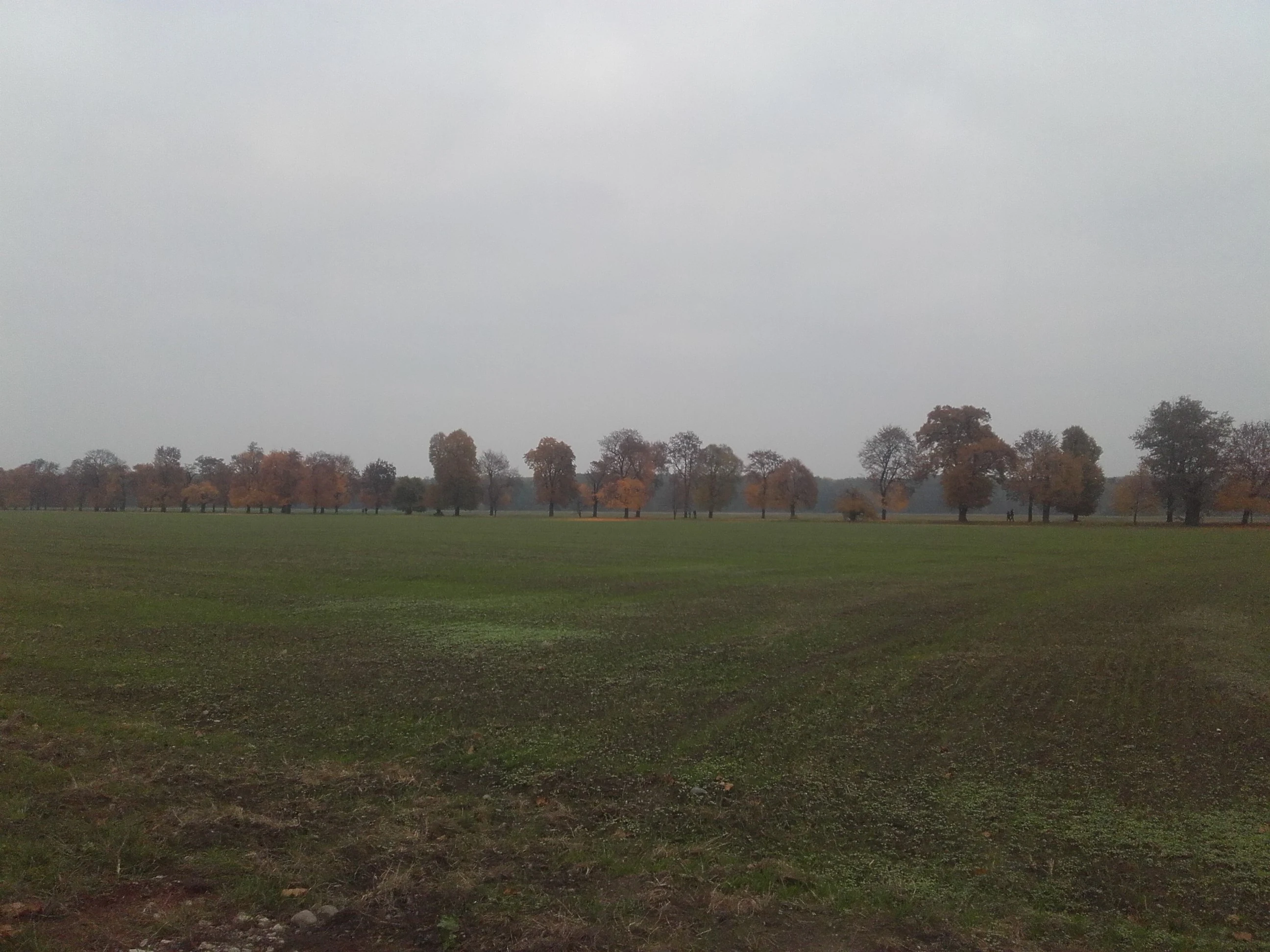
A wide view of a large, flat green field under an overcast, grey sky, with a line of autumn-colored trees stretching across the midground.
An axial alley lined with trees in the Veltrusy park landscape.

Veltrusy Natural Monument ecosystems, habitats, and plant life

Ecologically, Veltrusy is a managed hardwood floodplain parkland, classified as a maintained hard-wood floodplain forest (tvrdý luh) with some planted species augmenting the native composition. Despite being a designed park, it supports a relatively continuous canopy and a substantial population of mature and over-aged trees, which is the key ecological feature supporting the site's formal protection.

The tree cover is dominated by European beech (Fagus sylvatica) and pedunculate oak (Quercus robur), with hornbeam (Carpinus), maples (Acer), elms (Ulmus), ash (Fraxinus), and willows (Salix) contributing to species diversity. The avenues are largely formed of linden (Tilia), with smaller sections of horse chestnut (Aesculus hippocastanum). This composition mixes native woodland species with long-established ornamental plantings, producing a hybrid ecological character that is neither a purely wild forest nor a purely ornamental garden.

Hydrology plays an important role: the slow-moving to standing water sections of the Mlýnský potok in the northern parts of the park provide amphibian habitat, while the broader mosaic of ponds, channels, and seasonally flooded areas adds wetland diversity. The preserved old trees, dead-wood resources, and tree hollows throughout the park are the central ecological asset, supporting a community of saproxylic organisms that depend on aging wood.
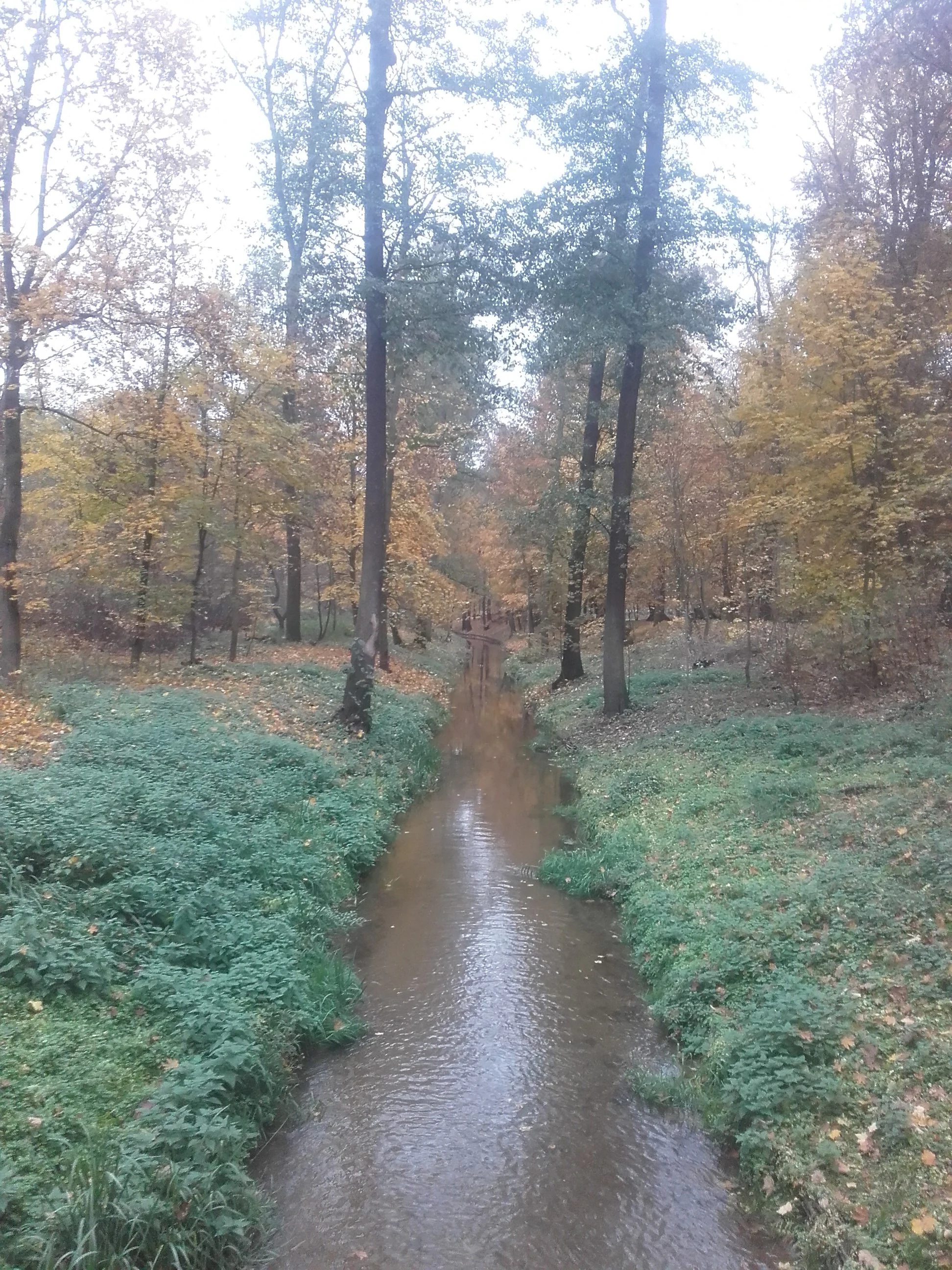
A narrow, calm mill race or canal flows centrally through a deciduous forest in autumn with yellowish leaves on the trees and green ground vegetation.
The Vsestudy mill race flowing through the forested landscape of Veltrusy natural monument.

Veltrusy Natural Monument wildlife and species highlights

The wildlife of Veltrusy is unusually focused on invertebrates, particularly beetles associated with old and decaying trees. The two species that triggered formal protection are the hermit beetle (Osmoderma eremita), a strictly protected European species that inhabits hollow broadleaves, and the stag beetle (Lucanus cervus), one of Europe's most iconic beetles. Both depend on veteran trees with sufficient internal cavities and decaying heartwood.

The park's invertebrate fauna is broader than these two flagship species. Glow-worms (Lampyris), the lesser stag beetle (Dorcus parallelipipedus), and a notably rich assemblage of rove beetles (Staphylinidae) all occur in the park, taking advantage of the same network of fallen branches, standing dead wood, and aging trunks. The combination of several notable saproxylic beetles in one site is unusual and is the main reason Veltrusy is registered within the European network of Important Sites.

In the slower, near-stagnant stretches of the Mlýnský potok in the north of the park, the smooth newt (Lissotriton vulgaris) finds suitable breeding conditions. Birdlife includes the common kingfisher (Alcedo atthis) along the stream corridors and the grey heron (Ardea cinerea) around the wetter sections, both reflecting the value of the park's riparian and pond habitats. In the castle's game enclosure, a herd of European fallow deer (Dama dama) continues to be kept; the deer's browsing helps keep the woodland open and prevents complete canopy closure, indirectly shaping habitat conditions for the park's other species. Several of the park's pavilions and small buildings are also used as bat roosts in winter.
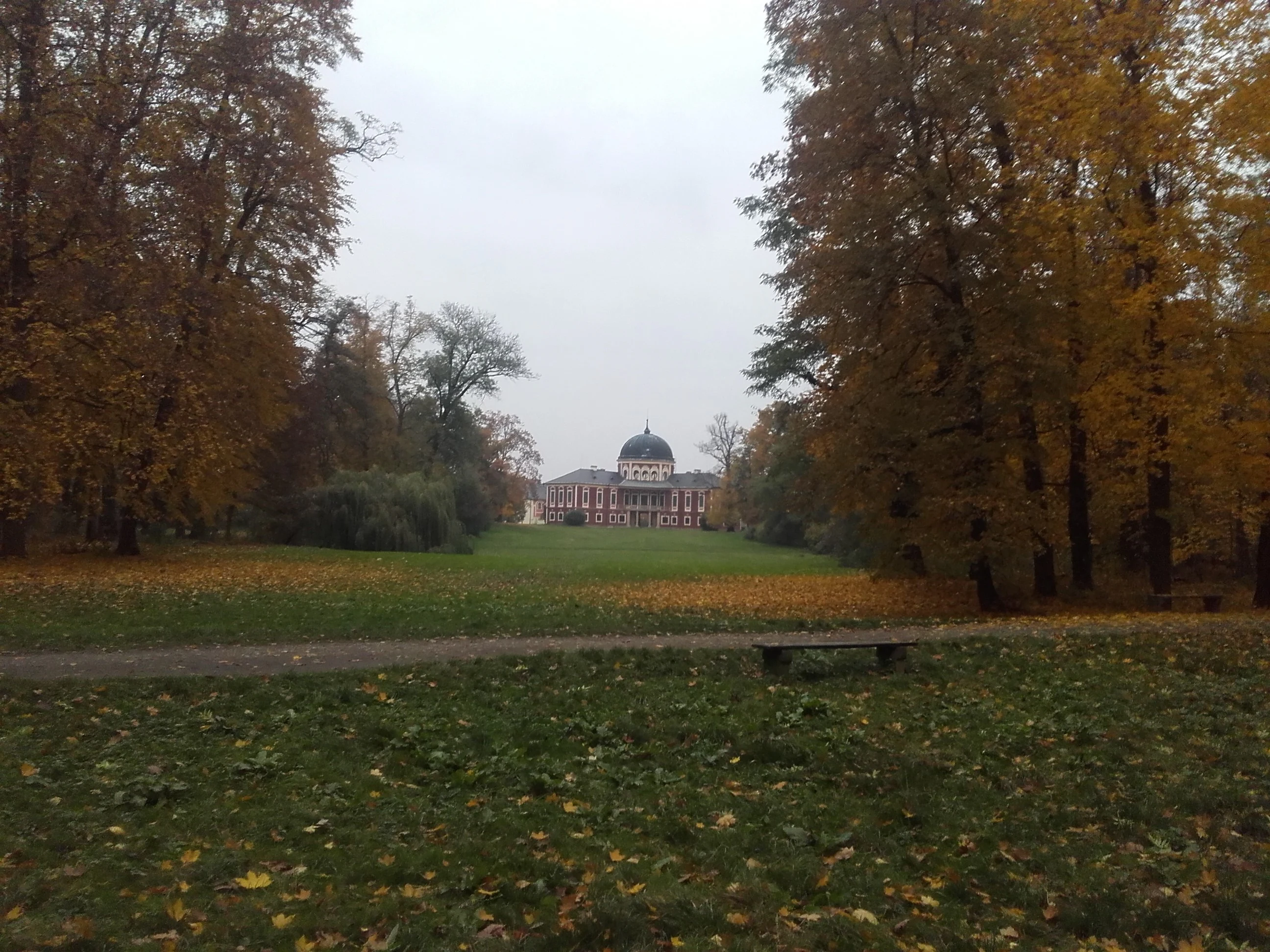
A wide angle view of the Veltrusy Mansion situated at the end of a long lawn, surrounded by autumn trees with yellow and orange leaves.
A view of the Veltrusy Mansion framed by trees during autumn.

Veltrusy Natural Monument conservation status and protection priorities

Veltrusy's conservation significance lies in its overlap of a designed cultural landscape with habitat for protected European beetle species. The site is recognized as a European Important Site for the conservation of the hermit beetle and stag beetle, two species whose survival is tightly linked to the preservation of ancient and decaying broadleaved trees. Designation as a Přírodní památka (Natural Monument) in 2013 placed the area under formal protection, with management aimed at maintaining the conditions these beetles require.

The conservation challenge at Veltrusy is unusual because the protected area is also an actively used park, subject to pressures that can run counter to beetle conservation. The park's tree stock has historically been managed for safety, aesthetics, and estate use, and clearing campaigns after the major Vltava floods of 2002 and 2013 removed large numbers of mature trees. While such removals help the park recover from flood damage, the loss of old and hollow-bearing trees is precisely the kind of pressure that threatens stag beetle and hermit beetle populations over the long term.

The site's conservation value is therefore both a matter of what is preserved and what must continue to be allowed to develop. Maintaining standing dead wood, retaining aging trees where safe, and ensuring that new generations of large broadleaves can mature will be central to keeping Veltrusy ecologically functional even as its design as a cultural park continues.

Veltrusy Natural Monument cultural meaning and human context

Veltrusy sits within a landscape with strong cultural and historical associations. The protected area is closely bound up with Veltrusy Castle and its estate, which forms the southern anchor of the park and gives the protected zone part of its identity as an historic designed landscape rather than just a natural site.

The English-style park layout, with its horseshoe geometry, axial avenue, scattered woodlands, ornamental water channels, and pavilions, reflects the European fashion for landscape gardens that reshaped many aristocratic estates in the 18th and 19th centuries. This makes the park a cultural artifact in its own right, even where planted species sit alongside native woodland.

The continued presence of European fallow deer in the castle's historic game enclosure links the present-day protected area to older traditions of hunting parks and managed landscape. Small architectural features distributed through the park, from the Laudon pavilion and remnants associated with a sphinx to a former mill now used as a retirement home, reinforce the site's character as a multi-layered cultural landscape where nature, design, and history remain visibly intertwined.
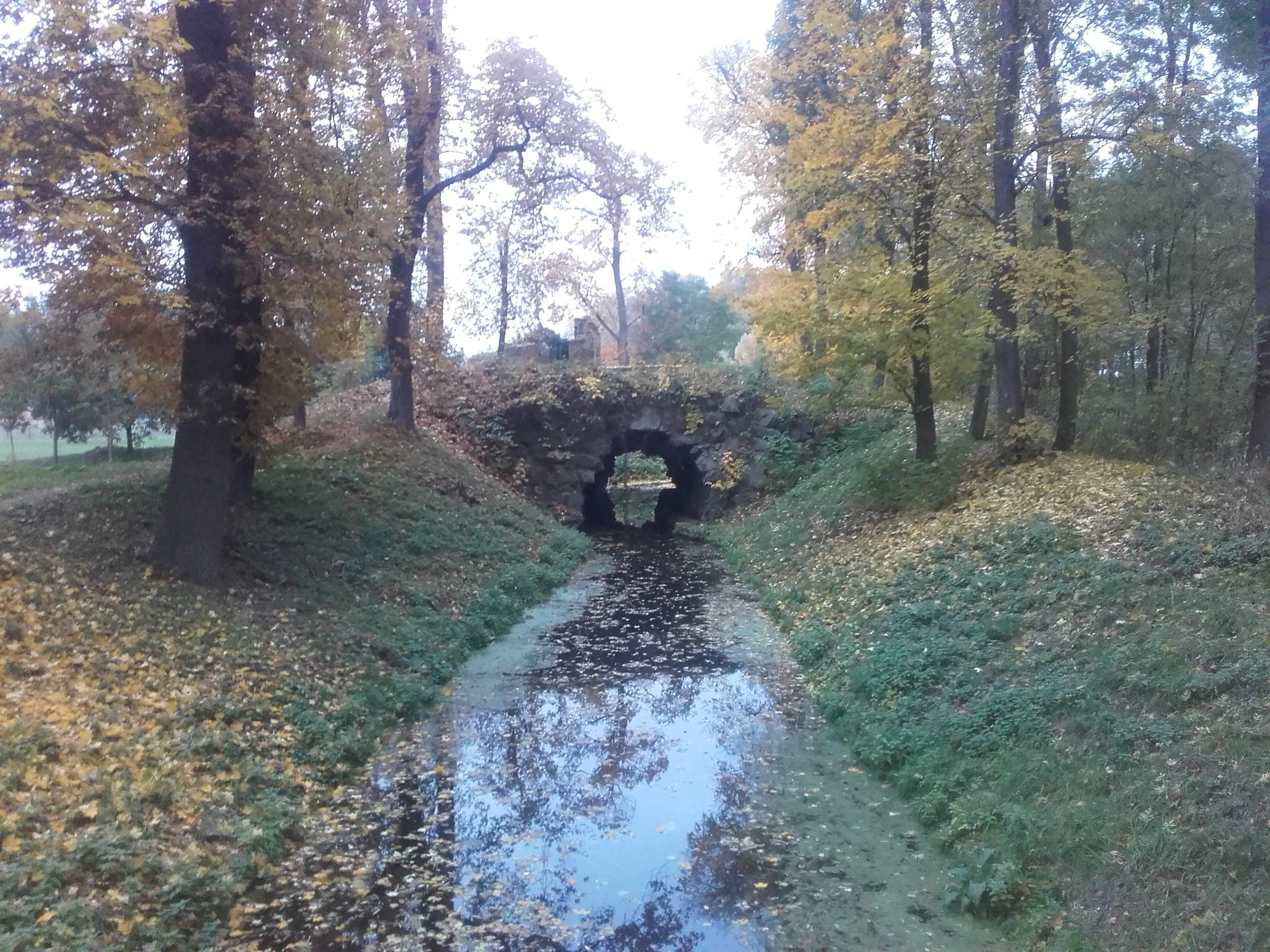
An old, small stone archway or ruin built into a grassy embankment, surrounded by trees with autumn foliage, spanning over a small, stagnant stream.
A stone ruin structure located within the forest grounds at Veltrusy.

Top sights and standout views in Veltrusy Natural Monument

A protected parkland that doubles as an ecological stronghold: Veltrusy's strongest points are its veteran trees and the rare beetle fauna they support, its English-style park composition on the Vltava floodplain, and the integration of formal conservation with an historic chateau landscape.

Few small protected areas in Central Bohemia combine a recognized European conservation role with such a deeply designed landscape character, and the resulting mix of avenues, ponds, ancient trees, and saproxylic beetle habitat gives the site a distinctive identity within its region.
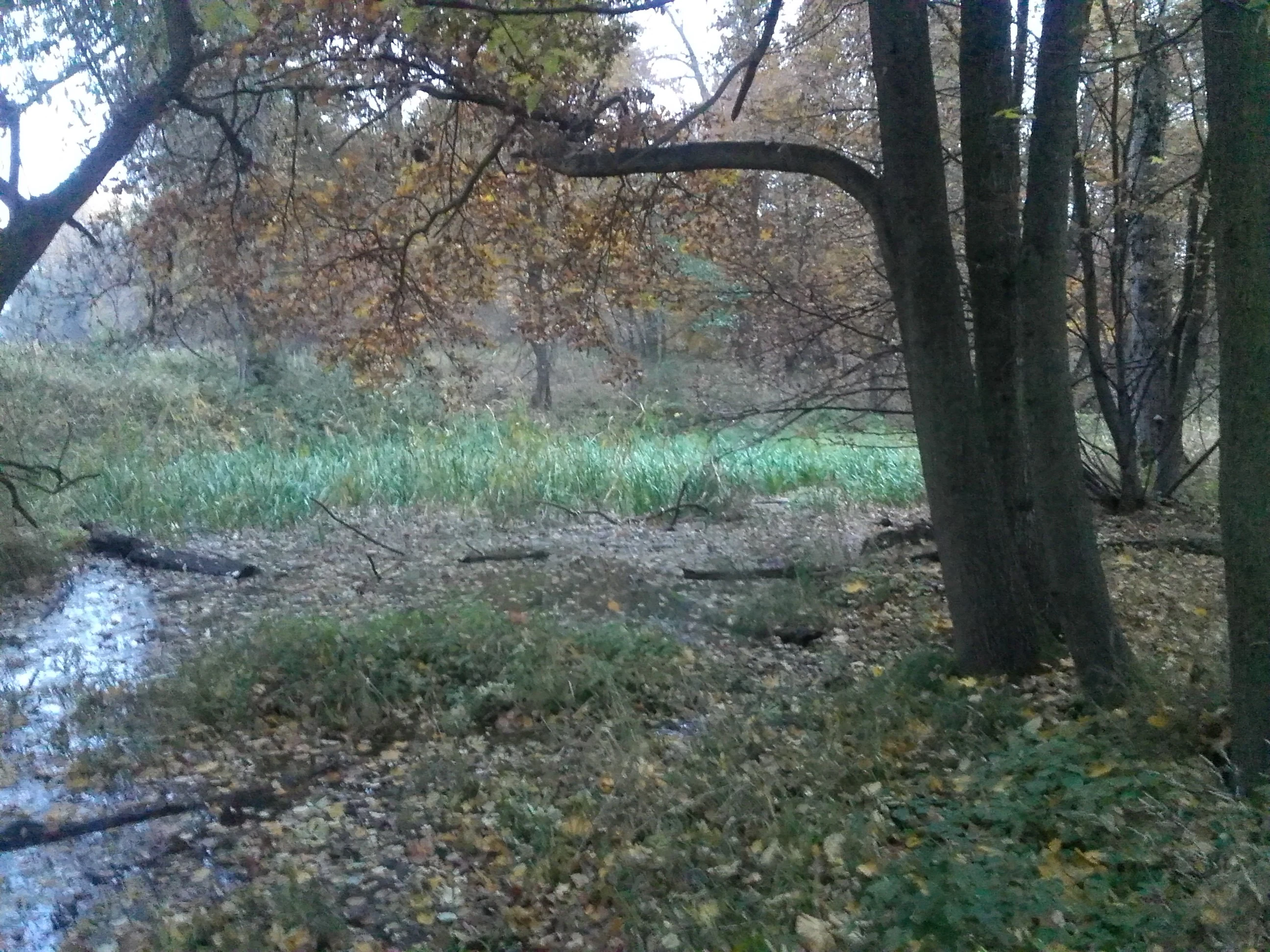
A forest wetland area with a small canal or stream flowing through a woodsy area with fallen leaves and reeds.
The Vsestudy canal area, showcasing the wetland habitats protected within the Veltrusy natural monument.

Best time to visit Veltrusy Natural Monument

Seasonal conditions at Veltrusy reflect both its floodplain setting and its character as a managed parkland. Late spring and early summer typically bring out the full canopy of the avenues and the broadleaf woodland, when birdlife along the Mlýnský potok, including kingfishers and grey herons, is most active and amphibian presence in slower stretches of the stream is easiest to observe.

Autumn highlights the park's oak and beech component, with mature trees showing strong seasonal color and a greater visibility of veteran trunks, dead wood, and old trees, which are the habitat features most relevant to the park's beetle fauna. Winter visits suit those interested in the park's architecture and broader landscape composition, with bare canopies opening views of the avenues, pavilions, and water channels, and bat roosts in some of the historic buildings becoming more visible. Visitors should keep in mind the park's flood-prone Vltava setting, which has historically affected accessibility after major flooding events.
Monthly climate preview

Long-term representative point measurements tracking monthly temperature and precipitation patterns

Veltrusy Climate Normals and Measured Annual Temperature Rhythm

Representative coordinate records show average temperatures ranging from negative values in winter months to over nineteen degrees Celsius in summer alongside steady daily precipitation rates. Examining the full twelve-month profile provides complete monthly climate data for analyzing the long-term meteorological rhythm across Veltrusy.
Annual mean9 °C
-2 °C20 °C
Jan-2°
Feb-1°
Mar
Apr
May14°
Jun18°
Jul20°
Aug19°
Sep14°
Oct
Nov
Dec-1°
Warmest month
July

19.8 °C

Coolest month
January

-2.3 °C

Wettest month
July

2.4 mm/day

Driest month
February

1 mm/day

Park location guide

Geography guide, regional context, and park location map for Veltrusy Natural Monument

Veltrusy Natural Monument park geography, regions, and map view in Czechia

Understand where Veltrusy Natural Monument sits in Czechia through a broader geographic reading of the surrounding landscape, nearby location context, and its mapped position within the national park landscape.

How Veltrusy Natural Monument fits into Czechia

Czech Republic is a landlocked Central European country with a population of approximately 10.9 million people. The nation was established as an independent state on January 1, 1993, following the dissolution of Czechoslovakia. Its capital and largest city is Prague, with other major urban centers including Brno, Ostrava, Plzeň, and Liberec.

Wider geography shaping Veltrusy Natural Monument in Czechia

The Czech Republic is a landlocked country in Central Europe. It is bordered by Germany to the west, Austria to the south, Poland to the northeast, and Slovakia to the southeast. The landscape is predominantly hilly, with the territory covering 78,871 square kilometers.

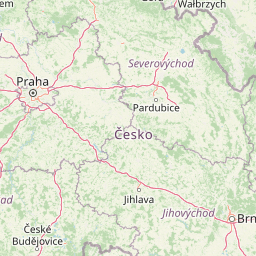
Map view of Veltrusy Natural Monument

Use this park location map to pinpoint Veltrusy Natural Monument in Czechia, understand its exact geographic position, and read its mapped placement within the surrounding landscape more clearly.

Pigeon | © OpenStreetMap contributors

Location context for Veltrusy Natural Monument

Středočeský kraj
Recorded earthquake history

Explore Recorded Earthquake History for Veltrusy Natural Monument

Access a chronological collection of seismic events documented near Veltrusy Natural Monument. This archive provides precise event data to help you analyze the historical earthquake patterns within the immediate geography of this protected landscape.

Veltrusy Earthquake History

Catalogued events

8 events

Strongest magnitude

Magnitude 3.7

Most recent event

Mar 29, 1991

This history includes earthquakes recorded inside the park or within 50 km of its borders

Visualizing the historic parkland, ancient tree habitats, and river floodplain scenery.

Veltrusy Photos and Landscape Imagery: Exploring the Protected Park Environment

Photographic views reveal the intricate design of the English style landscape park, highlighting ancient tree avenues, river channels, and open meadows along the Vltava basin. Examining these protected habitats provides clear visual insight into the rare veteran tree ecosystems and cultural terrain defining the region.

A two story red building with white window frames and a tiled roof, partially obscured by a large green tree in the foreground, situated near a small bridge.

A Neoclassical stone pavilion with arched openings standing above a small stream and a stone boat landing in a wooded park setting.

A wide view of a large, flat green field under an overcast, grey sky, with a line of autumn-colored trees stretching across the midground.

A narrow, calm mill race or canal flows centrally through a deciduous forest in autumn with yellowish leaves on the trees and green ground vegetation.

A wide angle view of the Veltrusy Mansion situated at the end of a long lawn, surrounded by autumn trees with yellow and orange leaves.

A large, mature deciduous tree with dense foliage and a visible official protected area sign standing on a grassy field.

An old, small stone archway or ruin built into a grassy embankment, surrounded by trees with autumn foliage, spanning over a small, stagnant stream.

A forest wetland area with a small canal or stream flowing through a woodsy area with fallen leaves and reeds.

Park atlas

Discover related protected landscapes and regional riverine park geography

Other Parks Near Veltrusy and Surrounding Protected Areas to Compare

Browsing other parks near Veltrusy reveals adjacent protected areas and riverine habitats across Central Bohemia. Comparing these connected landscapes provides wider regional context for veteran tree conservation and floodplain ecology.
A soft, pastel-colored watercolor painting depicting a gentle landscape with a small pond in the foreground, grassy meadows, and distant rolling hills under a pale sky.
Natural monumentCentral Bohemia Region
5.4 km away#1 closest

East

Slaná louka u Újezdce: Protected Natural Monument and Regional Landscape Geography

A rare Natura 2000 lowland grassland in the Central Bohemia Region

Slaná louka u Újezdce preserves a compact lowland landscape defined by saline influences and calcareous soil substrates. This natural monument serves as an important ecological island, maintaining the steppe-like vegetation and halophytic flora that mark this specific Czech locality as a priority for habitat protection.

Area
0.014 km²
Established
2013
IUCN
III
Relief
Lowland
Natural monumentStředočeský kraj
About 14 km away#2 closest

Northeast

Vehlovické opuky Natural Monument: Geological Mapping and Historical Mining Context

Protected paleontological and mining heritage in the Czech Republic

Vehlovické opuky stands as a compact but rich natural monument in the Středočeský kraj region. This protected area showcases the geological legacy of the Bohemian Cretaceous Basin, preserving fossilized remains within yellowish opuka beds and demonstrating historical underground extraction techniques that now support local bat populations.

Area
0.009 km²
Established
2002
IUCN
III
Relief
Lowland
A pale watercolor painting showing a river winding through green hills and gentle slopes.
Protected landscapePrague
About 15 km away#3 closest

South

Přírodní park Drahaň-Troja: Protected Landscape Geography and Mapped Terrain Analysis

Deep stream valleys and rocky steppe habitats in Prague

Přírodní park Drahaň-Troja represents a vital protected landscape characterized by its pronounced relief, including the Bohnické, Čimické, and Drahanské valleys. This area reveals the geological history of the Prague region through its exposed shales and volcanic rhyolite veins. Discover how this continuous green corridor integrates rare steppe ecosystems with the metropolitan urban edge.

Area
5.79 km²
Established
1990
Relief
Upland
Climate
Temperate
Natural monumentLitoměřice District
15 km away#4 closest

Northwest

Vrbka Natural Monument: Exploring Protected Limestone Habitats and Bohemian Lowland Geography

A rare botanical reserve in the Litoměřice District of the Czech Republic

Vrbka Natural Monument protects a significant 15.5-hectare expanse of warm limestone slopes and dry meadows. This geographic landmark serves as an essential repository for rare orchid species and diverse insect populations, functioning as a representative habitat patch within the intensively cultivated landscapes of the surrounding region.

Area
0.155 km²
Established
2013
IUCN
IV
Relief
Upland
A horizontal watercolor illustration depicting a soft, rolling landscape with green hills, a small winding stream, and meadow vegetation on a white background.
Natural monumentÚstecký kraj
16 km away#5 closest

Northwest

Na Dlouhé stráni Natural Monument: Regional Protected Area and Botanical Landscape

A conservation-focused look at the Mšenský potok valley slope

Na Dlouhé stráni is a designated natural monument in the Czech Republic, renowned for its concentration of thermophilous grassland flora. This protected area, located near Mšené-lázně, preserves a specific slope habitat that supports declining plant species. The site offers an important look at regional conservation efforts and the mapping of small-scale protected habitats within the diverse Ústecký kraj geography.

Area
0.126 km²
Established
2012
IUCN
IV
Relief
Lowland
Watercolor painting of a pastoral landscape featuring rolling green hills, patches of trees, and a river flowing through the center.
Natural monumentStředočeský kraj
About 17 km away#6 closest

West

Slánská hora Natural Monument: Volcanic Geography and Protected Hilltop Terrain in Central Bohemia

Detailed geological mapping of a Tertiary volcanic outlier and historic monument

Slánská hora functions as a significant geological landmark where basaltic vent remnants meet centuries of human history. This natural monument offers a window into the volcanic processes of the region through exposed columnar basalt and rock fissures. The site serves as a vital protected area, balancing remnants of warm-loving steppe vegetation and deciduous forest with the legacy of former quarries and ancient archaeological strata atop the Slaný ridge.

Area
0.022 km²
Established
1998
IUCN
III
Relief
Mountain
Natural monumentPrague
About 18 km away#7 closest

South

Velká skála Natural Monument: Geological Protected Area within the Prague Plateau

A landmark siliceous rock outcrop in the Troja district

Velká skála offers a concentrated look at the geological heritage of central Bohemia. As a designated natural monument, the site protects a rare siliceous rock outcrop that contrasts with the rolling terrain of the surrounding Prague Plateau, serving as a vital reference for regional geomorphology.

Area
0.018 km²
Established
1968
IUCN
III
Relief
Upland
A horizontal watercolor illustration showing a soft, dreamy landscape with rolling green hills, light purple and yellow tones, a winding path or stream, and a lone bare tree in the foreground.
Protected landscapePraha
About 18 km away#8 closest

South

Přírodní park Šárka-Lysolaje: Protected Landscape Mapping and Geographic Identity in Praha

A dense mosaic of stream valleys and protected natural monuments near the heart of Praha

Examine the detailed geography of Přírodní park Šárka-Lysolaje, an extensive protected landscape in Praha that functions as a critical green corridor. Its terrain, defined by deeply incised stream valleys and steep forested slopes, hosts a unique concentration of smaller nature reserves and monuments, creating a coherent ecological framework directly adjacent to the urban metropolitan environment.

Area
10.05 km²
Established
1990
Climate
Temperate
Scope
Terrestrial

Common questions about visiting, size, designation, and location context for Veltrusy Natural Monument

Veltrusy Natural Monument FAQs for park facts, access, geography, and protected area context

Find quick answers about Veltrusy Natural Monument, including protected-area facts, park geography, trail and visitor context, and how the park fits into its surrounding country and regional landscape.
MoriAtlas Explorer

Continue Your Protected Areas Search Across the Global Atlas

Deepen your exploration by continuing the structured search for national parks and protected areas worldwide. Utilize the comprehensive filtering capabilities to compare different conservation landscapes and refine your understanding of global park geography. Discover more about the distribution and characteristics of protected natural areas.

Global natural geography