Why Vogelmoor stands out
Vogelmoor is best known for conserving one of the largest remaining birch-dominated bog woodland complexes in the southeastern Lower Saxon lowlands, within a landscape of drained and historically peat-cut raised and lowland bogs. The reserve is also historically important as one of the last western German breeding sites of the common crane before that species recovered across the region. Its habitat mosaic combines sphagnum-rich alder and birch bog forest, peat-cut ponds, quaking fens, sedge communities, wet heath with cross-leaved heath, and small oak stands on sandy soils. Conservation management of the area includes traditional mowing, extensive grazing with Fjäll cattle, and active rewetting.
Vogelmoor history and protected-area timeline
Vogelmoor has been under formal protection since 16 January 1974, when it was designated a nature reserve (Naturschutzgebiet) with the identifier NSG BR 026 and an initial area of roughly 129 hectares. It has since been slightly enlarged to its present size of around 133.5 hectares. Most of the area has also been designated as a European Fauna-Flora-Habitat area (FFH-Gebiet) under the EU Habitats Directive, integrating it into the pan-European NATURA 2000 ecological network.
Long before its formal protection, however, the bog had already been shaped by centuries of human use. Peat cutting and agriculture affected the area for generations, and from the late nineteenth century onward the mire was drained and exploited for peat on a much larger scale. This dramatically altered the original raised and lowland bog system, breaking up the former mire into the fragmented, peat-cut mosaic of habitats seen today.
In its early phase, when peat cutting and drainage were still active, the bog had already gained an unexpected claim to conservation fame: the common crane, which had largely vanished as a breeding bird across much of western Germany, maintained one of its last breeding populations at Vogelmoor and its surroundings. That role helped justify the eventual statutory protection of the area and continues to inform its cultural memory as a bird refuge.
In later decades, conservation management expanded to include measures aimed at restoring bog function, such as maintenance of wet conditions via the existing ditch systems draining toward the Kleine Aller, along with traditional mowing, extensive grazing, and selective abandonment of former grassland. The adjoining protected area, the Erweiterungsflächen Vogelmoor, was later designated to extend the same habitat complex northward and northwestward, reinforcing the reserve's role as a regional anchor for bog and bog-forest conservation.
Vogelmoor landscape and geographic character
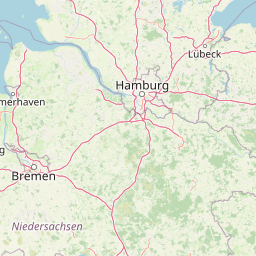
Vogelmoor occupies a shallow depression in the glacial ground moraine of the southeastern Lower Saxon lowlands, between the villages of Barwedel to the west and Ehra-Lessien to the east. The terrain is remarkably flat, ranging only from roughly 64 to 74 meters above sea level. Despite this subtlety, the landscape is structurally diverse because it combines open bog hollows, wooded bog margins, peat-cut water bodies, and small patches of dry mineral soils.
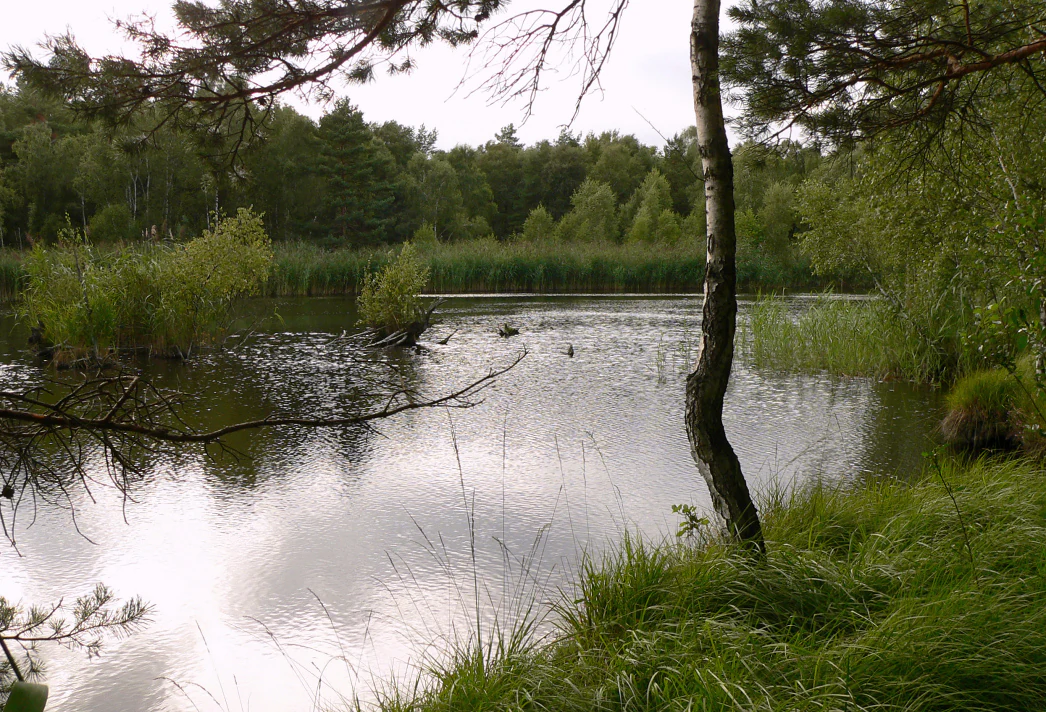
The reserve's surface reflects its mire origins: it is dotted with peat-cut ponds and old diggings, some of which have grown together into larger open water bodies, while ditches and natural drainage routes channel water toward the Kleine Aller river. Floating, quaking mats of peat vegetation fringe the open water, and in some former cut-over areas water lilies, bladderwort, and dwarf bulrush have colonized the re-wetted surfaces. In the south, the historic millpond of the former Vogelmühle still exists, now embedded in a small farmstead rather than an industrial mill setting.
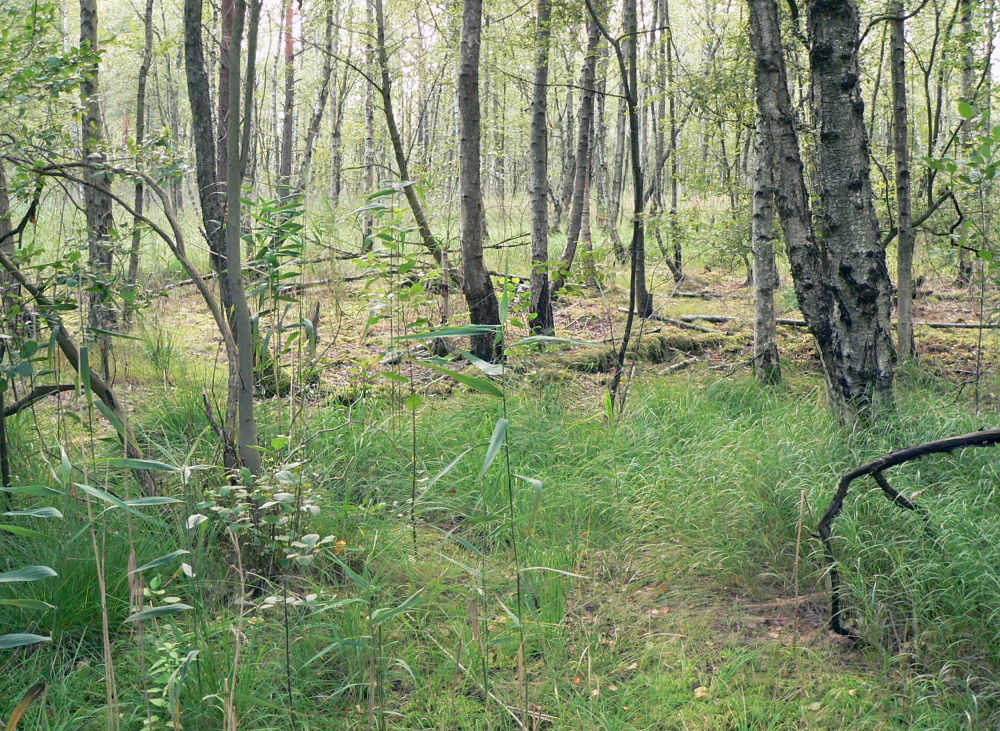
Woodland dominates much of the area. The bog forests are visually distinctive: slender birches and alders rise out of a hummocky, moss-rich ground layer of sphagnum, with small white orchid and royal fern scattered through the understory. Where the bog gives way to slightly drier sandy soils, particularly in the southern part of the reserve, low oak woodland takes over. Open areas between the wooded sections hold wet heath dominated by cross-leaved heath, raised-bog-like vegetation with cottongrass and sundew, and sedge fen communities.
Vogelmoor ecosystems, habitats, and plant life
Vogelmoor preserves a habitat mosaic that is unusual for the southeastern Lower Saxon lowlands because it combines genuinely bog-related vegetation with carr and bog woodland in a single, contiguous complex. The most extensive habitats are sphagnum-rich birch and alder bog and carr forests, which together form the heart of the protected area. These forests have evolved on peat substrates and are characterized by an unusual layering of moss hummocks, trees of modest stature, and a distinctive herb flora.
The herb layer of the bog forests includes small white orchid (Listera cordata) and royal fern (Osmunda regalis), both indicators of long-established, humid woodland conditions. High amounts of old and dead wood within the forests increase the habitat value for saproxylic species, lichens, and fungi dependent on decaying wood.
In open areas, raised-bog-and-lowland-bog vegetation persists in degraded but still recognizable form. Cottongrass (Eriophorum) and round-leaved sundew (Drosera) appear in patches that retain a high-bog character, alongside acid-tolerant sedges such as dioecious sedge and slender sedge. Sphagnum-filled hollows and channels host beak-sedge communities typical of the surrounding bult-slenk complexes. Cross-leaved heath (Erica tetralix) shapes the wet heath transitions, while the open water of former peat cuts supports a different biota altogether: white water lily, bladderwort (Utricularia), dwarf bulrush, and frog's-bit (Hydrocharis morsus-ranae).
This juxtaposition of bog, wet woodland, open water, and small patches of dry mineral-soil oak forest is the core ecological identity of Vogelmoor. When the reserve is considered together with the adjacent Erweiterungsflächen Vogelmoor, it forms one of the largest remaining birch-dominated bog woodland complexes in this part of Lower Saxony, and its FFH designation ties it directly into the broader European Habitats Directive network.
Vogelmoor wildlife and species highlights
Vogelmoor's wildlife character is shaped overwhelmingly by its bog and bog-forest habitats, which support specialized fauna typical of northern German lowland mires. The wet woodlands provide habitat for typical bog-woodland bird species, while the peat-water systems and floating mats support amphibians, dragonflies, and aquatic invertebrates associated with nutrient-poor, acidic waters.
The site has a particularly significant cultural and ornithological history with the common crane. Before large-scale protective measures were taken across wide parts of western Germany, the common crane had been lost as a breeding bird across most of the region. Vogelmoor and its surroundings held one of the last recorded breeding refuges for the species in this part of Germany, making the area an early symbol of crane conservation in the country.
The high proportion of old and dead wood in the forests increases the value of the site for saproxylic invertebrates, lichens, and fungi, and for cavity-using birds and bats. Wet heath, sedge fen, and open peat-cut water add further structural diversity for wading birds, amphibians, and dragonflies. Although many bog specialist species depend on sensitive moisture levels and continued conservation management, the habitat mosaic itself is highly favorable for sustaining characteristic mire fauna in a largely agricultural landscape.
Vogelmoor conservation status and protection priorities
Vogelmoor carries conservation significance at multiple levels, from regional habitat protection to European ecological networking. Nationally, it has been a statutory nature reserve under Lower Saxon law since 16 January 1974 and carries the designation NSG BR 026. The Lower Saxon State Agency for Water Management, Coastal Protection and Nature Conservation (NLWKN) provides technical oversight, while the Gifhorn district acts as the responsible lower nature conservation authority on the ground.
At the European level, most of the reserve is co-designated as an FFH (Fauna-Flora-Habitat) area under the EU Habitats Directive, embedding Vogelmoor in the NATURA 2000 network. This status obligates the site to maintain favorable conservation status for the habitat types and species for which it was listed, including its bog woodland complexes and mire-related species.
The conservation challenge at Vogelmoor is closely tied to its history. Centuries of peat cutting and large-scale drainage from the late nineteenth century onward fundamentally altered the original mire. Protection since 1974 has shifted the trajectory toward recovery, but the area is not, and likely never will be, a pristine raised bog; instead, conservation strategy emphasizes maintaining and restoring the mosaic of secondary habitats that have developed since drainage. Management practices include partial forestry of the bog forests while retaining high levels of old and dead wood, mowing of grassland, extensive grazing with Fjäll cattle on selected sections, and abandonment of other areas to allow natural processes to resume. Drainage via ditches into the Kleine Aller continues to influence water levels and remains a focus of management attention.
By linking the original Vogelmoor with its neighboring Erweiterungsflächen Vogelmoor protected area, conservation managers have effectively secured one of the largest contiguous birch-dominated bog woodland complexes left in the southeastern Lower Saxon lowlands, ensuring that even a heavily altered mire can support regionally significant biodiversity.
Vogelmoor cultural meaning and human context
The name Vogelmoor, meaning roughly 'bird moor' in German, reflects the area's long-standing local reputation as a bird-rich wetland, particularly for the common crane. The reserve is also historically known by the place name Koleitz, hinting at older regional naming traditions.
Human use of the bog has shaped it for centuries. Peat was cut here for fuel and horticulture, and parts of the area were converted to wet grassland. The presence of the former Vogelmühle and its surviving millpond in the south of the reserve is a reminder of how rural mill economies once depended on bog water and bog-edge streams. Today the mill site functions as part of a small farmstead, integrating the historic estate into the present-day landscape.
Conservation grazing with the hardy Fjäll cattle breed, a Scandinavian heritage breed, is used as a modern land-management tool, but it also connects to broader European traditions of using robust livestock to maintain open, semi-natural landscapes. In this way, Vogelmoor's cultural layer is not only historical but ongoing: peat, mills, drainage, and grazing are all part of the human story written into this mire.
Top sights and standout views in Vogelmoor
Vogelmoor stands out as a protected bog-and-bog-forest complex in the Gifhorn district of Lower Saxony, with formal statutory protection dating from 1974 and additional status as an EU FFH area. Its defining strength is the size and quality of its birch-dominated bog woodland, which, along with the adjacent extension area, forms one of the largest contiguous bog forests in the southeastern Lower Saxon lowlands.
Equally distinctive is the reserve's habitat mosaic. Sphagnum-rich alder and birch bog forests alternate with peat-cut ponds, floating mats, sedge fen, raised-bog remnants, wet heath, and small oak stands, creating structural complexity far beyond what one would expect from a flat, low-elevation landscape. The site's conservation history, beginning with its role as one of the last western German strongholds of the common crane, gives it an enduring place in the story of European bird and mire protection.
Best time to visit Vogelmoor
Vogelmoor is a working nature reserve with limited visitor infrastructure, so any visit is best planned with awareness of its character as a sensitive bog habitat. Spring and early summer are generally the most rewarding periods, when raised-bog vegetation is active, bog-forest birdlife is at its peak, and the contrast between open water, sedge fen, and green birch woodland is at its strongest.
Late summer and autumn can also be appealing as cottongrass, heather, and changing leaf color transform the open bog and wet heath areas. Winter visits, while quieter, can highlight the structural simplicity of the bog woodland and its open water. Because the reserve sits in an agricultural plain and is bordered by busy roads and farms, any visit should aim for quieter periods and stick to legal paths and dykes to avoid disturbing both wildlife and grazing Fjäll cattle.