
Why Wonieść Lake stands out
Wonieść is best known as a hybrid landscape: a working agricultural retention reservoir that has, over the decades, become one of the more important waterbird refuges in west-central Poland. Its large open water surface, combined with surrounding reedbeds, meadows, and forests, has attracted a rich breeding avifauna that includes Annex I species of the European Birds Directive and rare wetland birds such as the ferruginous duck and the white-winged tern. The reservoir is also closely associated with the recovery of the European pond turtle in this region of Poland, with a dedicated nature reserve and a Special Area of Conservation named 'Ostoja żółwia błotnego' overlapping with the Wonieść protection zone. Together, these traits make the lake a landmark site for birdwatchers, wetland ecologists, and visitors interested in the postglacial landscapes of the Wielkopolska region.
Wonieść Lake history and protected-area timeline
The history of Wonieść is essentially the history of a deliberate reshaping of the local water system in late 20th-century Poland. Before the reservoir was built, the basin hosted five separate postglacial lakes distributed along a narrow north-south oriented valley: Drzeczkowskie, Witosławskie, Wojnowickie, Jezierzyckie, and Wonieskie lakes. These lakes had long served local communities for fishing and milling, but their small individual surface areas limited their usefulness for larger-scale water management.
The decision to dam the Wonieść valley and unify these lakes into a single retention reservoir was carried out between 1974 and 1983. The new water level was set noticeably higher than the natural surfaces of the former lakes, submerging considerable stretches of former shore and riparian land under an additional 1.5 to 2.75 m of water. Once completed, the reservoir became one of the key water-storage features of the region, supplying irrigation water for surrounding farmland and contributing to flood control along the Wonieść watercourse.
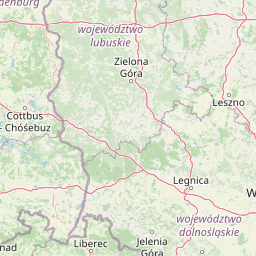
In parallel with this hydraulic purpose, the lake gradually acquired formal ecological recognition. On 21 July 2004, Poland's Minister of the Environment established the Special Protection Area 'Zbiornik Wonieść' (PLB300005), covering roughly 2,802 hectares of the surrounding landscape across four adjacent municipalities: Osieczna, Kościan, Krzywiń, and Śmigiel. This designation formally acknowledged the reservoir's role as a significant bird refuge, and it now overlaps with broader landscape protection areas and a nature reserve dedicated to the European pond turtle, reinforcing the lake's dual identity as both a working reservoir and a conservation site.
Wonieść Lake landscape and geographic character
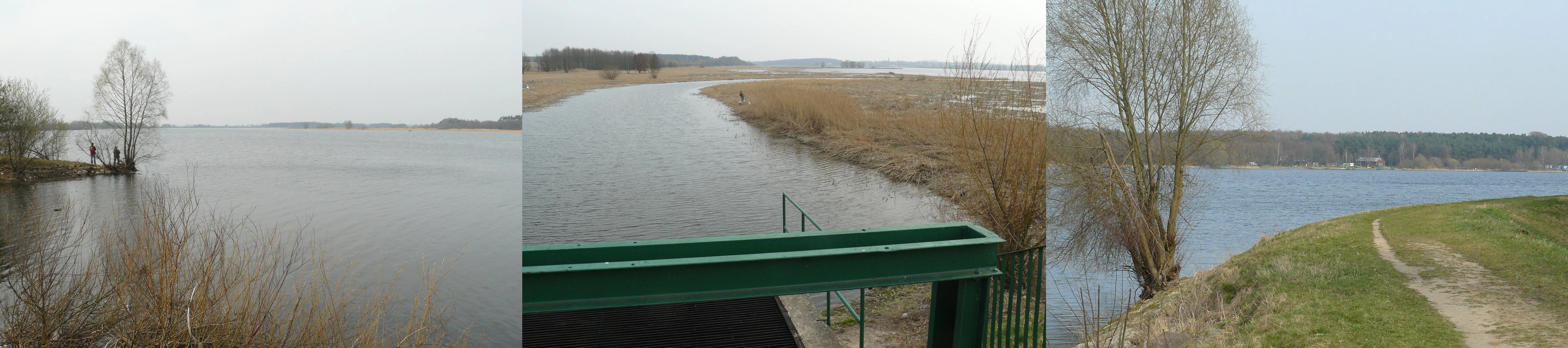
The Wonieść landscape reflects the classic character of the postglacial lowlands of western Wielkopolska, where the legacy of Pleistocene glaciation has softened into a mosaic of low moraine ridges, broad outwash plains, and elongated river-like depressions. The reservoir itself follows one of these inherited valleys, producing an unusually long and narrow water body stretching roughly 12.7 km while maintaining a maximum width of only about 1.3 km. The result is a lake whose shoreline unfolds almost like an inland waterway through the rural landscape.
Along the shores, the terrain shifts between pine-dominated forests, herb-rich meadows, wet depressions, and open farmland. Forests occupy much of the immediate buffer around the reservoir, providing a darker, quieter visual setting, while narrow ribbons of meadows and grazing land interrupt the tree cover near villages. In several places, low-lying marshy strips along the water's edge carry typical features of a postglacial reservoir margin: emergent reeds, flooded shrubs, and shallow bays that bend inward toward the agricultural fields behind them.
The broader topographic context is gentle rather than dramatic. Elevations around the lake vary only modestly, and there are no cliffs or steep escarpments; instead, the impression is of a softly rolling countryside framed by woodland and patched with the bright green of cultivated fields in summer and the muted ochres and browns of stubble in autumn. The Wonieść Canal, visible in older photographs from the village of Wonieść, traces part of the older drainage history of this same valley and helps connect the modern reservoir to its pre-impoundment landscape.
Wonieść Lake ecosystems, habitats, and plant life
Ecologically, Wonieść is shaped by the interaction between a large, open artificial water body and a richly varied buffer of natural and semi-natural habitats. The lake's long shoreline and shallow bays support extensive stands of reed, sedge, and various aquatic macrophytes, creating sheltered conditions for fish, amphibians, and invertebrates. Surrounding forests, dominated in many stands by Scots pine mixed with broadleaf species, alternate with meadow strips that retain much of the floral character of traditional Wielkopolska agricultural countryside.
Because the reservoir is relatively shallow compared to its surface area, much of the lake bottom lies within the photic zone, permitting the development of submerged vegetation that in turn supports a diverse invertebrate fauna. These conditions, combined with the seasonal presence of extensive wet meadows and flooded marginal habitats near Drzeczkowo, sustain a high density and species richness of birds throughout the breeding season and on migration.
Wonieść's ecological identity is therefore not defined by any single dramatic habitat type, but by the close coexistence between open water, reedbeds, wetland meadows, dry pine forests, and cultivated fields. This juxtaposition is a key reason the lake has become such an important regional refuge for birdlife and for reptiles such as the European pond turtle, whose relict populations find refuge in the wet depressions and oxbow-like habitats to the south of the main reservoir.
Wonieść Lake wildlife and species highlights
Wonieść is best known in wildlife terms for its exceptional bird richness. Within the 2,802-hectare Special Protection Area that surrounds the reservoir, surveys have confirmed the breeding presence of around 131 bird species, including 26 species listed in Annex I of the European Union Birds Directive and 10 species that appear in the Polish Red Data Book of Animals. Among the most notable Annex I species recorded here are the ferruginous duck, the white-winged tern, the little bittern, and the bearded reedling, all of which depend on healthy reedbed habitats around the lake.
The combination of large open water, shallow marshy bays, and seasonally wet meadows produces conditions that benefit not just breeding species but also migratory waterfowl and waders passing through Wielkopolska in spring and autumn. Flocks of ducks, herons, and gulls regularly congregate on the reservoir, and the surrounding meadows and field margins add small passerines and birds of prey to the overall richness of the area.
Beyond birds, the region around Drzeczkowo supports a small but nationally significant population of the European pond turtle, a species protected both in Poland and across the European Union. The presence of these reptiles, alongside the rich avifauna, gives Wonieść a distinct profile among Polish inland wetlands and has shaped the layered conservation designations that now protect much of the lake's catchment.
Wonieść Lake conservation status and protection priorities
Conservation is central to the modern identity of Wonieść. The reservoir and its surroundings are protected under a stacked framework of European and Polish designations, beginning with the Special Protection Area 'Zbiornik Wonieść' (PLB300005), established in 2004 and covering roughly 2,802 hectares across the municipalities of Osieczna, Kościan, Krzywiń, and Śmigiel. This designation places the lake within the Natura 2000 network of the European Union, obligating national authorities to safeguard the habitats of rare and protected bird species identified on site.
The same area is also part of, or closely overlaps with, the Special Area of Conservation 'Zachodnie Pojezierze Krzywińskie' (PLH300014), the 'Ostoja żółwia błotnego' nature reserve dedicated to the European pond turtle, and the broader Krzywińsko-Osiecki Protected Landscape Area, which includes historically significant woodlands planted under the direction of General Dezydery Chłapowski. Together, these designations reflect a recognition that the reservoir is not just an isolated waterwork but a keystone ecological feature within a wider protected landscape.
From a conservation perspective, the lake's importance lies in the way its size and habitat diversity combine to support multiple rare species simultaneously: Annex I waterbirds, Polish Red Data Book species, and protected reptiles. Maintaining water-level regimes compatible with both the reservoir's agricultural function and the ecological needs of reedbed and pond-turtle habitats is the central management challenge, and it is what makes Wonieść a meaningful case study in balancing utilitarian water infrastructure with biodiversity conservation.
Wonieść Lake cultural meaning and human context
Although Wonieść is primarily a natural and ecological feature, it sits within a region with a strong agricultural and land-improvement heritage. The surrounding countryside falls within the historic cultural landscape of Wielkopolska, where generations of farmers and landowners have reshaped fields, meadows, and woodlands to support mixed agriculture. Part of the broader protected landscape overlapping the lake includes the planned plantings and experimental fields associated with General Dezydery Chłapowski, a 19th-century figure known for promoting rational, ecologically informed land use in this part of Poland.
The lake is closely identified with the small village of Wonieść, from which it takes its name and through which the historic Wonieść Canal still passes. The canal, captured in older photographs alongside the reservoir, is itself a monument to the long history of drainage and water management in the region, connecting the modern dammed lake to older efforts to organize water across the rural landscape.
Recreational traditions around the lake are modest but real. A small number of holiday centers dot the shoreline, and local residents use the reservoir for fishing, walking, and quiet waterside leisure rather than for mass tourism. This gives Wonieść a cultural profile shaped less by visitor spectacle than by everyday rural life and by the local sense of stewardship over a piece of water that, despite being artificial, has taken on deep regional significance.
Top sights and standout views in Wonieść Lake
The standout features of Wonieść center on its unusual combination of hydrology, ecology, and regional culture. The reservoir itself is one of the longest, narrowest inland water bodies of its size in west-central Poland, and its origin as a merger of five separate postglacial lakes gives it a distinctive, segmented shoreline that rewards detailed exploration by boat or kayak.
Ecologically, the lake's highlights include its Annex I waterbird populations, the confirmed breeding of 131 bird species in the surrounding protection area, and the regionally important presence of the European pond turtle near Drzeczkowo. Layered conservation designations, including a Natura 2000 site, a Special Area of Conservation, a dedicated reptile reserve, and a broader protected landscape area, make the lake a particularly informative site for those interested in modern Polish environmental policy.
For visitors, the lake's appeal lies in its quiet Wielkopolska setting, the forest-fringed shoreline, the contrast between open water and agricultural fields, and the visual rhythm of small villages, historic canals, and forest edges that line the route around the reservoir.
Best time to visit Wonieść Lake
The character of Wonieść changes meaningfully with the seasons in this part of west-central Poland. Late spring and early summer bring the broadest expression of the lake's ecological richness: breeding waterbirds are active across the reedbeds and meadows, surrounding forests are fully leafed, and agricultural fields around the shoreline form a vibrant green mosaic. This is also when birdwatching interest in the site is highest, as the visibility of Annex I species and the audible presence of breeding communities peak.
In high summer, the surroundings settle into the typical warm, agricultural atmosphere of Wielkopolska, with shallow bays warming quickly and offering conditions for water-based recreation. The forested sections of the shoreline continue to provide shaded walking, even as open fields turn golden and the visual contrast between water, woodland, and fields becomes more pronounced.
Autumn offers a different appeal: quieter shores, cooler conditions that favor migrating waterfowl and concentrations of waterbirds, and an atmospheric landscape shaped by fog over the long, narrow water surface. Winter around the lake brings a colder, more subdued rural setting with the reservoir's length imposing a distinctive visual rhythm across the frost-covered countryside.