Why Żerkowice-Skała stands out
Żerkowice-Skała is best known as a reference site for the delicate filmy fern (Trichomanes speciosum), a rare and ecologically sensitive species whose strongholds in central Europe are closely tied to humid, shaded rock crevices. The area is also recognized for its outlier sandstone formations and its position as one of the northernmost Cretaceous sandstone exposures associated with the Bohemian Massif. Another defining trait of the site is the contrast between the dramatic sandstone rock edge with its cliffs and the well-preserved deciduous forest cover that surrounds it. This pairing of geological spectacle and old-growth forest habitat gives the site a distinctive character within the regional Natura 2000 network.
Żerkowice-Skała history and protected-area timeline
Żerkowice-Skała was formally designated in 2011 as a Site of Community Importance within Poland's Natura 2000 network. Its inclusion followed the recognition that the area combined several habitat types of European conservation interest together with reference populations of Trichomanes speciosum. The identification was driven by habitat-based criteria rather than bird protection, which shaped its later designation as a proposed Special Area of Conservation.
The site's contemporary context is shaped by centuries of human activity in the surrounding Bóbr valley settlements, including forestry, agriculture, and the long tradition of sandstone quarrying in the Izera Foothills. The presence of two large operating quarries immediately north of the protected area reflects an ongoing tension between mineral resource extraction and the protection of smaller, biologically valuable forest and rock sites.
Although the Natura 2000 designation is the most clearly documented formal step, the broader landscape of sandstone outliers and deciduous forests around Lwówek Śląski has long been recognized locally as a distinctive scenic and natural area, eventually grouped under the regional nickname of Szwajcaria Lwówecka.
Żerkowice-Skała landscape and geographic character
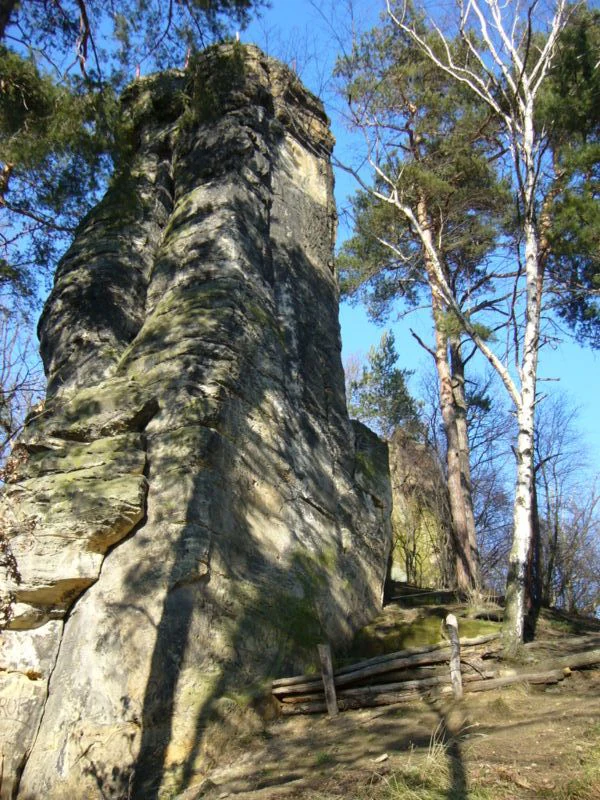
The landscape of Żerkowice-Skała is shaped by a sandstone cuesta whose edge rises above the surrounding terrain and is broken into a series of individual rock remnants, rocky outcrops, and small cliff faces. These geological features give the area its characteristic profile: a wooded highland edge occasionally punctuated by vertical sandstone walls and isolated standing rocks.
The sandstone belongs to the Cretaceous sequence associated with the Bohemian Massif, and the site lies at the northern tip of the broader band of such exposures that continues further south into the Sudetes foothills. This strategic position gives the area both its scenic character and a special place in regional geological understanding.
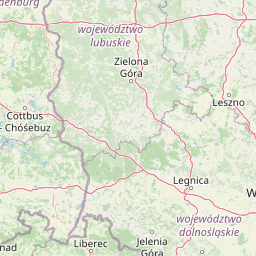
Around the rock edge, the terrain softens into the agricultural and village landscapes of the commune of Lwówek Śląski. Cultivated fields and the rural settlements of Żerkowice and Skała frame the protected area, while to the north the landscape changes abruptly into the operational landscape of two large sandstone quarries. This juxtaposition of small-scale habitats with intensive extraction is one of the most striking visual aspects of the site.
Żerkowice-Skała ecosystems, habitats, and plant life
The ecological character of Żerkowice-Skała arises from a tightly knit combination of forest, rock, and humidity-driven microhabitats. On the better-drained slopes and plateau positions, the vegetation consists of well-developed central European and subcontinental oak-hornbeam forests, known in Polish as grądy. These forests form the broad wooded matrix in which the sandstone rocks are embedded.
Where the terrain drops toward the Bóbr river valley, the vegetation shifts to elm-ash riparian forest, locally referred to as łęg wiązowo-jesionowy. These moister floodplain forests occupy the transition zone between the cuesta edge and the river system, contributing both habitat diversity and structural contrast along the slope gradient.
The rock faces and associated scree are themselves a specific habitat type within the site. Silicate cliff and scree habitats create the conditions for shade-loving, moisture-dependent species that would not survive in the surrounding forest interior. This combination of habitats, rather than any single forest type, is what gives Żerkowice-Skała its conservation profile.
Żerkowice-Skała wildlife and species highlights
The wildlife of Żerkowice-Skała is shaped less by charismatic large mammals and more by specialized habitat-dependent species tied to the sandstone rock crevices and old deciduous forest. The most prominent species is the delicate filmy fern, Trichomanes speciosum, for which the site is considered part of the reference range of high importance.
The fern benefits from the persistent humidity, deep shade, and sheltered microclimates found along the sandstone cliffs and under rock overhangs. Although it is a plant rather than an animal, it is often framed in conservation literature as a flagship species for the kind of small-scale, structurally complex habitat that the site protects. The site's mature deciduous forest also supports a broader community of woodland invertebrates, mosses, and bryophytes that respond to the same shaded, humid conditions.
Larger forest fauna typical of Lower Silesian deciduous woodlands is also expected to use the area, but the conservation emphasis of the site lies clearly with its habitat structures and the dependent specialist species rather than with game or large mammal populations.
Żerkowice-Skała conservation status and protection priorities
Żerkowice-Skała is a habitat-focused Natura 2000 site whose conservation importance is closely linked to its structural diversity and to the populations it supports of Trichomanes speciosum. The site's designation as a proposed Special Area of Conservation means that its primary role is to maintain, and where necessary improve, the conservation status of the listed habitat types rather than to serve primarily as a landscape-scale reserve.
The protected habitats include silicate cliff and scree environments, oak-hornbeam forests in their central European and subcontinental forms, and riparian elm-ash forests along the Bóbr valley. Maintaining these habitats simultaneously requires both preserving the local microclimate conditions in the rock crevices and maintaining the continuity and natural composition of the surrounding forest.
A particular conservation challenge lies in the proximity of two large sandstone quarries operating immediately north of the protected area. These operations influence hydrology, dust loads, and visual context, raising questions about how the sensitive microhabitats along the cliff edge can be preserved in the face of continuing industrial extraction of the same sandstone formation.
Żerkowice-Skała cultural meaning and human context
The cultural context of Żerkowice-Skała is rooted in the long pastoral and forestry traditions of the Bóbr river valley, where the villages of Żerkowice and Skała have shaped the land for centuries. The surrounding countryside is a mosaic of fields, meadows, orchards, and small woodland patches typical of historic Silesian rural landscapes.
Sandstone itself is deeply embedded in regional identity, both as a building material and as a raw material extracted from the quarries that still operate around Lwówek Śląski. The same geology that supports the protected habitats also provides the economic backbone of parts of the local economy, creating a layered relationship between landscape, heritage, and industry.
In regional tourism and cultural geography, the broader sandstone landscape is promoted under names such as Szwajcaria Lwówecka, and individual rock features like Skała z Medalionem, Panieńskie Skały, and Skały Kawalerskie have become local landmarks. Huzarski Skok, a historical cavalry event held in Żerkowice, adds another layer of cultural memory to the area. Together these features make the site part of a region where natural and cultural heritage are tightly intertwined.
Top sights and standout views in Żerkowice-Skała
Among the standout features of Żerkowice-Skała are the sandstone outlier rocks along the cuesta edge, the well-preserved deciduous forest cover, and the unusually favorable conditions for Trichomanes speciosum along the shaded cliff faces. The site also stands out for its position as one of the northernmost Cretaceous sandstone exposures linked to the Bohemian Massif, giving it a special geological significance in a regional context.
A further highlight is the site's role within the wider scenic landscape of the Lwówek region, where it sits alongside named rock formations and viewpoints that together form part of the identity of Szwajcaria Lwówecka. The green hiking trail passing through the area ties it into the broader recreational geography of Lower Silesia.
Best time to visit Żerkowice-Skała
Spring and early summer tend to bring out the freshness of the deciduous forest cover and make the sandstone outcrops easy to approach along forest paths, while the shaded conditions along the cliffs remain appealing through the warmer months. Autumn brings colorful foliage across the oak-hornbeam and riparian forests, contrasting sharply with the warm tones of the sandstone rocks themselves.
Mild, damp weather highlights the qualities that give the site its conservation significance, as humidity favors both the filmy fern and the broader community of moisture-loving plants and invertebrates along the rock faces. Very cold winter periods and heavy snow can make the rock edges and forest paths slippery, so winter visits require some caution while still offering a quieter perspective on the landscape.