
Why Chanivaz, Delta de l'Aubonne stands out
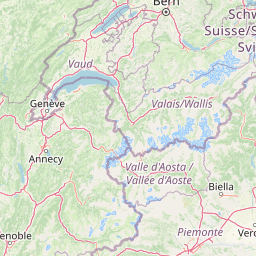
Chanivaz, Delta de l'Aubonne is best known for being one of the rare glacial morphologic geotopes on the Swiss shore of Lake Geneva, where the River Aubonne has built a clearly terraced alluvial fan at the edge of the lake basin. The site's four distinct elevation steps, formed during the retreat of the Würm-era Rhone glacier, give the delta more layered terraces than other Lake Geneva river mouths and form the geological core of its national landscape designation. Equally distinctive is its ecological character, combining a freely meandering river, an intact floodplain forest, one of the last large reedbelt areas of the lake (Les Batiaux), and a mosaic of marshland, meadows, and oak woodland. These habitats support rare amphibians such as the European tree frog, migratory and breeding birds including marsh harrier, bluethroat, common kingfisher, and black tern, and fish like the threatened lake trout that still use the Aubonne as a spawning stream.
Chanivaz, Delta de l'Aubonne history and protected-area timeline
The area's recorded history stretches back to Roman times. A substantial archaeological site was discovered in the 19th century on the plain east of the Aubonne river, between the Roman towns of Lousanna (Lausanne) and Colonia Iulia Equestris (Nyon). The settlement, whose ancient name is not preserved, lay directly on the lakeshore and is believed to have been damaged or destroyed by the Tauredunum tsunami of 563 AD, which flooded the Lake Geneva shoreline with waves several meters high, as recorded by the bishops Gregory of Tours and Marius of Avenches.
In the Middle Ages, the locality became the center of a parish; the parish church is documented in 1228 in the Lausanne chartulary of the Burgerbibliothek Bern under the name Chanliva. Chanliva, later Chanivaz, is a Franco-Provençal form meaning 'oak' or 'oak grove,' and the silent final -z typical of the regional dialect explains why it is not pronounced. The neighboring estate of Les Fontanettes ('the springs,' likely referring to groundwater seeps near the lake) has a long and continuous history as well, and both the Chanivaz farmstead and Fontanettes remain living parts of the cultural landscape around which the BLN zone is organized.
During the Ancien Régime, the area belonged to the Seigneurie d'Allaman, a patrimonial lordship administered from the Château d'Allaman and held under the city and republic of Bern through its Amt Morges. A historic lakeside road between Geneva and Lausanne once passed directly through the protected area; since 1431 the main road (today's Swiss Route 1) has bypassed the delta, crossing the Aubonne farther upstream at Claveleire. The railway line Geneva–Lausanne–Bern and, later, the A1 motorway both cross the valley on large viaducts farther upstream, beyond the delta geotope itself.
In the 20th century, the area gradually came under residential pressure from the expanding lakeside development around Buchillon. By the 1970s, a major real-estate project envisioned a large housing development for several hundred or even a thousand residents directly in the Chanivaz plain. After the municipality of Buchillon had already approved the investment, the Swiss Federal Council imposed a building ban in 1980, turning the case into a landmark of Swiss landscape protection. Despite this protection, recreation on the lake, agricultural intensification, groundwater pumping for regional water supply, and gravel extraction continue to influence the site's condition.
Chanivaz, Delta de l'Aubonne landscape and geographic character
The landscape of Chanivaz – Delta de l'Aubonne is shaped by the interaction between the River Aubonne and Lake Geneva, producing one of the clearest and most layered delta systems on the Swiss side of the lake. Over the roughly three square kilometers of alluvial fan that the Aubonne has built since the end of the Würm glaciation, the terrain rises from the lakeshore in a sequence of four distinct terraces at about 3, 10, 25, and 35 meters above the present lake surface of 372 meters. These terraces are unusually well preserved compared to other Lake Geneva deltas, because the Aubonne cut through older moraines deposited by the Rhone glacier and the older terraces remain as flat plateaus that have not been fully reworked.
The lowest terrace forms the actual river mouth and lower floodplain, extending inland as far as the railway viaduct at Aubonne. Above it, the 10-meter terrace carries the wet meadows and pastures around the Pècherie west of the river and the historic estates of Chanivaz and Fontanettes to the east. The 25-meter terrace forms the broad plateau of Grands-Bois and Buchillon, while the 35-meter terrace forms the elevated ground at Allaman, crowned by the Château d'Allaman. Beneath the lake surface, Aubonne sediments extend several more square kilometers into the lake basin.
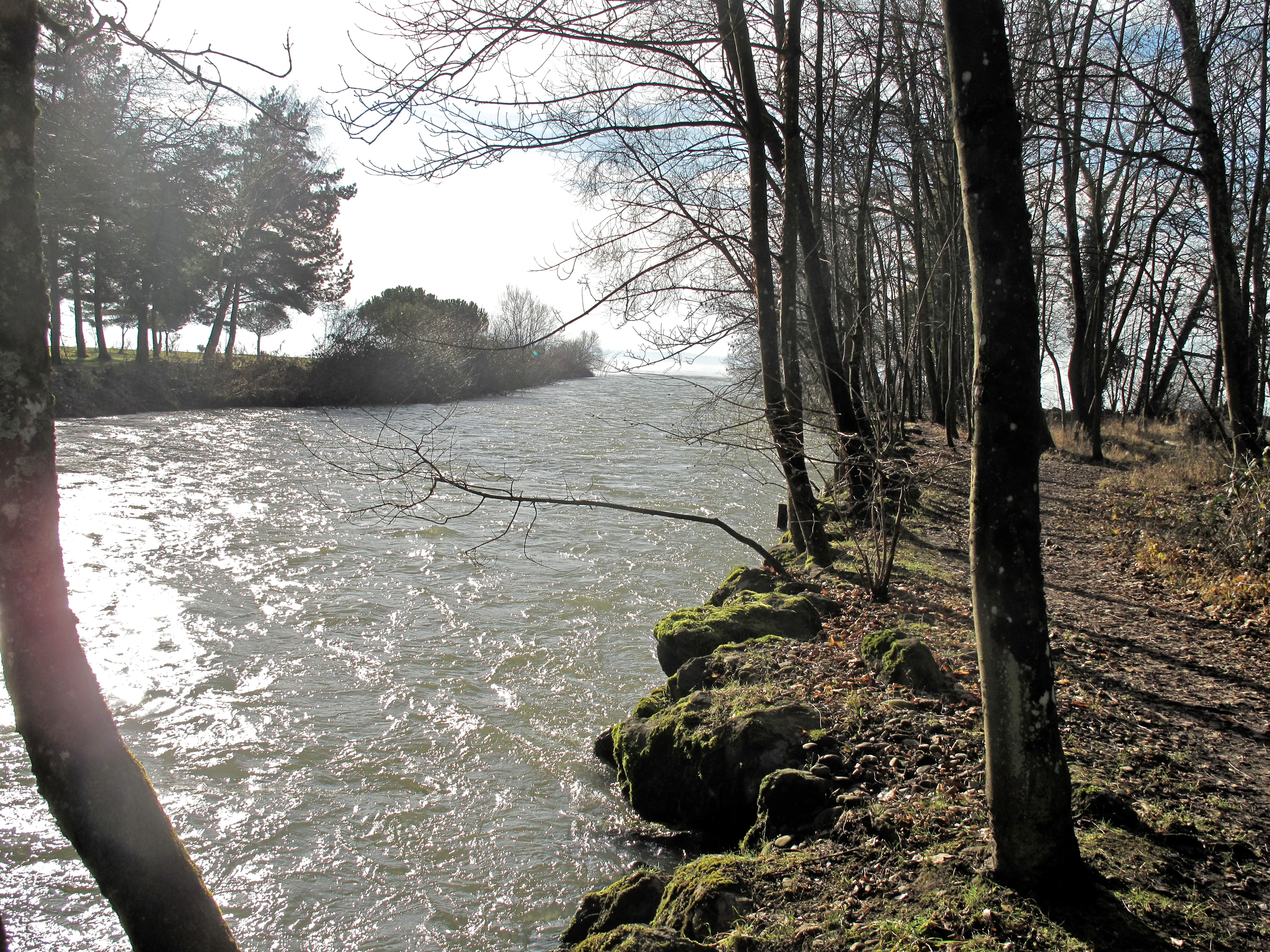
Visually, the protected area is a patchwork of contrasting textures: a freely meandering river that has not been channelized, dense softwood floodplain forest with willows, ashes and alders, mature oak stands that have given the locality its name, open meadows, vineyards on the Allaman slopes, and large reedbeds along the lake. The shoreline itself is asymmetric; west of the river mouth it is a coarse gravel and boulder beach, while east of the Aubonne mouth a broad belt of reeds, including the Les Batiaux marsh, dominates. Older maps even show a plot east of the river mouth named Au Marais ('in the marsh'), reflecting the long-standing presence of these wet habitats.
Chanivaz, Delta de l'Aubonne ecosystems, habitats, and plant life
The ecological identity of Chanivaz – Delta de l'Aubonne rests on the unusually close coexistence, within a small area, of aquatic, wetland, forest, meadow and dry-ground habitats. The combination of an active, freely meandering river, a large and largely intact floodplain forest, several hectares of lake-shore reedbed, wet meadows, and a mosaic of oak woodland and dry pine stands on the terraces has earned the landscape its national-level designations for floodplains, amphibian spawning, and landscape quality.
The forest structure is particularly important. Along the river, classic softwood floodplain species such as willow, ash, and especially black alder dominate, while on the higher and drier terraces, mixed oak woodland and pine forest take over. Old oaks are still present in the area, and the jay, which caches acorns to support forest regeneration, is closely associated with this oak-dominated character. At the lakeshore, small populations of the increasingly rare European sea-grass (Strandling) survive in patches of shore rush vegetation, while orchids bloom in some of the open meadows.
The wetland habitats around the river mouth and the Les Batiaux reedbed are central to the site's biodiversity. They form habitats for amphibians, including the European tree frog, which is still relatively widespread in the Aubonne valley and is rare elsewhere in Switzerland, and the yellow-bellied toad along the gravelly shore. The reedbeds and adjacent lake shallows are important for waterbirds, with breeding and migratory species ranging from reed-bed specialists to fish-eaters, while the gravel lakeshore is one of the few remaining natural nesting grounds for sand martins. Insect diversity is also notable, including threatened species such as the mallow skipper, a butterfly at risk of extinction in Switzerland.
Chanivaz, Delta de l'Aubonne wildlife and species highlights
Wildlife is one of the strongest reasons the area has been protected. The Lutry-Les Batiaux reedbed marsh, although situated beyond the strict BLN core, is acknowledged as one of the last large remaining reed areas of Lake Geneva and serves both as a habitat for breeding birds and as a resting place for migratory species. Among species documented here are ferruginous duck, great cormorant, bluethroat, Eurasian nuthatch, marsh harrier, common redshank, common gull, black tern, Eurasian hoopoe, common kingfisher, water rail, common tern, barn swallow, red kite, chiffchaff, grey wagtail, great crested grebe, and marsh tit.
In the broader protected mosaic, woodland birds play a major role. Woodpeckers such as the middle spotted woodpecker and the green woodpecker inhabit the oak and mixed forest along the Aubonne, while the Eurasian jay, closely linked to the area's old oaks, supports natural forest regeneration through its acorn caches. Songbirds, including the common nightingale, are also characteristic of the site.
Aquatic fauna is similarly diverse. The Aubonne is one of the few remaining spawning rivers for the lake trout, a species considered highly threatened in Lake Geneva; brown trout and bullhead also live in the river. Reptiles and amphibians are widespread in the warm, structurally varied shoreline, where the gravelly beach west of the river mouth is officially listed as a nationally important amphibian spawning site, and the yellow-bellied toad still occurs. The European tree frog remains relatively common in the Aubonne valley, making the area an important stronghold for this species in Switzerland.
Chanivaz, Delta de l'Aubonne conservation status and protection priorities
Chanivaz – Delta de l'Aubonne is protected at multiple levels, which is what gives it its unusually strong conservation profile. Since 1996 it has been part of the federal Inventory of Landscapes and Natural Monuments of National Importance (BLN or French IFP), listed as object 1210. Its delta is also registered in the federal inventory of floodplains of national importance, and the lakeshore strip is included in the inventory of nationally important amphibian spawning areas under a 2001 federal ordinance. In addition, the canton of Vaud has classified part of the river-mouth landscape as the cantonal nature reserve Embouchure de l'Aubonne in 2003, and the Allaman vineyards and the Les Batiaux reed area are registered in the cantonal inventory of natural monuments and sites.
The site's conservation importance lies in the combination of geological and ecological values that are otherwise difficult to preserve together. The four-level terrace sequence is a textbook example of glacial-river interaction and is rare in such clarity along Lake Geneva. Ecologically, the freely meandering river, the softwood floodplain, and the reedbed mosaic represent a small-scale but unusually complete example of a natural northern-shore lakeside ecosystem, with breeding, wintering, and migratory species concentrated in close proximity. The protection of archaeological and historic features, from the Roman settlement to the medieval site and the pilgrimage route, is also written into the BLN designation as an explicit objective.
Despite this layered protection, the area faces ongoing pressures. Recreational boat traffic around the Allaman marina built in the 1980s affects fauna in the reedbed. Agriculture in the Chanivaz estate and the use of plant-protection products in the surrounding vineyards can influence the protected habitats, and groundwater pumping for regional water supply, from a designated protection zone at Chanivaz and Chaney, operates within the delta's gravel aquifer. The 1980 federal building ban, following the canceled large-scale real-estate project, is a key reason this stretch of the Lake Geneva shore remained largely unbuilt, and the site remains a benchmark case in Swiss landscape-protection law.
Chanivaz, Delta de l'Aubonne cultural meaning and human context
The cultural landscape of Chanivaz – Delta de l'Aubonne is built around the small hamlets and estates of Chanivaz and Les Fontanettes, at the heart of the protected area. The Chanivaz farmstead, rebuilt around 1900, remains the center of a working agricultural estate focused on potato and onion cultivation, while the Fontanettes estate has stayed in private hands for a long time and extends, with its historic park, all the way down to the lakeshore. Both are listed within the BLN objectives for protecting historic structures.
The Swiss section of the Way of St. James enters the area from Buchillon and crosses the Aubonne delta; pilgrims can walk partly along an unbuilt path under the forest canopy from Buchillon into the protected zone. Tangible traces of older cultures exist as well. Although the Roman settlement's ancient name is lost, the archaeological remains underline the location's long role as a stopping point on the lakeside route between the Roman towns of Lausanne and Nyon. The medieval parish of Chanivaz, the seigneurial castle of Allaman, and the legendary 563 Tauredunum tsunami, which reportedly reached the settlement, are important context for how deeply human history is interwoven with the lake and river landscape.
Top sights and standout views in Chanivaz, Delta de l'Aubonne
Chanivaz – Delta de l'Aubonne stands out for the unusually clear four-level terrace sequence of its alluvial fan, a textbook glacial delta landscape that is rare among Lake Geneva river mouths. It also hosts one of the few remaining stretches of the northern Lake Geneva shore where a river still flows freely into the lake through an intact floodplain, and where the large Les Batiaux reedbed still functions as a breeding and stopover site for waterbirds.
Other distinctive features include the continued presence of the European tree frog in the Aubonne valley, the use of the river by the threatened lake trout as a spawning stream, and the close proximity of Roman ruins, a medieval parish center, and a modern Camino de Santiago route within a single federal landscape protection zone.
Best time to visit Chanivaz, Delta de l'Aubonne
Spring and early summer are particularly rewarding, when water levels in the Aubonne are higher, the floodplain forest is in fresh leaf, and migratory and breeding waterbirds are most active in the reedbeds and shallow waters of the Les Batiaux marsh and along the lake edge. Meadow habitats, including the orchid-rich grassland near Chanivaz, are at their most visible in late spring.
Late summer and early autumn tend to be quieter, with lower water in the Aubonne, which exposes larger areas of the gravel riverbed and shoreline, and makes the layered structure of the delta easier to read on the ground. Winters, although mild along the lake, are generally less colorful, though the open landscape and reduced vegetation can make the terrace sequence and the Roman-historic sites easier to appreciate.