Mori Atlas logo
Nature reserveFrançois Leguat Giant Tortoise and Cave Reserve

A detailed look at the island rewilding project, subterranean cave systems, and indigenous coastal plant restoration.

François Leguat Giant Tortoise and Cave Reserve: Exploring the Protected Coastal Karst Landscapes of Rodrigues

Located on the Anse Quitor peninsula, François Leguat Giant Tortoise and Cave Reserve stands as a critical protected landscape within the Rodrigues island ecosystem. The reserve features complex limestone karst formations and subterranean caverns, serving as a sanctuary for reintroduced giant tortoises and the restoration of rare native coastal flora. This geographic overview highlights the terrain, ecological boundaries, and the intersection of natural history and geological significance within the Indian Ocean landscape.

island reservecoastal floratortoise sanctuarycave systemrewilding projectMascarene Islands

François Leguat Giant Tortoise and Cave Reserve

Nature reserve

Park overview

Structured park overview, official facts, and landscape profile for François Leguat Giant Tortoise and Cave Reserve

François Leguat Giant Tortoise and Cave Reserve park facts, protected area profile, and essential visitor context

Review the core facts for François Leguat Giant Tortoise and Cave Reserve, including designation, size, terrain, visitor scale, habitats, and operating context in one park-focused overview.

About François Leguat Giant Tortoise and Cave Reserve

François Leguat Giant Tortoise and Cave Reserve is a protected natural area on the island of Rodrigues centred on the recovery of an almost extinct coastal ecosystem. Rodrigues, the smallest and most easterly of the Mascarene Islands, lost a remarkable share of its native fauna after human settlement in the eighteenth and nineteenth centuries, including two species of giant tortoise, flightless birds such as the Rodrigues solitaire and Rodrigues rail, multiple endemic pigeons and parrots, a day gecko, a night heron, a starling, and a scops owl. The reserve is, in effect, an attempt to repair some of that loss by combining habitat restoration, the reintroduction of closely related tortoise species, captive conservation of critically endangered chelonians, and public interpretation.

The site lies on the Anse Quitor peninsula in the south-west of Rodrigues, a few hundred metres from the local airport and immediately beside the Anse Quitor Nature Reserve. Together with that neighbouring reserve it contains the only remaining patch of Rodrigues' indigenous coastal vegetation. Since 2007 the reserve has been actively replanted, and over 100,000 plants from 33 indigenous and endemic species have been established across the property.

The reserve is structured around three main experiences: the open-air tortoise park, set in and around a deep canyon known as Tiyel Canyon; the cave system, with guided tours through formations such as the Grande-Caverne and the Caverne-de-la-Vierge; and an on-site museum and education centre that frames the reserve's work within the broader natural and human history of Rodrigues. The reserve also operates a restaurant and is closely tied to the tourism economy of Rodrigues, which is the most remote of the inhabited Mascarene islands.

Quick facts and research context for François Leguat Giant Tortoise and Cave Reserve

François Leguat Giant Tortoise and Cave Reserve is located on Rodrigues, the smallest of the Mascarene Islands and an autonomous republic within the Republic of Mauritius. The reserve opened in August 2007 as part of the same conservation project that established La Vanille Reserve on Mauritius, and it is named after the French Huguenot François Leguat, whose writings documented Rodrigues' lost natural history.

The site functions simultaneously as a conservation area, a botanical restoration project, a working tortoise sanctuary, and a show cave system. Over 100,000 plants representing more than 30 indigenous and endemic species have been established, and the herd of introduced giant tortoises has grown from an initial several hundred to roughly 2,000 individuals. The reserve also hosts Rodrigues fruit bats and surviving endemic birds, namely the Rodrigues Warbler and the Rodrigues Fody.

Protection and recognition

Terrestrial protection metrics, designation history, and international conservation recognition sources

François Leguat Giant Tortoise and Cave Reserve Protection Status and Recognized Conservation Scope

François Leguat Giant Tortoise and Cave Reserve holds documented terrestrial protection status with established management parameters and structured conservation records. Systematic conservation tracking compiles available designation history and official recognition data for this protected area.

Protection details

Protection scope
Terrestrial
Transboundary protection
No
Park context

Deeper park guide and search-rich context for François Leguat Giant Tortoise and Cave Reserve

François Leguat Giant Tortoise and Cave Reserve history, landscape, wildlife, and travel context

Explore François Leguat Giant Tortoise and Cave Reserve through its history, landscape character, ecosystems, wildlife, conservation priorities, cultural context, and seasonal travel timing in a structured park guide built for atlas discovery and search intent.

Why François Leguat Giant Tortoise and Cave Reserve stands out

The reserve is best known for its population of introduced giant tortoises, particularly Aldabra giant tortoises, that have been brought to Rodrigues to fulfil the ecological role of two extinct endemic Cylindraspis species. The tortoises graze, disperse seeds, and help rejuvenate the recovering coastal vegetation in a landscape that had lost all of its native giant reptiles centuries ago. It is also recognised for its cave system, which includes the only show caves in the Indian Ocean equipped with permanent lighting. The combination of ecological restoration using surrogate megafauna and accessible interpretive caves makes the reserve unusual among protected areas in the Mascarenes.
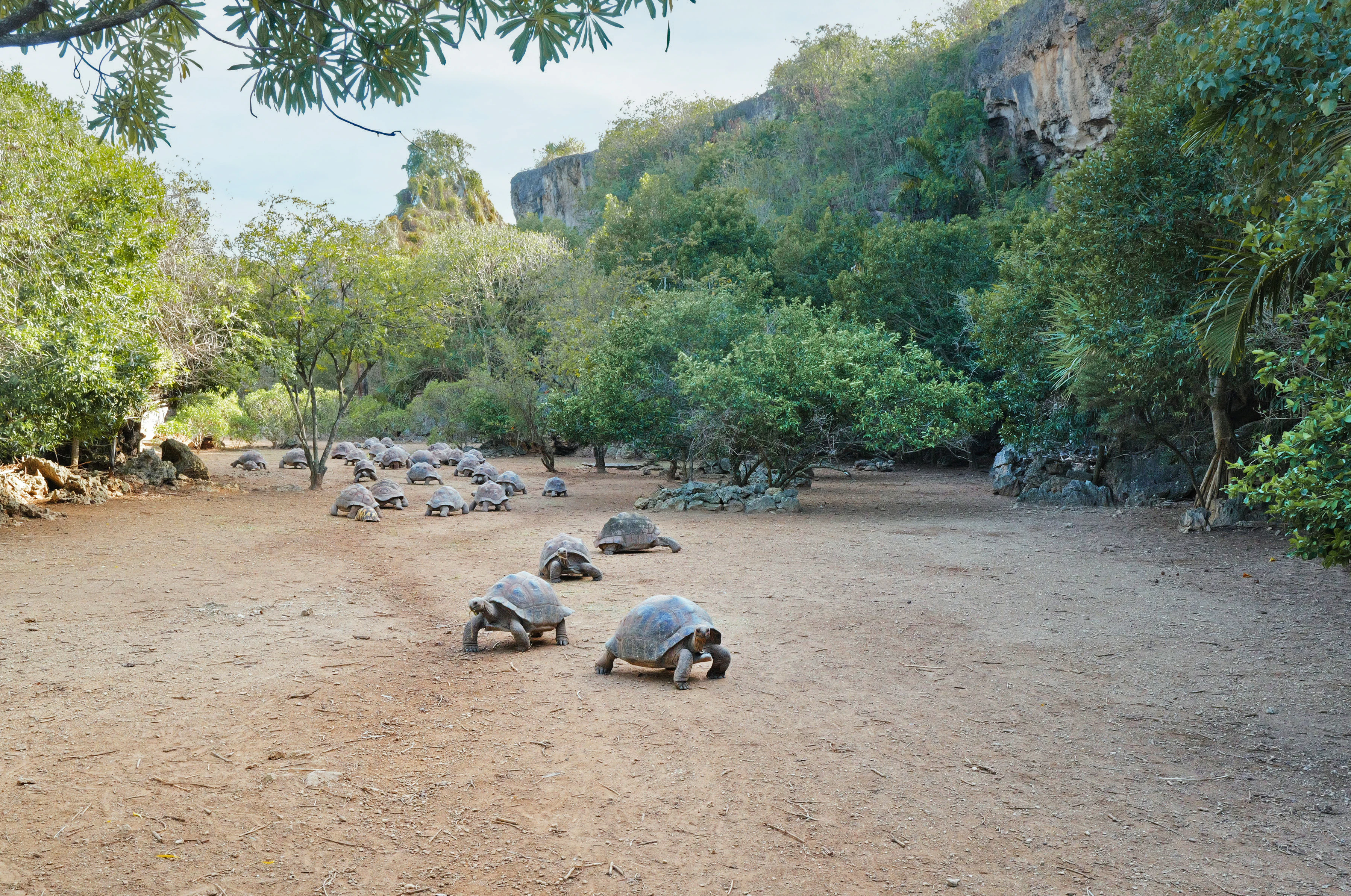
Many giant tortoises walking across a dry, sandy canyon floor surrounded by trees and limestone cliffs.
A group of giant tortoises roaming through Tyel Canyon in the reserve.

François Leguat Giant Tortoise and Cave Reserve history and protected-area timeline

François Leguat Giant Tortoise and Cave Reserve was opened in August 2007 as part of the same conservation initiative that established La Vanille Reserve on Mauritius. The project set out to create a working sanctuary on Rodrigues focused on the island's devastated indigenous ecosystems and on reconciling visitors with the natural heritage that the eighteenth-century French Huguenot François Leguat had been among the first to document.

The name of the reserve honours François Leguat himself, the French Protestant settler who arrived on Rodrigues in 1691 and whose journal remains one of the most important historical sources for the island's lost natural history. Leguat recorded dense herds of giant tortoises sailing across the open plains in long lines, a range of now-extinct birds including the Rodrigues solitaire, and the broader ecological character of an island that had never before been inhabited by humans.

Since its opening, the reserve has become a centre for tortoise-based ecological restoration. It introduced a founding population of Aldabra giant tortoises to take over the grazing and seed-dispersal role once performed by the extinct Cylindraspis species, added Radiated tortoises, and more recently took in rescued Ploughshare tortoises. Planting campaigns have run in parallel, and the reserve's population of introduced tortoises has grown from the original several hundred towards roughly 2,000 individuals. The reserve also contributes to the conservation of the Rodrigues fruit bat, the rarest bat in the world according to the reserve's own framing, whose population recovered from a low point of about 70 individuals in 1970 thanks to sustained intervention.

François Leguat Giant Tortoise and Cave Reserve landscape and geographic character

The reserve occupies part of the Anse Quitor peninsula in the south-west of Rodrigues, a low-lying coastal landscape of calcarenite rock, dry scrub, and exposed limestone formations that is typical of the island's drier coast. The most visually striking feature of the reserve is Tiyel Canyon, a deep, vegetated cleft in the limestone where the introduced Aldabra giant tortoises congregate in large, slow-moving herds and where visitors encounter them at close range.

The peninsula itself carries the last substantial fragment of Rodrigues' indigenous coastal flora, an ecosystem that is otherwise almost entirely lost across the island. Where the reserve meets the sea, the coast is rough and rocky, and the inland terrain rises gently into the karst plateau that supports the cave system. Two developed caves, the Grande-Caverne, which extends around 500 metres, and the Caverne-de-la-Vierge, at roughly 255 metres, are joined by additional passages that are either closed for safety or not yet rehabilitated for public access.

Vegetation in and around the reserve is a mixture of regenerating native coastal flora and planted indigenous and endemic species. Open patches of low scrub alternate with denser thickets, creating the patchy habitat that the tortoises depend on for grazing and that supports the surviving native birdlife. The landscape is small in scale but unusually rich in ecological detail, with the dramatic line of the canyon and the cave entrances providing clear focal points for visitors.
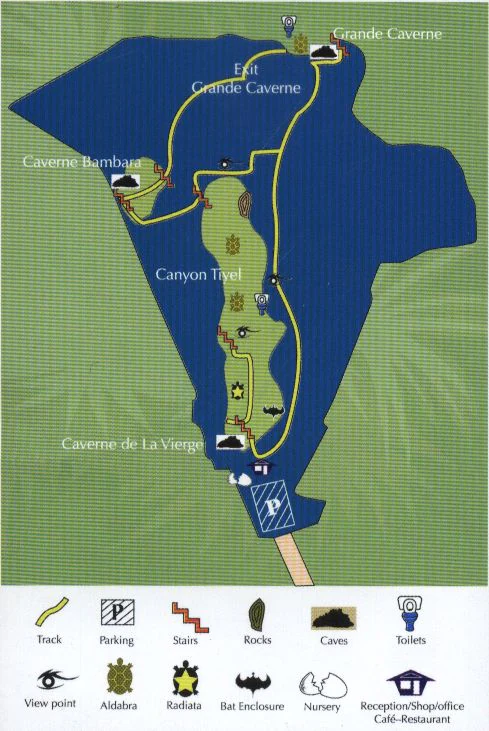
A diagrammatic park map of the François Leguat Giant Tortoise and Cave Reserve, displaying trails, cave locations, visitor facilities, and a legend with icons for tortoises and other landmarks.
Visitor map of the François Leguat Giant Tortoise and Cave Reserve, showing trails and points of interest.

François Leguat Giant Tortoise and Cave Reserve ecosystems, habitats, and plant life

The reserve protects what is, along with the neighbouring Anse Quitor Nature Reserve, the only surviving patch of Rodrigues' nearly extinct coastal flora. Restoration is a central activity rather than just an outcome: more than 100,000 plants from around 33 indigenous and endemic species have been planted across the site, and the vegetation is being actively managed using the grazing and movement of giant tortoises as a kind of living tool.

This tortoise-driven restoration model is the reserve's defining ecological idea. Before human settlement, the island's native giant tortoises browsed trees and grazed grasses, dispersed seeds, and shaped the structure of the vegetation in ways that no surviving Rodrigues species can replicate. By introducing Aldabra, Radiated, and Ploughshare tortoises, the reserve attempts to re-establish that process using closely related species that can survive in the same environment. The herd has grown from an initial release of roughly 500 Aldabra tortoises, plus 40 Radiated tortoises and later additions of Ploughshare tortoises, to a population of about 2,000.

Beyond the tortoise programme, the reserve protects habitat for the few endemic animals that still survive on Rodrigues, including the Rodrigues fruit bat, the Rodrigues Warbler, and the Rodrigues Fody. Two formerly surviving lizard species, Bojer's skink and Telfair's skink, have become locally extinct on Rodrigues, making the surviving endemic mammals and birds particularly important for the island's biodiversity. The reserve's caves additionally shelter a distinct subterranean fauna that is part of the wider Rodrigues karst ecosystem.
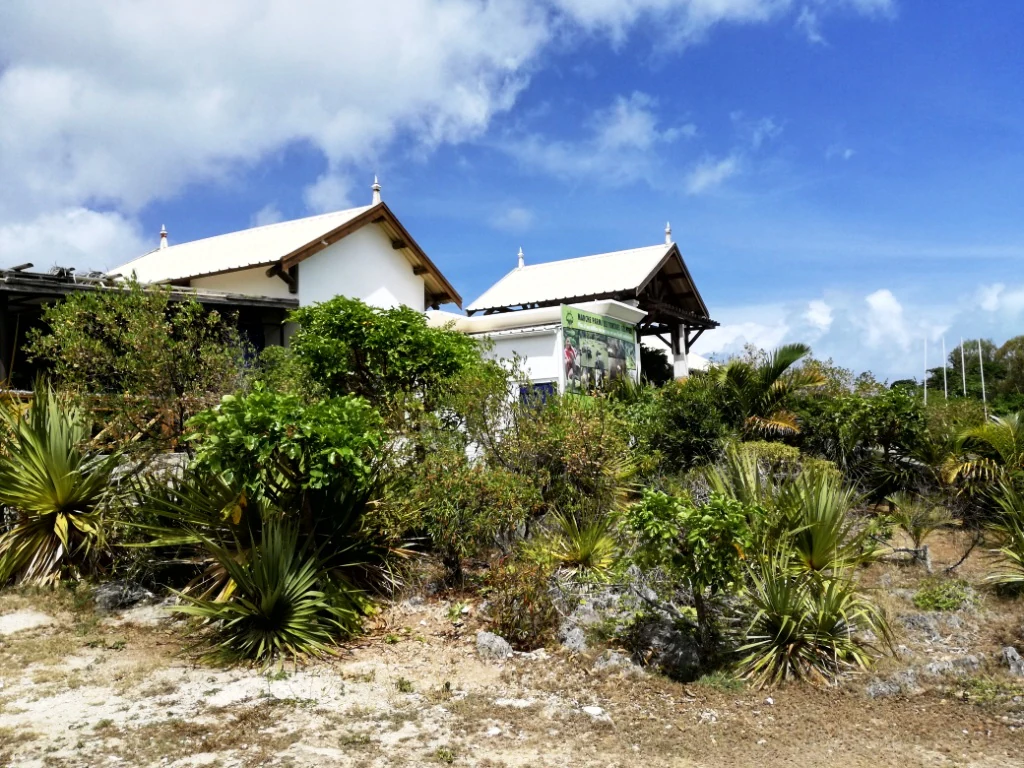
A white building with a dark roof nestled amongst dense tropical vegetation under a bright blue sky.
The visitor center at the François Leguat Giant Tortoise and Cave Reserve on Rodrigues Island.

François Leguat Giant Tortoise and Cave Reserve wildlife and species highlights

The wildlife of the reserve is dominated visually and ecologically by its introduced giant tortoises. The Aldabra giant tortoise (Aldabrachelys gigantea), originally from the Aldabra atoll in the Seychelles, forms the core of the population and is the species most often encountered by visitors in Tiyel Canyon. Radiated tortoises (Astrochelys radiata), native to southern Madagascar, have also been established on the site, and several rescued Ploughshare tortoises (Astrochelys yniphora), one of the rarest tortoises in the world and endemic to Madagascar, have more recently been added to the collection.

These tortoises stand in for two extinct Rodrigues endemics: the saddle-backed Cylindraspis vosmaeri, which browsed trees and bushes, and the dome-shelled Cylindraspis peltastes, which grazed ground vegetation. Early European accounts described tortoise herds so dense that they resembled moving islands, and noted that, like many isolated island species, the animals were unusually tolerant of human approach. Both species were hunted out within a few generations of colonisation, with the last stragglers recorded in isolated valleys around 1802 and the populations extinguished soon after as settlers burnt large areas of the island to clear land for agriculture.

Mammals and birds are a smaller but ecologically important component of the reserve. The Rodrigues fruit bat (Pteropus rodricensis), considered the rarest bat in the world and one of only three endemic animals still surviving on Rodrigues, roosts and forages across the peninsula, and its population has recovered from a 1970 low of about 70 individuals thanks to intensive conservation work. The reserve also supports the two surviving endemic land birds of Rodrigues, the Rodrigues Warbler and the Rodrigues Fody, alongside a range of more widespread Indian Ocean species that use the coastal habitat.
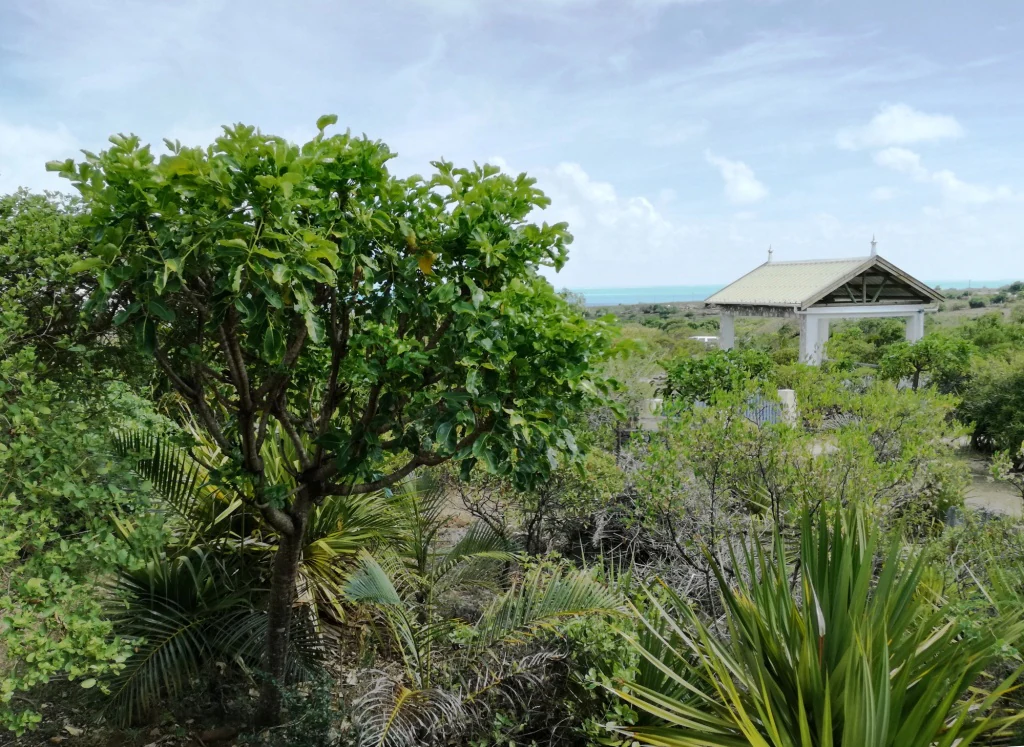
A leafy green tree stands in the foreground of a natural landscape with a small open shelter structure in the middle distance under a cloudy sky.
A specimen of the endemic Polyscias rodriguesiana, or bois blanc, within the François Leguat Reserve.

François Leguat Giant Tortoise and Cave Reserve conservation status and protection priorities

The conservation value of François Leguat Reserve lies in its attempt to restore, rather than simply protect, an ecosystem that has been almost entirely lost. Rodrigues' indigenous coastal vegetation survives only in this and the immediately adjacent Anse Quitor reserve, and the tortoise-based restoration programme is, in practical terms, a rewilding project of regional significance in the Mascarene Islands.

The reserve is also a working sanctuary for the Rodrigues fruit bat, the rarest bat in the world according to its own publications, and for several critically endangered chelonians including the Ploughshare tortoise. By housing multiple tortoise species in open, semi-natural conditions on Rodrigues, the reserve contributes to insurance populations for species that are heavily threatened in their native ranges.

The educational and interpretive infrastructure, including the museum and education centres, is part of the conservation strategy as well. The reserve frames much of its work around the writings of François Leguat, whose seventeenth-century descriptions of abundant tortoise herds and a rich native fauna provide a baseline against which the modern restoration project is measured. In this way, the reserve functions simultaneously as a refuge, a restoration site, and an institutional memory for Rodrigues' lost natural history.

François Leguat Giant Tortoise and Cave Reserve cultural meaning and human context

The reserve is named after François Leguat, the French Huguenot who landed on Rodrigues in 1691 and whose journal is the most detailed early European account of the island's flora and fauna. Leguat's descriptions of enormous tortoise herds, docile Rodrigues solitaires, and other vanished wildlife are central to how the reserve presents itself, and his writing effectively anchors the site's interpretive narrative.

Rodrigues itself has a distinct cultural identity within the Republic of Mauritius, with a population whose history includes Creole, African, Malagasy, Indian, and European influences, and an economy that remains closely tied to small-scale agriculture and fishing. The reserve's role in the local tourism economy, including its restaurant and guided cave tours, makes it a point of contact between conservation activity and the everyday life of the island.

The reserve also engages with the broader cultural memory of extinction on Rodrigues. The loss of the giant tortoises and the flightless Rodrigues solitaire within a few generations of human settlement is a recurring theme in the museum displays and education programmes, linking the reserve's work to wider conversations about species loss and human responsibility for island ecosystems.

Top sights and standout views in François Leguat Giant Tortoise and Cave Reserve

The reserve offers four major highlights that together define its identity. The first is the open-air tortoise experience in Tiyel Canyon, where large herds of introduced Aldabra giant tortoises graze amid the restored coastal vegetation and visitors can observe the animals at close range. The second is the restoration of Rodrigues' coastal flora, with more than 100,000 plants from 33 indigenous and endemic species planted across what is effectively the last surviving patch of that ecosystem.

The third is the cave system, anchored by the Grande-Caverne and the Caverne-de-la-Vierge, which are presented as the only caves in the Indian Ocean equipped with permanent lighting and which combine geological interest with the reserve's broader interpretive programme. The fourth is the collection of rare chelonians, particularly the rescued Ploughshare tortoises, which gives the reserve a definite role in global tortoise conservation beyond its Rodrigues-specific restoration work.

Best time to visit François Leguat Giant Tortoise and Cave Reserve

Rodrigues has a tropical climate with a warm, wetter summer and a cooler, drier winter, and the reserve can be visited throughout the year. The drier months tend to bring calmer seas and clearer conditions for approaching the peninsula, while the warmer, wetter months produce lusher vegetation and more active tortoise movement. Because the reserve is largely an open-air experience, cooler parts of the year are generally more comfortable for extended time on the property, while the warmer months highlight the lushness of the recovering coastal flora.

The tortoise herds are present year-round and do not migrate, so sightings are reliable in any season. Cave tours run regardless of weather, as the formations are lit and enclosed, though combining a cave visit with an outdoor walk in the canyon works best in months when rain is less frequent. Visitors interested in birdlife, including the Rodrigues fruit bat, Rodrigues Warbler, and Rodrigues Fody, will find the most active periods around the breeding seasons, when the surviving endemic species are most vocal around the peninsula.
Monthly climate preview

Long-term temperature and monthly precipitation normals across the representative coordinate

François Leguat Giant Tortoise and Cave Reserve Climate and Weather by Month

Representative coordinates record mean monthly temperatures spanning from 22.39 °C to 26.92 °C alongside varying precipitation rates across the annual cycle. Reviewing complete monthly climatology profiles provides deeper insight into long-term thermal and moisture patterns.
Annual mean25 °C
22 °C27 °C
Jan26°
Feb27°
Mar27°
Apr26°
May25°
Jun24°
Jul23°
Aug22°
Sep22°
Oct23°
Nov24°
Dec25°
Warmest month
March

26.9 °C

Coolest month
August

22.4 °C

Wettest month
February

3.5 mm/day

Driest month
August

0.4 mm/day

Park location guide

Geography guide, regional context, and park location map for François Leguat Giant Tortoise and Cave Reserve

François Leguat Giant Tortoise and Cave Reserve park geography, regions, and map view in Mauritius

Understand where François Leguat Giant Tortoise and Cave Reserve sits in Mauritius through a broader geographic reading of the surrounding landscape, nearby location context, and its mapped position within the national park landscape.

How François Leguat Giant Tortoise and Cave Reserve fits into Mauritius

Mauritius is an island nation in the Indian Ocean and part of the Mascarene Islands. The country gained independence from Britain in 1968 and became a republic in 1992. It is characterized by a diverse population of primarily Indian and Creole descent, with English and French as official languages and Mauritian Creole as the dominant spoken language.

Wider geography shaping François Leguat Giant Tortoise and Cave Reserve in Mauritius

Mauritius is located in the Indian Ocean approximately 2,000 km east of Africa and east of Madagascar. The main island is volcanic in origin, and the country also includes the islands of Rodrigues, Agaléga, and St. Brandon (Cargados Carajos shoals). The territory is part of the Mascarene Islands, with nearby Réunion being a French overseas department.

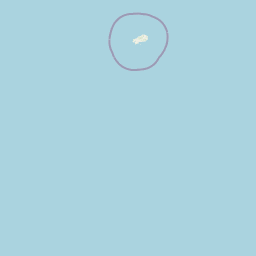
Map view of François Leguat Giant Tortoise and Cave Reserve

Use this park location map to pinpoint François Leguat Giant Tortoise and Cave Reserve in Mauritius, understand its exact geographic position, and read its mapped placement within the surrounding landscape more clearly.

Pigeon | © OpenStreetMap contributors

Location context for François Leguat Giant Tortoise and Cave Reserve

Rodrigues

Visual reference collection highlighting dry coastal terrain, limestone canyons, and native island habitats.

François Leguat Giant Tortoise and Cave Reserve Photos and Landscape Scenery

Visual records document the distinct topography, coastal scrublands, and limestone formations found within François Leguat Giant Tortoise and Cave Reserve. Detailed imagery reveals the restored habitats of Tiyel Canyon and the subterranean environments of the protected reserve.

Many giant tortoises walking across a dry, sandy canyon floor surrounded by trees and limestone cliffs.

A large Aldabra giant tortoise resting on the sandy ground in front of a tree with exposed roots.

A diagrammatic park map of the François Leguat Giant Tortoise and Cave Reserve, displaying trails, cave locations, visitor facilities, and a legend with icons for tortoises and other landmarks.

A white building with a dark roof nestled amongst dense tropical vegetation under a bright blue sky.

A leafy green tree stands in the foreground of a natural landscape with a small open shelter structure in the middle distance under a cloudy sky.

Two large giant tortoises on dirt ground with one partly resting its head near the other, and another tortoise partially visible at the top edge of the frame.

Park atlas

Compare surrounding protected areas, island reserves, and regional coastal landscapes

Parks Near François Leguat Giant Tortoise and Cave Reserve

Browse protected areas and island reserves located near François Leguat Giant Tortoise and Cave Reserve in the Mascarene archipelago. Expanding the geographic comparison reveals broader regional park networks, coastal habitats, and connected conservation landscapes.
A watercolor painting showing a stylized, panoramic landscape of rolling green hills and patches of pink, suggestive of a lush forest setting.
Nature reserveRodrigues
About 11 km away#1 closest

Northeast

Grande Montagne Nature Reserve: Protected Upland Terrain and Forest Mapping

Centrally located conservation area in the Rodrigues highlands

Positioned atop the volcanic ridges of eastern Rodrigues, Grande Montagne Nature Reserve functions as an essential sanctuary for rare endemic biodiversity. This compact landscape provides a unique opportunity to study the intersection of volcanic geology, native forest regeneration, and island-specific conservation efforts through mapped trails and elevated viewpoints.

Area
0.2 km²
Relief
Mountain
Climate
Tropical
Access
Easy access
A horizontal watercolor painting showing a calm bay with green islands in the distance and a single white bird in flight against a pale sky.
Nature reserveMauritius
About 585 km away#2 closest

West

Round Island Nature Reserve: Protected Volcanic Landscape and Geography of Mauritius

Rugged volcanic terrain and endemic restoration site

Located north of the main Mauritian landmass, Round Island functions as a significant protected nature reserve. This volcanic islet is characterized by dramatic sea cliffs, steep slopes, and recovering palm forest habitats that support a high density of endemic reptiles and birds within its small geographic footprint.

Area
1.69 km²
Established
1957
Relief
Upland
Access
Highly restricted
A horizontal watercolor painting showing green coastal vegetation, a small waterway, and distant hills under a soft sky.
National parkMauritius
About 589 km away#3 closest

West

Île aux Fouquets National Park: Coral Islet Geography and Lighthouse Heritage in Mauritius

Protected maritime landscape and offshore reef terrain

This compact coral island represents a critical piece of the national park system in Mauritius. Known for its distinct limestone geology and nineteenth-century lighthouse ruins, it provides a unique window into the maritime history and offshore reef ecosystems of the Indian Ocean, contrasting with the volcanic landforms of the mainland.

Area
0.025 km²
Established
2004
Relief
Lowland
Access
Remote access
Watercolor illustration of a forest scene with trees, ferns, and distant mountains
National parkMauritius
About 593 km away#4 closest

West

Bras d'Eau National Park: Mauritius National Park Protected Landscape Discovery

Explore coastal terrain, endemic species habitats, and wetland geography.

Bras d'Eau National Park, situated on Mauritius, offers an in-depth look at a protected coastal lowland landscape vital for conservation. This national park showcases remnant forest patches critical for endemic flora and fauna, complemented by a unique system of four mares, including the mangrove-rich Mare sarcelle. Its mapped geography provides context for island ecosystems and serves as a key location for understanding Mauritius's protected natural areas.

Area
4.97 km²
Established
2011
Relief
Lowland
Climate
Tropical
Nature reserveMauritius
About 594 km away#5 closest

West

Ile aux Aigrettes: Exploring the Protected Coral Coastal Landscape of Mauritius

A critical nature reserve and rewilding site in the Grand Port bay

Ile aux Aigrettes represents a unique geographic outpost off the south-east coast of Mauritius, defined by its flat coral limestone terrain. As a protected nature reserve, it offers insights into the recovery of rare dry coastal forest ecosystems and the ongoing scientific efforts to maintain endemic biodiversity on a small maritime scale.

Area
0.27 km²
Established
1965
Relief
Lowland
Access
Easy access
Nature reserveGrand Port District
About 596 km away#6 closest

West

Vallée de Ferney Nature Reserve: Protected Mountain Landscapes in the Grand Port District

Indigenous rainforest, volcanic terrain, and conservation refuge

Located in the Bambou mountains of southeastern Mauritius, Vallée de Ferney is a 200-hectare nature reserve known for its protected indigenous rainforest and ongoing rewilding projects. As a key conservation site in the Grand Port District, the reserve offers a look at rare endemic species and the unique moisture-loving vegetation of the island's eastern volcanic series. Explore the mapped boundaries and natural terrain of this significant protected landscape.

Area
2 km²
Established
2006
Relief
Mountain
Climate
Tropical
A minimalist, flat vector illustration showing a colorful island scene with a waterfall, forest, and surrounding water.
Protected areaRivière du Rempart District
About 598 km away#7 closest

West

Île Plate: Protected Area Geography and Natural Features in Rivière du Rempart District

Island biodiversity and volcanic landscapes in northern Mauritius

Île Plate is a compact island covering approximately 2.5 square kilometres, notable for its basalt geology and status as a protected area. It anchors a wider system of islets, offering a rich study of indigenous vegetation, seabird habitats, and tangible maritime history in the Indian Ocean.

Area
2.53 km²
Relief
Lowland
Access
Moderate access
Scope
Mixed
A minimalist watercolor painting showing green rolling hills and distant terrain on a white background.
Nature reserveMoka District
About 613 km away#8 closest

West

Le Pouce Nature Reserve: Volcanic Geography and Protected Upland Habitat in Mauritius

A rugged basalt peak in the Moka District mountain range.

Le Pouce Nature Reserve guards a critical 0.69 square kilometer patch of upland forest on the slopes of the third highest mountain in Mauritius. This protected area is recognized for its dramatic volcanic terrain and as the rare surviving home for the critically endangered Le Pouce Mountain Screwpine, providing an essential window into the island's unique ecological and geological history within the Moka Range.

Area
0.69 km²
Established
1951
Relief
Mountain
Climate
Tropical

Common questions about visiting, size, designation, and location context for François Leguat Giant Tortoise and Cave Reserve

François Leguat Giant Tortoise and Cave Reserve FAQs for park facts, access, geography, and protected area context

Find quick answers about François Leguat Giant Tortoise and Cave Reserve, including protected-area facts, park geography, trail and visitor context, and how the park fits into its surrounding country and regional landscape.
MoriAtlas Explorer

Continue Your Protected Areas Search Across the Global Atlas

Deepen your exploration by continuing the structured search for national parks and protected areas worldwide. Utilize the comprehensive filtering capabilities to compare different conservation landscapes and refine your understanding of global park geography. Discover more about the distribution and characteristics of protected natural areas.

Global natural geography