Why Ipassa-Makokou Biosphere Reserve stands out
Ipassa-Makokou is best known for being Gabon's most ecologically intact lowland rainforest reserve, supported by more than six decades of continuous scientific research at the Ipassa research station. The reserve has gained international recognition as a reference site for studying tropical forest dynamics, species composition, and long-term ecological change in Central Africa. It is equally celebrated for its exceptional biodiversity density. Its plant, mammal, reptile, amphibian, fish, and bird communities make it a priority area for conservation, while its formal designation as an Important Bird Area underlines its central role in safeguarding forest bird populations across the Congo Basin.
Ipassa-Makokou Biosphere Reserve history and protected-area timeline
The conservation significance of the Ipassa area long predates its formal designation as a biosphere reserve. Permanent sample plots were established in the core zone in 1963, creating one of the earliest long-term forest monitoring programs in tropical Africa. A research station was subsequently developed on site, and for several decades the area served as a hub for ecological research, including prominent studies on agroforestry and the natural dynamics of Congolese-Guinean rainforest.
The reserve was formally designated as a UNESCO biosphere reserve in 1983, marking international recognition of its scientific and ecological value. However, by 1985 much of the active research program had ended, and the site entered a period of relative neglect. With reduced scientific presence, poaching and human encroachment became more pressing concerns in the surrounding forest.
Since then, multiple proposals have been put forward to rehabilitate the research station and revitalize the reserve's scientific role. While the core zone has retained much of its ecological character, the reserve remains underutilized compared to its historical importance, and ongoing debates about its future reflect broader questions about how to balance research, conservation, and community needs in Gabon's forest landscape.
Ipassa-Makokou Biosphere Reserve landscape and geographic character
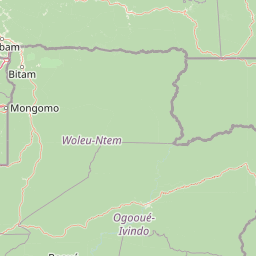
The landscape of Ipassa-Makokou is shaped by the Ivindo River and its surrounding lowland rainforest. The river forms a defining geographic axis through the reserve, and its banks support a mosaic of riverside vegetation that transitions into closed-canopy forest on higher ground. The terrain is generally gentle, reflecting the broader geological character of the Congo Basin, with the elevation profile dominated by lowland conditions rather than dramatic relief.
A defining landscape feature of the reserve is the relative intactness of its central forest. Because the core zone has been shielded from commercial logging, the interior retains the closed canopy, multi-layered structure, and large tree sizes typical of undisturbed Congolese-Guinean rainforest. This unbroken canopy, punctuated only by waterways, gives the area a strong sense of ecological continuity.
The river itself plays a major role in shaping local scenery. Forest stretches almost continuously to the water's edge, while villages and agricultural land occupy the southern bank just outside the reserve. This contrast between the densely forested reserve interior and the human-modified landscape beyond highlights how the geography of Ipassa-Makokou is defined as much by ecological boundaries as by physical terrain.
Ipassa-Makokou Biosphere Reserve ecosystems, habitats, and plant life
Ipassa-Makokou sits squarely within the Congolese-Guinean phytogeographic region, one of Africa's major blocks of humid tropical forest. The reserve protects a representative cross-section of this ecosystem, ranging from riparian vegetation along the Ivindo to mature interior forest dominated by tall hardwoods and a dense understory. The result is a layered, structurally complex forest that supports exceptionally high species diversity for an area of its size.
More than two thousand plant species have been identified within the reserve, including rare and range-restricted taxa such as Ardisia belingensis and Rhaptopetalum belingensis. The botanical richness reflects the diversity of microhabitats created by the river system and the relative absence of historical disturbance in the core zone.
Beyond its plant life, the reserve is ecologically significant for the combination of intact forest cover, isolation from logging, and proximity to other relatively undisturbed forest landscapes in northeastern Gabon. This ecological context allows Ipassa-Makokou to function as a refugium for forest-dependent species, particularly those sensitive to hunting pressure or habitat fragmentation.
Ipassa-Makokou Biosphere Reserve wildlife and species highlights
Wildlife at Ipassa-Makokou is among the most diverse in Gabon for an area of its size, with roughly 600 species of mammals, reptiles, fish, amphibians, and birds recorded in the reserve. This vertebrate richness reflects the integrity of the core forest and the diversity of aquatic and terrestrial habitats created by the Ivindo River system.
The reserve hosts primates and forest ungulates characteristic of Central African rainforest, along with reptiles, amphibians, and freshwater fish that depend on the river and its tributaries. Birds are a particular highlight: Ipassa-Makokou has been recognized as an Important Bird Area by BirdLife International because of the significant populations of forest bird species it supports.
Wildlife distribution is shaped by both habitat quality and human pressure. Fauna tends to be more concentrated deeper within the core zone, where logging and hunting have historically been limited, while areas closer to the southern bank of the Ivindo show greater signs of disturbance. The reserve's role as a refuge is therefore most pronounced in its least-accessible interior forests.
Ipassa-Makokou Biosphere Reserve conservation status and protection priorities
Ipassa-Makokou holds an unusually important position in Gabon's conservation framework. As a UNESCO biosphere reserve designated in 1983 and entered into the World Database on Protected Areas under record 5187, it carries international recognition alongside its national protection status. Its core zone is the only area in Gabon explicitly excluded from commercial logging, giving it a distinctive role as a benchmark of intact Congolese-Guinean rainforest.
Conservation interest in the reserve is heightened by its biodiversity profile. With over two thousand plant species and hundreds of vertebrate species recorded, including range-restricted plants and important bird populations, the reserve functions as a critical refugium within the larger Congo Basin forest landscape. Its designation as a Key Biodiversity Area for birds adds a further international layer of conservation recognition.
At the same time, conservation outcomes at Ipassa-Makokou have been uneven. After the research station became less active in the mid-1980s, poaching and encroachment gradually increased, raising concerns about the long-term integrity of the site. Periodic proposals to rehabilitate research and management infrastructure reflect the recognition that maintaining the reserve's value will require sustained investment in protection, monitoring, and community engagement along the river's southern approaches.
Ipassa-Makokou Biosphere Reserve cultural meaning and human context
Ipassa-Makokou sits within a landscape long inhabited by communities whose livelihoods are closely tied to the surrounding forest. Although no permanent habitation exists inside the reserve itself, numerous villages line the southern bank of the Ivindo River nearby, and the cultural geography of the area is shaped by this relationship between river, forest, and settlement.
Local livelihoods in these villages are traditionally based on small-scale agriculture, livestock keeping, and the harvesting of forest resources for food, materials, and trade. This pattern of subsistence-oriented land use has produced a sharp boundary between the relatively undisturbed reserve interior and the more visibly modified landscape just outside its borders, both defining and challenging the reserve's conservation role.
The reserve's cultural context is also marked by its scientific heritage. For several decades, the Ipassa research station brought researchers, students, and international collaborators into close contact with local communities and the surrounding forest. Although that presence has diminished since the late 1980s, it remains an important part of the area's identity and a reference point for ongoing discussions about the reserve's future.
Top sights and standout views in Ipassa-Makokou Biosphere Reserve
Ipassa-Makokou stands out as Gabon's most ecologically intact lowland rainforest reserve and as a global reference site for long-term tropical forest research. Its combination of protected core forest, exceptional species diversity, and decades of monitoring data gives it an outsized scientific and conservation significance despite its modest size.
Equally important is the reserve's role in regional bird conservation. Its status as a BirdLife International Important Bird Area reflects the importance of its forest bird populations and reinforces Ipassa-Makokou's place in the broader network of protected sites across Central Africa.
Best time to visit Ipassa-Makokou Biosphere Reserve
Ipassa-Makokou lies in an equatorial climate zone, where conditions are warm and humid throughout the year and rainfall is distributed across most months. Forest conditions stay broadly similar across the seasons, with the canopy remaining dense, rivers flowing steadily, and wildlife present year-round.
For visitors, the practical character of a visit is shaped less by seasonal weather shifts than by forest and river conditions. Drier spells tend to make internal trails and field activity more comfortable, while heavier rains can raise river levels and limit movement along forest tracks. Wildlife observation opportunities are relatively consistent, though periods of low human activity in the core forest can offer quieter conditions for those exploring the reserve's interior.