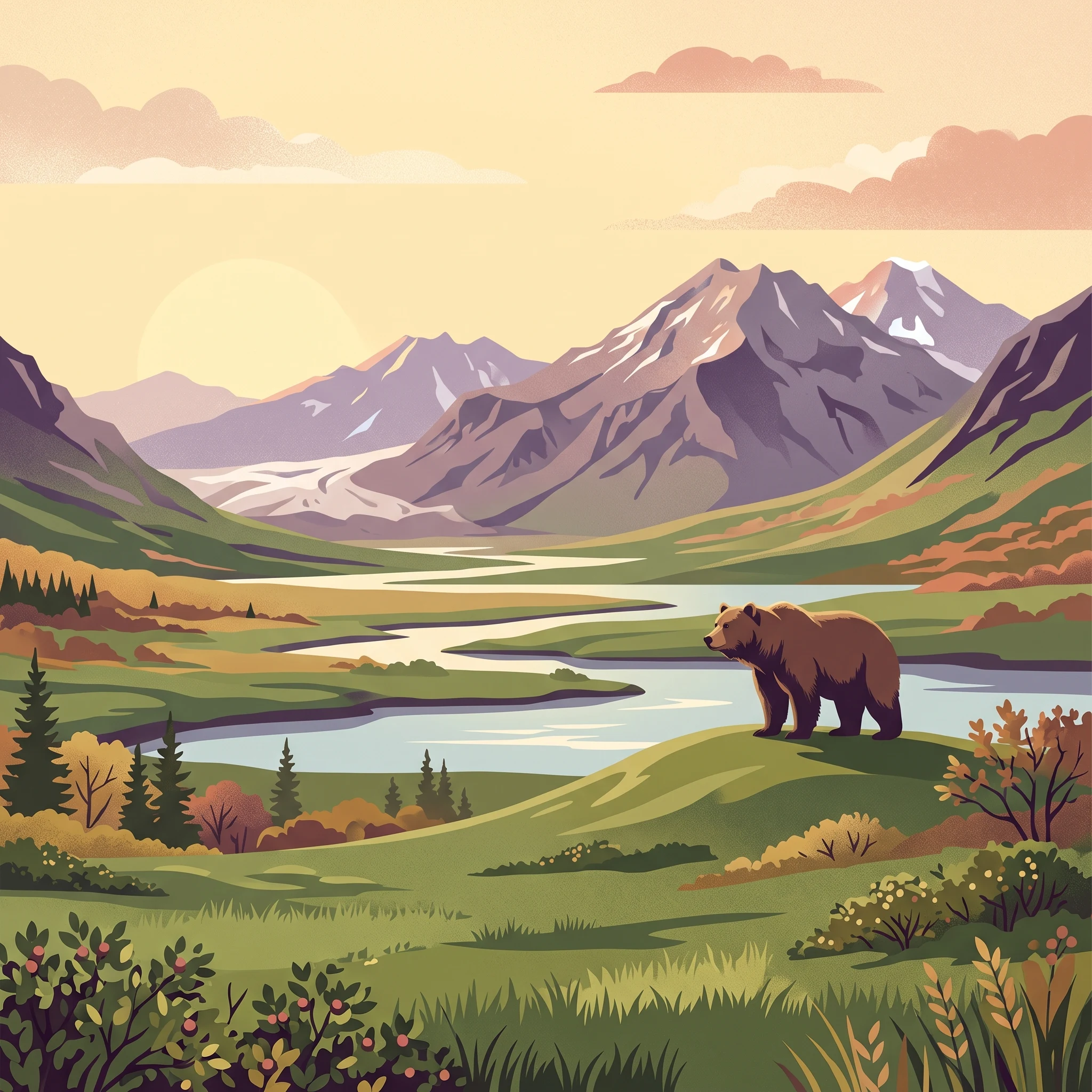
Why Katmai National Park and Preserve stands out
Katmai is best known for two exceptional features that define its identity. The Valley of Ten Thousand Smokes represents one of the most dramatic volcanic landscapes in North America, formed when the 1912 eruption of Novarupta deposited ash up to 300 feet deep across a 40-square-mile valley, creating thousands of steam vents that gave the area its name. The park's brown bear population is equally significant, with Katmai protecting the largest concentration of Alaska Peninsula brown bears in the world. Brooks Falls has become an iconic wildlife viewing location where bears捕食 sockeye salmon during their spawning runs, creating encounters between bears and humans that are remarkably unhindered by the bears' typical wariness. The park also hosts Fat Bear Week, an annual online voting competition begun in 2014 that celebrates the bears' preparation for hibernation and has drawn over a million votes yearly.
Katmai National Park and Preserve history and protected-area timeline
The history of Katmai protection begins with one of the most significant volcanic events of the twentieth century. In June 1912, Mount Katmai and Novarupta erupted simultaneously in what became known as the Novarupta-Katmai eruption, producing noise heard 750 miles away in Juneau and depositing ash as far as Puget Sound. The eruption transformed the nearby valley into the Valley of Ten Thousand Smokes, a landscape of steaming fumaroles and thick pyroclastic deposits. The National Geographic Society funded expeditions beginning in 1915, with botanist Robert Fiske Griggs discovering and naming the valley in 1916. These expeditions and subsequent publications generated public interest in protecting the area. President Woodrow Wilson proclaimed Katmai National Monument in 1918 under the Antiquities Act, protecting approximately 1.08 million acres around Mount Katmai and the valley. The monument remained largely undeveloped and unvisited for decades, with no permanent staff assigned until 1937. Under President Herbert Hoover in 1931, the monument expanded to 2.7 million acres, becoming the largest National Park Service unit at the time. Further expansions occurred in 1941 under Franklin Roosevelt, and in 1968 under Lyndon Johnson. The monument gained a full-time superintendent in 1971, and following the Alaska Native Claims Settlement Act, the National Park Service proposed substantial expansions. President Jimmy Carter used his Antiquities Act authority in 1978 to add 1.37 million acres. Finally, on December 2, 1980, the Alaska National Interest Lands Conservation Act established Katmai National Park and Preserve, creating the modern protected area with both fully protected park lands and preserve lands where hunting is permitted.
Katmai National Park and Preserve landscape and geographic character
The landscape of Katmai National Park and Preserve presents a dramatic combination of volcanic terrain, coastal wilderness, and lake-studded lowlands. The Aleutian Range forms the backbone of the park, with a chain of fifteen volcanic mountains running roughly southwest to northeast across the coastal southeastern portion. These peaks include active volcanoes such as Mount Katmai with its collapsed caldera, Novarupta with its prominent lava dome, Trident Volcano which was active between 1953 and 1974, and Mount Mageik with its multiple summit craters. The volcanic landscape shows the marks of the 1912 eruption throughout, particularly in the Valley of Ten Thousand Smokes where pyroclastic flow deposits have been carved by streams into deep narrow canyons. The park's coastline along Shelikof Strait and the Pacific Ocean is deeply indented with numerous bays and inlets, including Hallo Bay, Kukak Bay, and Kamishak Bay, providing critical coastal habitat for bears and marine mammals. The western portion of the park transitions to flatter terrain characterized by large lakes including Naknek Lake, the largest in the region, and connected lake systems that drain into Bristol Bay through the Naknek River. Glacial features including outwash plains, terminal moraines, and glacially sculpted valleys are scattered throughout, while the higher elevations support permanent snow and glaciers, including Fourpeaked Glacier on Fourpeaked Mountain and glaciers emanating from Mount Katmai's summit.
Katmai National Park and Preserve ecosystems, habitats, and plant life
The ecological character of Katmai reflects the subarctic climate and the convergence of marine, coastal, and inland habitats that define the Alaska Peninsula. The park experiences cool summers with average high temperatures around 63 degrees Fahrenheit and variable weather that reliably includes rain or drizzle, with heaviest precipitation near the coast reaching up to 60 inches annually. Despite the challenging climate, the park supports remarkable biodiversity including 29 mammal species, 137 bird species, 24 freshwater fish species, and four anadromous fish species. The most ecologically significant fish is the sockeye salmon, which enters the Naknek River drainage from Bristol Bay in June and July and spawns from August through October, providing a critical food source that sustains the park's brown bear population and numerous bald eagles. Vegetation communities include coastal sedge meadows, willow and alder scrub in riparian areas, and upland tundra on higher terrain, with common wildflowers such as beachhead iris, nootka lupine, and woolly geranium adding seasonal color. The extensive lake systems and wetlands provide critical habitat for waterfowl and migratory birds, while the marine environment supports harbor seals, sea lions, sea otters, and occasional whales. The park's wilderness designation over the majority of national park lands has preserved these ecological communities in a relatively natural state, allowing natural processes to continue without significant infrastructure or development pressure.
Katmai National Park and Preserve wildlife and species highlights
Katmai's wildlife is defined by the extraordinary abundance of brown bears that represent the largest protected population in North America, estimated at approximately 2,200 individuals. These Alaska Peninsula brown bears congregate at salmon-rich streams throughout the park, with the most famous concentration at Brooks Falls where bears捕食 spawning sockeye salmon in full view of visitors at viewing platforms. The bears display a remarkable tolerance for human presence, allowing closer approaches than typical bear behavior elsewhere, a result of decades of careful management by the National Park Service to prevent bears from obtaining human food or engaging in problematic encounters. Coastal areas including Hallo Bay, Kukak Bay, and Geographic Harbor support very high bear densities year-round due to availability of clams, coastal sedge, salmon, and other food sources. Beyond bears, the park supports diverse mammal species including moose, timber wolves, coyotes, beaver, lynx, wolverine, river otters, and smaller mammals like snowshoe hare and porcupine. Marine mammals in the park's waters include harbor seals, sea lions, sea otters, beluga whales, killer whales, and gray whales. The park's birdlife includes 137 species, with bald eagles being particularly prominent along salmon streams. Caribou from the Porcupine herd occasionally winter within the park boundaries.
Katmai National Park and Preserve conservation status and protection priorities
Katmai National Park and Preserve represents one of the most significant conservation designations in North America, protecting both critical volcanic geological resources and exceptional wildlife habitat. The park's designation as wilderness area for the majority of national park lands provides the highest level of protection under federal law, prohibiting commercial development and requiring that areas remain unmodified by human activity. The protection of brown bears is particularly significant, as the park contains the largest population of Alaska Peninsula brown bears in the world, a subspecies that faces pressure from habitat loss and hunting elsewhere on the peninsula. The preserve lands within the park, where regulated hunting is permitted, have raised ongoing conservation concerns due to the small population sizes and potential for overharvest of bears that may travel between park and preserve areas. The park's adjacent protected areas, including McNeil River State Game Sanctuary and Becharof National Wildlife Refuge, create a broader network of conservation lands that protect wildlife corridors and critical habitat. The park also contains significant archaeological sites, including the Brooks River Archeological District listed on the National Register of Historic Places, demonstrating the long human history of interaction with this landscape.
Katmai National Park and Preserve cultural meaning and human context
The Alaska Peninsula has supported human communities for thousands of years, with prehistoric artifacts found near the old Katmai village dating to approximately 6,000 years before present. Archaeological sites along the coast at locations including Kaguyak and Kukak show occupation into historic times, while the Amalik Bay Archeological District contains evidence of human activity dating back more than 7,000 years. The Brooks River area contains a significant archaeological site dating to about 4500 years before present, designated a National Historic Landmark in 1993. Russian fur traders were the first Europeans to arrive in significant numbers, encountering the Aglegmuit Eskimos on the Bristol Bay side and Koniag Eskimos along Shelikof Strait. Katmai Village was the only location within the present park boundaries where Europeans lived through the mid-19th century. The region served as a travel route during the Nome gold rush of the 1890s, and writer Rex Beach documented life on Bristol Bay during the salmon run in his novel The Silver Horde. Following the 1912 eruption, some villages including Katmai and Douglas were abandoned, while the Savonoski River mouth village was lost to the volcanic activity.
Top sights and standout views in Katmai National Park and Preserve
Katmai National Park and Preserve offers extraordinary encounters with North American wilderness at its most intact. The Valley of Ten Thousand Smokes provides access to one of the most powerful volcanic eruption sites in recorded history, where the 1912 Novarupta eruption created a landscape that still shows the marks of one of the twentieth century's largest volcanic events. Brooks Falls delivers perhaps the most accessible and reliable brown bear viewing opportunities in North America, where the bears捕食 sockeye salmon with an apparent indifference to human observers that makes for unforgettable wildlife photography. The park's volcanic chain includes mountains that remain active, with steam still rising from Mount Mageik and Mount Martin. The coastal areas provide additional bear viewing opportunities at locations like Hallo Bay where bears search for clams and sedge along the beach. The annual Fat Bear Week celebration has become a unique way to engage public interest in bear conservation while showcasing how the park's bears prepare for winter by consuming massive quantities of salmon. The park's vast wilderness and limited development ensure that visitors who venture beyond the popular Brooks Camp area experience a landscape that remains fundamentally wild.
Best time to visit Katmai National Park and Preserve
The optimal time to visit Katmai National Park and Preserve depends on interests, with the most popular period for bear viewing centered on July when sockeye salmon arrive at Brooks Falls in large numbers. September also offers excellent bear viewing as bears feed heavily before hibernation in the lower river areas. July and September are by far the best months for observing brown bears at Brooks Camp, with 43 to 70 individual bears documented during these periods. Summer temperatures are cool, averaging around 63 degrees Fahrenheit, and visitors should be prepared for variable weather including rain and drizzle, which is characteristic of the subarctic climate. The park is accessible primarily by floatplane or boat, with King Salmon serving as the primary gateway community. The Valley of Ten Thousand Smokes can be visited during the summer months, though the experience involves backcountry travel on foot. Winter visitation is minimal due to the challenging climate and limited access, with the park's subarctic conditions creating year-around precipitation and cold temperatures.