Why Kobuk Valley National Park stands out
Kobuk Valley National Park is best known for its extraordinary Great Kobuk Sand Dunes, which represent the largest active Arctic dune field in North America. These dunes have attracted scientific interest from NASA, which has funded research studying them as an analog for Martian polar dunes. The park is equally significant for its role as a corridor for the annual migration of the Western Arctic caribou herd, numbering approximately 400,000 animals, whose crossing of the Kobuk River has been central to Inupiat subsistence culture for millennia. The park also contains Onion Portage Archeological District, a National Historic Landmark that documents human occupation of the valley spanning at least 12,500 years.
Kobuk Valley National Park history and protected-area timeline
Human habitation in Kobuk Valley extends back at least 12,500 years, with the present Inupiat people continuing traditional subsistence hunting and fishing practices in the region. The Onion Portage Archeological District, located at the east end of the Kobuk River's course through the park, is a National Historic Landmark that documents nine distinct cultural complexes spanning from 8,000-6,000 BC to about 1000-1700 AD. This strategically important site was located at a major caribou river crossing and represents one of the most significant archaeological sites in northern Alaska. The first human inhabitants were people of the Paleo-Arctic tradition who hunted caribou at Onion Portage. After a period of desertion, people of the Archaic tradition arrived from the south and east, followed by those of the Arctic Small Tool tradition around 4,000 years ago. New people arrived by approximately 1200 AD, as documented by the Ahteut site located 25 miles downriver from Onion Portage. The valley remained occupied until the mid-19th century when declining caribou populations forced people to move closer to the coast. A brief gold rush in 1899-1900 brought approximately 32 prospectors' camps to the area, though archaeological surveys have not yet located these sites. Kobuk Valley was first proclaimed a national monument by President Jimmy Carter on December 1, 1978, using his Antiquities Act authority during Congressional negotiations on Alaska lands. The Alaska National Interest Lands Conservation Act was finally passed and signed by Carter on December 2, 1980, formally establishing the park.
Kobuk Valley National Park landscape and geographic character
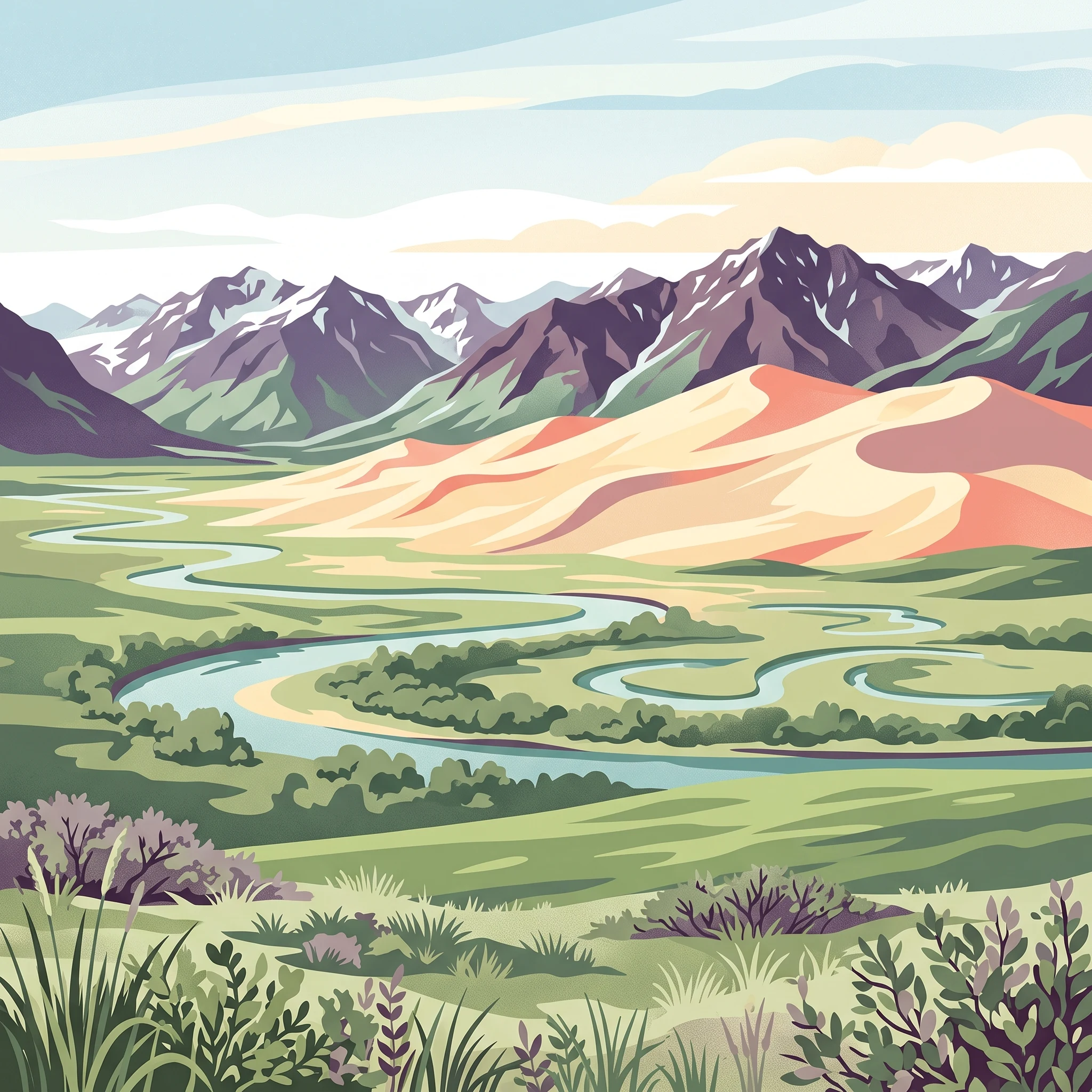
The landscape of Kobuk Valley is defined by the broad wetlands corridor of the Kobuk River as it flows through a ring of mountains in northwestern Alaska. The Baird Mountains, forming the northern boundary, are part of the western Brooks Range, while the shorter Waring Mountains create the southern perimeter, together enclosing the valley. The valley floor is primarily covered by glacial drift deposited during the retreat of Pleistocene glaciers. The most visually striking feature is the system of sand dunes on the south side of the Kobuk River, which includes the Great Kobuk Sand Dunes, Little Kobuk Sand Dunes, and Hunt River Dunes. These dunes are remnants of an extensive dune field that covered as many as 200,000 acres immediately after glacial retreat. Today, active dune fields cover approximately 20,500 acres, representing the largest active Arctic dune field in North America. The landscape transitions between boreal forest and tundra, with the river corridor creating wetland habitats through its meandering course. The park extends over 75 miles by river to the Chukchi Sea to the west.
Kobuk Valley National Park ecosystems, habitats, and plant life
Kobuk Valley National Park lies in a transition zone between boreal forest and tundra, creating a unique ecological environment that supports both southern and arctic species. The park is centered on the wetlands valley of the Kobuk River, which provides critical habitat for fish and wildlife typical of arctic and subarctic ecosystems. The vegetation patterns reflect the transition, with forested areas giving way to tundra as elevation increases toward the surrounding mountains. The river and its tributaries support diverse aquatic habitats, while the sand dune system creates specialized dune-adapted communities that are rare in the Arctic. The seasonal extremes, with temperatures ranging from -50°F in winter to 85°F in summer, and the extreme variation in daylight from midnight sun to near-darkness in winter, shape the ecological character of the park.
Kobuk Valley National Park wildlife and species highlights
The wildlife in Kobuk Valley National Park is typical of arctic and subarctic fauna, with the most visually spectacular element being the approximately 400,000 caribou of the Western Arctic herd. This massive herd migrates annually between winter breeding grounds south of the Waring Mountains and summer calving grounds north of the Baird Mountains, with their annual crossing of the Kobuk River forming a central event for both ecological function and Inupiat subsistence culture. Large mammals in the pack include wolf packs, Arctic and red foxes, moose, black bears, brown bears, beavers, river otters, Canadian lynxes, and Dall sheep. Smaller mammals include wolverines, martens, minks, porcupines, muskrats, snowshoe hares, and various voles. The fisheries resource is significant, with salmon species including chinook, chum, pink, and sockeye salmon, along with other salmonids such as Dolly Varden, Arctic char, lake trout, and Arctic grayling. Other fish species include burbot, Arctic lamprey, multiple whitefish species, and smelt.
Kobuk Valley National Park conservation status and protection priorities
Kobuk Valley National Park was established to preserve both outstanding natural and cultural resources. The primary conservation focus is on protecting the Great Kobuk Sand Dunes and the surrounding area including critical caribou migration routes. The park is designated entirely as wilderness, providing the highest level of protection, with only subsistence hunting by local residents permitted rather than sport hunting. The Kobuk Valley Wilderness of 174,545 acres represents a core protected zone within the larger park. The park's designation as an IUCN Category II protected area reflects its role in conserving natural ecosystems while allowing for sustainable traditional use by Indigenous peoples. The scientific interest in the sand dunes, including NASA research studying them as analogs for Martian polar dunes, highlights their unusual ecological and geological significance. The Onion Portage Archeological District's designation as a National Historic Landmark ensures protection of the significant cultural heritage within the park.
Kobuk Valley National Park cultural meaning and human context
The Inupiat people are the present inhabitants of Kobuk Valley, maintaining traditional subsistence hunting and fishing practices that have defined their culture for millennia. The annual caribou migration and the Kobuk River crossing are central to Inupiat subsistence, providing essential food resources for community survival. The Onion Portage Archeological District demonstrates continuous or recurring human occupation of the valley for at least 12,500 years, with documented cultural complexes spanning from the Paleo-Arctic tradition through more recent times. The Ahteut site, dating to approximately 1200 AD, provides evidence of later occupation. The descendants of people who lived in the valley, now known as the Kuuvangmiit, have mostly moved out of park lands but maintain cultural connections to the area. The valley contains Native corporation inholdings, with the NANA Regional Corporation holding rights within the park. The archaeological district remains an inholding of NANA Regional Corporation.
Top sights and standout views in Kobuk Valley National Park
Kobuk Valley National Park offers a rare combination of outstanding natural features, including the largest active Arctic dune field in North America, dramatic mountain-ringed wetlands, and one of the greatest caribou migrations on the continent. The park provides opportunities for backcountry exploration in a true wilderness setting, with visitors arriving by small aircraft to experience river travel, backcountry camping, and immersion in a landscape little changed from when humans first arrived here over 12,000 years ago. The cultural depth of the valley, with its National Historic Landmark archaeological district documenting millennia of human occupation, adds historical dimension that few other parks can match. The extreme seasonality, from midnight sun to aurora borealis displays, creates dramatic changes in the park's character throughout the year.
Best time to visit Kobuk Valley National Park
The best time to visit Kobuk Valley National Park is during the summer months of June through August, when temperatures average around 65°F and can reach 85°F, and the sun does not set from early June through mid-July, providing extended hours for exploration. This period coincides with the peak of the hiking and backpacking season, though visitors should be prepared for rain and wind common during arctic summers. For those interested in the caribou migration, timing the visit to coincide with the herd's river crossing can provide extraordinary wildlife viewing opportunities. Winter visits are possible but present extreme challenges, with temperatures regularly dropping below -50°F and only about 1.5 hours of sunlight on the winter solstice. The aurora borealis is often visible on winter nights when solar activity is high. All visitors must be fully self-sufficient, as there are no facilities, trails, or roads within the park.