
Why Metropolitan Natural Park stands out
Metropolitan Natural Park is best known for preserving the largest accessible remnant of Pacific tropical dry forest within Panama City, supporting an unusually high diversity of birds and mammals in an urban setting, and offering a combination of forest trails and panoramic views over the Panama Canal and the capital. Its role as the only wildlife refuge inside Panama City gives it an outsized importance for conservation, education, and urban green space. The park's dry forest ecosystem, combined with its proximity to the canal watershed, defines its ecological character and its appeal to naturalists and birdwatchers.
Metropolitan Natural Park history and protected-area timeline
The origins of Metropolitan Natural Park date to the mid-1970s, when the first steps were taken to safeguard green space near the Panama Canal. In 1975, President Jorge Illueca toured the forested slopes above the canal and supported a proposal to create a Metropolitan Natural Park, establishing the conceptual foundation for what would later become the country's most prominent urban protected area.
In 1983, the area was designated as the Curundú Recreational Area, marking its transition into a formally managed public space. Two years later, Law No. 8 of July 5, 1985 formally created the park. After additional preparation, the park was inaugurated on June 5, 1988, opening to the public as a combined natural refuge and recreational landscape for the residents of Panama City.
Since its inauguration, the park has evolved from an early conservation initiative into a permanent feature of Panama City's environmental identity. It has weathered urban expansion around its borders and has continued to expand its role in biodiversity protection, scientific study, and public education around tropical dry forest ecosystems.
Metropolitan Natural Park landscape and geographic character
The landscape of Metropolitan Natural Park is shaped by the forested slopes that border the Panama Canal watershed within the urban perimeter of Panama City. The terrain features ridges, valleys, and seasonal drainages that descend toward the canal corridor, creating varied topography within a relatively compact area.
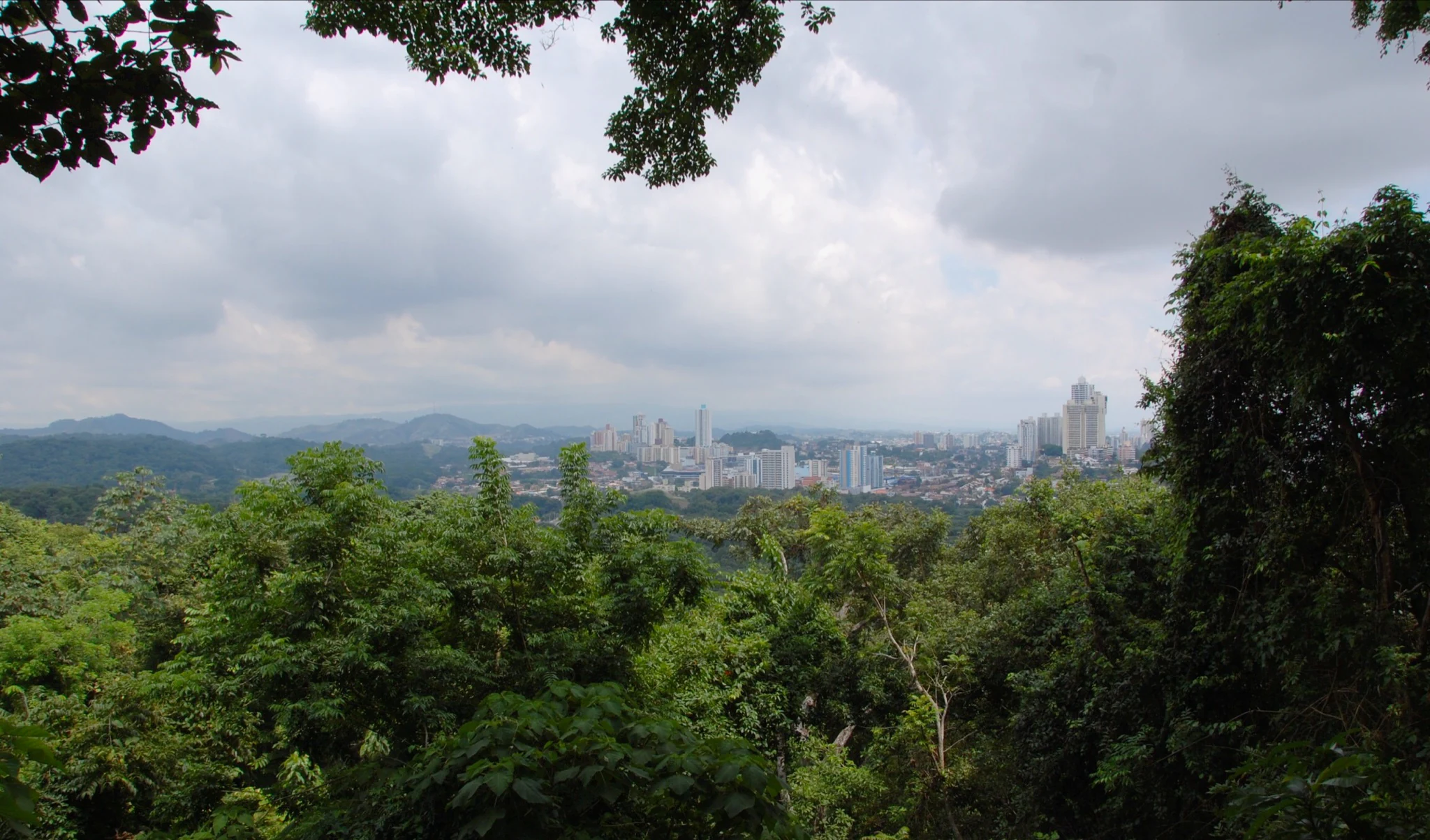
A defining visual feature of the park is the contrast between the dense tropical forest that covers most of its interior and the sweeping urban and canal views visible from higher points along the trail network. Visitors walking the park's paths encounter closed-canopy forest stretches interrupted by occasional clearings, seasonal streams, and elevated viewpoints that frame the modern skyline and the waterway below.
This blend of enclosed forest and open vantage points gives the park a layered scenic quality: areas of intimate, shaded woodland alternate with dramatic overlooks that place the dense green of the park against the broader Pacific landscape of the canal and the city. The dry forest cover also gives the slopes a distinctive seasonal character, with foliage changes that mark the dry and wet periods typical of Panama's Pacific side.
Metropolitan Natural Park ecosystems, habitats, and plant life
Metropolitan Natural Park protects one of the most significant remaining patches of Pacific tropical dry forest in Panama, covering roughly three quarters of its total area. This vegetation type once extended across much of the country's Pacific lowlands but has been drastically reduced by agricultural expansion and urban growth, making the park an important refuge for the ecological communities associated with it.
The forest is structurally diverse, with a mixture of mature trees, lianas, epiphytes, orchids, and mosses weaving together multiple layers of plant life. Around 284 plant species have been recorded, contributing to the complex habitat mosaic that supports a wide array of animals. Seasonal streams and microhabitats within the forest add further ecological variation to the slopes.
Beyond the dry forest itself, the park includes transitional vegetation and disturbed areas along its edges, which allow visitors and researchers to observe forest regeneration. This combination of intact dry forest, recovering areas, and riparian habitats underscores the park's ecological value as a living laboratory for tropical forest dynamics in an urban setting.
Metropolitan Natural Park wildlife and species highlights
Metropolitan Natural Park harbors a remarkably rich fauna for an urban protected area, supporting at least 227 bird species, 45 mammal species, 36 species of snakes, and 14 amphibian species. The density and diversity of wildlife are notable given the park's location within Panama City.
Among the mammals that find refuge in the park are species such as the marmoset monkey, the ñeque (a tropical rodent), squirrels, and a range of other small and medium-sized vertebrates typical of the Panamanian tropical forest. Reptiles are well represented, with a documented snake fauna of more than three dozen species.
Birds are perhaps the park's most celebrated asset. The combination of dry forest, riparian corridors, and proximity to the canal watershed attracts a varied avifauna, drawing both resident species and migrants. This has established the park as a key birdwatching destination in the country, where species typical of the Pacific dry forest can be observed in close proximity to the capital.
Metropolitan Natural Park conservation status and protection priorities
Metropolitan Natural Park holds significant conservation value as one of the last major remnants of Pacific tropical dry forest within Panama's metropolitan region. Roughly 75 percent of the park is covered by this ecosystem, which has been severely reduced elsewhere in the country due to agriculture and development. Protecting this habitat makes the park a critical reservoir for plant and animal species closely tied to dry forest environments.
Its role as the only wildlife refuge within Panama City amplifies its conservation importance. The park maintains habitat connectivity along the canal watershed slopes and provides refuge space for species that would otherwise be displaced by surrounding urban growth. This makes it a key component of green infrastructure for the metropolitan area.
Beyond habitat protection, the park serves as a center for environmental education, monitoring, and research. School programs, university studies, and bird surveys conducted within its boundaries have helped document the biodiversity of Panama's Pacific dry forests and have positioned the park as a model for integrating conservation with a major urban setting.
Metropolitan Natural Park cultural meaning and human context
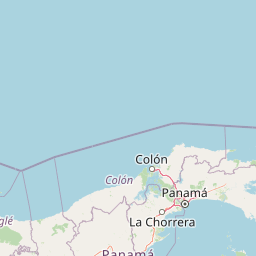
Metropolitan Natural Park occupies a meaningful place in the identity of Panama City as a place where residents and visitors can experience tropical forest within the capital's own boundaries. Its location in the Ancón area, close to the Panama Canal, ties the park symbolically to the country's most prominent geographic and economic feature.
The park has long functioned as a space for outdoor recreation, environmental education for schoolchildren, and community engagement with nature. Over time it has become part of the everyday cultural fabric of the city, representing the effort to preserve tropical ecosystems against urban expansion and offering a shared natural space for residents across the metropolitan area.
Top sights and standout views in Metropolitan Natural Park
Metropolitan Natural Park offers a rare combination of dense tropical dry forest, panoramic canal and city views, and high biodiversity within an urban setting. Its trail network weaves through secondary forest and seasonal streams, leading to viewpoints that frame the park's green expanse against the skyline of Panama City and the waterway of the Panama Canal.
The park's most distinctive draws include its 227 recorded bird species, its dry forest cover that has largely vanished from the rest of Panama, and its unique position as the only wildlife refuge inside the capital. These qualities make it both a notable conservation site and an accessible natural escape in the heart of one of Central America's largest cities.
Best time to visit Metropolitan Natural Park
Metropolitan Natural Park can be visited year-round, but the experience varies with Panama's distinct Pacific dry and wet seasons. The dry season, generally from roughly December through April, brings clearer skies, firmer trails, and excellent conditions for panoramic views of the city and the Panama Canal from the park's higher viewpoints. Birdwatching remains rewarding through this period.
The wet season, roughly from May through November, brings more rainfall and lusher vegetation, with the dry forest responding visibly to moisture. Trails can be muddier and humidity higher, but the forest becomes more active and green. Visitors interested in amphibians, lush foliage, and a quieter atmosphere often favor this period, while those focused on sweeping vistas and easier walking typically prefer the drier months.