Why Parc national La Visite stands out
La Visite is best known for hosting Haiti's largest surviving pine forest, a high-elevation stand of Hispaniolan pine embedded in a wet, ravine-cut plateau of the Massif de la Selle. The park is also recognized for its role as a UNESCO biosphere reserve core zone and as a highland counterpoint to Haiti's largely denuded coastal lowlands, giving it an outsized ecological and symbolic importance relative to its modest size.
Parc national La Visite history and protected-area timeline
Parc national La Visite was established in 1983 by decree of the Haitian government under President Jean-Claude Duvalier, with the explicit goal of protecting the park's flora from accelerating deforestation. At a time when much of Haiti's upland forest cover had already been lost to charcoal production, agriculture, and fuelwood harvesting, the creation of La Visite marked an attempt to safeguard one of the country's last substantial highland forest blocks.
The park's early decades were marked by ongoing pressure rather than full recovery. Despite its protected designation, deforestation continued within and around its boundaries, prompting calls for community engagement, environmental education, and the development of ecotourism as strategies to reduce pressure on the forest. The struggle to balance enforcement with the needs of nearby communities has remained a defining tension in the park's history.
In July 2012, La Visite drew wider national attention when a police operation to remove 142 families who had occupied the area since 1942 resulted in multiple fatalities. The episode sharpened national debate about land tenure, rural livelihoods, and the rights of long-established settlements within protected areas. Later in the same year, in 2012, La Visite was incorporated as a core zone of the La Selle Biosphere Reserve, designated by UNESCO, placing the park within a broader framework of internationally recognized conservation and sustainable development.
Parc national La Visite landscape and geographic character
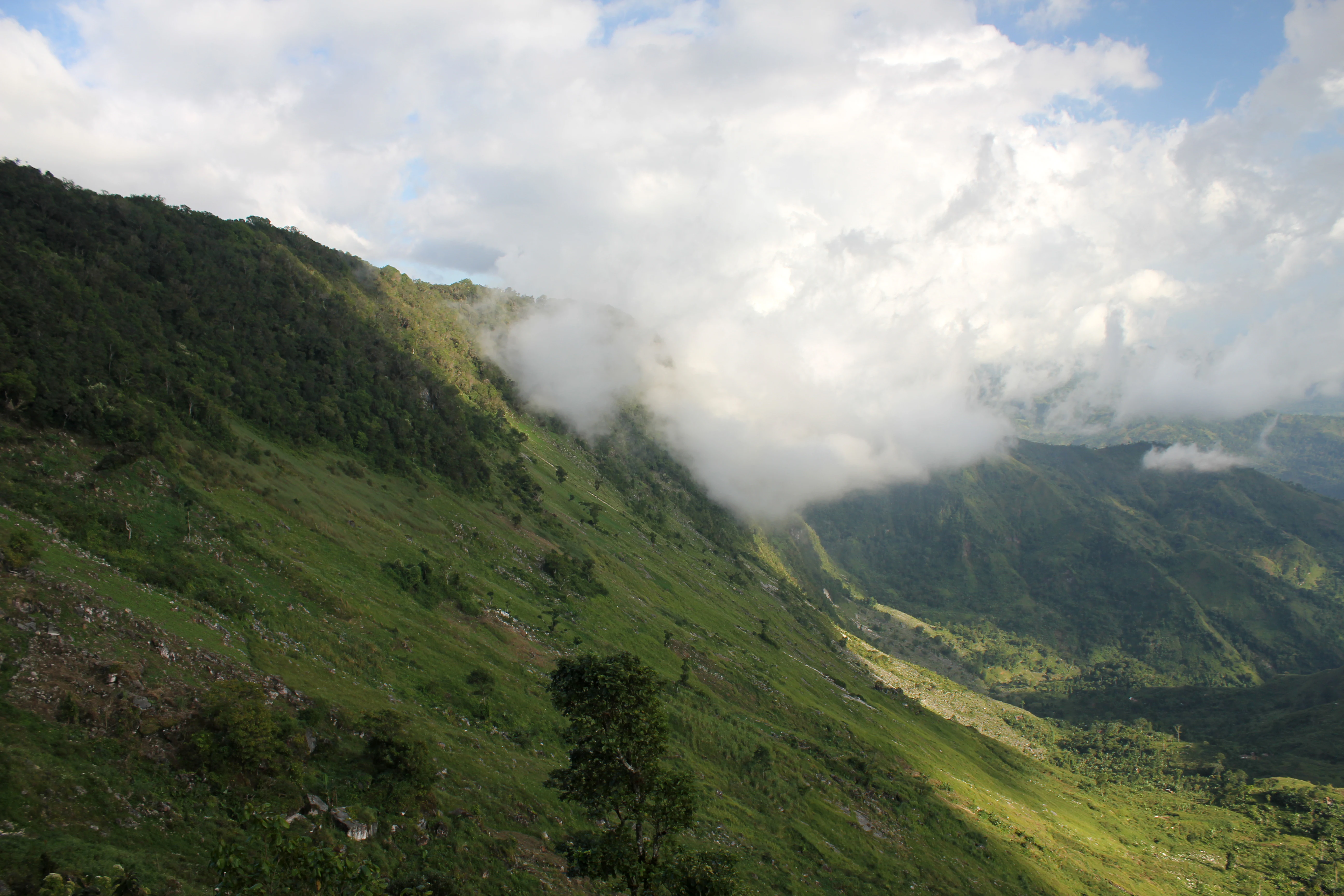
La Visite's landscape is shaped by the southern arm of the Massif de la Selle, the mountain spine that rises across southern Hispaniola. Within the park, broad high-elevation plateaus are dissected by a dense network of ravines carved by seasonal runoff, producing a relief that alternates between relatively flat ridge tops and steeply incised valleys. The result is a mosaic of open upland surfaces and narrow, shaded draws that gives the park much of its visual drama.
The park sits at a notably high elevation for Haiti, with much of its highest wildlife and forest habitat centered around 1,900 meters. This altitude produces a cooler, wetter microclimate than the surrounding lowlands, supporting conditions favorable to pine, mixed montane forest, and a variety of moisture-loving understory plants. Seasonal cascades tumble through the ravines during the wetter months, adding movement and sound to the otherwise quiet plateau scenery.
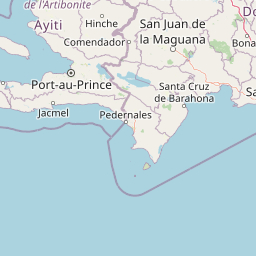
Beyond the park's own boundaries, the elevated vantage points of La Visite open onto wider Selle mountain vistas, with the ridges and valleys of the massif stretching eastward toward the Dominican Republic border. The park's landscape therefore reads simultaneously as an intimate, walkable highland environment and as a piece of a much larger cross-border mountain system, a perspective that reinforces both its scenic and its biogeographical significance.
Parc national La Visite ecosystems, habitats, and plant life
Ecologically, La Visite represents one of the best-preserved highland forest systems in Haitian territory. The park's vegetation is structured in layers that reflect both elevation and landform. On the higher, flatter parts of the plateau, open pine woodland dominated by Hispaniolan pine sets the tone, while on slopes and within ravines, mixed forests of broadleaf species and additional conifers create denser, more shaded habitats.
The combination of altitude, rainfall, and varied topography produces a microclimate distinct from Haiti's drier lowlands. Cooler temperatures and persistent moisture support a broader suite of plant communities than is typical at lower elevations, and the juxtaposition of pine-dominated plateaus with humid, sheltered ravines creates edge habitats that concentrate species richness. This highland mosaic is what makes La Visite ecologically valuable at the national scale: it retains a forest type and structure that has largely vanished elsewhere in Haiti.
The park's ecological character is also defined by what surrounds and threatens it. The forested core of La Visite sits within a heavily altered landscape, where most surrounding uplands have been converted to agriculture or affected by charcoal production. In this context, the park functions as both a refuge for native flora and a potential seed source for forest recovery in adjacent areas, an ecological role that underlies much of its conservation significance.
Parc national La Visite wildlife and species highlights
La Visite's wildlife profile is shaped by its montane forest setting and its position within the Selle mountain chain. The park's mixed pine and broadleaf forests provide habitat for a range of bird species typical of Hispaniola's highland ecosystems, and the combination of open pine canopy and denser ravine forest supports a vertical diversity of niches within a relatively small area. Native reptile and amphibian communities associated with wet montane habitats are also expected to find refuge here.
The park's significance for wildlife lies less in headline species than in the persistence of habitat itself. In a country where forest cover has been severely reduced and fragmented, La Visite offers one of the more contiguous blocks of highland habitat capable of supporting populations sensitive to disturbance, including forest-interior birds and moisture-dependent herpetofauna. Its inclusion in a UNESCO biosphere reserve reflects, in part, this role as a functioning ecosystem rather than simply a scenic landscape.
Wildlife observation in La Visite tends to be incidental to landscape and forest exploration: visitors encounter birds and forest sounds along plateau walks and ravine descents rather than at concentrated viewing points. This diffuse, habitat-based wildlife character is typical of small highland parks and reinforces the importance of protecting the underlying forest structure rather than relying on charismatic single species to anchor conservation attention.
Parc national La Visite conservation status and protection priorities
La Visite's conservation significance rests on its role as one of the last sizable pine-dominated upland forests in Haiti and as a core area of a UNESCO-recognized biosphere reserve. Within the national context, the park's mixed pine and broadleaf forests constitute an exceptional remnant: most comparable highland forest in Haiti has been lost to charcoal production, small-scale agriculture, and fuelwood harvesting, leaving La Visite as a critical refuge for native flora and for the ecological processes that depend on a forested highland landscape.
The park's protection history illustrates both the promise and the limits of formal designation in a context of widespread rural poverty and reliance on forest resources. Created in 1983 to counter deforestation, La Visite has nonetheless faced continuing pressure on its borders and, at times, within them. Conservation actors have consistently pointed to community engagement, environmental education, and the deliberate development of ecotourism as the most viable paths to long-term protection, rather than enforcement alone.
Recognition in 2012 as a core zone of the La Selle Biosphere Reserve placed La Visite within an international framework that frames the park simultaneously as a zone for biodiversity conservation and as a landscape in which human use and sustainable development are legitimate parts of the broader reserve model. This dual framing has shaped subsequent thinking about the park's management, emphasizing the need to integrate local livelihoods, land tenure resolution, and ecological recovery into any durable conservation strategy.
Parc national La Visite cultural meaning and human context
La Visite sits within a landscape whose human history predates its formal protection by centuries, and the relationship between the park and surrounding communities has been a defining feature of its modern identity. Households have lived in and around the forest for generations, with documented occupation of the area stretching back decades before the 1983 designation. The livelihoods of these communities have traditionally been closely tied to the forest, whether through small-scale agriculture, grazing, or the harvesting of wood for fuel and charcoal.
The park's cultural significance also extends to broader Haitian environmental memory. In a country where deforestation has shaped both rural poverty and urban experience, the surviving pine forests of La Visite carry symbolic weight as a reminder of landscapes that once extended far more widely across Haitian highlands. Conservation efforts in the park are therefore intertwined with national conversations about land tenure, rural futures, and the value placed on remaining forest cover.
The 2012 confrontation between eviction enforcement and long-established residents brought these tensions into public view and underscored that any durable conservation outcome in La Visite must engage with the social as well as the ecological history of the place, recognizing that the forest and its surrounding communities have shaped one another for far longer than the park boundary has existed.
Top sights and standout views in Parc national La Visite
Parc national La Visite's strongest points of distinction are concentrated in a few reinforcing features: a high-elevation plateau of the Massif de la Selle, the largest surviving pine forest in Haiti, ravine-and-cascade topography, and formal recognition as a UNESCO biosphere reserve core zone. Together, these create a profile that is unusually concentrated for a small national park.
For a visitor or reader, the park's highlights are best read as a layered experience: the cool highland atmosphere that contrasts with Haiti's lowland heat, the open pine canopy that frames long ridge views, the shaded ravine walks that descend toward seasonal waterfalls, and the wider context of a transboundary mountain ecosystem shared with the Dominican Republic. Each of these elements is accessible within the park's modest footprint, lending La Visite a coherence and density that larger but more diffuse reserves often lack.
Best time to visit Parc national La Visite
La Visite's highland setting gives it a cooler and wetter climate than much of Haiti, and seasonal patterns matter more here than at lower elevations. The drier months typically offer more reliable footing on plateau trails and ravine paths, as well as clearer views across the Selle ridges, while the wetter months bring fuller cascades in the park's seasonal waterfalls and lusher understory but also muddier, more demanding walking conditions.
Because the park sits around 1,900 meters of elevation, temperatures are noticeably cooler than in coastal Haiti year-round, and visitors from lowland areas should expect the highland air to feel distinctly brisk, especially in the early morning and during the cooler months. The pine forest's character shifts subtly with the seasons as well, with the canopy appearing more open and the forest floor drier in the dry season and denser, greener, and more saturated in the wet season, a contrast that influences both photography and birdwatching conditions.