Mori Atlas logo
National parkParc national La Visite

A vital protected mountain landscape within the Massif de la Selle range in southeastern Haiti.

Parc national La Visite: Mapping the Highland Plateau and Pine Forest Ecosystems of Haiti

Parc national La Visite stands as a significant protected highland plateau in southeastern Haiti, representing one of the last remaining strongholds for Hispaniolan pine within the broader Massif de la Selle. The park encompasses an undulating high-elevation terrain carved by seasonal ravines, offering a cool, moisture-rich environment that contrasts with the surrounding Caribbean lowlands. This protected area serves as a core zone for regional biodiversity, preserving a rare mosaic of mixed forest and mountain habitats that trace the geographic spine shared with the Dominican Republic.

highland plateaupine forestmixed forestbiosphere reservemassif de la Selleravines and cascades

Parc national La Visite

National park

Park overview

Structured park overview, official facts, and landscape profile for Parc national La Visite

Parc national La Visite park facts, protected area profile, and essential visitor context

Review the core facts for Parc national La Visite, including designation, size, terrain, visitor scale, habitats, and operating context in one park-focused overview.

About Parc national La Visite

Parc national La Visite lies in the southeastern corner of Haiti, occupying a section of the Chaîne de la Selle, the mountain chain that continues eastward into the Dominican Republic. The park's setting is decisively upland, with rolling plateau surfaces incised by ravines and seasonal cascades that give the terrain its characteristic undulating, dissected profile. From this high perch, the park extends to the international border, anchoring the Haitian side of one of the most ecologically important mountain systems on the island of Hispaniola.

The park's identity is inseparable from its pine forest. Across its roughly 30 square kilometers of protected area, La Visite preserves a substantial stand of Pinus occidentalis, the Hispaniolan pine, set among mixed broadleaf and conifer forests. This pinède, growing at around 1,900 meters in elevation on average, is widely regarded as the largest pine forest remaining in Haiti. Beyond its sheer size within the national context, the pine belt has a distinctive character: open-canopy woodlands above, denser mixed forest below, and a highland microclimate that supports cooler, moister conditions than surrounding lowlands.

Visitor experience in La Visite centers on this highland mosaic: walks along plateau ridges, descents into shaded ravines, and views across the broader Selle landscape. For naturalists and conservationists, the park serves as a reference site for what Haiti's upland ecosystems can look like under protection, and for what they have lost elsewhere due to charcoal production, smallholder agriculture, and fuelwood harvesting. The park's inclusion as a core zone of the La Selle Biosphere Reserve in 2012 elevated its profile within international conservation frameworks and underscored its role as a refuge ecosystem on a heavily pressured island.

Quick facts and research context for Parc national La Visite

Parc national La Visite is a national park located in southeastern Haiti, within the Chaîne de la Selle near the Dominican Republic border. It was established in 1983 and covers roughly 30 square kilometers of highland terrain. The park is classified as IUCN Category II and is part of the La Selle Biosphere Reserve, designated by UNESCO in 2012. Its defining feature is a pine-dominated forest belt, considered the largest pinède remaining in Haiti, growing on a plateau at approximately 1,900 meters of elevation.

Protection and recognition

Examine documented conservation standing, designation history, and registry records.

Parc national La Visite Protection Status and Recognized Protected Area Data

Parc national La Visite conservation metrics compile formal registry records, tracking parameters, and designated protected area listings. Systematic conservation tracking provides reliable contextual framing for researchers evaluating international protected area inventories.

Protection details

WDPA ID
7880
Park context

Deeper park guide and search-rich context for Parc national La Visite

Parc national La Visite history, landscape, wildlife, and travel context

Explore Parc national La Visite through its history, landscape character, ecosystems, wildlife, conservation priorities, cultural context, and seasonal travel timing in a structured park guide built for atlas discovery and search intent.

Why Parc national La Visite stands out

La Visite is best known for hosting Haiti's largest surviving pine forest, a high-elevation stand of Hispaniolan pine embedded in a wet, ravine-cut plateau of the Massif de la Selle. The park is also recognized for its role as a UNESCO biosphere reserve core zone and as a highland counterpoint to Haiti's largely denuded coastal lowlands, giving it an outsized ecological and symbolic importance relative to its modest size.
Parc national La Visite history and protected-area timeline

Parc national La Visite was established in 1983 by decree of the Haitian government under President Jean-Claude Duvalier, with the explicit goal of protecting the park's flora from accelerating deforestation. At a time when much of Haiti's upland forest cover had already been lost to charcoal production, agriculture, and fuelwood harvesting, the creation of La Visite marked an attempt to safeguard one of the country's last substantial highland forest blocks.

The park's early decades were marked by ongoing pressure rather than full recovery. Despite its protected designation, deforestation continued within and around its boundaries, prompting calls for community engagement, environmental education, and the development of ecotourism as strategies to reduce pressure on the forest. The struggle to balance enforcement with the needs of nearby communities has remained a defining tension in the park's history.

In July 2012, La Visite drew wider national attention when a police operation to remove 142 families who had occupied the area since 1942 resulted in multiple fatalities. The episode sharpened national debate about land tenure, rural livelihoods, and the rights of long-established settlements within protected areas. Later in the same year, in 2012, La Visite was incorporated as a core zone of the La Selle Biosphere Reserve, designated by UNESCO, placing the park within a broader framework of internationally recognized conservation and sustainable development.

Parc national La Visite landscape and geographic character

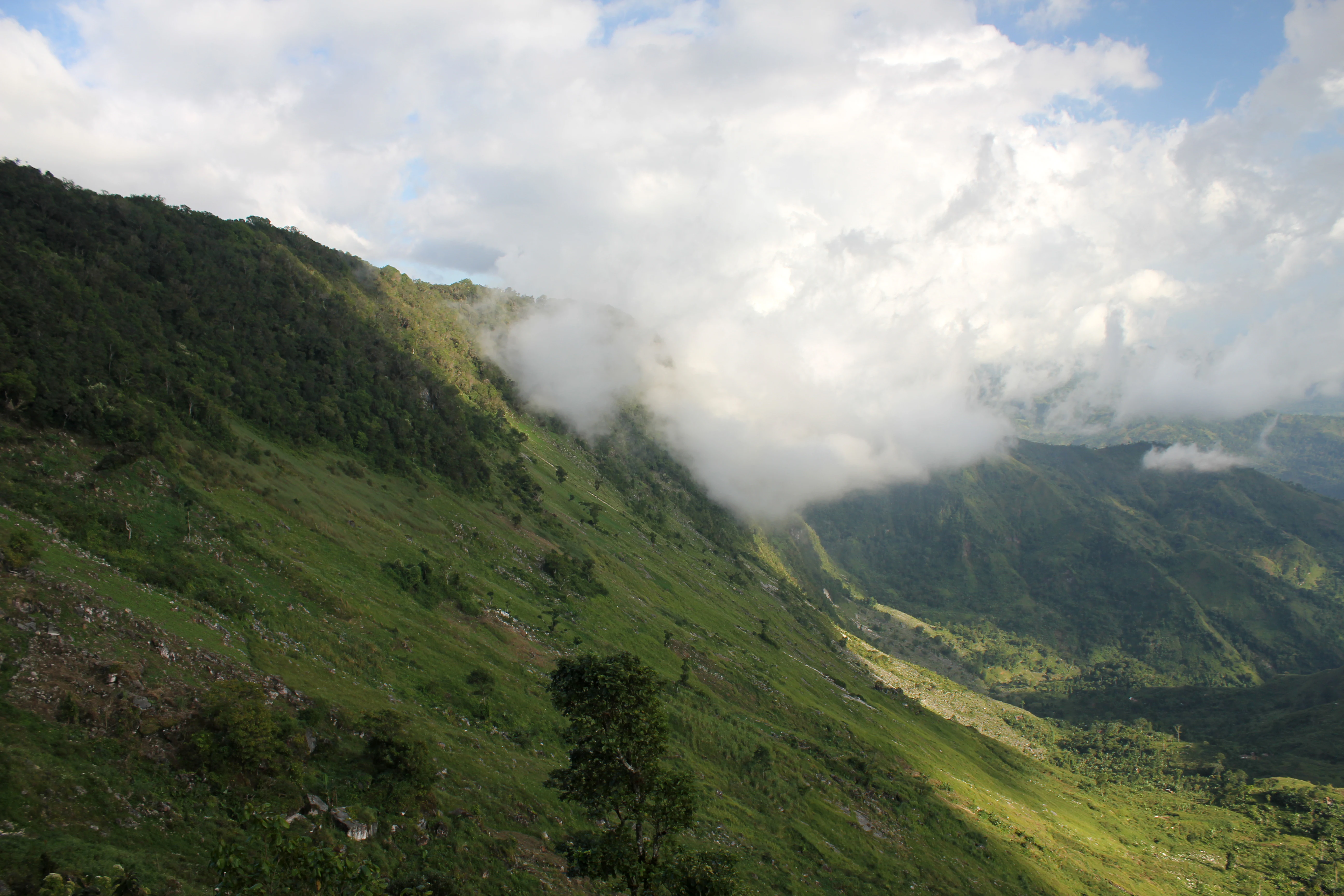
La Visite's landscape is shaped by the southern arm of the Massif de la Selle, the mountain spine that rises across southern Hispaniola. Within the park, broad high-elevation plateaus are dissected by a dense network of ravines carved by seasonal runoff, producing a relief that alternates between relatively flat ridge tops and steeply incised valleys. The result is a mosaic of open upland surfaces and narrow, shaded draws that gives the park much of its visual drama.

The park sits at a notably high elevation for Haiti, with much of its highest wildlife and forest habitat centered around 1,900 meters. This altitude produces a cooler, wetter microclimate than the surrounding lowlands, supporting conditions favorable to pine, mixed montane forest, and a variety of moisture-loving understory plants. Seasonal cascades tumble through the ravines during the wetter months, adding movement and sound to the otherwise quiet plateau scenery.

Beyond the park's own boundaries, the elevated vantage points of La Visite open onto wider Selle mountain vistas, with the ridges and valleys of the massif stretching eastward toward the Dominican Republic border. The park's landscape therefore reads simultaneously as an intimate, walkable highland environment and as a piece of a much larger cross-border mountain system, a perspective that reinforces both its scenic and its biogeographical significance.

Parc national La Visite ecosystems, habitats, and plant life

Ecologically, La Visite represents one of the best-preserved highland forest systems in Haitian territory. The park's vegetation is structured in layers that reflect both elevation and landform. On the higher, flatter parts of the plateau, open pine woodland dominated by Hispaniolan pine sets the tone, while on slopes and within ravines, mixed forests of broadleaf species and additional conifers create denser, more shaded habitats.

The combination of altitude, rainfall, and varied topography produces a microclimate distinct from Haiti's drier lowlands. Cooler temperatures and persistent moisture support a broader suite of plant communities than is typical at lower elevations, and the juxtaposition of pine-dominated plateaus with humid, sheltered ravines creates edge habitats that concentrate species richness. This highland mosaic is what makes La Visite ecologically valuable at the national scale: it retains a forest type and structure that has largely vanished elsewhere in Haiti.

The park's ecological character is also defined by what surrounds and threatens it. The forested core of La Visite sits within a heavily altered landscape, where most surrounding uplands have been converted to agriculture or affected by charcoal production. In this context, the park functions as both a refuge for native flora and a potential seed source for forest recovery in adjacent areas, an ecological role that underlies much of its conservation significance.

Parc national La Visite wildlife and species highlights

La Visite's wildlife profile is shaped by its montane forest setting and its position within the Selle mountain chain. The park's mixed pine and broadleaf forests provide habitat for a range of bird species typical of Hispaniola's highland ecosystems, and the combination of open pine canopy and denser ravine forest supports a vertical diversity of niches within a relatively small area. Native reptile and amphibian communities associated with wet montane habitats are also expected to find refuge here.

The park's significance for wildlife lies less in headline species than in the persistence of habitat itself. In a country where forest cover has been severely reduced and fragmented, La Visite offers one of the more contiguous blocks of highland habitat capable of supporting populations sensitive to disturbance, including forest-interior birds and moisture-dependent herpetofauna. Its inclusion in a UNESCO biosphere reserve reflects, in part, this role as a functioning ecosystem rather than simply a scenic landscape.

Wildlife observation in La Visite tends to be incidental to landscape and forest exploration: visitors encounter birds and forest sounds along plateau walks and ravine descents rather than at concentrated viewing points. This diffuse, habitat-based wildlife character is typical of small highland parks and reinforces the importance of protecting the underlying forest structure rather than relying on charismatic single species to anchor conservation attention.

Parc national La Visite conservation status and protection priorities

La Visite's conservation significance rests on its role as one of the last sizable pine-dominated upland forests in Haiti and as a core area of a UNESCO-recognized biosphere reserve. Within the national context, the park's mixed pine and broadleaf forests constitute an exceptional remnant: most comparable highland forest in Haiti has been lost to charcoal production, small-scale agriculture, and fuelwood harvesting, leaving La Visite as a critical refuge for native flora and for the ecological processes that depend on a forested highland landscape.

The park's protection history illustrates both the promise and the limits of formal designation in a context of widespread rural poverty and reliance on forest resources. Created in 1983 to counter deforestation, La Visite has nonetheless faced continuing pressure on its borders and, at times, within them. Conservation actors have consistently pointed to community engagement, environmental education, and the deliberate development of ecotourism as the most viable paths to long-term protection, rather than enforcement alone.

Recognition in 2012 as a core zone of the La Selle Biosphere Reserve placed La Visite within an international framework that frames the park simultaneously as a zone for biodiversity conservation and as a landscape in which human use and sustainable development are legitimate parts of the broader reserve model. This dual framing has shaped subsequent thinking about the park's management, emphasizing the need to integrate local livelihoods, land tenure resolution, and ecological recovery into any durable conservation strategy.

Parc national La Visite cultural meaning and human context

La Visite sits within a landscape whose human history predates its formal protection by centuries, and the relationship between the park and surrounding communities has been a defining feature of its modern identity. Households have lived in and around the forest for generations, with documented occupation of the area stretching back decades before the 1983 designation. The livelihoods of these communities have traditionally been closely tied to the forest, whether through small-scale agriculture, grazing, or the harvesting of wood for fuel and charcoal.

The park's cultural significance also extends to broader Haitian environmental memory. In a country where deforestation has shaped both rural poverty and urban experience, the surviving pine forests of La Visite carry symbolic weight as a reminder of landscapes that once extended far more widely across Haitian highlands. Conservation efforts in the park are therefore intertwined with national conversations about land tenure, rural futures, and the value placed on remaining forest cover.

The 2012 confrontation between eviction enforcement and long-established residents brought these tensions into public view and underscored that any durable conservation outcome in La Visite must engage with the social as well as the ecological history of the place, recognizing that the forest and its surrounding communities have shaped one another for far longer than the park boundary has existed.

Top sights and standout views in Parc national La Visite

Parc national La Visite's strongest points of distinction are concentrated in a few reinforcing features: a high-elevation plateau of the Massif de la Selle, the largest surviving pine forest in Haiti, ravine-and-cascade topography, and formal recognition as a UNESCO biosphere reserve core zone. Together, these create a profile that is unusually concentrated for a small national park.

For a visitor or reader, the park's highlights are best read as a layered experience: the cool highland atmosphere that contrasts with Haiti's lowland heat, the open pine canopy that frames long ridge views, the shaded ravine walks that descend toward seasonal waterfalls, and the wider context of a transboundary mountain ecosystem shared with the Dominican Republic. Each of these elements is accessible within the park's modest footprint, lending La Visite a coherence and density that larger but more diffuse reserves often lack.

Best time to visit Parc national La Visite

La Visite's highland setting gives it a cooler and wetter climate than much of Haiti, and seasonal patterns matter more here than at lower elevations. The drier months typically offer more reliable footing on plateau trails and ravine paths, as well as clearer views across the Selle ridges, while the wetter months bring fuller cascades in the park's seasonal waterfalls and lusher understory but also muddier, more demanding walking conditions.

Because the park sits around 1,900 meters of elevation, temperatures are noticeably cooler than in coastal Haiti year-round, and visitors from lowland areas should expect the highland air to feel distinctly brisk, especially in the early morning and during the cooler months. The pine forest's character shifts subtly with the seasons as well, with the canopy appearing more open and the forest floor drier in the dry season and denser, greener, and more saturated in the wet season, a contrast that influences both photography and birdwatching conditions.
Monthly climate preview

Long-term representative temperature and precipitation averages for Haiti

Parc national La Visite Climate Normals and Monthly Weather Patterns

Historical climate data for Parc national La Visite outlines measured long-term temperature ranges and monthly precipitation amounts recorded across twelve distinct periods. Examining the complete monthly profile provides deeper analytical context on annual meteorological rhythms without relying on short-term forecasts.
Annual mean27 °C
26 °C29 °C
Jan26°
Feb26°
Mar26°
Apr27°
May28°
Jun28°
Jul29°
Aug29°
Sep29°
Oct28°
Nov27°
Dec26°
Warmest month
August

29.1 °C

Coolest month
January

25.7 °C

Wettest month
May

2 mm/day

Driest month
February

0.5 mm/day

Park location guide

Geography guide, regional context, and park location map for Parc national La Visite

Parc national La Visite park geography, regions, and map view in Haiti

Understand where Parc national La Visite sits in Haiti through a broader geographic reading of the surrounding landscape, nearby location context, and its mapped position within the national park landscape.

How Parc national La Visite fits into Haiti

Haiti is a Caribbean country occupying the western third of Hispaniola Island in the Caribbean Sea. It gained independence from France in 1804 following the Haitian Revolution, becoming the first sovereign state established by a slave revolt and the second independent nation in the Americas. The country is known for its complex political history, economic challenges, and cultural significance in the Caribbean.

Wider geography shaping Parc national La Visite in Haiti

Haiti occupies the western third of Hispaniola Island in the Caribbean, sharing the island with the Dominican Republic. The country is positioned in the Caribbean Sea, east of Cuba and south of the Bahamas. Haiti's terrain is predominantly mountainous, with valleys and coastal plains. The country borders the Caribbean Sea on its western, southern, and southwestern coasts.

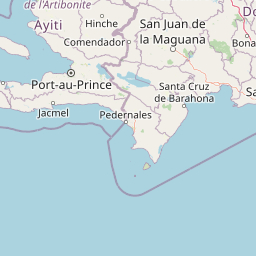
Map view of Parc national La Visite

Use this park location map to pinpoint Parc national La Visite in Haiti, understand its exact geographic position, and read its mapped placement within the surrounding landscape more clearly.

Pigeon | © OpenStreetMap contributors
Park atlas

Compare regional highland terrain, neighboring mountain reserves, and related protected landscapes

Explore Protected Areas and Parks Near Parc national La Visite

Continue geographic discovery by comparing Parc national La Visite with surrounding highland reserves and protected mountain environments across the region. Expanding the park search reveals connected upland ecosystems, cross border terrain, and wider conservation contexts throughout the Massif de la Selle.
National parkHaiti
Mapped park locations coincide#1 closest

East

La Visite National Park: Protected Highland Terrain and Endemic Pine Forest Landscape

Explore the geography and mapped park boundaries of Haiti's significant national park.

La Visite National Park is a vital protected area located in Haiti's mountainous Massif de la Selle region. It is distinguished by its rare montane ecosystems, including extensive Hispaniolan pine forests and high-altitude grasslands, creating a unique landscape within the Caribbean. This atlas entry focuses on the park's geographic setting, its mapped protected boundaries, and its ecological significance as a key component of Haiti's natural heritage, offering a detailed look at its distinctive terrain.

Area
30 km²
Established
1983
IUCN
II
Relief
Mountain
National parkHaiti
About 37 km away#2 closest

East

Parc national La Visite: Atlas and Geographic Overview of Haiti Protected Highlands

Highland pine forest refuges and karst limestone landscapes.

Located in the Chaîne de la Selle, Parc national La Visite serves as a key conservation anchor for the unique upland ecosystems of Haiti. This detailed atlas entry maps the park's steep limestone plateaus, deep gorges, and expansive pine forests, providing essential context on one of the Caribbean's most significant transboundary protected mountain landscapes.

Established
1983
National parkSud Department
About 37 km away#3 closest

East

Forêt des Pins National Park: Geographic Overview of Haiti's Highland Protected Landscapes

Mapping the pine-forested terrain and high-altitude mountain ecosystems of the southern massif.

Explore the expansive geography of Forêt des Pins National Park, which protects the remnants of Haiti's highland Caribbean pine forests. This protected area spans critical high-elevation slopes and mountain watersheds, offering a detailed look at the rugged natural terrain of the southern massif surrounding Pic la Selle.

Area
187.8 km²
Established
1937
National parkPedernales Province
About 72 km away#4 closest

Southeast

Jaragua National Park: Dominican Republic National Park Protected Landscape Atlas

Discover the mapped geography and protected boundaries of Jaragua National Park.

Jaragua National Park stands as a crucial national park within the Dominican Republic, located in Pedernales Province. This entry provides an in-depth, atlas-style examination of the park's protected landscape, focusing on its geographic features and mapped extent. Users can explore the park's position within the regional geography and understand its significance as a conservation area.

Area
1,374 km²
Established
1983
IUCN
II
Relief
Mountain
National parkIndependencia Province
About 100 km away#5 closest

East

La Gran Sabana National Park: National Park Identity and Geographic Mapping

Exploring protected landscapes and regional context.

This detail entry focuses on La Gran Sabana National Park, delineating its identity as a protected national park within Independencia Province. It provides essential context for understanding the park's mapped boundaries, its specific geographic setting, and its role within the natural landscape. Users can explore its atlas-relevant features and understand its place in the broader geography of the Dominican Republic.

Area
219.58 km²
Established
2009
IUCN
II
Relief
Lowland
National parkHaiti
About 138 km away#6 closest

North

National History Park National Park: Haiti's Protected Landscape and Geographic Atlas

Discover the park's mapped terrain and protected land geography.

The National History Park serves as a critical protected area within Haiti, offering detailed insights into its unique landscape and geographic setting. As a designated national park, it provides valuable data for atlas-based exploration of protected territories. Users can investigate the park's mapped boundaries, its regional context within Haiti, and the characteristics of its natural terrain, enriching their understanding of conservation landscapes.

Area
25.28 km²
Established
1968
IUCN
IV
Relief
Mountain
National parkNord
About 138 km away#7 closest

North

Parc national historique - Citadelle, Sans Souci, Ramiers: A Caribbean Historic Landscape

Protected mountain terrain and historic fortifications in northern Haiti

This national park protects an expansive mountain massif characterized by the massive Citadelle La Ferrière and the ruins of Sans-Souci Palace. Beyond its architectural significance, the park safeguards essential karst cave networks, natural springs, and forested river corridors that shape the rugged topography of northern Haiti.

Area
252.86 km²
Established
1968
Relief
Mountain
Scope
Terrestrial
National parkDominican Republic
About 138 km away#8 closest

Northeast

José Armando Bermúdez National Park: Dominican Republic National Park Atlas and Landscape Context

Discover the mapped protected area and geographic setting of this Dominican Republic national park.

Gain an understanding of José Armando Bermúdez National Park as a distinct protected landscape within the Dominican Republic. This entry focuses on its role as a national park, providing geographic context and highlighting its mapped boundaries for atlas exploration. Explore the park's specific terrain and its place within the nation's conservation network.

Area
766 km²
Established
1956
IUCN
II
Relief
Mountain

Common questions about visiting, size, designation, and location context for Parc national La Visite

Parc national La Visite FAQs for park facts, access, geography, and protected area context

Find quick answers about Parc national La Visite, including protected-area facts, park geography, trail and visitor context, and how the park fits into its surrounding country and regional landscape.
MoriAtlas Explorer

Continue Your Protected Areas Search Across the Global Atlas

Deepen your exploration by continuing the structured search for national parks and protected areas worldwide. Utilize the comprehensive filtering capabilities to compare different conservation landscapes and refine your understanding of global park geography. Discover more about the distribution and characteristics of protected natural areas.

Global natural geography