
Why Réserve naturelle régionale de la côte de Mancy stands out
The reserve is best known for its combination of calcareous grasslands, cliffs, and scrub that support an exceptional concentration of butterflies and reptiles, including endemic lepidopterans that first drew entomologists' attention in the second half of the twentieth century. These dry, sun-exposed habitats, set within a hillside landscape shaped by historical collective grazing, give the site a distinct identity among regional nature reserves in the Jura. The richness of orchids, butterflies, bats, breeding birds, and reptiles packed into such a small area reinforces its standing as a biodiversity hotspot of local and regional importance.
Réserve naturelle régionale de la côte de Mancy history and protected-area timeline
The hillside of Mancy has a long history as a communally managed space, with traditional agro-sylvo-pastoral techniques shaping its grasslands, scrub, and woodlands. These land uses created and sustained habitats that later became rare both in extent and in number. In the second half of the twentieth century, entomologists highlighted the site for its endemic lepidopterans, a discovery that drew scientific attention to its exceptional biodiversity value.
The plateau of Mancy was first classified as a voluntary nature reserve (réserve naturelle volontaire) in 1996, formalising early efforts to protect its habitats. On 12 February 2010, the site was reclassified as a regional nature reserve for a renewable period of ten years, giving it a stronger legal framework. It has since been incorporated into regional and European ecological inventories, being included in a ZNIEFF of type I (no. 00000028) and in the Natura 2000 ZSC FR4302001 Côte de Mancy.
Réserve naturelle régionale de la côte de Mancy landscape and geographic character
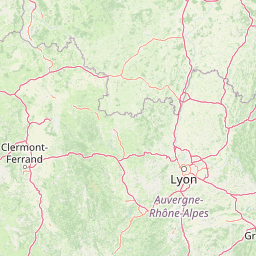
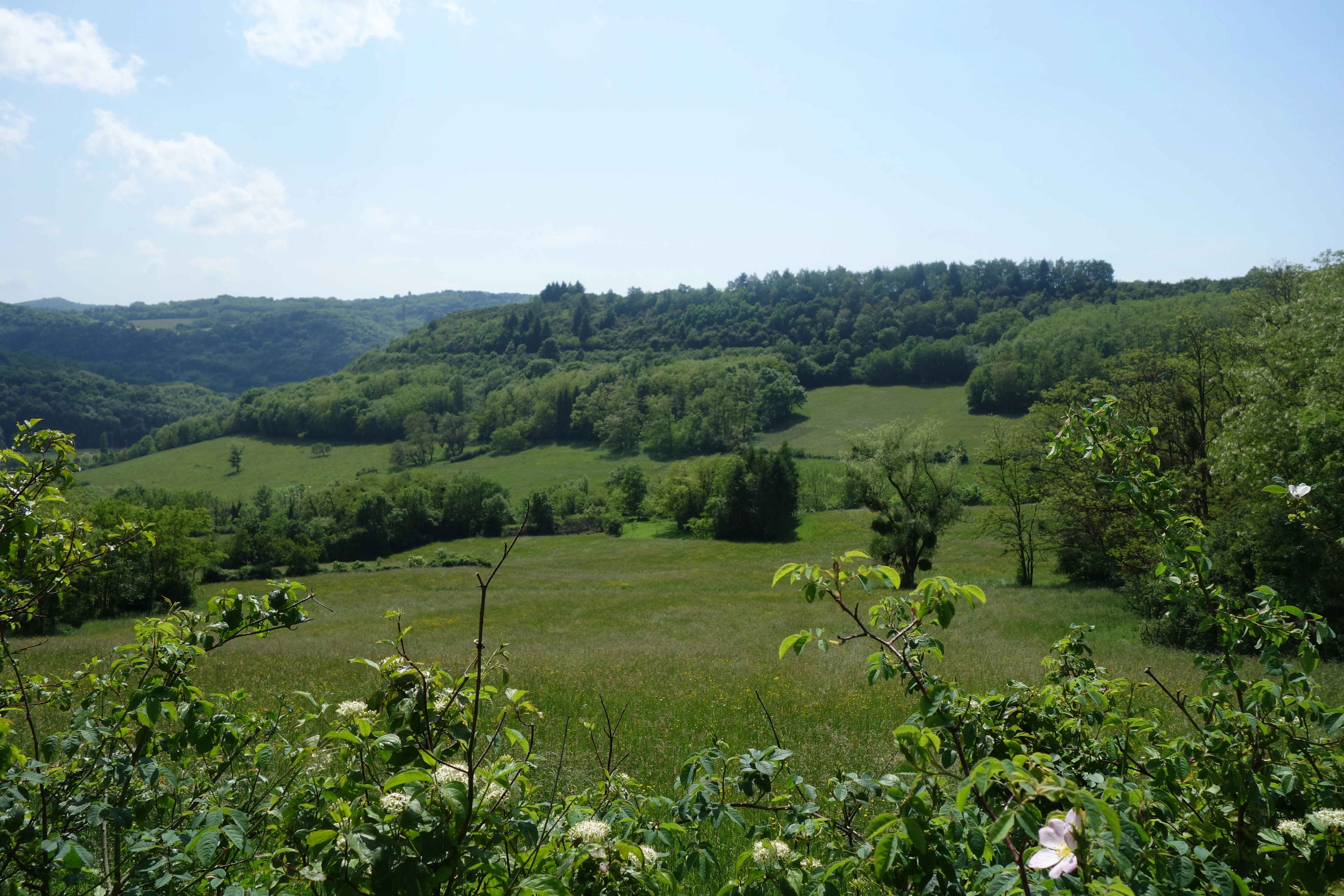
The reserve's landscape is defined by a north-south oriented limestone coteau forming part of the Revermont, an escarpment zone that marks the leading edge of the Jura's external overthrust onto the Bresse plain. Elevations range from about 278 metres to 415 metres, with the hillside overlooking Lons-le-Saunier and framing the entrance to the Vernantois reculée to the south.
Geologically, the site sits on Jurassic limestones of Bajocian age, with Toarcian and Aalenian layers also visible at the surface. Old limestone quarries along its edge, combined with cliffs, scree, and rocky outcrops, give the coteau a rugged, varied relief. This combination of steep slopes, exposed rock, and thin calcareous soils has produced a mosaic of dry grasslands, scrub, and woody fringes that visually distinguishes the reserve from the agricultural lowlands and vineyards of the surrounding area.
Réserve naturelle régionale de la côte de Mancy ecosystems, habitats, and plant life
Ecologically, the côte de Mancy is dominated by dry calcareous and marly grasslands, supplemented by scrub communities, rock faces, scree slopes, and peripheral woodlands. Seven habitats of community interest, recognised under the European Habitats Directive, are present within the reserve, a remarkable concentration given the site's small size.
The flora reflects this habitat diversity. Around 482 species of spermatophytes have been recorded, including four regionally protected species and one regional red-list species, the Baguenaudier. Several orchid species, such as the Monkey orchid, the Bee orchid, and the Spider orchid, sit at the threshold of regional red-list status. The site also supports nine liverwort species, 105 mosses, and eight ferns. Fungi and lichens are similarly diverse, with 229 fungi and 48 lichen species recorded by the end of 2022. The combination of open dry grasslands, cliffs, scree, and scrub creates the layered habitat structure that underpins the reserve's biodiversity value.
Réserve naturelle régionale de la côte de Mancy wildlife and species highlights
The reserve is renowned for its invertebrat and reptile fauna, particularly its lepidopterans. Endemic butterflies were the first group to attract scientific interest, and the dry calcareous and marly habitats continue to support a rich community of these insects. Reptiles are equally notable, with ten of the twelve reptile species recorded in Franche-Comté present on the site, including the Slow worm, the Viperine snake, the Grass snake, the Asp viper, and the Western green lizard.
The site also shelters a diverse bat community, with 18 species recorded, including the Schreibers' bat, the Common pipistrelle, the Lesser mouse-eared bat, and the Greater mouse-eared bat. Birdlife is well documented, with a permanent inventory listing 121 species, of which 49 are considered to breed at the site. Among the breeding and regularly recorded species are the Woodlark, the Red-backed shrike, the Lesser spotted woodpecker, the Black woodpecker, the European honey buzzard, the Black kite, and the Red kite, reflecting the value of the wooded fringes as well as the open slopes.
Réserve naturelle régionale de la côte de Mancy conservation status and protection priorities
The côte de Mancy is significant for conservation because it concentrates a high number of priority habitats and species into a very small area, acting as a local refuge for several rare or endemic taxa. Its seven habitats of community interest and the presence of endemic lepidopterans, regionally protected plants, and a large share of Franche-Comté's reptile fauna underline its biodiversity importance well beyond its modest size.
Protection operates on multiple, overlapping levels. The site is a regional nature reserve, a ZNIEFF of type I, and a Special Area of Conservation (ZSC FR4302001 Côte de Mancy) under the European Natura 2000 network. Management by the Conservatoire d'espaces naturels de Franche-Comté and Jura Nature Environnement, supported by grazing with Konik polski horses and Thônes et Marthod sheep, is designed to maintain the open habitats that depend on continued pastoral activity. Without this, the reserve's rare grasslands and the species tied to them would risk being lost to scrub encroachment and ecological fragmentation.
Réserve naturelle régionale de la côte de Mancy cultural meaning and human context
The reserve embodies a long tradition of collective agro-sylvo-pastoral land use on what was once a communal space. These traditional techniques shaped a landscape of calcareous grasslands, scrub, and woodlands, and their later partial abandonment, combined with residual pastoral management, helped create the mosaic of habitats that make the site ecologically valuable today. The côte de Mancy therefore illustrates how centuries of human activity and nature conservation can become closely intertwined in the southern Revermont.
Top sights and standout views in Réserve naturelle régionale de la côte de Mancy
Within only about 49 hectares, the reserve combines seven habitats of community interest with endemic butterflies, ten regional reptile species, eighteen bat species, and more than 120 recorded bird species. Traditional grazing by Konik polski horses and Thônes et Marthod sheep continues to maintain its open limestone grasslands, and the same hillside confines old quarries, cliffs, scree, and scrub in close proximity. As both a ZNIEFF and a Natura 2000 Special Area of Conservation, the côte de Mancy demonstrates how a small site can carry a disproportionately large share of regional biodiversity.
Best time to visit Réserve naturelle régionale de la côte de Mancy
The coteau is accessible on foot throughout the year, with dogs required to be kept on lead. Late spring and early summer are especially appealing for visitors interested in orchids and butterflies, when calcareous grasslands come into bloom and many of the lepidopteran species associated with the site are most active. Warm, sunny days in late spring and summer also offer the best chances of observing reptiles on the dry, rocky slopes. Autumn highlights the fungi and lichens for which the reserve has an ongoing inventory, while winter and early spring reveal the open structure of the grasslands maintained by extensive grazing.