Mori Atlas logo
Nature reserveRéserve naturelle régionale des Riez de Nœux-lès-Auxi

Examining the ecological mosaic and protected calcareous grassland boundaries in northern France

Réserve naturelle régionale des Riez de Nœux-lès-Auxi: A Thermophilic Limestone Slope Landscape

The Réserve naturelle régionale des Riez de Nœux-lès-Auxi stands as a vital protected area in the Hauts-de-France region, defined by its south-facing limestone slopes and rare thermophilic vegetation. This concentrated mosaic includes open calcareous grasslands, juniper shrublands, and ravine forests, offering a study in how microclimates sustain specialized plant and invertebrate communities within a northern landscape.

regional nature reservelimestone slopecalcareous grasslandthermophilic habitatjuniper shrublandorchid flora

Réserve naturelle régionale des Riez de Nœux-lès-Auxi

Nature reserve

Park overview

Structured park overview, official facts, and landscape profile for Réserve naturelle régionale des Riez de Nœux-lès-Auxi

Réserve naturelle régionale des Riez de Nœux-lès-Auxi park facts, protected area profile, and essential visitor context

Review the core facts for Réserve naturelle régionale des Riez de Nœux-lès-Auxi, including designation, size, terrain, visitor scale, habitats, and operating context in one park-focused overview.

About Réserve naturelle régionale des Riez de Nœux-lès-Auxi

The Réserve naturelle régionale des Riez de Nœux-lès-Auxi is a compact but ecologically important protected area in the Pas-de-Calais, part of the Hauts-de-France region. It sits northeast of the small commune of Nœux-lès-Auxi, near the valley of the Authie river, occupying a fragment of south-facing limestone slope that catches more sunlight and heat than the surrounding northern French countryside.

What makes the reserve unusual for its geographic setting is the combination of microclimate, soil chemistry, and long-standing land management. The south-facing slope, basic dry soils, and centuries of extensive grazing by cattle, goats, and sheep have produced a vegetation mosaic that is highly atypical for the region. Open calcareous grasslands (pelouses calcicoles) grade into calcicole fringes (ourlets calcicoles) that act as ecotones toward thorny scrub and juniper shrublands, with a nearby ravine forest described as among the finest of its kind in the region.

This mosaic supports a biodiversity that one would normally associate with habitats much further south in France. The reserve is therefore valued not only for its intrinsic nature but also as a demonstration of how a small protected area can conserve ecological communities that would otherwise have vanished from northern France. Managed by the Conservatoire d'espaces naturels du Nord et du Pas-de-Calais, it is also recognized as an important site for environmental education and a focal point of regional conservation work, despite concerns about preserving it from excessive visitor pressure and from broader environmental decline affecting the surrounding landscape.

Quick facts and research context for Réserve naturelle régionale des Riez de Nœux-lès-Auxi

The Réserve naturelle régionale des Riez de Nœux-lès-Auxi is a regional nature reserve in the Hauts-de-France region, located in the Pas-de-Calais department near the Authie valley. It covers about 8 hectares of south-facing limestone slope. Originally classified as a voluntary nature reserve in 1999, it was reclassified as a regional nature reserve in November 2007 and is managed by the Conservatoire d'espaces naturels du Nord et du Pas-de-Calais. The site is registered under UICN Category IV (habitat and species management area) and is recognized as the most thermophilic limestone slope of the former Nord-Pas-de-Calais region.

Protection and recognition

Documented terrestrial protection scope, establishment year, and administrative records

Réserve naturelle régionale des Riez de Nœux-lès-Auxi Protection Status and Official Designation History

Terrestrial protection status for Réserve naturelle régionale des Riez de Nœux-lès-Auxi encompasses establishment records from 2007 within standard administrative frameworks. Database tracking records verify official designation details, territorial boundaries, and recognized protection scope.

Protection details

Protection scope
Terrestrial
Designated year
2007
Transboundary protection
No
WDPA ID
555514383
Park context

Deeper park guide and search-rich context for Réserve naturelle régionale des Riez de Nœux-lès-Auxi

Réserve naturelle régionale des Riez de Nœux-lès-Auxi history, landscape, wildlife, and travel context

Explore Réserve naturelle régionale des Riez de Nœux-lès-Auxi through its history, landscape character, ecosystems, wildlife, conservation priorities, cultural context, and seasonal travel timing in a structured park guide built for atlas discovery and search intent.

Why Réserve naturelle régionale des Riez de Nœux-lès-Auxi stands out

The reserve is best known for protecting what is widely described as the most thermophilic limestone slope in the former Nord-Pas-de-Calais region, a small but ecologically distinctive south-facing dry grassland habitat in a region otherwise dominated by cooler, wetter conditions. The site's calcareous grassland mosaic, including juniper stands, calcicole grassland edges, and thorny scrub transitions, supports a flora unusually rich in orchids and a fauna of warm-loving insects, butterflies, and a small wild mygale (Atypus affinis) rarely seen this far north. The reserve is thus a celebrated example of how microclimate and historical land use can produce strikingly southern-flavored biodiversity in a very northern landscape.
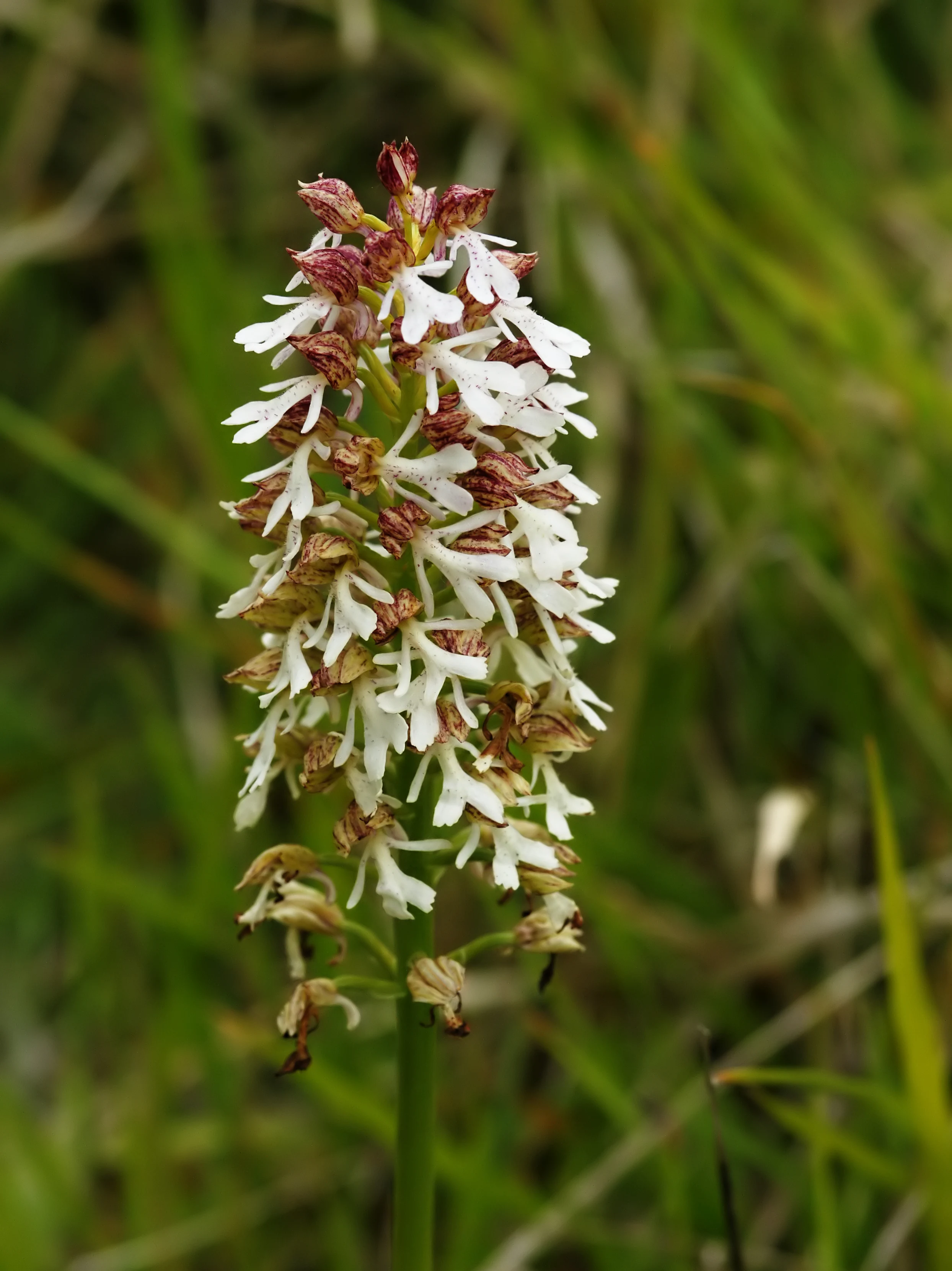
A close-up view of an Orchis x angusticruris hybrid orchid inflorescence with white and reddish-brown petals, captured against a soft-focus green grassy background.
A hybrid orchid (Orchis x angusticruris) inflorescence observed in the dry grasslands of the reserve.

Réserve naturelle régionale des Riez de Nœux-lès-Auxi history and protected-area timeline

The toponym "Les Riez" derives from the old Middle French words "riez" or "rié," which once referred to fallow or uncultivated land, a hint to the long-standing marginal or low-intensity use of the slopes before they were formally protected.

The area was first formally recognized for its ecological value when it was classified as a voluntary nature reserve in November 1999. This initial protection reflected the local and regional recognition of the slope's remarkable limestone habitats and species. A reclassification process subsequently lifted the site into the regional nature reserve framework, with the newly designated Réserve naturelle régionale des Riez de Nœux-lès-Auxi coming into being through a deliberation of the Nord-Pas-de-Calais regional council on 16 October 2007, with the classification taking effect in November 2007.

Since then, the site has been managed through a sequence of formal management plans covering successive multi-year periods, beginning in 1998 and continuing through subsequent renewals, all administered by the Conservatoire d'espaces naturels du Nord et du Pas-de-Calais. The historical trajectory of the reserve reflects a broader evolution in French nature conservation policy, moving from voluntary local protection toward standardized regional protection under a published management framework with measurable conservation objectives.

Réserve naturelle régionale des Riez de Nœux-lès-Auxi landscape and geographic character

The reserve occupies a single dramatic topographical feature: a south-facing limestone slope east of Nœux-lès-Auxi, bordering the Authie valley and oriented to receive maximum solar exposure. This exposure is the key environmental driver behind the site, defining both its microclimate and its vegetation structure.

The terrain is shaped by thin, dry, basic (calcareous) soils over limestone bedrock. Vegetation is structured as a clear gradient: open dry calcareous grasslands dominate the slope, fringed by calcicole vegetation edges that transition into dense thorny scrub and juniper shrublands. These juniper formations are among the most notable stands of common juniper in the former Nord-Pas-de-Calais region and contribute significantly to the local landscape character.

Nearby, a steep-sided ravine forest punctuates the surrounding terrain and is considered among the finest of its kind in the region, providing a striking contrast in humidity and shade next to the dry open slopes. The juxtaposition of open, sun-drenched grassland and shadowy wooded ravine over short distances creates a tightly compressed landscape mosaic unusual for the otherwise gentle countryside of inland Pas-de-Calais.
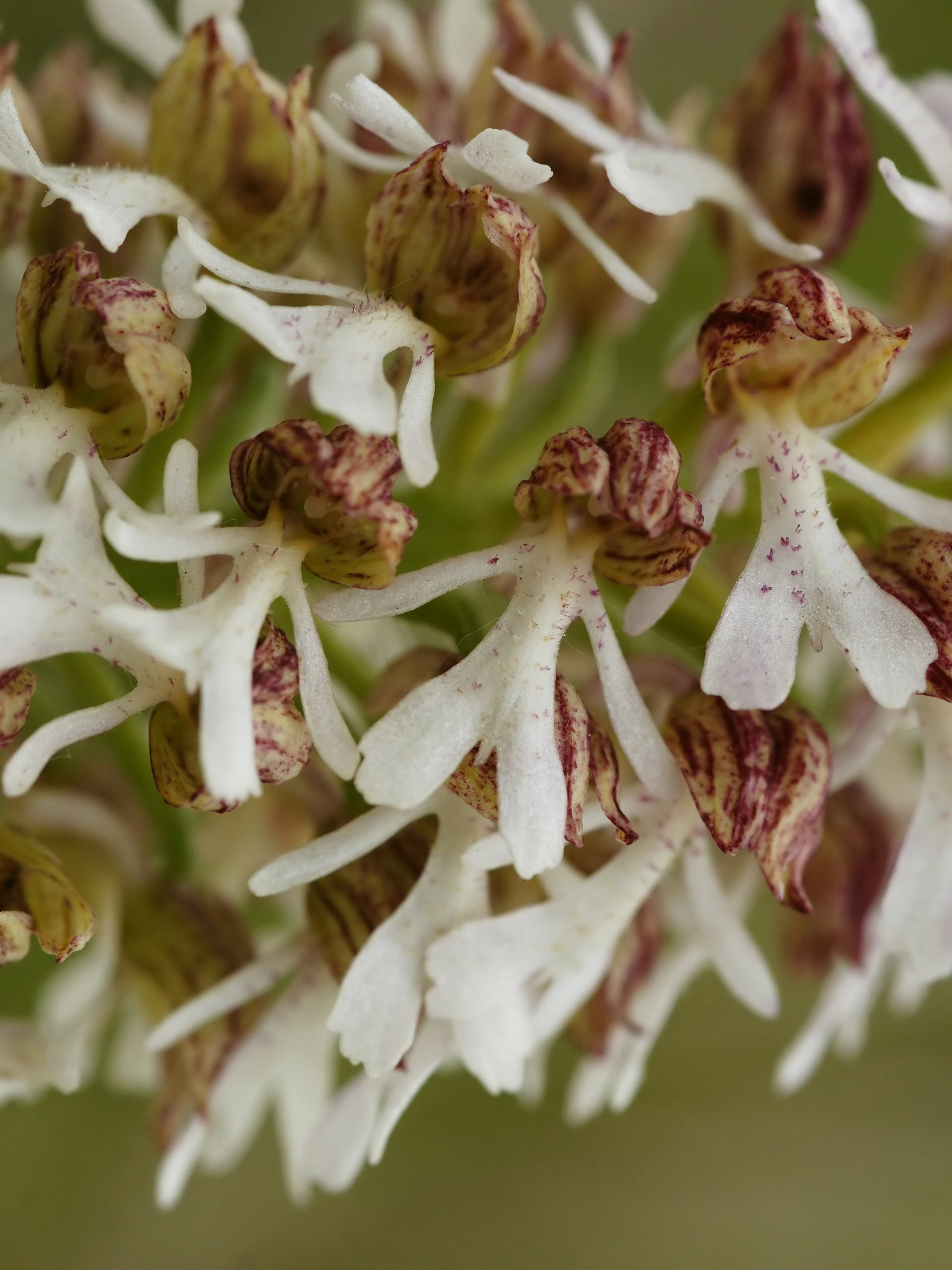
A macro shot focusing on the delicate, white and purple-spotted petals of an orchid flower cluster.
A close-up view of the hybrid orchid Orchis x angusticruris, found in the calcareous grasslands of the reserve.

Réserve naturelle régionale des Riez de Nœux-lès-Auxi ecosystems, habitats, and plant life

Ecologically, the reserve represents a remarkable example of dry calcareous grassland conservation in a northern French context. The combination of south-facing exposure, basic limestone soils, and extensive low-intensity grazing has maintained a vegetation community that includes open grassland, calcicole fringes, juniper stands, thorny scrub, and transitional ecotones connecting them.

The ecological character of the site is heavily shaped by the persistence of traditional grazing regimes. Cattle, goats, and sheep have grazed the slopes for a very long time, and their continued presence, supplemented by selective scrub-cutting, is essential to preventing the open habitats from being lost to encroachment by scrub or woodland. Without this disturbance regime, the calcicole grasslands and their associated biodiversity would rapidly disappear.

Beyond the grasslands themselves, the broader ecological interest of the area extends to the adjacent ravine forest, which adds forest habitat and humidity to the local ecological mosaic. The site is also ecologically linked to surrounding protected and inventoried areas, including a nearby ZNIEFF (the Mont de Boffles) and a Natura 2000 site covering acidic heaths, ponds, and woods on neighbouring plateaus, all of which contribute to a broader ecological network that the reserve helps anchor in the Pas-de-Calais countryside.
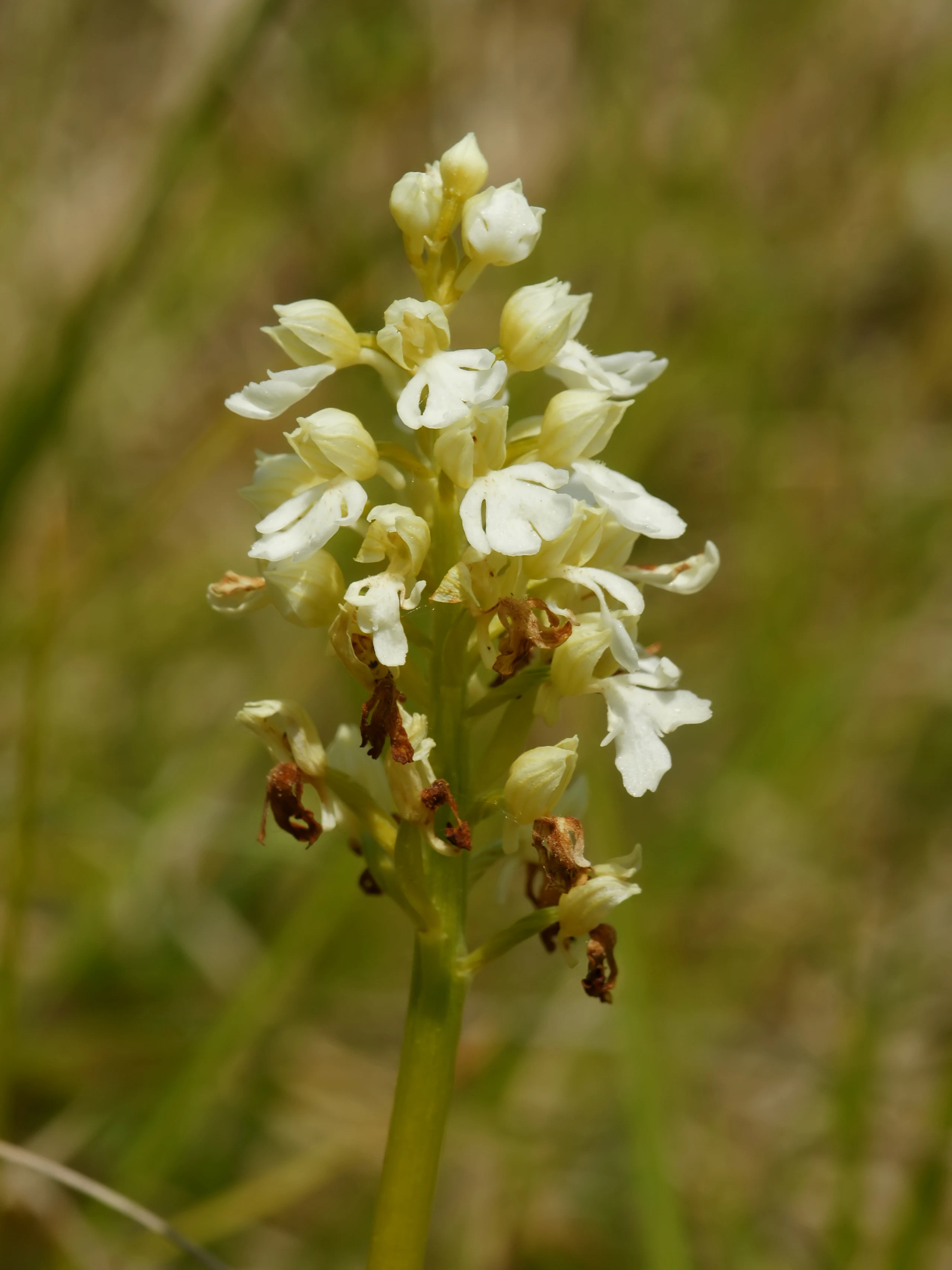
A close-up view of a Lady Orchid flower spike, showing delicate white blooms against a soft, out-of-focus green background.
A white-flowered variation of the Lady Orchid, a species found in the calcareous grasslands of the reserve.

Réserve naturelle régionale des Riez de Nœux-lès-Auxi wildlife and species highlights

The wildlife of the Réserve naturelle régionale des Riez de Nœux-lès-Auxi reflects its dry, open, sun-warmed habitats rather than the wider northern French countryside. Invertebrates dominate the conservation interest, with a particularly rich community of grasshoppers, crickets, and bush-crickets (including Decticelle, Stenobothrus lineatus, and Tetrix species) recorded for thermophilic grasslands of the region.

Butterflies are abundant and diverse, with both day-flying and nocturnal moth species benefiting from the mix of open grassland and scrub edges. Spiders are also well represented, including notably Atypus affinis, a small and harmless mygalomorph spider considered the only wild mygale found in the region, an unexpected faunal highlight for a northern French reserve.

The mosaic of grassland, scrub, and adjoining ravine forest also supports a diverse community of other invertebrates, notably glow mushrooms (Hygrocybe species) and gastropods, which have been inventoried as part of regional faunal studies. Together these groups make the reserve an important reference site for thermophilic invertebrate communities in northern France, even though its small size limits populations of larger vertebrates.

Réserve naturelle régionale des Riez de Nœux-lès-Auxi conservation status and protection priorities

The reserve's conservation significance lies primarily in the rarity of its habitats in northern France. Calcareous dry grasslands, juniper shrublands, and their associated thermophilic species are scarce in Hauts-de-France, and the reserve is recognized as the most thermophilic limestone slope in the former Nord-Pas-de-Calais region, making it an important refuge for species that would otherwise have vanished locally.

Conservation management is delivered through a formal multi-year management plan implemented by the Conservatoire d'espaces naturels du Nord et du Pas-de-Calais, with active measures including the maintenance of extensive grazing, selective scrub control, and ecological monitoring. The site's Mont de Boffles is itself classified as a ZNIEFF of type 1, reinforcing its recognized natural heritage value.

Key conservation concerns include overgrazing, which is identified as the principal direct threat, and broader environmental pressures affecting the landscape beyond the reserve's boundaries, such as eutrophication and pesticide use. These external pressures can contribute to ecological insularization, isolating the reserve's species populations from once-connected habitats and reducing long-term viability for low-dispersal organisms. The site is also connected into regional water management through the SAGE of the Authie, recognizing its role in the broader catchment-scale ecological framework.

Réserve naturelle régionale des Riez de Nœux-lès-Auxi cultural meaning and human context

The cultural context of the reserve is closely tied to long-standing rural land use in the Auxi region. The name "Les Riez" itself comes from the Middle French term for fallow or unworked land, evoking generations of marginal or low-intensity agricultural use that shaped the slopes into what they are today.

Traditional extensive grazing by cattle, goats, and sheep is not merely a conservation tool but also a continuation of longstanding pastoral practice in the area. This blending of agricultural heritage and ecological value is central to the reserve's identity, and the management approach explicitly maintains the grazing regime to preserve both biodiversity and landscape character.

The reserve also serves a cultural and educational function, providing opportunities for environmental pedagogy and landscape awareness in a region where such habitats are very rare. At the same time, managers are cautious about over-promoting visitor access, recognizing the risk of human pressure on a small, ecologically sensitive site.

Top sights and standout views in Réserve naturelle régionale des Riez de Nœux-lès-Auxi

Among the standout features of the Réserve naturelle régionale des Riez de Nœux-lès-Auxi are its status as the most thermophilic limestone slope in the former Nord-Pas-de-Calais region, the rare juniper shrubland formations, a rich orchid flora supported by basic dry soils, and the presence of Atypus affinis, the only wild mygale found so far north in France.

Equally distinctive is the intimate landscape mosaic compressed into a few hectares: open calcareous grasslands, calcicole fringes, thorny scrub, juniper stands, and a nearby ravine forest, all maintained by traditional extensive grazing. Managed by the Conservatoire d'espaces naturels du Nord et du Pas-de-Calais under a formal multi-year plan, the reserve exemplifies how a very small protected site can carry disproportionate ecological and educational value in a region where such habitats are otherwise scarce.

Best time to visit Réserve naturelle régionale des Riez de Nœux-lès-Auxi

Given its calcareous dry grassland character and abundant orchid flora, late spring through early summer is generally the most rewarding period to experience the reserve's vegetation at its peak, when orchids flower and the warm-loving insects are most active. Late spring and early summer also offer the best chance to observe butterflies and orthopterans in their most visible state.

Visits outside these months can also be rewarding for landscape appreciation and quieter observation, with the mosaic of scrub, juniper, and adjacent ravine forest offering year-round scenic interest; however, specific botanical and entomological highlights are strongly concentrated in the late spring to early summer window typical of thermophilic grassland sites in northern France.
Monthly climate preview

Long-term annual temperature and precipitation rhythm from representative coordinates

Réserve naturelle régionale des Riez de Nœux-lès-Auxi Climate and Temperature Normals

Representative coordinates record measured monthly temperature ranges and steady precipitation rates across the annual cycle. Detailed twelve-month climate profiles supply complete reference tables for comparative analysis.
Annual mean10 °C
3 °C18 °C
Jan
Feb
Mar
Apr
May13°
Jun16°
Jul18°
Aug17°
Sep14°
Oct11°
Nov
Dec
Warmest month
July

17.6 °C

Coolest month
January

2.8 °C

Wettest month
December

2.6 mm/day

Driest month
April

1.6 mm/day

Park location guide

Geography guide, regional context, and park location map for Réserve naturelle régionale des Riez de Nœux-lès-Auxi

Réserve naturelle régionale des Riez de Nœux-lès-Auxi park geography, regions, and map view in France

Understand where Réserve naturelle régionale des Riez de Nœux-lès-Auxi sits in France through a broader geographic reading of the surrounding landscape, nearby location context, and its mapped position within the national park landscape.

How Réserve naturelle régionale des Riez de Nœux-lès-Auxi fits into France

France is a unitary semi-presidential republic and one of the world's largest economies. It borders Belgium, Luxembourg, Germany, Switzerland, Italy, Monaco, Andorra, and Spain, with a maritime border to the United Kingdom. The country is known for its cultural influence, art, cuisine, and political history spanning centuries.

Wider geography shaping Réserve naturelle régionale des Riez de Nœux-lès-Auxi in France

France is located in Western Europe. Metropolitan France extends from the Rhine to the Atlantic Ocean and from the Mediterranean Sea to the English Channel and North Sea. The country borders Belgium, Luxembourg, Germany, Switzerland, Italy, Monaco, Andorra, Spain, and has a maritime border with the United Kingdom.

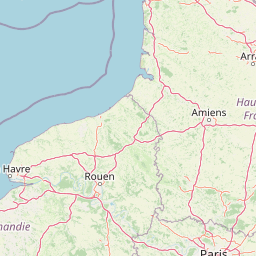
Map view of Réserve naturelle régionale des Riez de Nœux-lès-Auxi

Use this park location map to pinpoint Réserve naturelle régionale des Riez de Nœux-lès-Auxi in France, understand its exact geographic position, and read its mapped placement within the surrounding landscape more clearly.

Pigeon | © OpenStreetMap contributors

Location context for Réserve naturelle régionale des Riez de Nœux-lès-Auxi

Hauts-de-France

Visual reference collection showcasing limestone slopes, dry calcareous grasslands, and juniper habitats

Réserve naturelle régionale des Riez de Nœux-lès-Auxi Landscape Photos and Scenery

Visual documentation captures the dramatic topography of the southern limestone slopes and sun-drenched dry grasslands of Réserve naturelle régionale des Riez de Nœux-lès-Auxi. Photographic records reveal the rare vegetation mosaics, juniper shrublands, and ravine forest transitions that define the protected landscape character.

A close-up view of an Orchis x angusticruris hybrid orchid inflorescence with white and reddish-brown petals, captured against a soft-focus green grassy background.

A vertical close-up of a Lady Orchid flower spike, featuring a dense cluster of purple-brown hooded flowers and white lips speckled with purple spots.

A macro shot focusing on the delicate, white and purple-spotted petals of an orchid flower cluster.

A close-up view of a Lady Orchid flower spike, showing delicate white blooms against a soft, out-of-focus green background.

Park atlas

Compare surrounding calcareous grasslands and regional protected landscapes across northern France.

Exploring Other Parks and Protected Areas Near Réserve naturelle régionale des Riez de Nœux-lès-Auxi

Browse other parks and protected areas situated near Réserve naturelle régionale des Riez de Nœux-lès-Auxi to compare regional terrain features. Examining adjacent limestone slopes and protected habitats provides a broader understanding of northern French conservation geography.
A soft watercolor illustration of rolling hills with gentle green and yellow tones, dotted with clusters of green trees and hints of pink flowers on a white background.
Nature reservePas-de-Calais
About 5.2 km away#1 closest

West

Réserve naturelle régionale de la Pâture Mille Trous: Protected Chalk Grassland Geography

Authie valley landscape and calcareous plateau habitat

Located in the Pas-de-Calais department of northern France, this regional nature reserve preserves a rare chalk plateau and slope ecosystem. The area is marked by a distinctive field of historic lime-kiln depressions, creating a varied micro-topography. This protected landscape hosts an exceptionally diverse plant community, including numerous orchid species, within a compact mosaic of grassland and woodland edges overlooking the Authie valley.

Area
0.064 km²
Established
2007
IUCN
IV
Relief
Upland
Nature reservePas-de-Calais
About 18 km away#2 closest

North

Réserve naturelle régionale du marais de la Grenouillère: Wetland Geography and Map

Protected alluvial floodplain in the Pas-de-Calais region

This regional nature reserve encompasses sixteen hectares of high-density wetland habitats along the Ternoise river. Its flat topography sustains a delicate mosaic of alkaline marshes, wet meadows, and riparian alder woodlands that serve as a critical ecological buffer within the broader landscape of northern France.

Area
0.166 km²
Established
2000
IUCN
IV
Relief
Lowland
A soft watercolor illustration showing a landscape with sparse trees, a sunlit clearing, and rolling hills in the background, set against a plain white background.
Nature reserveHauts-de-France
About 37 km away#3 closest

West

Réserve naturelle régionale du bois des Agneux: Protected Nature Reserve Landscape

Wetland habitat and acidiphile woodland in Hauts-de-France

Examine the geography of Réserve naturelle régionale du bois des Agneux, a nature reserve in the Somme department of Hauts-de-France. This protected area stands out for its mosaic of acidiphile oak woodland, seasonal pools, and sandy micro-relief, serving as a critical refuge for specialized flora and fauna on the Picardy coast.

Area
0.256 km²
Established
2015
IUCN
IV
Relief
Lowland
A soft watercolor painting of a grassy landscape with exposed limestone rock faces and green vegetation.
Nature reserveHauts-de-France
About 45 km away#4 closest

North

Réserve naturelle régionale des anciennes carrières de Cléty: Protected Geological Landscape

Regional nature reserve in the Hauts-de-France, France

A significant geological protected area in the Pas-de-Calais, this reserve features an exposed chalk quarry face that serves as a stratigraphic record for the Cretaceous period. The landscape hosts a rare intersection of geological heritage and diverse ecosystems, including orchids, butterflies, and bat colonies, within a compact footprint.

Area
0.02 km²
Established
2011
IUCN
IV
Watercolor painting of a coastal salt marsh with winding tidal channels, grassy banks, and soft green and purple tones.
Nature reserveSomme
About 46 km away#5 closest

West

Reserve naturelle nationale de la baie de Somme: Estuarine Geography and Protected Boundaries

Coastal mapping of the Somme estuary in northern France

Covering a wide range of tidal environments, the Reserve naturelle nationale de la baie de Somme represents one of France's most significant protected estuarine systems. This overview focuses on the interplay of river and tide, showcasing the expansive mudflats, salt marshes, and dune habitats that support immense bird populations and harbor seals along the Picardy shoreline.

Area
34.209 km²
Established
1994
IUCN
IV
Relief
Lowland
Watercolor painting of a marshy wetland landscape featuring rolling hills, green trees, and foreground grasses against a white background.
Nature reservePas-de-Calais
About 48 km away#6 closest

Northeast

Marais de Cambrin, Annequin, Cuinchy et Festubert Regional Nature Reserve: Protected Wetland Atlas

Alluvial floodplains and biodiversity refuges in Pas-de-Calais

Trace the boundaries and protected features of the Marais de Cambrin, Annequin, Cuinchy et Festubert Regional Nature Reserve. This site preserves an essential mosaic of open water, peat-rich fens, and damp alluvial woods that function as a crucial nesting ground for waterfowl and a repository for rare botanical heritage in northern France.

Area
0.742 km²
Established
2009
IUCN
IV
Relief
Lowland
Nature reserveHauts-de-France
About 50 km away#7 closest

North

Réserve naturelle régionale du plateau des landes: Regional Nature Reserve Landscape Profile

Protected heathland geography in the Pas-de-Calais corridor.

Understand the ecological structure of the Réserve naturelle régionale du plateau des landes. This protected area features a unique crescent shape and mosaic of heathland sectors spread across several communes, offering a focused study of low-elevation inland conservation management in the heart of northern France.

Area
1.811 km²
Established
2009
IUCN
IV
Watercolor painting of a coastal landscape with sand dunes, beach grasses, and distant hills under a light sky.
Nature reservePas-de-Calais
About 51 km away#8 closest

Northwest

Réserve naturelle nationale de la baie de Canche Protected Area Map and Geography

Coastal dune ecosystems and tidal estuary landscapes in Pas-de-Calais

This protected area offers a look into the geomorphology of the Canche estuary, where longshore drift, salt marshes, and rare chalk-cliff dune systems create a distinct environment. Understand the landscape context of this French national nature reserve, serving as a sanctuary for migratory bird populations and a site for active coastal research along the English Channel.

Area
5.05 km²
Established
1987
IUCN
IV
Relief
Lowland

Common questions about visiting, size, designation, and location context for Réserve naturelle régionale des Riez de Nœux-lès-Auxi

Réserve naturelle régionale des Riez de Nœux-lès-Auxi FAQs for park facts, access, geography, and protected area context

Find quick answers about Réserve naturelle régionale des Riez de Nœux-lès-Auxi, including protected-area facts, park geography, trail and visitor context, and how the park fits into its surrounding country and regional landscape.
MoriAtlas Explorer

Continue Your Protected Areas Search Across the Global Atlas

Deepen your exploration by continuing the structured search for national parks and protected areas worldwide. Utilize the comprehensive filtering capabilities to compare different conservation landscapes and refine your understanding of global park geography. Discover more about the distribution and characteristics of protected natural areas.

Global natural geography