Why Thaidene Nëné National Park Reserve stands out
Thaidene Nëné is best known for its position at the ecological boundary between Canada's boreal forest and Arctic tundra, a transition zone of exceptional biodiversity and visual drama. The park reserve protects critical habitat for boreal woodland caribou, a species at risk, as well as significant populations of muskox, moose, wolves, and grizzly bears. The landscape is characterized by striking red granite cliffs rising from the boreal woodlands, giving way to an spectacular array of peninsulas, canyons, and waterfalls as the forests transition northward into tundra. This geological and ecological meeting point creates one of the most visually distinctive protected areas in Canada's north, with the added cultural significance of representing a successful model of Indigenous-guided conservation where First Nations played a central role in shaping the protected area's boundaries and management.
Thaidene Nëné National Park Reserve history and protected-area timeline
The establishment of Thaidene Nëné National Park Reserve represents a conservation journey spanning more than five decades. Initial consideration for a national park in the region emerged in the 1970s, but a proposed 7,340 square kilometer protected area was withdrawn under the Territorial Lands Act in 1970. The proposal lay dormant until 2001, when the Łutsël K'é Dene First Nation (then known as the Snowdrift band) reignited interest in protecting their traditional territory. From 2002 to 2004, formal consultations proceeded, eventually expanding to include the Métis Nation. In 2005, the Łutselk'e produced a Band Council Resolution supporting a national park as part of a broader protection initiative for their traditional lands. A pivotal 2006 memorandum of understanding between the Łutselk'e Dene First Nation and the federal Minister of Environment expanded the study area by an additional 26,350 square kilometers. By 2014, the Northwest Territories government assumed administrative control of the 33,690 square kilometer study area, proposing a scaled-down National Park Reserve of approximately 14,000 square kilometers combined with territorial designations protecting 75 percent of the total area. After public consultations and federal budget allocation in 2016, the Łutselk'e Dene First Nation voted to approve the park's creation on February 15, 2019. The formal agreement was signed on August 21, 2019, establishing the national park reserve alongside complementary territorial protected areas.
Thaidene Nëné National Park Reserve landscape and geographic character
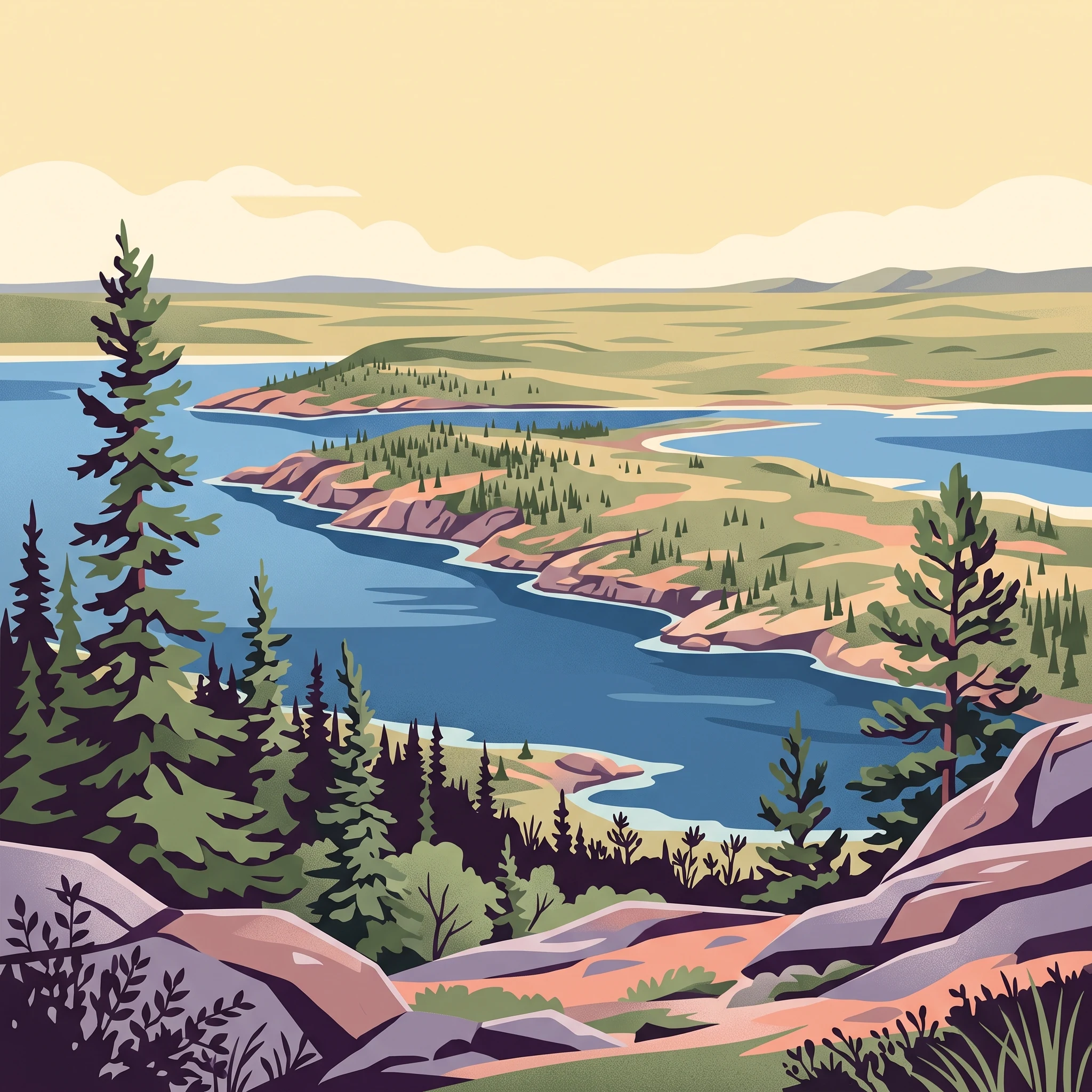
The landscape of Thaidene Nëné National Park Reserve presents a dramatic north-south ecological and visual transition across approximately 14,070 square kilometers of northern Canadian wilderness. The southern portions of the reserve lie within the boreal forest, characterized by dense stands of coniferous trees including spruce, fir, and pine, interspersed with deciduous species like aspen and birch. As visitors travel northward through the park, the forest gradually thins and gives way to the open terrain of the northern tundra, creating a striking visual progression that defines the park's character. The geology is marked by spectacular red granite cliffs and exposed bedrock that create dramatic backdrops throughout the reserve. The landscape features an extraordinary array of peninsulas jutting into Great Slave Lake, deep canyons carved by ancient waterways, and numerous waterfalls where streams cascade over granite ledges. The eastern arm of Great Slave Lake itself forms a dominant feature of the park, its deep blue waters contrasting with the surrounding boreal woodlands and rocky shores. This combination of boreal forest, tundra, freshwater ecosystems, and rugged granite topography creates one of the most visually distinctive protected landscapes in Canada's north.
Thaidene Nëné National Park Reserve ecosystems, habitats, and plant life
Thaidene Nëné occupies a critical ecological position at the transition between Canada's boreal forest and Arctic tundra, creating a unique environment of exceptional biodiversity and ecological significance. The boreal forest that covers the southern portions of the reserve represents Canada's largest land ecosystem, while the northern reaches transition into tundra habitats characteristic of the subarctic. This ecological boundary zone supports species from both ecosystems, creating an unusual diversity of plant and animal life within a single protected area. The park protects significant freshwater ecosystems associated with Great Slave Lake and its tributaries, including numerous rivers, streams, and wetlands that provide critical habitat for aquatic species and migratory waterfowl. The combination of forest, tundra, and aquatic habitats creates a mosaic of ecological communities that supports the wide array of species documented within the reserve.
Thaidene Nëné National Park Reserve wildlife and species highlights
The wildlife of Thaidene Nëné reflects the park's unique position at the meeting point of boreal and Arctic ecosystems, with species from both environments found within its boundaries. The park provides crucial habitat for boreal woodland caribou, a species listed as threatened in Canada, whose conservation was a primary driver for the protected area's establishment. The reserve supports healthy populations of large mammals including moose, white-tailed deer, and both black bear and grizzly bear. The predator community includes wolves, Canada lynx, and wolverine, while smaller mammals like American marten, beaver, red fox, and Arctic fox are also present. Muskox inhabit the northern portions of the park, representing an Iconic Arctic species at the southern edge of its range. Barren-ground caribou, a separate ecotype from the woodland caribou, also utilize the reserve's tundra habitats during seasonal migrations. The area features significant birdlife, with various migratory duck species and songbirds staging and nesting in the wetlands and forests during the brief Arctic summer.
Thaidene Nëné National Park Reserve conservation status and protection priorities
Thaidene Nëné National Park Reserve represents a landmark achievement in Canadian conservation, embodying a new approach to protected area establishment that centers Indigenous leadership and collaborative governance. The reserve protects nationally significant boreal forest, tundra, and freshwater ecosystems that contain critical habitat for species at risk, particularly the boreal woodland caribou. The park's establishment followed extensive negotiations that resulted in a comprehensive conservation framework spanning over 26,000 square kilometers when combined with adjacent territorial protected areas and wildlife conservation zones. This layered approach to protection, which includes federal national park designation, territorial protected areas, and Indigenous Protected Area status, creates a robust conservation model that addresses both ecological and cultural values. The reserve contributes to Canada's international conservation commitments while protecting lands that have been central to Dene stewardship and traditional use for generations.
Thaidene Nëné National Park Reserve cultural meaning and human context
The name Thaidene Nëné derives from the Dene Chipewyan language and carries profound cultural meaning, translating to "land of our ancestors" and reflecting the deep connection between Indigenous peoples and this landscape. The Łutselk'e Dene First Nation played the central role in driving the establishment of the protected area, with their leadership and vision shaping both the boundaries and the management framework of the reserve. The creation process explicitly involved three First Nations—the Łutselk'e Dene First Nation, Deninu K'ue First Nation, and Yellowknives Dene First Nation—alongside the Métis Nation, representing a truly collaborative approach to northern conservation. The park forms part of the broader Thaıdene Nëné Indigenous Protected Area, a designation that recognizes the ongoing cultural connection between Indigenous communities and the land. This partnership model has become a reference point for how Indigenous peoples can lead conservation initiatives in Canada, demonstrating that protected areas can be established in ways that honor Indigenous rights, knowledge, and vision for their traditional territories.
Top sights and standout views in Thaidene Nëné National Park Reserve
Thaidene Nëné offers visitors access to one of Canada's most significant northern wilderness areas, with its dramatic transition from boreal forest to tundra creating a unique and visually striking landscape. The red granite cliffs and waterfalls of the east arm country represent some of the most impressive geological features in the Northwest Territories. Wildlife viewing opportunities are exceptional, with the chance to encounter muskox, moose, caribou, wolves, and grizzly bear in their natural boreal and Arctic habitats. The park represents a pioneering model of Indigenous-led conservation, where First Nations played a central role in shaping the protected area's establishment and continue to be partners in its management. The area's significance as a cultural landscape for the Dene people adds depth to the visitor experience, connecting natural beauty with Indigenous heritage and the meaning of "land of our ancestors."
Best time to visit Thaidene Nëné National Park Reserve
The optimal time to experience Thaidene Nëné National Park Reserve aligns with the brief northern summer, typically from mid-June through September, when temperatures are milder and the landscape is accessible. During this period, the boreal forest is green, waterfalls flow strongly, and wildlife is active throughout the extended daylight hours of the northern summer. The short but intense flowering season in late June and July brings the tundra to life with colorful wildflowers. Visitors interested in wildlife viewing may find the shoulder seasons of late spring and early fall particularly rewarding, as animals become more active during transitional periods. Winter visits offer the chance to experience the park's stark northern character, though access and services are extremely limited. The park's northern location means that summer visitors can experience the phenomenon of the midnight sun, while winter brings extended periods of darkness characteristic of the Arctic.