Why Acadia National Park stands out
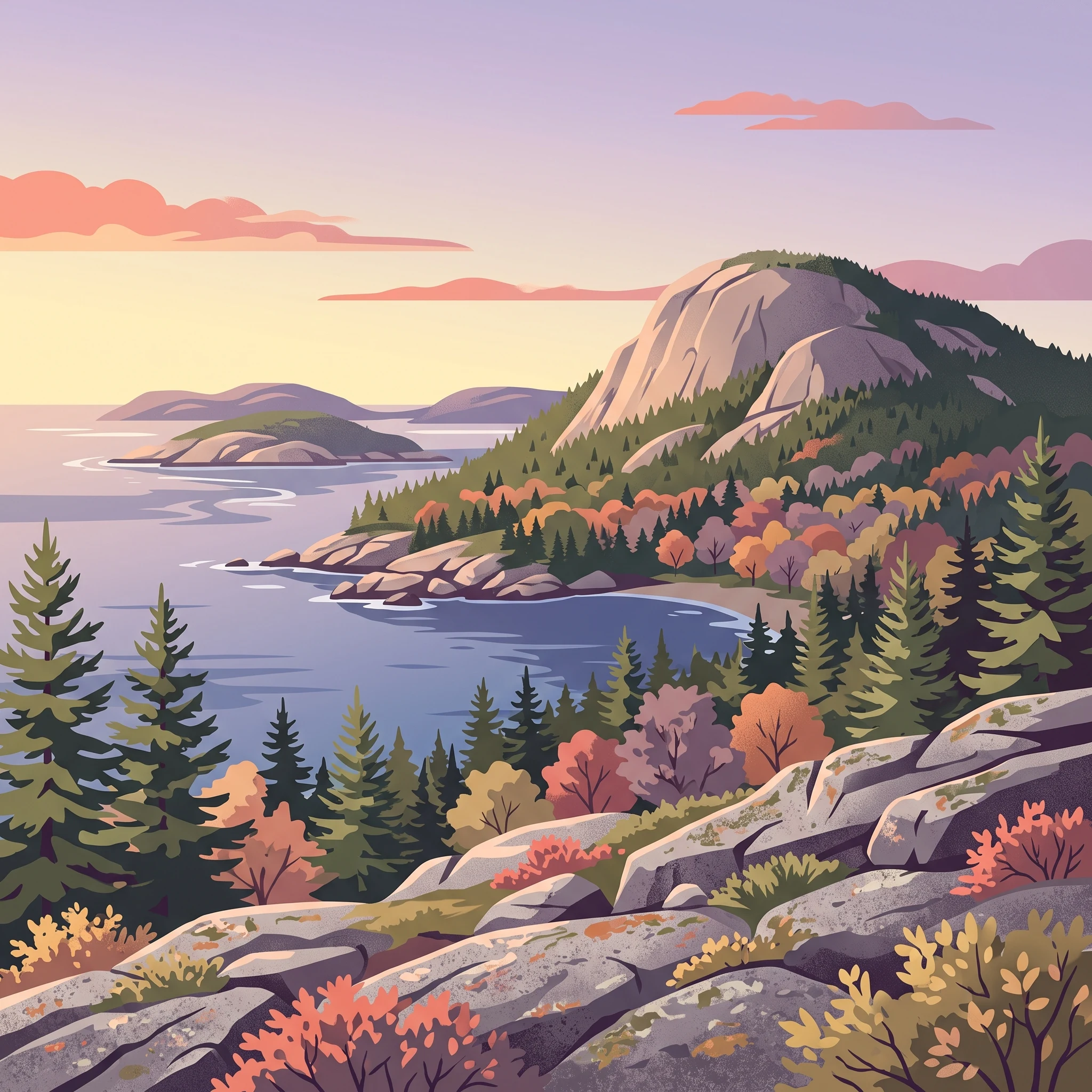
Acadia is best known for its distinctive combination of coastal mountain scenery, with granite domes and exposed ridges rising dramatically from the Atlantic Ocean, and an extensive historic carriage road system that remains a signature feature of the park experience. The summit of Cadillac Mountain provides sweeping panoramic views and holds special significance as the first place in the continental United States to witness sunrise from early October through March. The Park Loop Road, which traverses 27 miles of the park's eastern side, passes notable landmarks including the Beehive, Sand Beach, Thunder Hole, Otter Cliff, Jordan Pond, and The Bubbles. The park's spruce-fir boreal forests, freshwater wetlands, and intertidal zones support remarkable biodiversity, while the legacy of John D. Rockefeller Jr.'s patronage is visible in the carefully designed carriage roads, stone bridges, and granite guardrails known colloquially as "Rockefeller's Teeth".
Acadia National Park history and protected-area timeline
The human history of Acadia extends back over ten thousand years to the Wabanaki Confederacy, whose ancestral homeland included Mount Desert Island, which they called Pemetic, meaning "the range of mountains." European exploration began in the early 16th century, with Giovanni da Verrazzano sailing along the coast in 1524 and Samuel de Champlain arriving in 1604, who named the island Isle des Monts Deserts due to its barren granite peaks. The first French missionary colony was established on the island in 1613, followed by periods of French, British, and finally American control. Summer visitors began arriving in the 1850s, and by the 1880s the island had become a prestigious summer retreat for wealthy American families including the Rockefellers, Morgans, Fords, Vanderbilts, Carnegies, and Astors. The conservation movement that led to the park's creation emerged from the efforts of landscape architect Charles Eliot, George B. Dorr, and Charles W. Eliot, who advocated for protection of the island's natural beauty. President Woodrow Wilson established the park's federal status as Sieur de Monts National Monument on July 8, 1916, and it was redesignated as Lafayette National Park in 1919 before receiving its current name in 1929. The catastrophic fire of 1947 burned over 10,000 acres within the park and destroyed numerous historic summer cottages, after which natural regeneration transformed the landscape with new deciduous forests of birch and aspen.
Acadia National Park landscape and geographic character
The landscape of Acadia National Park reflects the powerful forces of glacial activity that shaped the region during the last Ice Age, leaving behind a distinctive terrain of granite domes, U-shaped valleys, and coastal exposures that defines the park's visual character. Mount Desert Island's geology centers on the Cadillac Mountain Intrusive Complex, where Silurian-era granite roughly 420 million years old forms the dominant bedrock, its pinkish color deriving from perthite feldspar. The twenty-six mountains of the park rise from the Atlantic as rounded summits and exposed cliffs, with the most prominent being Cadillac Mountain, whose 1,530-foot height makes it the tallest peak along the eastern seaboard. Glacial carving created the deep valley of Somes Sound, a five-mile-long fjard that nearly divides the island in half and reaches depths of 130 feet at its deepest point. The coastline alternates between rocky headlands where Atlantic waves batter granitic cliffs and more sheltered coves containing cobble and sand beaches, with notable features including Otter Cliff, Thunder Hole, and Sand Beach. The interior landscape encompasses numerous lakes and ponds formed in glacial valleys, including Jordan Pond, Eagle Lake, and Echo Lake, surrounded by forests that blanket the mountain slopes and valley floors.
Acadia National Park ecosystems, habitats, and plant life
Acadia's ecological character reflects its position at the intersection of boreal and temperate forest zones, creating a mosaic of habitats that supports remarkable biological diversity. The park's ecological zones progress from nearly barren mountain summits through northern boreal spruce-fir forests on the mountainsides, to eastern deciduous forests of oak, maple, and beech on lower slopes, then down to freshwater lakes and wetlands in the valleys, and finally to the Atlantic shoreline with its rocky and sandy beaches. Spruce-fir forests cover more than sixty percent of the naturally vegetated areas, representing the southern limit of the boreal forest ecosystem in eastern North America. Freshwater habitats include fourteen great ponds and numerous smaller bodies of water, together with extensive wetlands encompassing marshes, swamps, and bogs that constitute more than twenty percent of the park's area. The Mount Desert Island portion of the park harbors more than half of all vascular plant species found in Maine, with over 400 indigenous species represented in the Wild Gardens of Acadia established in the Sieur de Monts area. Coastal environments feature more than sixty miles of rocky shoreline supporting diverse intertidal communities including starfish, blue mussels, sea cucumbers, and rockweed.
Acadia National Park wildlife and species highlights
The diverse habitats of Acadia support a rich assemblage of wildlife, with the park documenting 37 mammalian species, 215 confirmed bird species, numerous amphibians, reptiles, and fish, as well as marine mammals in the surrounding waters. Mammalian residents include white-tailed deer and moose as the primary large herbivores, with predators such as coyotes, red foxes, and the elusive black bear maintaining ecological balance. The park's forests and wetlands provide habitat for smaller mammals including beavers, porcupines, eastern chipmunks, and several species of shrews and bats, with the northern long-eared bat notably affected by white-nose syndrome since 2012. Birdlife is particularly diverse, with species ranging from common loons and waterfowl in wetland areas to raptors including bald and golden eagles, peregrine falcons, and various hawks and owls. The park has been particularly significant for peregrine falcon recovery, with successful nesting occurring annually since 1991 after the species had been absent from the park since the 1950s. Marine waters support seals and whales, with humpback whales commonly observed from the coast and whale-watching excursions departing regularly from Bar Harbor.
Acadia National Park conservation status and protection priorities
Acadia National Park serves as a critical conservation anchor for the Northeastern United States, protecting a coastal ecosystem that represents the southern limit of boreal forest habitat in eastern North America and preserving ecological communities found nowhere else in the region. The park's designation as an IUCN Category V protected landscape acknowledges its exceptional combination of natural beauty, ecological significance, and the successful integration of human cultural elements including the historic carriage road network. Conservation challenges facing the park include managing the impacts of increasing visitation, with over four million annual visitors creating congestion and infrastructure strain, while climate change has extended the growing season by nearly two months, facilitating the spread of invasive species and placing additional stress on park resources. The park maintains an active land acquisition program, with the boundary established by Congress in 1986 including substantial private lands under conservation easements. Partnerships with organizations such as Friends of Acadia provide critical support for trail maintenance, research programs, and the carriage road endowment, while the Schoodic Education and Research Center advances scientific understanding of coastal ecosystems.
Acadia National Park cultural meaning and human context
The cultural landscape of Acadia reflects over twelve thousand years of human occupation, beginning with the Wabanaki Confederacy whose ancestral homeland encompassed the coastal areas of Maine and who continue to maintain connections to the region today. The park name derives from the Mi'kmaq term akadie, meaning "piece of land," which French explorers rendered as l'Acadia, later translated into English as Acadia. Following European contact, the Wabanaki engaged in the fur trade and subsequently suffered devastating population losses from introduced diseases, while the island passed through French, British, and finally American control. The 19th century brought an influx of artists from the Hudson River School who popularized the island's scenery, followed by wealthy summer visitors who built elaborate estates known as cottages, creating a distinctive Gilded Age cultural landscape. The park's creation through private land donations represents a unique chapter in American conservation history, with George B. Dorr earning recognition as the "Father of Acadia National Park" for his tireless advocacy. The Wabanaki continue to participate in the park's cultural life through the annual Bar Harbor Native American Festival, craft demonstrations at the Abbe Museum, and ongoing consultation on park management.
Top sights and standout views in Acadia National Park
Acadia National Park offers visitors an exceptional combination of natural wonders and recreational opportunities that have made it one of the most visited national parks in the United States. The iconic Park Loop Road provides access to sweeping coastal vistas, with stops at Thunder Hole where waves crash dramatically into a rocky crevasse, Sand Beach for ocean swimming, and the summit of Cadillac Mountain for panoramic views across Frenchman Bay and the Porcupine Islands. The carriage road system, a National Historic Landmark, provides over 45 miles of well-maintained routes for hiking and bicycling through the heart of the park's forested interior, with distinctive granite bridges and the characteristic "Rockefeller's Teeth" guardrails. Jordan Pond, with its famous teahouse offering popovers with afternoon tea, represents a beloved tradition for generations of visitors. The park's island locations, particularly Isle au Haut with its remote Duck Harbor Campground accessible only by boat, offer more secluded wilderness experiences within the park system. Winter transforms the park into a wonderland for cross-country skiing, snowshoeing, and snowmobiling, with the carriage roads providing scenic routes through snow-draped forests.
Best time to visit Acadia National Park
Acadia offers compelling seasonal experiences throughout the year, though the peak visitation occurs during the summer months of June through August when warm temperatures and long days enable the full range of park activities. Summer brings daytime temperatures averaging in the 70s Fahrenheit, comfortable for hiking the mountain trails, cycling the carriage roads, or swimming at Sand Beach and Echo Lake, while ocean water temperatures range from 50 to 60 degrees. Fall provides arguably the park's most spectacular visual appeal as the deciduous forests display brilliant foliage in shades of red, orange, and gold, typically peaking in mid-October, while the reduced crowds allow for more contemplative exploration of the park's landscapes. Spring brings the emergence of wildflowers and the return of migratory birds along the Atlantic Flyway, though trail conditions may be affected by mud season. Winter offers a dramatically different park experience, with cross-country skiing and snowshoeing on the carriage roads providing access to a quiet, snow-covered landscape, though many facilities are closed and the park requires more self-reliant exploration.