
Why Anyuysky National Park stands out
Anyuysky National Park is best known for its role as a vital ecological corridor linking the Amur River floodplain with the high forested mountains of the Sikhote-Alin, creating a continuous protected habitat that spans dramatically different ecosystems. The park protects significant populations of the endangered Amur tiger (Siberian tiger), one of the rarest large cats in the world. It also encompasses the valley of Tordoki Yani, the highest peak in the Sikhote-Alin range. The park's wetlands support exceptional migratory bird populations, while its forests contain the Korean pine, described by the World Wildlife Fund as the heart of the ecosystem, though this species faces severe pressure from illegal logging.
Anyuysky National Park history and protected-area timeline
Anyuysky National Park was established on May 15, 1999, formalizing protection for the Anyuy River basin and its surrounding landscapes in Khabarovsk Krai. The Nanai people have been the traditional inhabitants of the local rural settlements in this region for generations, maintaining their cultural connection to the land and its resources. During the Soviet era, the small village of Arsenyevo on the interior border of the park served as a place of exile during the 1930s collectivization period. The same village later functioned as a Japanese prisoner-of-war camp during the 1940s, reflecting the region's turbulent 20th-century history. In 2011, the Sakhalin-Khabarovsk-Vladivostok pipeline was completed, following a section of an earlier pipeline along the Amur River above Khabarovsk and running along the western border of Anyuysky Park. The operator, Gazprom, stated that minimal environmental impact requirements were observed during construction, with operations carried within existing communication lines and disturbed lands remediated. By 2012, the park reported opening a visitors center and employing approximately 50 people. A significant conservation milestone occurred in 2015 when an Amur tiger named Uporny (Russian for Stubborn) was released in the region. After wandering for six weeks, GPS tracking recorded the tiger establishing a territory within Anyuysky National Park, demonstrating the park's suitability as habitat for this endangered species.
Anyuysky National Park landscape and geographic character
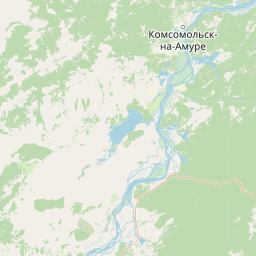
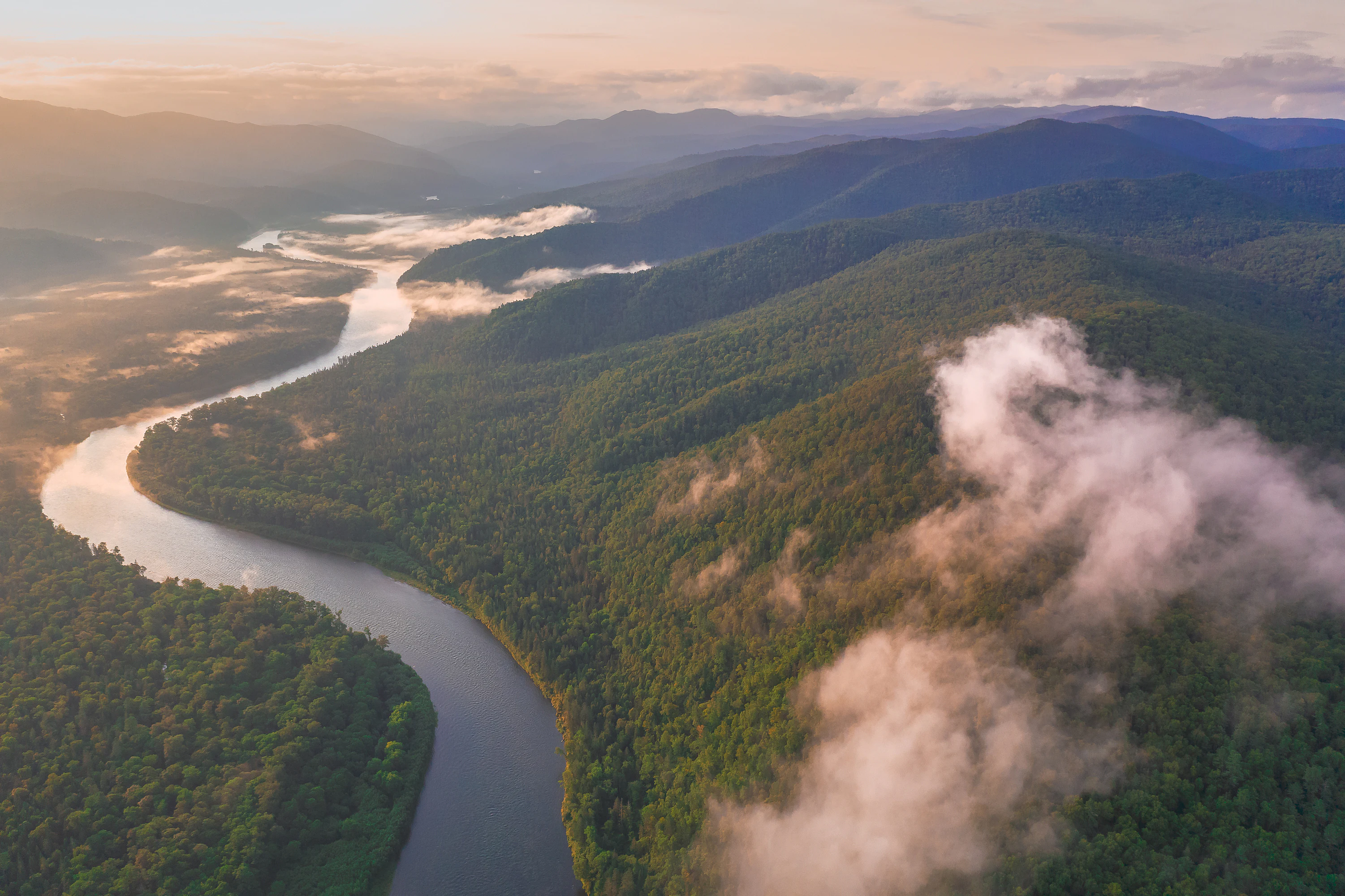
The landscape of Anyuysky National Park exhibits a striking contrast between its western and eastern portions, defined by the transition from the Amur River lowlands to the Sikhote-Alin highlands. The western half of the park sits on a low-lying eastern extension of the Sredneamurskaya plain, a flat, boggy depression situated between the Sikhote-Alin ridge to the east and the Lesser Khingan mountains to the west. These alluvial lowlands of the Amur River floodplain reach altitudes as low as 40 meters. The park's boundaries form a horseshoe shape that follows the dividing ridges of the small river basins of the Anyuy and Pihtsy rivers, both of which flow west into the Amur River. The southeastern wing of the park encompasses the valley of the Pihtsy River and remains relatively flat, while the northeastern wing follows the Anyuy River valley and its tributaries through steeper, deeper canyons at an average altitude of 600 meters. The ultimate headwaters of the Anyuy rise at Tordoki Yani, the highest peak in the Sikhote-Alin mountain range. The southern boundary follows the northern line of the Three Sisters dividing range of mountains, creating the park's distinctive shape that extends from the Amur floodplain upward into the forested mountains.
Anyuysky National Park ecosystems, habitats, and plant life
Anyuysky National Park occupies a critical position within the Ussuri broadleaf and mixed forests ecoregion, an area renowned for its extraordinary level of endemism in plants and invertebrates. This exceptional biodiversity stems from multiple factors: the convergence of several distinct ecological regions, the relatively isolated and less developed state of the Russian portion of the Amur River basin compared to more heavily utilized Chinese and Korean territories, and the absence of glaciation during the most recent ice age which preserved ancient species. The park is distinguished by its continuous habitat gradient spanning from river floodplains through valley-mountain sub-taiga to mountain ridges. Approximately 45% of the park's tree cover consists of Far Eastern Taiga, while 30% is sub-taiga mid-mountain coniferous forest, 14% is river floodplain and delta, and 11% is marshland. Fully one-quarter of the park's territory comprises temperate wetlands within the Amur-Heilong River Basin, making it an important habitat for wetland species and fish in the mountain streams above the Amur. The Korean pine (Pinus koraiensis), also known as Korean cedar, has been described as the heart of the ecosystem by the World Wildlife Fund, though populations have declined by two-thirds in the past 50 years due to logging pressures.
Anyuysky National Park wildlife and species highlights
Anyuysky National Park provides crucial habitat for the endangered Amur tiger (Panthera tigris altaica), also known as the Siberian tiger, which remains a resident species within the park alongside most mountain species of the northern Sikhote-Alin. The Amur tiger population represents one of the rarest and most endangered large cat populations globally, making the park's role in its conservation critically important. The lower floodplain areas are particularly significant for their support of migratory bird populations, serving as important stopping and nesting grounds along avian migration routes. Several vulnerable species inhabit the park, including the near-threatened mountain weasel, the vulnerable Asian black bear, and the long-tailed birch mouse, which carries a data deficient conservation status according to IUCN definitions. The Amur River and its tributary streams support remarkable freshwater biodiversity, hosting more species than any other river in Russia—approximately 120 species—and particularly renowned for the salmon that migrate upstream to spawn in the mountain streams that flow through the park.
Anyuysky National Park conservation status and protection priorities
Anyuysky National Park serves as a vital component in the network of protected areas spanning the middle and lower Amur River basin, representing one of the few remaining large-scale corridors protecting continuous habitat from river floodplains to mountain forests in the Russian Far East. The park's conservation significance is amplified by its position protecting the Ussuri broadleaf and mixed forests ecoregion, which harbors extraordinarily high levels of plant and invertebrate endemism. The protection of the Amur tiger population remains a central focus, with the 2015 release and successful territorial establishment of tiger named Uporny demonstrating the park's value as tiger habitat. However, the park faces significant conservation challenges, particularly from illegal logging that has dramatically reduced Korean pine populations throughout the region. The Amur-Heilong River Basin wetlands, comprising one-quarter of the park's territory, represent another critical conservation focus, supporting both migratory bird populations and freshwater fish species including salmon. The completion of the Sakhalin-Khabarovsk-Vladivostok pipeline along the park's western border introduced potential infrastructure-related pressures that require ongoing monitoring.
Anyuysky National Park cultural meaning and human context
The Anyuysky region has been home to the Nanai people, an indigenous group whose traditional settlements have depended on the local resources for generations. The Nanai represent approximately a quarter of the population in nearby settlements, maintaining cultural practices tied to the river and surrounding forests. The local economy has historically centered on salmon fishing, logging, and hunting—activities that shaped both the landscape and the cultural identity of the region. The village of Arsenyevo, located on the interior border of the park, carries historical significance from the Soviet era when it served as a place of exile during the 1930s collectivization period and later as a Japanese prisoner-of-war camp during the 1940s. These historical layers reflect the complex human history interwoven with this remote corner of the Russian Far East, where indigenous heritage meets 20th-century geopolitical turbulence.
Top sights and standout views in Anyuysky National Park
Anyuysky National Park stands out as a critical ecological corridor spanning from the Amur River floodplain to the Sikhote-Alin mountain heights, protecting one of the most biodiverse temperate forest regions in the Northern Hemisphere. The park provides essential habitat for the endangered Amur tiger, with successful tiger reintroduction efforts demonstrating its conservation value. Its wetlands support exceptional migratory bird populations and fish species, including salmon runs in the mountain streams. The Korean pine forests, though threatened by illegal logging, remain the ecological heart of this protected landscape. The park's geography ranges from flat alluvial plains at 40 meters elevation to the heights of Tordoki Yani, the highest peak in the Sikhote-Alin, creating remarkable habitat diversity within a single protected area.
Best time to visit Anyuysky National Park
Anyuysky National Park experiences a humid continental climate with four distinct seasons, featuring cold, dry winters and warm, wet summers. The warmest period occurs during the summer months when average temperatures reach into the 20s Celsius, making this the most biologically active season when wildlife is most observable and vegetation is in full growth. Autumn brings the characteristic fall foliage for which the Ussuri broadleaf and mixed forests ecoregion is renowned, with the Korean pine and Mongolian oak displaying vibrant colors. Winter, while harsh with temperatures well below freezing and minimal precipitation, offers a stark landscape experience though access may be limited. Spring brings renewed activity as temperatures rise and migratory birds return to the wetland areas. The summer months likely offer the most accessible and rewarding visitor experience, though the park's remote location and limited infrastructure mean that any visit requires careful planning.