
Mori Atlas logo
Wildlife reserveBoabeng-Fiema Monkey Sanctuary

Discover the mapped landscape and community-led conservation dynamics of this unique central Ghana primate sanctuary.

Boabeng-Fiema Monkey Sanctuary Wildlife Reserve and Protected Forest Geography in Bono East Region

(Boabeng-Fiema Monkey Wildlife Sanctuary)

The Boabeng-Fiema Monkey Sanctuary spans 4.4 square kilometers of lush forest within the Bono East Region, serving as a critical habitat for Campbell's mona monkeys and the endangered Geoffrey's pied colobus. This protected landscape is defined by the intersection of traditional community values and ecological preservation, where sacred primate populations thrive under long-standing local protection taboos. Explore the geographic boundaries and forest terrain of this distinctive West African wildlife reserve through structured map data.

primate sanctuarycommunity-based conservationGeoffrey's pied colobusCampbell's mona monkeysacred monkeystraditional wildlife protection

Boabeng-Fiema Monkey Sanctuary

Wildlife reserve

Park overview

Structured park overview, official facts, and landscape profile for Boabeng-Fiema Monkey Sanctuary

Boabeng-Fiema Monkey Sanctuary park facts, protected area profile, and essential visitor context

Review the core facts for Boabeng-Fiema Monkey Sanctuary, including designation, size, terrain, visitor scale, habitats, and operating context in one park-focused overview.

About Boabeng-Fiema Monkey Sanctuary

The Boabeng-Fiema Monkey Sanctuary is a small but ecologically and culturally significant protected area located in central Ghana, within the Nkoranza North District of the Bono East Region. The sanctuary encompasses roughly 4.4 square kilometers of forest between the twin communities of Boabeng and Fiema, situated about 22 kilometers from the district administrative center. Although modest in size compared to many national parks and reserves elsewhere in Africa, the area functions as an important refuge for primate species that have lost habitat across much of the surrounding landscape.

The sanctuary was established in the 1970s as a community-led initiative to protect the forest and the animals living within it. Over the decades, it has grown into a nationally recognized tourist destination, while remaining closely tied to the everyday life of the surrounding villages. The protected forest contains a mix of tree species, birdlife, reptiles, and small populations of deer, giving it a layered biodiversity profile beyond its well-known primates.

What makes Boabeng-Fiema especially distinctive is the way in which local cultural and spiritual traditions have become the primary mechanism of wildlife protection. Within the communities of Boabeng and Fiema, monkeys are regarded as sacred animals, and for generations residents have observed traditional prohibitions against harming them. These customary rules are reinforced through ceremonies, including formal burial rites performed when individual monkeys die. The result is a sanctuary whose conservation depends less on formal ranger patrols and more on the enduring relationship between local people and the forest they share with the primates.

The sanctuary also reflects the practical realities of coexistence between humans and wildlife. Some villagers continue to leave food out for the monkeys, reflecting long-standing traditions of sharing space with the animals, while the sanctuary management discourages this practice to avoid conflict over food. This ongoing negotiation between cultural custom and modern wildlife management adds another layer to Boabeng-Fiema's identity as a living, community-rooted protected area.

Quick facts and research context for Boabeng-Fiema Monkey Sanctuary

Boabeng-Fiema Monkey Sanctuary lies in the Nkoranza North District of the Bono East Region, Ghana, approximately 22 kilometers from the district center. It is a community-based wildlife sanctuary of about 4.4 square kilometers, established in the 1970s, protecting a mixed forest habitat that supports primates, birds, reptiles, and deer.

The primate population is the sanctuary's central feature, with around 700 monkeys present, including Campbell's mona monkey and the critically endangered Geoffrey's pied colobus. The site is recognized as a national tourist destination and is accessible by road, with protection of the monkeys enshrined in long-standing local traditional law.

Protection and recognition

Review documented terrestrial protection metrics and official administrative designations.

Boabeng-Fiema Monkey Sanctuary Protection Status and Conservation Scope

Boabeng-Fiema Monkey Sanctuary maintains a defined terrestrial protection scope within the regional conservation network. Structured conservation records compile official designation history and management data for territory analysis.

Protection details

Protection scope
Terrestrial
Transboundary protection
No
Park context

Deeper park guide and search-rich context for Boabeng-Fiema Monkey Sanctuary

Boabeng-Fiema Monkey Sanctuary history, landscape, wildlife, and travel context

Explore Boabeng-Fiema Monkey Sanctuary through its history, landscape character, ecosystems, wildlife, conservation priorities, cultural context, and seasonal travel timing in a structured park guide built for atlas discovery and search intent.

Why Boabeng-Fiema Monkey Sanctuary stands out

Boabeng-Fiema is best known for its community-led conservation of primates, particularly the rare and culturally sacred monkey populations that share the forest with the villages of Boabeng and Fiema. The sanctuary's reputation rests on two intertwined strengths: its ecological role as a refuge for species such as the critically endangered Geoffrey's pied colobus, and its cultural role as a place where traditional beliefs actively protect wildlife. The practice of holding funerals for deceased monkeys and prohibiting harm to them is one of the most distinctive features of the site, making it a leading example in West Africa of a sanctuary where biodiversity protection and indigenous beliefs reinforce one another.
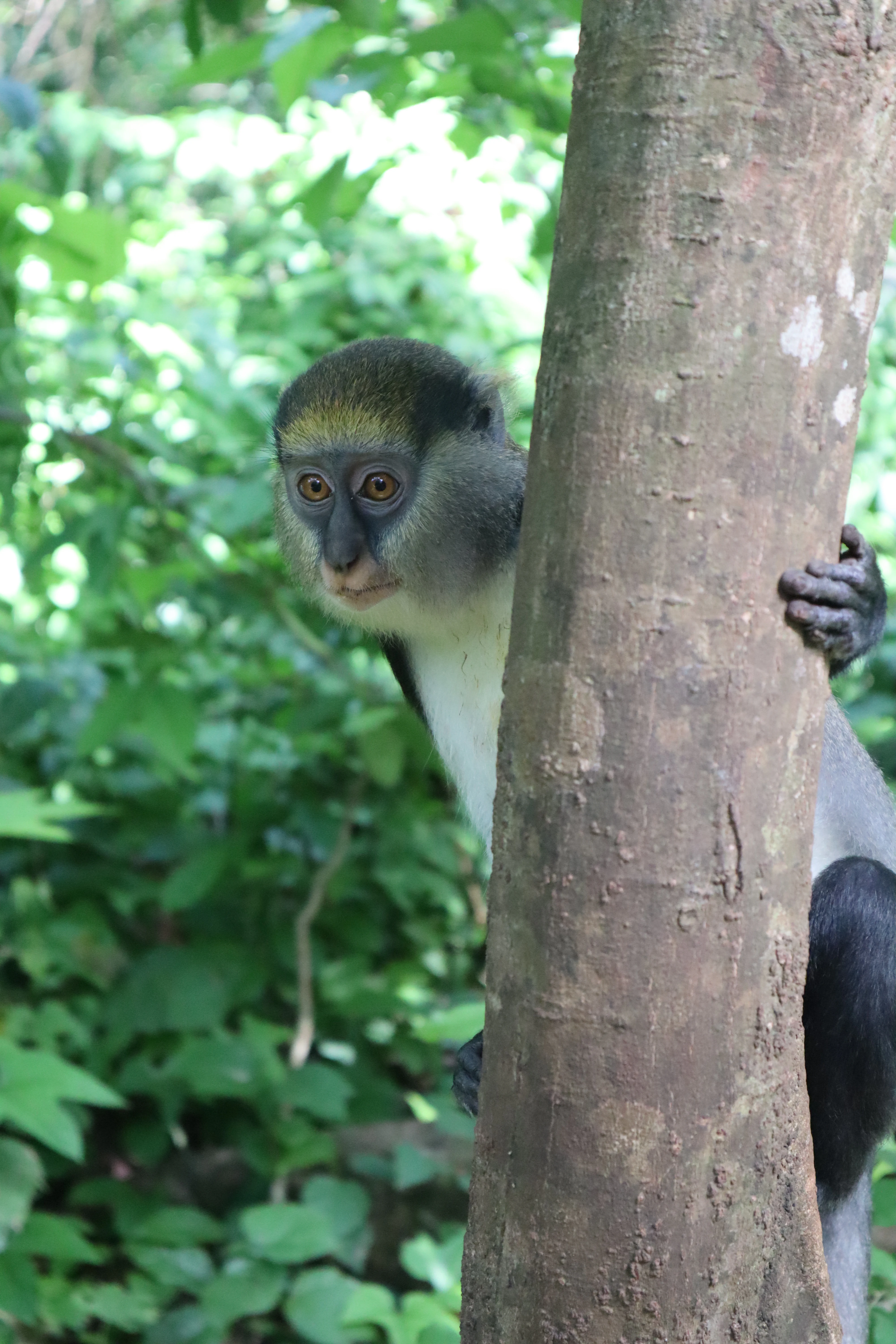
A monkey with a grey, white, and black face looking out from behind a tree trunk in a lush forest.
A monkey peering from behind a tree in the Boabeng-Fiema Monkey Sanctuary.

Boabeng-Fiema Monkey Sanctuary history and protected-area timeline

The Boabeng-Fiema Monkey Sanctuary was formally established in the 1970s, when the local communities recognized the need to protect the forest and the monkey populations living within it. The sanctuary's creation built upon traditional beliefs that had long shielded the local primates, translating those customary protections into a more structured and recognized conservation area.

Over time, the sanctuary gained wider recognition as a national tourist site, drawing attention to the unusual example of a community-managed monkey reserve in central Ghana. Traditional protections, including prohibitions against harming monkeys and the practice of holding funerals for deceased individuals, have continued to play a central role in the sanctuary's conservation approach, blending customary law with modern wildlife preservation goals.

Boabeng-Fiema Monkey Sanctuary landscape and geographic character

The sanctuary occupies a forested area of roughly 4.4 square kilometers situated between the twin communities of Boabeng and Fiema in central Ghana. The terrain lies at a relatively modest elevation of about 366 meters above sea level, typical of the woodland landscapes found across the Bono East Region.

The protected area is dominated by mixed forest cover, with a closed or semi-closed canopy that provides habitat for arboreal primates, ground-dwelling reptiles, birds, and small mammals such as deer. The relatively compact scale of the forest creates an intimate landscape where villages and wildlife habitat meet directly at the forest edge, an unusual arrangement that has shaped both the conservation history and the cultural identity of the area.

Boabeng-Fiema Monkey Sanctuary ecosystems, habitats, and plant life

Ecologically, Boabeng-Fiema functions as a small but important mosaic of West African forest habitat surrounded by agricultural land and village settlements. The sanctuary's forest supports a layered ecological community, ranging from the canopy and understory used by monkeys to lower forest zones inhabited by reptiles, ground-dwelling small mammals, and a variety of bird species.

Although the sanctuary is small in absolute terms, its protected status provides a refuge for forest-dwelling species within a region where habitat fragmentation is a continuing pressure. The mixed tree composition of the forest gives the sanctuary habitat diversity that is relevant both for primates and for the broader community of forest birds, reptiles, and other animals that depend on similar wooded environments.

Boabeng-Fiema Monkey Sanctuary wildlife and species highlights

Wildlife at Boabeng-Fiema is dominated by the primate population that gives the sanctuary its name. The forest is home to roughly 700 monkeys, including Campbell's mona monkey and Geoffrey's pied colobus, the latter being a species classified as critically endangered and therefore of particular conservation significance.

Beyond the primates, the sanctuary supports populations of birds, reptiles, and small forest mammals such as deer. The relatively close proximity of people and wildlife, combined with the cultural protection extended to the monkeys, allows for regular and visible encounters between visitors and the resident animals, making the wildlife experience at Boabeng-Fiema both ecological and cultural in character.

Boabeng-Fiema Monkey Sanctuary conservation status and protection priorities

Boabeng-Fiema represents a distinctive model of conservation in which traditional cultural beliefs serve as the primary protection mechanism for wildlife. The local communities consider monkeys to be sacred, and traditional prohibitions against harming them have persisted across generations. These customary protections are reinforced through ceremonies, including formal burials performed when individual monkeys die.

The sanctuary's conservation significance is heightened by the presence of the critically endangered Geoffrey's pied colobus, a species whose survival in central Ghana depends on protected forest patches such as this one. At the same time, ongoing tensions between villagers who leave food for the monkeys and sanctuary management efforts to discourage this practice highlight the practical challenges of balancing deep-rooted cultural traditions with modern wildlife management goals.

Boabeng-Fiema Monkey Sanctuary cultural meaning and human context

The cultural identity of Boabeng-Fiema is inseparable from the spiritual relationship between the local communities and the monkeys of the forest. For generations, the people of Boabeng and Fiema have regarded the resident monkeys as sacred, embedding them into local belief systems and everyday community life.

This cultural framework has produced specific practices, including prohibitions against harming monkeys, the holding of funeral ceremonies for deceased monkeys, and customary traditions of leaving food for the animals. Together, these practices have helped maintain a rare form of coexistence between humans and primates in which wildlife protection is grounded in cultural respect rather than only in formal enforcement.

Top sights and standout views in Boabeng-Fiema Monkey Sanctuary

Boabeng-Fiema offers a rare combination of primate conservation and living cultural tradition, structured around the protection of around 700 monkeys, including the critically endangered Geoffrey's pied colobus. The sanctuary's small but ecologically meaningful 4.4-square-kilometer forest provides habitat for monkeys, birds, reptiles, and deer within a landscapes that sits directly alongside two traditional Ghanaian communities.

The sanctuary's defining highlight is its traditional protection system, in which monkeys are treated as sacred animals whose deaths are marked by formal burial rites. This cultural foundation, paired with the site's recognition as a national tourist destination, places Boabeng-Fiema among the more distinctive community-led sanctuaries in West Africa.

Best time to visit Boabeng-Fiema Monkey Sanctuary

The forest setting of Boabeng-Fiema means the sanctuary can be visited throughout much of the year, though seasonal conditions in central Ghana influence both landscape character and overall accessibility. Drier periods generally offer easier road access to the sanctuary and more comfortable conditions for walking through the forest and observing monkeys and other wildlife at the forest edge.

Because the sanctuary's primate activity is closely tied to the rhythms of the forest rather than to formal opening schedules, visits coordinated with the calmer, drier conditions of the regional climate often allow for relaxed exploration of the villages, the surrounding forest, and the cultural ceremonies associated with the monkeys.

Monthly climate preview

Track long-term representative temperature ranges and monthly precipitation patterns across the protected landscape

Boabeng-Fiema Monkey Sanctuary Climate Normals and Annual Temperature Rhythm

Boabeng-Fiema Monkey Sanctuary exhibits recorded monthly mean temperatures spanning from 24.57 degrees Celsius to 28.41 degrees Celsius alongside varying daily precipitation rates. Reviewing the complete twelve-month climatology dataset clarifies the detailed seasonal temperature swings and rainfall distribution.
Annual mean26 °C
25 °C28 °C
Jan26°
Feb28°
Mar28°
Apr28°
May27°
Jun26°
Jul25°
Aug25°
Sep25°
Oct25°
Nov26°
Dec26°
Warmest month
March

28.4 °C

Coolest month
August

24.6 °C

Wettest month
September

6.1 mm/day

Driest month
January

0.3 mm/day

Park location guide

Geography guide, regional context, and park location map for Boabeng-Fiema Monkey Sanctuary

Boabeng-Fiema Monkey Sanctuary park geography, regions, and map view in Ghana

Understand where Boabeng-Fiema Monkey Sanctuary sits in Ghana through a broader geographic reading of the surrounding landscape, nearby location context, and its mapped position within the national park landscape.

How Boabeng-Fiema Monkey Sanctuary fits into Ghana

Ghana, officially the Republic of Ghana, is a West African nation spanning approximately 240,000 km² along the Gulf of Guinea. It achieved independence from Britain in 1957, becoming the first Sub-Saharan colony to do so, and transitioned to a republic in 1960. The country has a population of over 35 million, with Accra as its capital and largest city. Ghana features diverse ecosystems from coastal savannas to tropical rainforests and is linguistically and ethnically rich, with English as the official language.

Wider geography shaping Boabeng-Fiema Monkey Sanctuary in Ghana

Ghana is located in West Africa along the Gulf of Guinea and Atlantic Ocean to its south. It borders Côte d'Ivoire to the west, Burkina Faso to the north, and Togo to the east. The country spans diverse ecologies including coastal savannas and tropical rainforests.

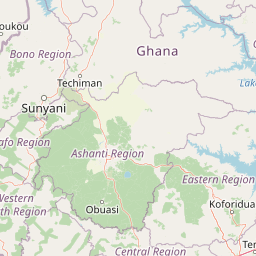
Map view of Boabeng-Fiema Monkey Sanctuary

Use this park location map to pinpoint Boabeng-Fiema Monkey Sanctuary in Ghana, understand its exact geographic position, and read its mapped placement within the surrounding landscape more clearly.

Pigeon | © OpenStreetMap contributors

Location context for Boabeng-Fiema Monkey Sanctuary

Bono East Region

Visual reference guide to forest habitats, primate populations, and sanctuary terrain

Boabeng-Fiema Monkey Sanctuary Photos and Protected Forest Landscape Scenery

Photographic documentation reveals the enclosed forest canopy and shared village edge that define Boabeng-Fiema Monkey Sanctuary. Visual research into protected woodland habitats illustrates the terrain and wildlife environments supporting rare primate species across central Ghana.

A monkey with a grey, white, and black face looking out from behind a tree trunk in a lush forest.

Three monkeys sitting on a dirt path covered in dry autumn leaves in a forest setting.

Park atlas

Discover related wildlife reserves and regional woodland habitats across central Ghana

Explore Parks Near Boabeng Fiema Monkey Sanctuary and Surrounding Protected Landscapes

Compare Boabeng Fiema Monkey Sanctuary with other regional protected areas and community woodland reserves. Examining nearby habitats provides broader context on West African forest conservation and wildlife distribution.
National parkGhana
About 96 km away#1 closest

Northwest

Bui National Park: Protected Savanna Landscape and Black Volta River Geography in Ghana

Explore the mapped boundaries and unique ecosystems of this national park.

Bui National Park, a protected national park in Ghana, offers a rich geographic discovery of savanna ecosystems bisected by the Black Volta River. Its vast mapped area provides a unique setting for understanding riparian corridors, woodland savanna, and mountainous terrain. The park is critically important for its significant hippopotamus population and its designation as an Important Bird Area, showcasing its ecological value. Exploration of Bui National Park provides insight into Ghana's protected landscapes and their strategic position within West African geography, serving as a key entity for any natural atlas.

Area
1,820 km²
Established
1971
IUCN
II
Relief
Mixed relief
Wildlife reserveGhana
About 102 km away#2 closest

Southeast

Bomfobiri Wildlife Sanctuary: Mapped Geography and Protected Landscapes in Central Ghana

A diverse habitat mosaic featuring forests, savanna, and waterfalls.

Bomfobiri Wildlife Sanctuary offers a compressed look at Ghana's natural diversity, where riverine corridors transition into open savanna. The protected area is recognized for its combination of dense forest, varied geological rock formations, and significant natural landmarks like the Lion Stone and local waterfalls, providing a clear perspective on the region's complex physical geography.

Area
53 km²
Established
1975
Wildlife reserveAshanti Region
About 122 km away#3 closest

South

Bobiri Forest Reserve and Butterfly Sanctuary: Mapped Wildlife Reserve and Forest Geography

Ashanti Region protected landscape and butterfly habitat

Focusing on its status as a dedicated butterfly sanctuary, this protected forest reserve in Ghana offers a clear window into semi-deciduous ecology. Covering 54 square kilometers, the site is recognized for high insect biodiversity and its unique position as both an active research area and a managed wildlife reserve near the village of Kubease.

Area
54.65 km²
Established
1939
Relief
Upland
Climate
Tropical
National parkBono East Region
About 162 km away#4 closest

East

Digya National Park: Ghana's Oldest National Park, Bordering Lake Volta

Explore its unique geography and mapped protected boundaries.

Digya National Park is a significant protected area in Ghana, renowned as the nation's oldest, established in 1900 and gazetted as a national park in 1971. Occupying 3,743 square kilometers in the Bono East Region, it is distinctively bordered on three sides by the vast Lake Volta, creating an unparalleled terrestrial-aquatic habitat interface. This national park represents a key point in Ghana's geographic atlas, situated in a transitional zone between forest and savanna ecosystems, and is a vital hub for wildlife conservation and the study of its unique landscape character.

Area
3,743 km²
Established
1971
IUCN
II
Relief
Lowland
National parkSavannah Region
About 167 km away#5 closest

North

Mole National Park: A Premier Protected Landscape in Ghana's Savannah Region

Explore mapped boundaries and Guinea savannah ecosystems.

Mole National Park represents a significant protected landscape within Ghana's Savannah Region, serving as the country's largest national park and a crucial conservation area for West African wildlife. The park's geography is defined by extensive Guinea savannah, characterized by grasslands with scattered woodlands and a prominent escarpment along its southern edge. Its vast expanse offers a unique opportunity to study mapped park boundaries and understand the ecosystem's role in regional conservation efforts. Discover the unique landscape context and protected area identity of this major West African wildlife refuge.

Area
4,840 km²
Established
1958
IUCN
II
Visitors
17.8K annual
Watercolor illustration of a landscape with green fields, trees, and a body of water
National parkIvory Coast
About 192 km away#6 closest

Northwest

Comoé National Park: Geographic and Environmental Overview of the Ivory Coast Reserve

Mapping the transitions of West Africa's largest protected savanna ecosystem.

Comoé National Park serves as an ecological crossroads in north-eastern Ivory Coast, protecting 11,500 square kilometers of diverse terrain. The park hosts an extraordinary gradient of habitats, from dense gallery forests hugging the 230 kilometer stretch of the Comoé River to open, dry Sudanian savannas. Its geological foundation, featuring dramatic granite inselbergs and wide plains, supports a highly complex network of life, making it a cornerstone for understanding West African regional conservation and landscape ecology.

Area
11,500 km²
Established
1983
IUCN
II
Relief
Lowland
A soft watercolor illustration showing a calm pond in the foreground, with gentle grassy hills and sparse trees in the background.
National parkIvory Coast
About 192 km away#7 closest

Northwest

Comoé National Park: Geographic Overview and Protected Landscape Analysis

Mapping the savanna and river corridors of Ivory Coast

Comoé National Park spans the northeastern reaches of Ivory Coast, providing a crucial protected space for West Sudanian savanna and gallery forests. This large-scale reserve is characterized by the hydrological influence of the Comoé River, which carves through the undulating plains to create seasonal floodplains and dense riverine corridors that serve as essential habitat for regional wildlife populations.

Area
11,491.5 km²
Established
1968
IUCN
II
Relief
Upland
National parkGhana
About 230 km away#8 closest

South

Kakum National Park: Ghana's Landmark Protected Rainforest and Canopy Walkway

Mapped tropical forest landscape and unique elevated park exploration.

Kakum National Park represents a significant protected area within Ghana, characterized by its 375 square kilometers of moist evergreen tropical rainforest. The park's identity is strongly linked to its iconic canopy walkway, an engineering feat offering elevated views into the forest structure. As a national park, Kakum provides crucial mapped context for understanding West African biodiversity and regional geography, including notable primate populations and the densest concentration of forest elephants in Ghana. Its community-driven establishment also marks it as a key site for participatory conservation examples.

Area
375 km²
Established
1992
IUCN
II
Visitors
135.9K annual

Common questions about visiting, size, designation, and location context for Boabeng-Fiema Monkey Sanctuary

Boabeng-Fiema Monkey Sanctuary FAQs for park facts, access, geography, and protected area context

Find quick answers about Boabeng-Fiema Monkey Sanctuary, including protected-area facts, park geography, trail and visitor context, and how the park fits into its surrounding country and regional landscape.
MoriAtlas Explorer

Continue Your Protected Areas Search Across the Global Atlas

Deepen your exploration by continuing the structured search for national parks and protected areas worldwide. Utilize the comprehensive filtering capabilities to compare different conservation landscapes and refine your understanding of global park geography. Discover more about the distribution and characteristics of protected natural areas.

Global natural geography