Why Chełm Landscape Park stands out
Chełm Landscape Park is best known for its exceptional calcareous peatlands, particularly the tufted sedge fen communities that are unique within Poland. The calcium-rich substrate gives the area a botanical distinctiveness that is not commonly found elsewhere in the country. The park is also recognized as a stronghold for breeding wetland birds, including rare and threatened species such as the aquatic warbler, black stork, common crane, and lesser spotted eagle. Its invertebrate fauna is exceptionally rich as well, with more than 800 recorded butterfly species, many of which are not found elsewhere in Poland. Together, these features make the park a key conservation area for peatland, forest, and wetland biodiversity in the Lublin region.
Chełm Landscape Park history and protected-area timeline
Chełm Landscape Park was established in 1983 to protect a mosaic of forest and peatland ecosystems that had already been recognized as nationally valuable. The initiative came during a broader period of expanded nature conservation legislation in Poland, when landscape parks were being designated across the country to safeguard representative regional landscapes and their associated biodiversity.
Before the park existed, parts of the area had already received formal protection. The Bachus forest reserve was created in 1958, and the buffer zone later incorporated the Serniawy forest reserve, originally established in 1965. After the park's creation, additional reserves were designated to address the area's distinctive calcareous peatlands: Brzeźno in 1973, Roskosz in 1990, and Bagno Serebryskie in 1991. These peatland reserves were important additions because they protected habitats and species that were not adequately covered by the original forest-focused reserve network.
When first established, the park covered about 14,350 hectares with a buffer zone of 9,528 hectares. Subsequent adjustments, formalized in part through the 1993 regulation by the Voivode of Bydgoszcz that is still cited as one of the park's founding legal acts, expanded its footprint to the present-day area of roughly 16,457 hectares, with a buffer zone of around 10,878 hectares. The additions primarily incorporated further peatland and forest complexes, strengthening the park's role as a refuge for rare wetland and forest species.
Chełm Landscape Park landscape and geographic character
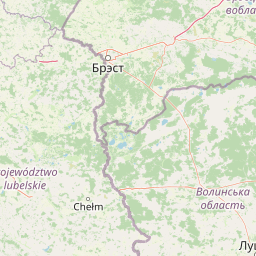
The landscape of Chełm Landscape Park is shaped by two adjoining physical-geographical mesoregions. To the west, the terrain rises into the gentle, often loess-capped hills of the Pagóry Chełmskie, while to the east it descends into the flatter, lower-lying Obniżenie Dubieńskie. This transition between upland and lowland gives the park a varied topography, with rolling hill country giving way to broad depressions that collect moisture and support extensive wetland systems.
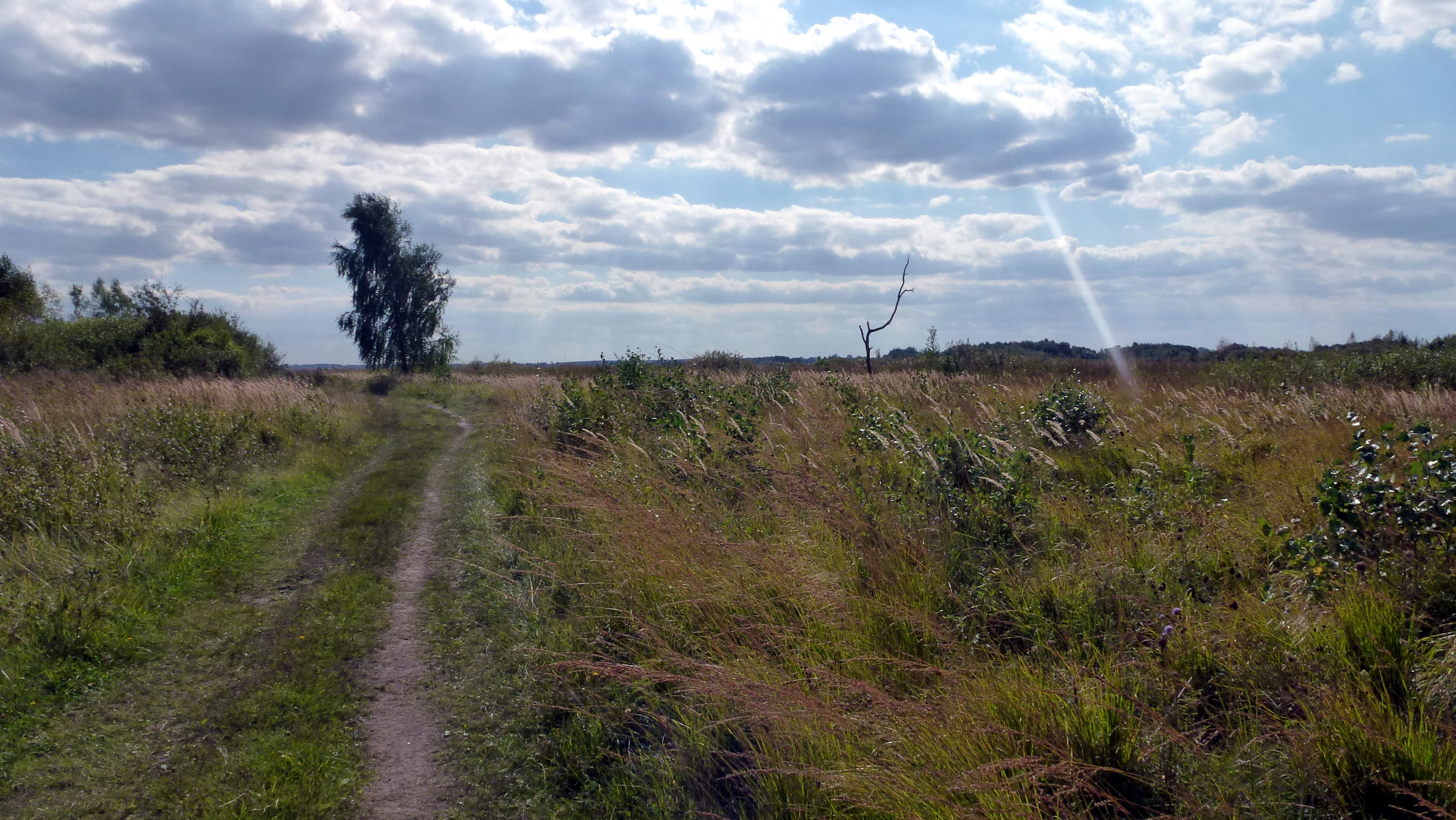
A central visual element of the park is its network of open peatlands. Unlike the acid peat bogs that dominate much of northern Poland, the peatlands here are calcareous, formed over calcium-rich substrate. Their surface is often covered by dense stands of tufted sedge, with marginal communities of sedges and other moisture-loving plants ringing the fens. Around these open peatlands lie extensive forest tracts, ranging from dry pine-dominated woodlands on sandy and moraine-derived soils to richer oak-hornbeam forests on loess-covered slopes and moist riparian forests along watercourses.
The visual experience of the park alternates between these closed-canopy forests, open expansive mires, and the agricultural margins that lie just beyond the protected boundary. Observation towers in the Bagno Serebryskie and Brzeźno reserves allow visitors to look out across wide stretches of fen and bog, while the surrounding protected forest landscapes offer a more enclosed, structurally diverse setting. The result is a protected landscape that blends the textures of upland, lowland, wetland, and woodland into a single coherent system.
Chełm Landscape Park ecosystems, habitats, and plant life
The ecological character of Chełm Landscape Park is defined first by the unusual chemistry of its soils. Calcium carbonate is abundant in the substrate, and this has produced a series of distinctive plant communities that differ markedly from those of typical lowland Poland. On the peatlands, this calcium-rich environment supports the nationally rare tufted sedge fens, while the surrounding forests include dry pine woodland, richer oak-hornbeam stands, and moist riparian forests along streams and floodplains.
Vegetation surveys have documented a remarkable number of legally protected plant species. Within the park and its vicinity, 53 plant species are protected under strict conservation rules and a further 13 under partial protection. Some populations are large enough to number in the thousands of individuals, particularly on the peatlands. Notable species include spring pheasant's eye, dwarf cherry, stemless carline thistle, cross gentian, large-flowered anemone, showy pink, Siberian iris, and bloody crane's-bill, alongside several orchid species associated with the area's varied forest and mire habitats.
The combination of forest types, open peatlands, and wetland margins creates a mosaic of habitats that supports an unusually broad spectrum of fauna. The park's habitat diversity is often highlighted in regional conservation planning as the reason behind its exceptionally rich bird and invertebrate communities, and it explains why the park functions as a regional stronghold for species that depend on multiple, closely interlocking habitat types.
Chełm Landscape Park wildlife and species highlights
The wildlife profile of Chełm Landscape Park is dominated by birds. Surveys have documented 152 breeding bird species within the park and its immediate surroundings, a figure that reflects both the variety of habitats and the high quality of the more sensitive ones. Among the most ecologically significant breeding species are the black stork, common crane, lesser spotted eagle, short-eared owl, great snipe, Eurasian curlew, and the aquatic warbler, one of Europe's most endangered wetland passerines.
Reptiles and amphibians are also represented by notable species. The European pond turtle has been recorded in the peatlands near the village of Stanisławów and in the forests of the Sawin forestry district, an occurrence that is unusual enough to draw attention to the ecological value of these particular sites. Wetland margins and forest pools throughout the park provide habitat for a broader amphibian community typical of eastern Polish lowlands.
The invertebrate fauna of the park is exceptionally rich. More than 800 butterfly species have been recorded within the park and adjacent areas, accounting for roughly 38 percent of the entire Polish butterfly fauna. Several of these species have not been observed elsewhere in Poland outside the Chełm area, and many are listed on Poland's Red List of endangered and threatened animals. This invertebrate richness is closely tied to the diversity of plant communities and habitat structure, including the unusual calcareous peatlands and the varied forest types.
Chełm Landscape Park conservation status and protection priorities
The conservation significance of Chełm Landscape Park rests on its role in protecting calcareous peatlands, a habitat type that is nationally rare and ecologically distinctive. These fens and the surrounding calcium-influenced plant communities are not adequately represented in other protected areas of similar size in Poland, making the park a critical refuge for the species that depend on them. The protected landscape designation buffers these communities against changes in land use, drainage, and forestry practice.
The park's reserve network reinforces this broader protection. The Bachus forest reserve, together with the peatland reserves of Brzeźno, Bagno Serebryskie, and Roskosz, accounts for roughly 1,099 hectares of strictly protected habitat within the park, while the forested Serniawy reserve extends strict protection into the buffer zone. This reserve system creates core areas of high-integrity habitat that anchor the wider landscape-level protections and support populations of species that would otherwise be vulnerable to gradual environmental change.
The park also carries national importance for several threatened species. Breeding populations of the aquatic warbler, the European pond turtle, and a suite of protected butterflies give the area recognition beyond the regional scale. Fifty-three natural monuments have been designated within the park and its surroundings, including individual trees and other small features, reflecting both the biological and the cultural-natural value attached to the landscape. Educational and visitor infrastructure, including observation towers and the Brzeźno interpretive center, supports monitoring, public engagement, and long-term stewardship.
Chełm Landscape Park cultural meaning and human context
The region around Chełm has a long human history tied to its agricultural landscape and its small rural municipalities. The five municipalities overlapping the park, Chełm, Dorohusk, Sawin, Ruda-Huta, and Kamień, are predominantly rural and have shaped the surrounding land use through traditional farming, forestry, and small-scale settlement. This rural setting has helped maintain the open peatlands and forest edges that the park protects, although it also places pressure on the protected areas through drainage, forestry, and land conversion pressures common in agricultural lowlands of eastern Poland.
The park's interpretive and educational infrastructure reflects an attempt to integrate these rural communities into the park's conservation story. The didactic-museum center at the Brzeźno reserve, operated by the Chełm Landscape Parks Authority, and the observation towers in the Bagno Serebryskie and Brzeźno reserves, serve both as visitor facilities and as venues for local environmental education. The natural monuments designated across the park add a further layer of cultural-natural significance, recognizing individual trees and other small features that are valued both ecologically and as part of regional identity.
Top sights and standout views in Chełm Landscape Park
The strongest point of distinction for Chełm Landscape Park is the combination of calcareous peatlands and calcium-rich forest communities set within a single protected landscape. Calcareous peatlands dominated by tufted sedge are uncommon in Poland, and the park's peatland reserves such as Bagno Serebryskie, Brzeźno, and Roskosz are among the principal strongholds for this habitat type in the country.
Equally distinctive is the area's wildlife concentration. With 152 breeding bird species, important populations of rare wetland and forest raptors and passerines, the European pond turtle, and over 800 recorded butterfly species, the park hosts a level of faunal diversity that exceeds most comparably sized protected areas in eastern Poland. The integration of four in-park nature reserves with a landscape-level protection regime makes Chełm Landscape Park a particularly effective model for protecting habitat mosaics in a lowland-upland transition zone.
Best time to visit Chełm Landscape Park
Seasonality strongly influences the park's character. Spring and early summer are the most rewarding periods for botanical interest, when the calcareous peatlands and forest interiors come alive with flowering populations of protected plants such as Siberian iris, large-flowered anemone, and various orchids, and when breeding birds are most vocal across both woodland and wetland habitats.
Late spring and early summer also provide the best conditions for observing breeding wetland birds, including species associated with open peatlands where access on foot may otherwise be limited. Autumn brings quieter conditions, cooler temperatures, and a shift in atmosphere as forest colors change and peatland vegetation dies back. Winter visits offer a stark, open landscape across the fens and a different perspective on the forest and mire mosaic, though snow cover and cold temperatures limit the visibility of typical wildlife and flora. Across all seasons, the observation towers and the Brzeźno educational center offer structured points of access for visitors.