
Mori Atlas logo
National parkGuadalupe Mountains National Park

Discover the mapped boundaries and natural terrain of this national park in Culberson County.

Guadalupe Mountains National Park: Protected Landscape Atlas and Regional Geography

Guadalupe Mountains National Park represents a significant protected area within the vast expanse of Culberson County, Texas. As a designated national park, its boundaries encompass unique natural landscapes and geological features, offering a distinct point of study for geographic exploration and atlas-driven understanding. This entry serves as a gateway to understanding the park's role within the regional geography of West Texas, highlighting its mapped terrain and protected conservation status for focused landscape analysis.

Desert ParksMountain ParksTexas ParksWilderness AreasNational ParksHiking Parks

Guadalupe Mountains National Park

National park

Park overview

Structured park overview, official facts, and landscape profile for Guadalupe Mountains National Park

Guadalupe Mountains National Park park facts, protected area profile, and essential visitor context
Review the core facts for Guadalupe Mountains National Park, including designation, size, terrain, visitor scale, habitats, and operating context in one park-focused overview.

About Guadalupe Mountains National Park

Guadalupe Mountains National Park preserves an isolated mountain range that rises dramatically from the Chihuahuan Desert floor in West Texas. The park encompasses a landscape of exceptional geological and ecological significance, protecting the ancient remnants of a Permian-era reef complex that once formed the margins of a shallow tropical sea. The mountains extend from their southwestern terminus at El Capitan, approximately 90 miles east of El Paso, northward into New Mexico where they approach Carlsbad Caverns National Park near Carlsbad. The park's terrain ranges from gypsum sand dunes along the western boundary near Dell City to the windswept summit of Guadalupe Peak, creating a vertical diversity that supports remarkable habitat variation. Visitors explore a landscape where prehistoric hunter-gatherers lived for over 10,000 years, where Mescalero Apaches harvested agave and followed game, and where stagecoach travelers on the Butterfield Overland Mail route used El Capitan as a landmark. The park contains the restored Frijole Ranch, the first permanent ranch house in the region constructed in 1876, along with the Williams Ranch House built in 1908 and the Wallace Pratt Lodge in McKittrick Canyon. These historic structures provide glimpses into the human history that unfolded among these ancient mountains.

Quick facts and research context for Guadalupe Mountains National Park

Guadalupe Mountains National Park is situated in Culberson and Hudspeth Counties in West Texas, with the nearest community being Dell City. The park was established on September 30, 1972, following the donation of land by petroleum geologist Wallace Pratt, who contributed approximately 6,000 acres of McKittrick Canyon. The park shares the same mountain range as Carlsbad Caverns National Park, located about 25 miles to the north in New Mexico. In 1978, Congress designated 46,850 acres of the park as wilderness area. The park receives approximately 200,000 visitors annually.

Park context

Deeper park guide and search-rich context for Guadalupe Mountains National Park

Guadalupe Mountains National Park history, landscape, wildlife, and travel context
Explore Guadalupe Mountains National Park through its history, landscape character, ecosystems, wildlife, conservation priorities, cultural context, and seasonal travel timing in a structured park guide built for atlas discovery and search intent.

Why Guadalupe Mountains National Park stands out

Guadalupe Mountains National Park is best known for containing Guadalupe Peak, the highest point in Texas, which rises 8,751 feet above sea level. The park is also famous for the dramatic limestone escarpment known as "The Rim" on the northwestern extension, the historic McKittrick Canyon with its stone cabin built in the 1930s, and the remnants of the Butterfield Overland Mail stagecoach route including the Pinery Station ruins near Pine Springs. The park preserves three distinct ecosystems spanning from desert salt flats through canyon riparian corridors to alpine pine forests.

Guadalupe Mountains National Park history and protected-area timeline

The Guadalupe Mountains have a human history stretching back over 10,000 years, as evidenced by archaeological discoveries of projectile points, baskets, pottery, and rock art in caves and alcoves throughout the range. The first Europeans arrived in the 16th century, but it was the Spanish introduction of horses that transformed indigenous mobility, and nomadic tribes like the Mescalero Apaches soon found them valuable for hunting and migration. The Mescalero occupied the mountains through the mid-19th century, harvesting agave for food and fiber and leaving behind roasting pits and other cultural artifacts still visible in the park today. The American transportation route challenged Apache presence at the end of the Civil War, with many immigrants crossing the area during the 1840s and 1850s. In 1858, Pinery Station was constructed near Pine Springs for the Butterfield Overland Mail, crossing Guadalupe Pass at 5,534 feet above sea level. The 9th Cavalry Regiment was ordered to the area to stop Indian raids on settlements and the mail route, and during the winter of 1869, Lt. H.B. Cushing led troops into the mountains and destroyed two Mescalero Apache camps, eventually driving them to reservations. Felix McKittrick worked cattle in the 1870s, giving his name to McKittrick Canyon. The Rader brothers constructed Frijole Ranch in 1876, which became the only major building in the region and served as a community center and post office from 1916 to 1942. Wallace Pratt, a geologist for Humble Oil and Refining Company, was impressed by McKittrick Canyon's beauty in 1921 and bought land to build two summer homes, the Wallace Pratt Lodge and the Wallace E. Pratt House, which his family used until 1960. Pratt donated approximately 6,000 acres of McKittrick Canyon, which became the core of Guadalupe Mountains National Park, dedicated and opened to the public in September 1972.

Guadalupe Mountains National Park landscape and geographic character

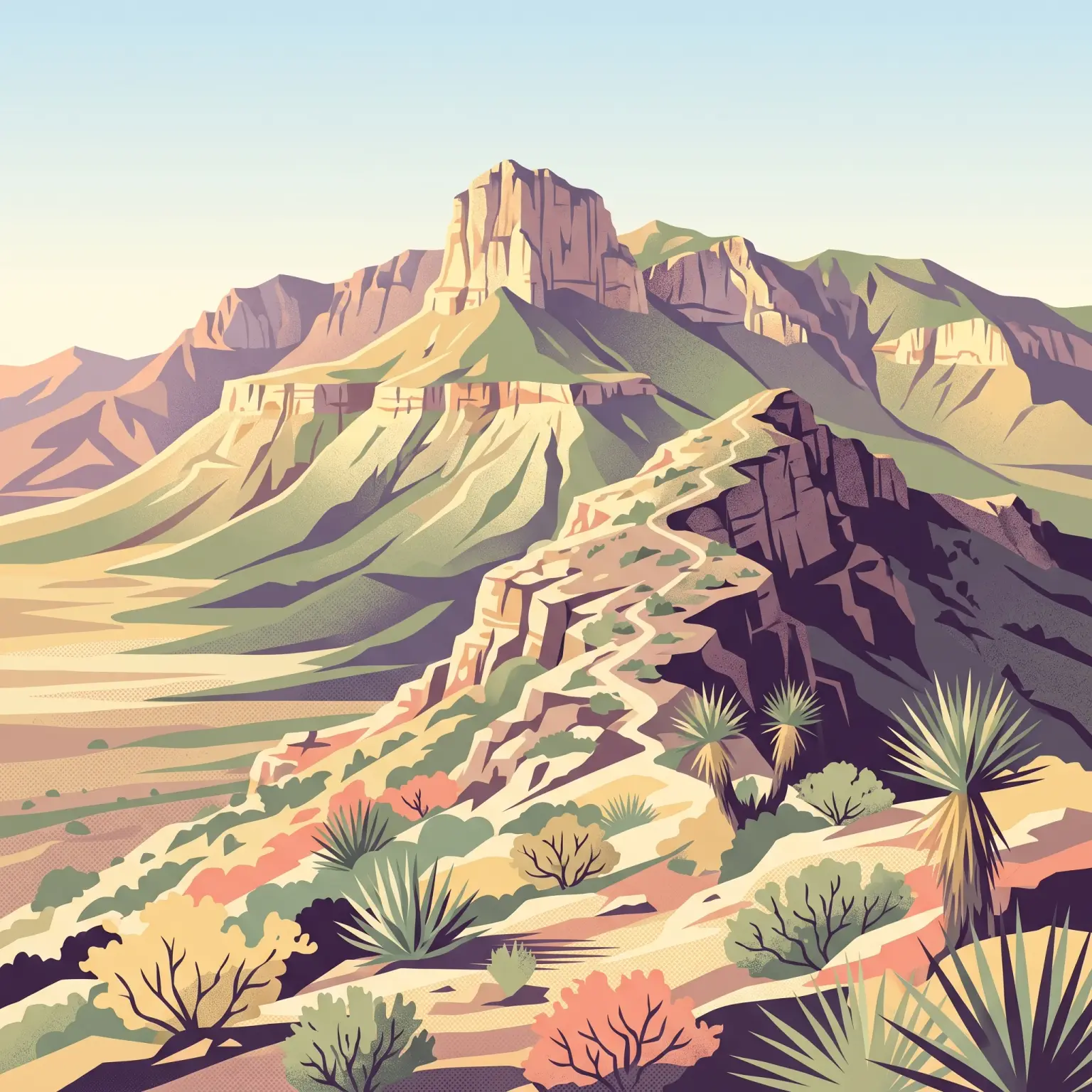
The Guadalupe Mountains rise more than 3,000 feet above the arid Chihuahuan Desert floor, creating a striking island of terrain in the South Texas landscape. The range extends north-northwest and northeast from Guadalupe Peak in Texas into New Mexico, with the northeastern extension ending about 10 miles southwest of Carlsbad near Carlsbad Caverns National Park, while the southwestern terminus at El Capitan lies approximately 90 miles east of El Paso. The mountains are bordered by the South Plains to the east and north, the Delaware Mountains to the south, and the Sacramento Mountains to the west. The northwestern extension features a dramatic escarpment known as "The Rim," which extends much further into New Mexico approaching the Sacramento Mountains. The range is bounded on the north by Four Mile Canyon, on the east by the valley of the Pecos River, and on the west by Piñon Creek, Big Dog Canyon, Valley Canyon, Middle Dog Canyon and West Dog Canyon. The mountains are built almost entirely of limestone, formed from the ancient Capitan Reef during the Permian Period, resulting in upland areas with little or no surface water except for McKittrick Creek in McKittrick Canyon. Elevations at the base of the range vary from 4,000 feet above sea level on the western side to 5,000 feet on the eastern side, with several peaks on the southern end exceeding 8,000 feet.

Guadalupe Mountains National Park ecosystems, habitats, and plant life

Guadalupe Mountains National Park contains three major ecosystems that create remarkable ecological diversity within its boundaries. The Chihuahuan Desert dominates the lower elevations, exhibiting salt flats, creosote bushes, and honey mesquite on the western side, while low elevations on the eastern side support grassland, pinyon pine, and junipers. The canyon interiors, including McKittrick Canyon, Bear Canyon, and Pine Springs Canyon, exhibit bigtooth maple, velvet ash, chinkapin oak, and other deciduous trees fed by springs recharged by mountain streams. Above 7,000 feet, alpine areas contain forests of ponderosa pine, Arizona pine, southwestern white pine, Rocky Mountain Douglas-fir, alligator juniper, and small stands of quaking aspen. The park is home to over 1,000 species of plants, including the rare Guadalupe Mountains violet, which is endemic to the park. The range contains significant cave systems including Carlsbad Caverns and Lechuguilla Cave, representing important geological and biological resources.

Guadalupe Mountains National Park wildlife and species highlights

The diverse habitats of Guadalupe Mountains National Park support a rich variety of wildlife. Mammals inhabiting the park include elk, javelina, gray fox, American black bear, coyote, bobcat, striped skunk, hog-nosed skunk, badger, sixteen species of bat, mule deer, and mountain lion. The bird population includes great horned owl, chickadee, sparrow, woodpecker, turkey vulture, greater roadrunner, hummingbird, peregrine falcon, golden eagle, wren, and grosbeak. This diversity reflects the park's range of ecosystems from desert scrub through riparian canyons to alpine conifer forests, each supporting distinct communities of fauna adapted to the varying conditions of the Chihuahuan Desert island environment.

Guadalupe Mountains National Park conservation status and protection priorities

Guadalupe Mountains National Park preserves an area of outstanding geological values, scenery, wilderness, and natural resources in the northern Chihuahuan Desert of West Texas. The park's designation as a wilderness area in 1978 protected 46,850 acres within the National Wilderness Preservation System, preserving the pristine character of the most remote and ecologically sensitive portions of the park. The geological significance of the range, representing the ancient Capitan Reef from the Permian Period, provides important scientific context for understanding Earth's deep history. The three distinct ecosystems contained within the park, from desert through canyon to alpine environments, represent a protected continuum of habitat types that support both common and endemic species, including the rare Guadalupe Mountains violet that is found nowhere else on Earth.

Guadalupe Mountains National Park cultural meaning and human context

The human history of Guadalupe Mountains National Park spans over 10,000 years of continuous cultural occupation. Ancient Pueblo and Mogollon peoples utilized the caves and alcoves of the mountains, leaving behind archaeological evidence of their presence. The Mescalero Apaches, whose name derives from their practice of harvesting and processing agave (mescal) for food and fiber, occupied the mountains through the mid-19th century. The park preserves the remnants of the Butterfield Overland Mail route, including the Pinery Station near Pine Springs, which served as a critical communication link across the American Southwest during the 1850s and 1860s. The historic ranches of the region, including Frijole Ranch, Williams Ranch, and the Wallace Pratt Lodge in McKittrick Canyon, represent the frontier settlement period and subsequent conservation history that led to the establishment of the national park.

Top sights and standout views in Guadalupe Mountains National Park

Guadalupe Mountains National Park offers visitors the opportunity to climb to the highest point in Texas at Guadalupe Peak via the Guadalupe Peak Trail, which ascends through pinyon pine and Douglas-fir forests over 3,000 feet to panoramic views of El Capitan and the Chihuahuan Desert. McKittrick Canyon provides a forested canyon experience with the historic Wallace Pratt Lodge and the Pratt House, known as "Ship on the Desert," accessible via a scenic trail. The park preserves historic sites including the ruins of the Butterfield Overland Mail stagecoach station at Pine Springs and the restored Frijole Ranch with its cultural museum. The Gypsum sand dunes on the western side of the park near Dell City offer a distinctive desert landscape, while the wilderness area designation protects the most remote and pristine portions of this unique mountain environment.

Best time to visit Guadalupe Mountains National Park

The Guadalupe Mountains experience hot summers, calm and mild autumn weather, and cool to cold conditions in winter and early spring. The best time to visit depends on activity preferences: spring and fall offer the most comfortable temperatures for hiking and exploring, with mild days and cool evenings. Summer brings high temperatures but also the chance of late summer monsoon thunderstorms that can dramatically transform the desert landscape. Winter and early spring can bring snow, sleet, freezing rain, and fog, along with frequent high wind warnings, but also offer the solitude of fewer visitors. The park observes Mountain Time, and visitors should be prepared for rapid weather changes regardless of season.
Park location guide

Geography guide, regional context, and park location map for Guadalupe Mountains National Park

Guadalupe Mountains National Park park geography, regions, and map view in United States of America
Understand where Guadalupe Mountains National Park sits in United States of America through a broader geographic reading of the surrounding landscape, nearby location context, and its mapped position within the national park landscape.

How Guadalupe Mountains National Park fits into United States of America

The United States of America is a federal presidential republic and one of the world's largest countries by area and population. It consists of 50 states across a vast territory spanning multiple time zones, with its capital in Washington, D.C. and largest city in New York City. The nation has a diverse economy, influential political system, and significant cultural and military presence globally.

Wider geography shaping Guadalupe Mountains National Park in United States of America

The United States occupies a vast territory in North America, bordered by Canada to the north and Mexico to the south. The 48 contiguous states stretch from the Atlantic to the Pacific Ocean, while Alaska occupies the northwestern region and Hawaii is an archipelago in the Pacific. The country encompasses diverse terrain including the Rocky Mountains, Appalachian Mountains, Great Plains, and extensive river systems.

Map view of Guadalupe Mountains National Park

Use this park location map to pinpoint Guadalupe Mountains National Park in United States of America, understand its exact geographic position, and read its mapped placement within the surrounding landscape more clearly.

Pigeon | © OpenStreetMap contributors

Location context for Guadalupe Mountains National Park

Culberson CountyHudspeth CountyTexas
Park atlas

Explore a wider selection of national parks and protected landscapes across West Texas and the adjacent Chihuahuan Desert terrain for comparison.

Discover Other National Parks and Protected Areas Near Guadalupe Mountains National Park, Texas and the Chihuahuan Desert Region
Continue your protected area exploration beyond Guadalupe Mountains National Park to discover other significant parks, wilderness areas, and natural reserves located in West Texas and the broader Chihuahuan Desert region. Comparing these diverse landscapes provides valuable geographic context for understanding the unique geology, ecosystems, and conservation efforts across the American Southwest.
National parkEddy County

Carlsbad Caverns National Park: Detailed Protected Area and Landscape Exploration

View mapped terrain and geographic context for this Eddy County national park.

Gain a deep understanding of Carlsbad Caverns National Park through its specific geographic features and protected landscape identity. This entry provides foundational atlas-level information on the park's mapped boundaries and its role as a designated national park within the broader regional geography of Eddy County. It is designed to offer precise context for users focused on understanding the specific natural terrain and conservation geography of this important protected area, facilitating structured discovery.

Area
189.26 km²
Established
1930
IUCN
II
Visitors
410.8K annual
National parkNew Mexico

White Sands National Park: National Park with Unique Dune Landscape in New Mexico

Explore its protected boundaries and desert geography.

White Sands National Park is a protected national park renowned for its stunning gypsum dunes, offering a unique landscape within New Mexico's geography. This page provides detailed information on its mapped protected area, serving as a valuable resource for understanding the park's specific geographic context and its identity as a significant protected natural landscape.

Area
601.3 km²
Established
2019
IUCN
V
Visitors
729.1K annual
National parkBrewster County

Big Bend National Park: National Park, Mapped Protected Landscape, and Regional Geography

Explore Brewster County's protected natural terrain.

Big Bend National Park is a prominent national park defined by its protected landscape and geographic features within Brewster County. This destination provides users with detailed atlas-style information, focusing on the park's mapped boundaries and its contribution to the understanding of regional natural geography. Delve into the specific context of this protected area to enhance your geographic discovery.

Area
3,242.19 km²
Established
1944
IUCN
II
Visitors
568.1K annual
National parkChihuahua

Cumbres de Majalca National Park: National Park Discovery and Geographic Context in Chihuahua

Mapped protected landscape exploration in Chihuahua.

Delve into the protected landscape of Cumbres de Majalca National Park, a national park situated in the Chihuahua region of Mexico. This entry provides essential geographic context and details on its mapped boundaries, serving as a key point for atlas-based exploration of Mexico's protected areas. Understand its specific contribution to the regional geography and conservation landscape.

Area
47.72 km²
Established
1939
IUCN
II
Relief
Mountain
National parkOcampo Municipality

Basaseachic Falls National Park: National Park Geography and Mapped Boundaries

Explore protected lands within Ocampo Municipality.

Basaseachic Falls National Park serves as a key protected area within Ocampo Municipality, Mexico. This page provides detailed geographic information and mapped boundaries, essential for understanding its landscape context and its significance as a national park. Dive into the atlas-style data to appreciate the park's protected terrain and its contribution to the regional geography, offering a factual discovery experience.

Area
58.03 km²
Established
1981
IUCN
II
Relief
Mountain
National parkPima County

Saguaro National Park: Discover Its Protected Landscape Geography and Mapped Boundaries

Explore the natural terrain and regional context of this national park.

Saguaro National Park offers a focused exploration of a specific protected landscape, highlighting its unique geographic features and mapped boundaries within Pima County. This detail page provides an atlas perspective, allowing for a deep dive into the park's natural terrain and its regional significance. Understand the protected area's identity and its place within the wider geographical context.

Area
371.16 km²
Established
1994
IUCN
II
Visitors
946.4K annual
National parkNavajo County

Petrified Forest National Park: National Park Protected Landscape and Geographic Atlas

Explore its mapped terrain and regional park context.

Petrified Forest National Park represents a significant protected landscape within Navajo County, Arizona, offering focused insights into its unique terrain and geographic distribution. As a national park, it provides valuable data for understanding mapped park boundaries, regional landscape context, and its role within the broader atlas of protected areas. Discover the specific geographic features and natural identity that define this unique natural reserve.

Area
895.94 km²
Established
1962
IUCN
II
Visitors
644.9K annual
National parkColorado

Great Sand Dunes National Park and Preserve: Colorado's Unique Mapped Landscape

Explore the natural terrain and protected boundaries.

Great Sand Dunes National Park and Preserve offers a unique protected landscape within Colorado, characterized by its distinct natural terrain and extensive dune fields. This destination provides valuable context for atlas exploration, detailing the park's mapped boundaries and its specific geographic setting. Understand its significance as a protected area and appreciate the unique natural features that define its landscape for a richer geographic discovery.

Area
603.1 km²
Established
2004
IUCN
V
Visitors
432.5K annual

Common questions about visiting, size, designation, and location context for Guadalupe Mountains National Park

Guadalupe Mountains National Park FAQs for park facts, access, geography, and protected area context
Find quick answers about Guadalupe Mountains National Park, including protected-area facts, park geography, trail and visitor context, and how the park fits into its surrounding country and regional landscape.
MoriAtlas Explorer

Continue Your Protected Areas Search Across the Global Atlas

Deepen your exploration by continuing the structured search for national parks and protected areas worldwide. Utilize the comprehensive filtering capabilities to compare different conservation landscapes and refine your understanding of global park geography. Discover more about the distribution and characteristics of protected natural areas.

Global natural geography