Why Gulf Islands National Park Reserve stands out
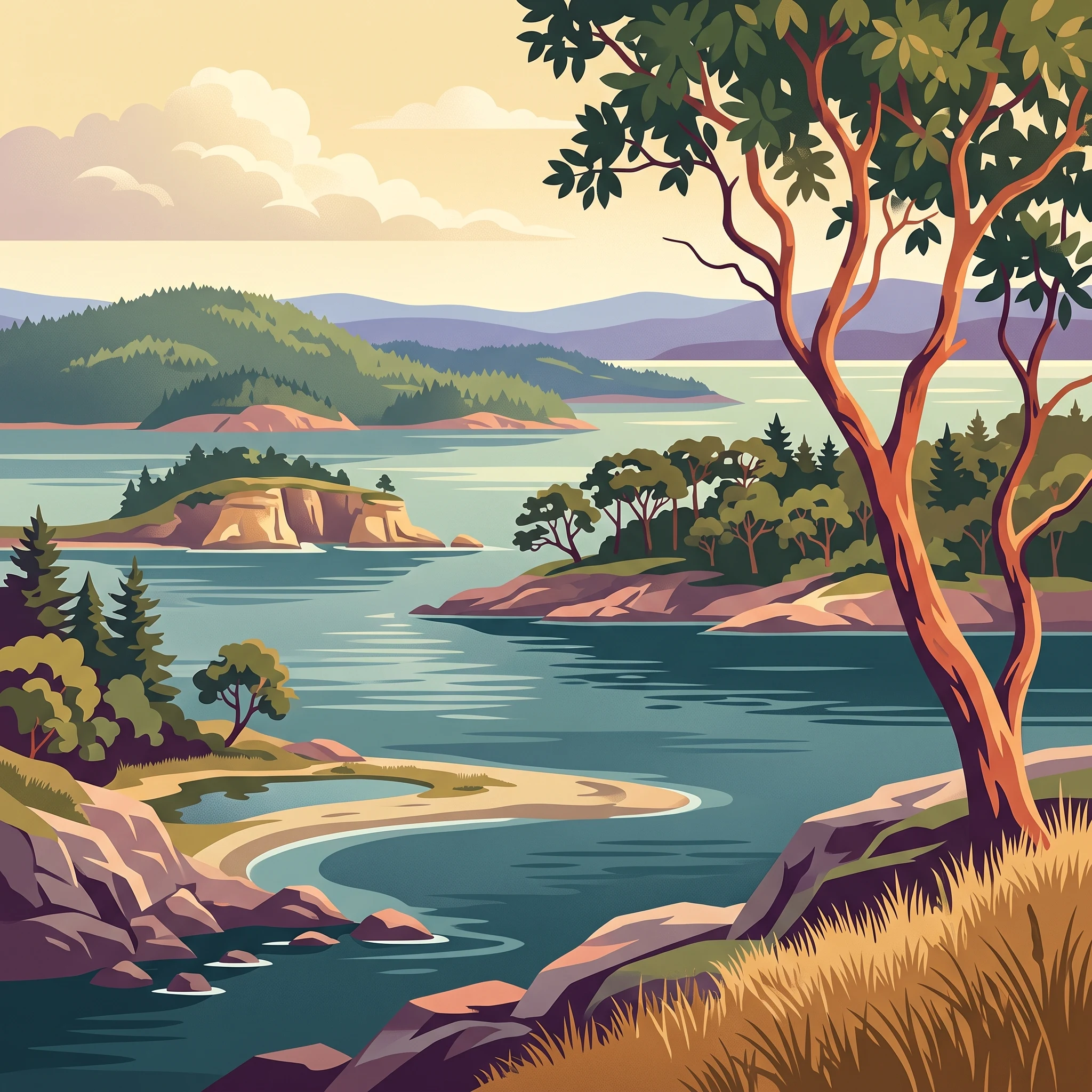
Gulf Islands National Park Reserve is best known for its unique Mediterranean climate, the only such climate in Canada, which supports an unusual blend of temperate and sub-Mediterranean vegetation. The park protects rare Garry oak and arbutus woodlands at their northern limits, diverse marine ecosystems with orca and seal populations, and a chain of scenic islands with sandy spits, sandstone cliffs, and coastal Douglas-fir forests. The park also preserves several historic sites including a former leper colony on D'Arcy Island, the Active Pass Lighthouse dating to 1885, and Coast Salish archaeological sites including clam gardens.
Gulf Islands National Park Reserve history and protected-area timeline
The establishment of Gulf Islands National Park Reserve represents decades of conservation effort in the face of intensive private development on the Gulf Islands. Early conservation initiatives focused on establishing provincial marine parks, including D'Arcy Island Marine Park and Princess Margaret Marine Park, while the Islands Trust was created with a mandate to preserve the unique amenities and environment of the Gulf Islands. Federal interest emerged in 1971 when local MP David Anderson advocated for organized conservation, leading to a feasibility study for a marine park. The 1973 joint feasibility study with the United States explored a transboundary protected area spanning the San Juan Islands and Point Roberts. Progress remained stalled until 1995 when the Canada-British Columbia Pacific Marine Heritage Legacy program committed $30 million from each level of government for land acquisition. A pivotal donation of ecologically sensitive land on Saturna Island by Ulla Ressner and John Fry in July 2002 helped catalyze the formal park announcement on May 9, 2003. In April 2004, the province transferred nine former provincial parks, two ecological reserves, and additional Crown lands to Parks Canada.
Gulf Islands National Park Reserve landscape and geographic character
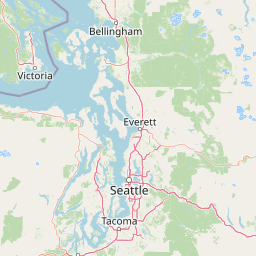
The Gulf Islands landscape is defined by its archipelagic character, with islands arranged in a northwesterly-southeasterly alignment shaped by geological forces including sedimentary folding within the Nanaimo Group and glacial erosion during the last ice age when 1.5 kilometres of ice covered the land. Post-glacial rebound continues to influence the terrain today. The islands feature varied topography including the sandy spits that create Sidney Island's long beaches and sheltered lagoon, the sandstone cliffs and coastal bluffs of Saturna Island, the forested ridges of Mount Norman on Pender Island, and the rolling terrain leading to viewpoints overlooking Boundary Pass and the San Juan Islands. The landscape transitions from second-growth forest at the SMONEĆTEN Campground to old-growth Douglas-fir on Georgeson Island's sandstone ridge, from salt marshes and shell middens to open meadows and forested uplands.
Gulf Islands National Park Reserve ecosystems, habitats, and plant life
The ecological character of Gulf Islands National Park Reserve is defined by the Coastal Douglas-fir Biogeoclimatic Zone, representing the northernmost extent of this typically more southerly ecosystem. The forest community is dominated by coastal Douglas-fir, with western red cedar and grand fir in wetter areas, while drier sites support arbutus and Garry oak, the northernmost populations of these drought-tolerant species. The understory features salal, Oregon-grape, oceanspray, and a diverse fern community including sword fern and lady fern. Wetland areas support salmonberry, false lily of the valley, vanilla-leaf, and skunk cabbage. The marine environment encompasses eelgrass beds in Sidney Island's lagoon and productive waters supporting numerous fish species. This Mediterranean climate zone creates conditions that support species assemblages found nowhere else in Canada.
Gulf Islands National Park Reserve wildlife and species highlights
The park supports diverse wildlife both terrestrial and marine. The largest land animal is the black-tailed deer, while introduced fallow deer from the islands' history as private hunting grounds also persist. Smaller mammals include mink, river otters, raccoons, and deer mice. The marine waters are home to orcas, porpoises, seals, salmon, lingcod, shiner perch, saddleback gunnel, and three-spined stickleback. The avifauna includes cormorants, bald eagles, red-tailed hawks, falcons, turkey vultures, rhinoceros auklets, Brant geese, great blue herons, Hermann's gulls, and oystercatchers. The Belle Chain Islets serve as seal and sea lion haulouts, while Georgeson Island supports old-growth forest that provides habitat for various species.
Gulf Islands National Park Reserve conservation status and protection priorities
Gulf Islands National Park Reserve plays a crucial conservation role in protecting the only Mediterranean climate ecosystem in Canada and representing the Strait of Georgia Lowlands, the smallest and most urbanized of Canada's 39 natural regions. The park preserves rare Garry oak and arbutus woodland at their northern global limits, protects significant marine habitat including eelgrass beds and productive fishing grounds, and maintains coastal ecosystems in a region where over 75 percent of land has been converted to private use. The transfer of former provincial parks and ecological reserves to federal management consolidated protection across multiple islands and islets, while the inclusion of Brackman Island as a special preservation area reflects heightened ecological sensitivity. The park works in conjunction with the Islands Trust conservation mandate and nearby American San Juan Islands National Monument to provide transboundary ecological continuity.
Gulf Islands National Park Reserve cultural meaning and human context
The Gulf Islands have been inhabited by Coast Salish peoples for millennia, as evidenced by archaeological sites including midden deposits on Portland Island and the foreshore clam garden on Russell Island, demonstrating traditional First Nations marine resource management. Several islands bear traces of more recent European settlement, including the ruins of a leper colony on D'Arcy Island from 1891 to 1924, the abandoned 1892 sandstone settler's house at Taylor Point on Saturna Island, and the historical brickworks operation on Sidney Island from 1906 to 1915. Place names reflect the islands' diverse heritage, from the French Isle-de-Lis (formerly Rum Island for its rum-running history during U.S. Prohibition) to the W̱SÁNEĆ place name SMONEĆTEN applied to the campground in 2021 through collaboration with the W̱SÁNEĆ Leadership Council. Russell Island was owned by a Native Hawaiian family from 1886 to 1959, and Portland Island was given to Princess Margaret during her 1958 tour of British Columbia before becoming a marine park.
Top sights and standout views in Gulf Islands National Park Reserve
The park's standout features include the Mediterranean-climate ecosystem found nowhere else in Canada, the rare Garry oak and arbutus woodlands at their northern limits, the scenic sandy spits and lagoons of Sidney Island, the sandstone cliffs and lighthouse at East Point on Saturna Island, and the marine paddling routes linking islands past seal haulouts and through island chains. The diverse campground network ranges from the accessible drive-in SMONEĆTEN Campground to backcountry sites reachable only by kayak on islands like D'Arcy Island and Isle-de-Lis. Historic elements including the 1885 Active Pass Lighthouse, the leper colony ruins on D'Arcy Island, and Coast Salish archaeological sites add cultural depth to the natural landscape.
Best time to visit Gulf Islands National Park Reserve
The Gulf Islands experience a Mediterranean climate with dry, sunny summers and mild, wet winters, making late spring through early fall the most popular visiting period. Summer months offer warm, mostly clear weather ideal for camping, hiking, kayaking, and beach activities, though this coincides with peak season. The should season brings pleasant temperatures and fewer visitors while still providing access to most facilities. Winter visits offer a quieter experience with the landscape's character transformed by higher rainfall and storm activity, though some facilities may have reduced services. The climate monitoring station on Saturna Island has operated since 1989, recording the approximately 838 millimetres of annual precipitation with most falling between October and February.