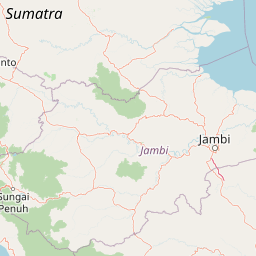
Why Kerinci Seblat National Park stands out
Kerinci Seblat National Park is best known for protecting the highest tiger population in Sumatra, with an estimated 165-190 individuals representing the highest density of Sumatran tigers anywhere on the island. The park is also famous for its remarkable plant diversity, including the world's largest flower, Rafflesia arnoldii, and the titan arum, which holds the record for the largest unbranched inflorescence in the plant kingdom. The park's dramatic volcanic landscapes centered around Mount Kerinci, coupled with Lake Gunung Tujah caldera lake, make it a unique combination of highland and montane ecosystems. It serves as one of the 12 most important protected areas in the world for tiger conservation under the Global Tiger Initiative.
Kerinci Seblat National Park history and protected-area timeline
Kerinci Seblat National Park has a complex establishment history spanning nearly two decades. The area was first declared as a candidate national park at the Third World National Parks Congress in Bali in 1982, when the Minister of Agriculture designated approximately 1.42 million hectares as a proposed national park. This initial designation consolidated numerous separate protected areas including nature reserves, wildlife sanctuaries, watershed protection forests, tourist forests, and production forests. After a lengthy review and restructuring process, the Minister of Forestry confirmed the park's borders in 1996 through decree No. 192/KptsII/1996, establishing approximately 1.36 million hectares as the official park boundary. The park was formally established in 1999 through decree No. 901/Kpts-II/1999, which set the final area at approximately 1.38 million hectares. Additional adjustments occurred in 2004 when the Sipurak Hook production forest area of approximately 14,160 hectares was incorporated into the park. The park was inscribed as a UNESCO World Heritage Site in 2004 as part of the Tropical Rainforest Heritage of Sumatra, alongside Gunung Leuser and Bukit Barisan Selatan National Parks. In 2011, the World Heritage site was placed on the Danger List due to ongoing threats from poaching, encroachment, and habitat degradation.
Kerinci Seblat National Park landscape and geographic character
The landscape of Kerinci Seblat National Park is dominated by the dramatic topography of the Barisan mountain range, a volcanic arc that runs the entire length of Sumatra. The park's terrain is characterized by extreme steepness, with approximately 70% of the area having slopes exceeding 60%, and elevations ranging from 200 meters to 3,805 meters at Mount Kerinci's summit. The central portion of the park features a distinctive enclosed valley spanning roughly 140,000 hectares, completely surrounded by the peaks of Mount Kerinci and other volcanic cones. This valley, known as the Kerinci Valley, is surrounded by higher terrain on all sides and represents a unique basin within the park. Lake Gunung Tujuh, the highest caldera lake in Southeast Asia, occupies a volcanic crater in the northern section of the park. The park contains approximately 30 named mountains and volcanic peaks, with Mount Kerinci being the most prominent. The Great Sumatran Fault, a major geological structure, passes through the park, making it of particular interest to geologists. Rivers originating in the park flow both eastward toward the Sumatran interior plains and westward toward the coast, creating a complex watershed system.
Kerinci Seblat National Park ecosystems, habitats, and plant life
The ecological character of Kerinci Seblat National Park reflects the extraordinary diversity of Sumatra's montane and lowland rainforests. The park spans multiple vegetation zones from lowland dipterocarp forests through montane forests to sub-alpine ecosystems, with the most important forest type being the tropical rainforest dominated by Dipterocarpaceae species found below 1,000 meters elevation. These forests contain species such as Shorea parvifolia, Dipterocarpus, Parashorea, and Koompassia malaccensis. Between 1,000 and 1,500 meters, the forest transitions to lower montane rainforests with Hopea and Shorea species giving way to Lauraceae and Euphorbiaceae. Above 1,500 meters, upper montane forests are dominated by Podocarpus, Castanopsis, and Ericaceae. The park also contains unique peat swamp ecosystems at Rawa Ladeh and Rawa Bento, the highest peat swamps in Sumatra, located at approximately 1,950 meters elevation. More than 4,000 plant species have been documented in the park, including the iconic Rafflesia arnoldii, the titan arum, and numerous orchid species.
Kerinci Seblat National Park wildlife and species highlights
Kerinci Seblat National Park supports exceptional wildlife diversity, most notably serving as the most important stronghold for Sumatran tigers on the island. Recent surveys indicate the park contains 165-190 tigers, representing the highest population density in Sumatra and more tigers than exist in all of China, Laos, Cambodia, and Vietnam combined. The park protects a complete guild of Sumatra's felids including the Sunda clouded leopard, marbled cat, leopard cat, and Asian golden cat, with the Asian golden cat being particularly widespread and adaptable. Other critically endangered species include the Sumatran elephant, Malayan tapir, Malayan sun bear, and Sumatran dhole. The park was historically home to the Sumatran rhinoceros, with population estimates around 500 individuals in the 1980s, though the population is now considered extinct due to poaching. In 2008, the Sumatran muntjac was rediscovered in the park after not being recorded since the 1920s, subsequently recognized as a distinct species. The avifauna includes more than 370 bird species, with 17 of Sumatra's 20 endemic species present, making the Kerinci area particularly significant for ornithologists.
Kerinci Seblat National Park conservation status and protection priorities
Kerinci Seblat National Park occupies a critical position in global conservation, designated as one of the 12 most important protected areas for tiger conservation worldwide under the Global Tiger Initiative. The park's inclusion in the UNESCO World Heritage Site Tropical Rainforest Heritage of Sumatra reflects its irreplaceable ecological value, though its listing as World Heritage in Danger since 2011 highlights significant ongoing threats. Conservation challenges include poaching for the illegal wildlife trade, which has devastated populations of tigers and other species, encroachment from agricultural expansion, and habitat fragmentation. The park's management operates through a zoning system that includes core zone, wilderness zone, utilization zone, rehabilitation zone, special zone, and traditional use zone, with the core zone covering approximately 738,831 hectares. The park is also recognized as an ASEAN Heritage Site, providing additional international conservation framework. Conservation efforts focus on protecting the remaining tiger population, preventing the extinction of other endangered species, and maintaining the connectivity of Sumatran rainforest ecosystems.
Kerinci Seblat National Park cultural meaning and human context
Kerinci Seblat National Park surrounds the densely populated Kerinci Valley, an agricultural region where local communities have maintained traditional relationships with the surrounding landscape for generations. The park encompasses areas traditionally used by local communities, with a traditional use zone covering approximately 11,606 hectares in the 2017 zoning revision. The Kerinci people inhabit the valley floor and lower slopes, cultivating rice paddies and other crops in the fertile volcanic soils. The park's establishment involved consolidation of numerous former protection forests, wildlife reserves, and other designations that had various levels of community involvement and traditional use. The area contains significant cultural sites and the local community maintains connections to the mountain and forest areas that are reflected in traditional practices and land use patterns.
Top sights and standout views in Kerinci Seblat National Park
The defining highlights of Kerinci Seblat include the dramatic volcanic peak of Mount Kerinci rising to 3,805 meters as Sumatra's highest point, the extraordinary tiger population representing the species' last major stronghold, and the presence of the world's largest flower Rafflesia arnoldii in the park's lush rainforests. Lake Gunung Tujuh offers a spectacular caldera lake setting at high elevation, while the complete range of elevation from 200 to 3,805 meters creates remarkable ecological zonation. The park's status as part of a World Heritage Site and its position as Sumatra's largest protected area underscore its regional and global significance. The diversity of big cat species, from tigers to clouded leopards to golden cats, makes this one of the most remarkable places for felid conservation anywhere in Asia.
Best time to visit Kerinci Seblat National Park
The best time to visit Kerinci Seblat National Park corresponds to the dry season, which typically runs from April to October, though the park receives rainfall throughout the year. The wetter months from November to March bring heavier precipitation and can make some trails more difficult, though the rainforest remains green and vibrant. The climate varies with elevation, with the Kerinci Valley experiencing temperatures between 16 and 28 degrees Celsius, while higher elevations are noticeably cooler. The park's montane character means that mist and cloud cover are common, particularly in the morning and evening, adding atmosphere to the landscape. Visitors seeking to climb Mount Kerinci should plan for the drier months to maximize safe access to the summit. Wildlife viewing can be productive year-round, though the drier season may concentrate animals around water sources.