Mori Atlas logo
Wildlife reserveKhijadiya Bird Sanctuary

Explore the unique intersection of freshwater lakes, salt marshes, and coastal mangrove tidal creeks

Khijadiya Bird Sanctuary: A Protected Wetland Mosaic on the Gujarat Coastline of Western India

(Khijadia Wildlife Sanctuary)

Khijadiya Bird Sanctuary stands as a critical protected wildlife reserve located in the Jamnagar district of Gujarat. The terrain creates a striking ecological contrast where the freshwater flows of the Ruparel River meet the saline influence of the Gulf of Kutch. This compact landscape supports an immense diversity of migratory waterfowl and shorebirds within a mosaic of inland marshes and estuarine channels.

bird sanctuaryRamsar wetlandfreshwater lakesalt marshmangrove creekmigratory birds

Khijadiya Bird Sanctuary

Wildlife reserve

Park overview

Structured park overview, official facts, and landscape profile for Khijadiya Bird Sanctuary

Khijadiya Bird Sanctuary park facts, protected area profile, and essential visitor context

Review the core facts for Khijadiya Bird Sanctuary, including designation, size, terrain, visitor scale, habitats, and operating context in one park-focused overview.

About Khijadiya Bird Sanctuary

Khijadiya Bird Sanctuary sits at the northeastern coastal edge of the Jamnagar district, at the meeting point of the Ruparel and Kalindri river systems and the tidal influence of the Gulf of Kutch. Its position at the interface between freshwater drainage and marine conditions gives it a layered ecological profile that is unusual among Indian bird sanctuaries.

The protected area is built around a historic check dam constructed before Indian independence, which interrupted the flow of the Ruparel River just before it reached the sea. Over time, this intervention created a stable freshwater body on one side of the bund while allowing tidal saltwater and creek systems to persist on the other. As a result, the sanctuary contains a deliberate but organically evolved mosaic: freshwater lakes, brackish marshes, mangrove-lined creeks, and patches of inland scrub and tree cover.

On the landward side of the bund, vegetation such as babul, Pilu, and Prosopis establishes a dry inland character. On the seaward side, mangrove and marine vegetation line tidal creeks that connect to the Gulf of Kutch. The sanctuary's proximity to Narara Island also ties it into a broader coastal ecosystem known for coral reef habitat, extending its biodiversity value beyond the bird community alone.

Birdwatching is the defining experience at Khijadiya. The sanctuary supports both resident and migratory species, with the winter months drawing species from across Eurasia. Reports from the site have recorded sightings of pelicans, flamingos, black-necked storks, cranes, ducks, harriers, bee-eaters, and a wide range of shorebirds and passerines. The diversity of nesting types, including tree nests, ground nests, and floating water nests built by ducks, adds to the site's ornithological richness.

Today, Khijadiya functions both as a conservation area and as a recognized eco-tourism destination, having hosted an international birdwatchers' conference and serving as a base for visitors exploring the wetlands of the Gulf of Kutch coast.

Quick facts and research context for Khijadiya Bird Sanctuary

Khijadiya Bird Sanctuary is a bird-focused protected area in Jamnagar district, Gujarat, India, situated near the Gulf of Kutch coastline. Covering roughly 6 square kilometers, it was established as a sanctuary in 1982 and later designated as a Ramsar Wetland of International Importance. Its protected status combines inland freshwater habitat with tidal salt marshes and mangrove creeks, making it one of Gujarat's most important bird sanctuaries and a significant site on India's migratory bird flyway.

Protection and recognition

Documented protection history and Ramsar wetland recognition data

Khijadiya Bird Sanctuary Protection Status and International Recognition

Khijadiya Bird Sanctuary maintains a mixed protection scope supported by documented international recognition records including formal Ramsar wetland status. Official designation details and historical conservation milestones provide structured context for this protected natural area.

International recognition

Protection details

Protection scope
Mixed
Designated year
2022
Transboundary protection
No
Park context

Deeper park guide and search-rich context for Khijadiya Bird Sanctuary

Khijadiya Bird Sanctuary history, landscape, wildlife, and travel context

Explore Khijadiya Bird Sanctuary through its history, landscape character, ecosystems, wildlife, conservation priorities, cultural context, and seasonal travel timing in a structured park guide built for atlas discovery and search intent.

Why Khijadiya Bird Sanctuary stands out

The sanctuary is best known for the unusual coexistence of freshwater lakes, salt marshes, and mangrove-influenced tidal creeks within a single protected boundary. This rare combination of inland and coastal habitats draws an exceptionally diverse bird community, with an estimated 257 to 300 migratory bird species recorded, including pelicans, flamingos, storks, cranes, and several rare winter visitors. Khijadiya is also known for its historical connection to early Indian ornithology; Salim Ali's 1984 visit reportedly documented 104 species in a single day, underscoring the sanctuary's enduring importance for bird study in the Indian subcontinent.
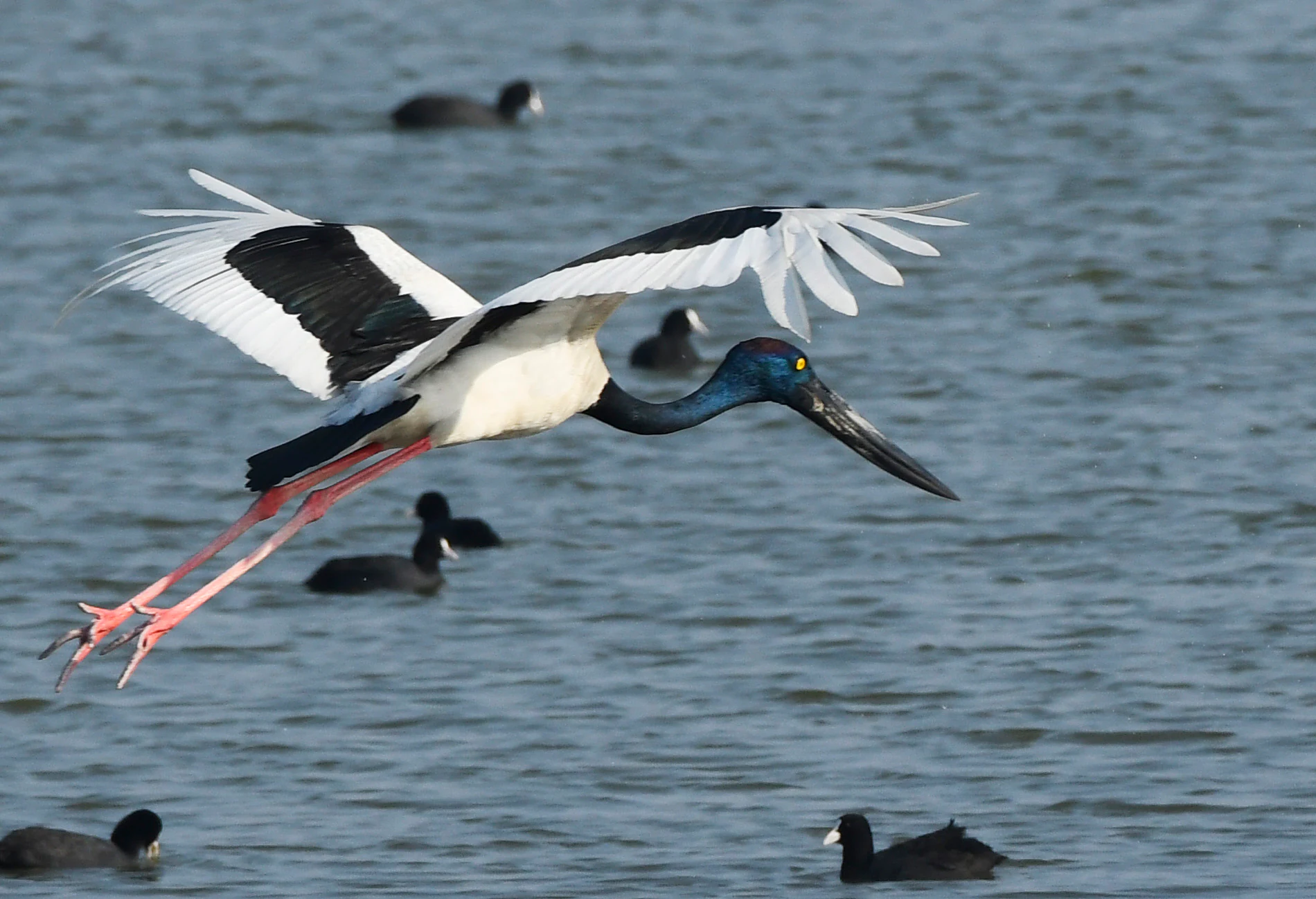
A black-necked stork with black and white wings in mid-flight above a body of water, with several smaller dark birds swimming in the background.
A black-necked stork in flight over a wetland in Khijadiya Bird Sanctuary.

Khijadiya Bird Sanctuary history and protected-area timeline

The physical foundation of the sanctuary was laid before Indian independence, when a check dam was constructed across the Ruparel River near the coast to store freshwater. Over the decades that followed, freshwater inputs from rainfall and the river interacted with the tidal saltwater of the nearby Gulf of Kutch, gradually forming the wetland mosaic that defines the protected area today.

In 1982, the area was formally declared a sanctuary under Indian wildlife protection law, making it the largest bird sanctuary in Gujarat. The sanctuary gained wider recognition in the ornithological community in 1984, when the noted Indian ornithologist Salim Ali visited the site and is reported to have recorded 104 bird species in a single day.

On 2 February 2022, World Wetlands Day, Khijadiya was internationally recognized when it was declared India's 49th Ramsar site, listed under the official name Khijadia Wildlife Sanctuary. This designation elevated its status as a wetland of international importance, reinforcing its value in regional and global migratory bird conservation efforts.

Khijadiya Bird Sanctuary landscape and geographic character

Khijadiya's landscape is a compact coastal wetland mosaic shaped by a single engineering intervention: a bund that separated the historic freshwater flow of the Ruparel River from the tidal influx of the Gulf of Kutch. Behind the bund, freshwater lakes and inland marshlands dominate the terrain. Beyond it, tidal creeks and mangrove-edged channels bring marine influence directly into the protected area.

The terrain is largely flat and low-lying, typical of the coastal fringe of the Gulf of Kutch. Inland vegetation includes drought-tolerant species such as babul, Pilu, and Prosopis, giving the landward edges a scrubby semi-arid character that contrasts sharply with the wetter marshes. The mangrove-fringed creeks on the seaward side introduce a distinctly tropical coastal feel, while the freshwater lake systems provide open water expanses and reed-fringed margins favored by waterfowl.

The broader setting places Khijadiya in the northeastern coastal stretch of the Jamnagar district, with the Gulf of Kutch forming the marine boundary and nearby Narara Island extending the coastal ecosystem outward into reef-influenced waters.
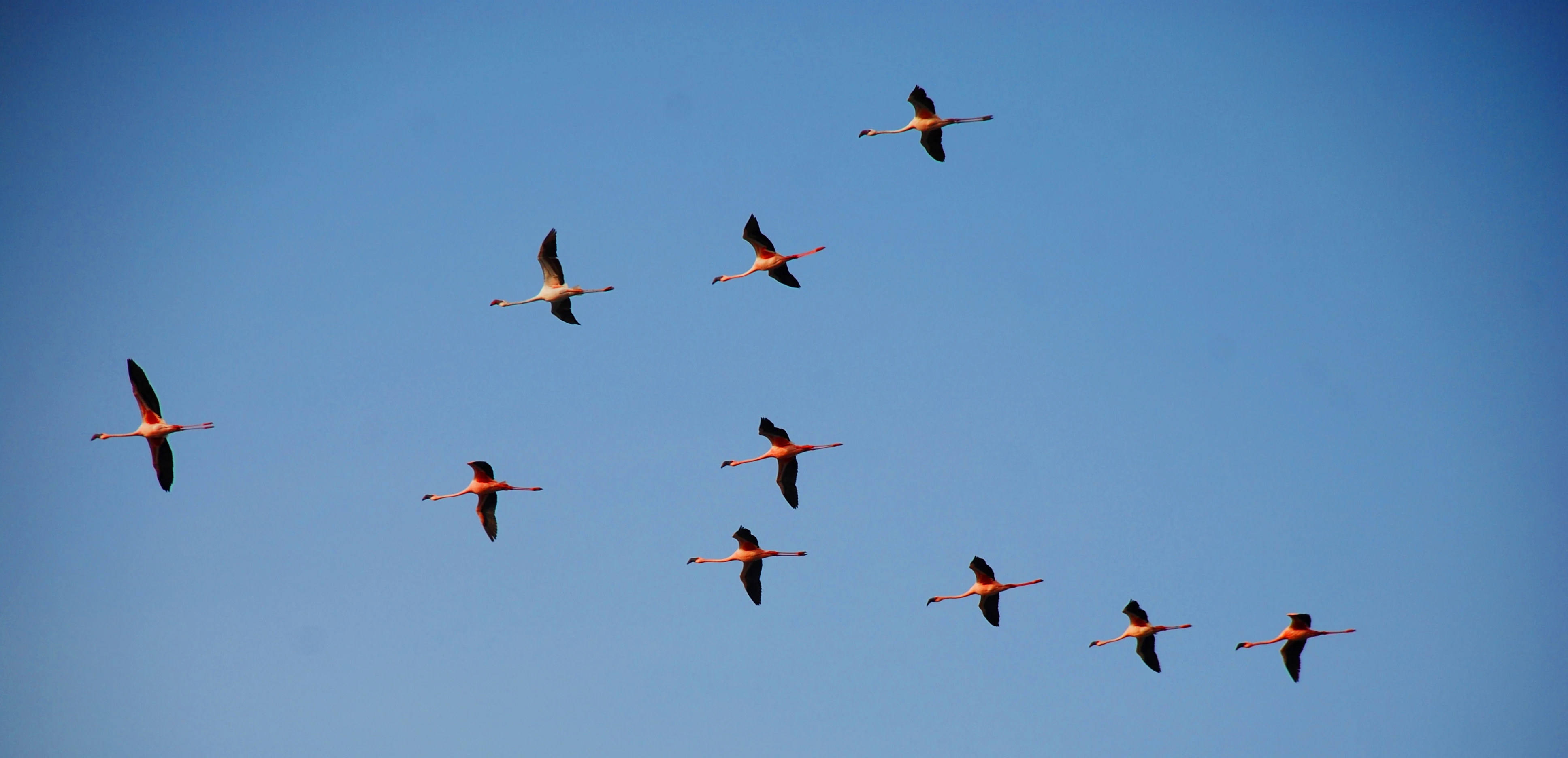
A group of pink flamingos flying in a scattered formation across a bright blue sky.
A flock of flamingos in flight against a clear blue sky.

Khijadiya Bird Sanctuary ecosystems, habitats, and plant life

Ecologically, Khijadiya is defined by the convergence of three distinct habitat types within a small protected footprint. Freshwater lakes and marshes fed by the Ruparel and seasonal rainfall form one core zone. Salt marshes and mangrove-lined tidal creeks tied to the Gulf of Kutch form a second. Inland woodland and scrub communities with babul, Pilu, and Prosopis anchor the third.

This arrangement supports a layered vegetation pattern that shifts abruptly across the bund. Aquatic and semi-aquatic plants characterize the inner freshwater zones, mangroves and salt-tolerant flora dominate the tidal side, and dryland scrub species occupy intermediate and upland patches. The variety of water regimes and the proximity of reef habitat near Narara Island amplify the sanctuary's overall biodiversity value beyond its bird populations.

The interpretive importance of Khijadiya in Indian ecology rests on this unusual ability of a single protected area to demonstrate both freshwater wetland and estuarine dynamics simultaneously.

Khijadiya Bird Sanctuary wildlife and species highlights

Khijadiya is overwhelmingly known as a bird sanctuary, and the diversity of its avifauna is its primary wildlife asset. Reports from the site have documented between roughly 257 and 300 migratory bird species along with resident species, making it one of the richest bird areas in Gujarat.

Among winter and passage visitors, the sanctuary hosts large numbers of pelicans, including Great white pelicans and Dalmatian pelicans, as well as Greater and Lesser flamingos. Wading species are well represented by black-necked storks, black ibises, black-tailed godwits, common greenshanks, great thick-knees, and pheasant-tailed jacanas. Ducks in significant variety include knob-billed ducks, common teals, northern pintails, shovelers, Eurasian wigeons, gadwalls, and garganeys, while whistling ducks are also documented.

Raptors are a notable feature of the sanctuary, with sightings including the imperial eagle, Indian spotted eagle, marsh harrier, pale harrier, black-winged kite, and shikra. Passerines and smaller species recorded at the site include the grey hypocolius, forest wagtail, grey-necked bunting, black-headed bunting, European roller, blue-cheeked bee-eater, barn swallow, crested lark, isabelline shrike, and grey francolin. The sanctuary is also known for supporting species such as the great crested grebe, common crane, demoiselle crane, greylag goose, little tern, dunlin, and brahminy kite.

Black-necked storks are a particular highlight, as the species is rare across much of India but reportedly occurs in notable numbers at Khijadiya. The site also exhibits varied nesting behaviors, including tree, ground, and floating water nests, with several duck species constructing floating nests over the freshwater lakes.

Beyond birds, the sanctuary supports a small but ecologically interesting mammal community reported to include blue bull (nilgai), jackal, wolf, jungle cat, mongoose, Indian hare, and snakes, reflecting the dryland-marshland mosaic at the edge of the protected area.

Khijadiya Bird Sanctuary conservation status and protection priorities

Khijadiya's conservation significance lies in its designation as a Ramsar Wetland of International Importance, achieved on 2 February 2022, when it became India's 49th Ramsar site under the official name Khijadia Wildlife Sanctuary. This recognition formally placed the wetland within an international framework for the conservation of wetlands and their waterbird populations.

At the national level, its status as a sanctuary declared in 1982 under Indian wildlife protection legislation provides legal protection against habitat degradation and unregulated use. The sanctuary's Ramsar status specifically emphasizes its importance for migratory waterbirds, the integrity of its freshwater and tidal wetland systems, and its role within broader flyway-scale conservation networks.

Habitat preservation at Khijadiya is uniquely targeted: the bund that originally shaped the wetland continues to define the freshwater-saltwater interface, allowing both systems to coexist rather than compete. This makes the sanctuary a living example of how engineered hydrological changes can, over time, create habitat value that supports international conservation goals.

The sanctuary's relevance extends beyond birds to the broader coastal ecosystem, including the mangrove creeks of the Gulf of Kutch and the adjacent coral reef area around Narara Island, reinforcing its importance as a multi-habitat conservation landscape rather than a single-species reserve.

Top sights and standout views in Khijadiya Bird Sanctuary

Khijadiya Bird Sanctuary's strongest distinctions are its unusual freshwater-meets-saltwater wetland structure, its exceptional migratory bird diversity, and its position as a Ramsar-recognized site of international importance. The combination of inland scrub, freshwater lakes, salt marshes, and mangrove creeks within a single boundary creates a layered ecological experience that few Indian sanctuaries can match.

Its identification with early Indian ornithology, notably Salim Ali's 1984 visit, and its role as an eco-tourism destination and host of an international birdwatchers' conference reinforce its standing as both a working conservation site and a recognized hub for bird-focused exploration along the Gulf of Kutch.

Best time to visit Khijadiya Bird Sanctuary

The most rewarding season to experience Khijadiya is winter, broadly from September through February or early March, when migratory waterfowl, shorebirds, raptors, and passerines are present in significant numbers. During this period, the sanctuary's freshwater lakes, marshes, and tidal creeks host the bulk of its recorded bird diversity, including pelicans, flamingos, cranes, ducks, and storks.

Outside the winter window, resident species and the wetland landscape itself remain present, but the migratory influx that defines the sanctuary's birding character is largely absent, making the cooler, drier months clearly the high point for both bird activity and visitor experience.

Monthly climate preview

Long-term monthly temperature averages and precipitation measurements for Khijadiya Bird Sanctuary

Khijadiya Bird Sanctuary Climate Normals and Annual Temperature Rhythm

Historical data records monthly mean temperatures ranging from 20.56 to 30.85 degrees Celsius alongside distinct precipitation variations across the representative coordinate. Examining twelve-month meteorological patterns provides a clear baseline for understanding annual environmental conditions.
Annual mean27 °C
21 °C31 °C
Jan21°
Feb23°
Mar26°
Apr29°
May31°
Jun31°
Jul29°
Aug28°
Sep28°
Oct28°
Nov26°
Dec22°
Warmest month
June

30.9 °C

Coolest month
January

20.6 °C

Wettest month
July

6.5 mm/day

Driest month
December

0 mm/day

Park location guide

Geography guide, regional context, and park location map for Khijadiya Bird Sanctuary

Khijadiya Bird Sanctuary park geography, regions, and map view in India

Understand where Khijadiya Bird Sanctuary sits in India through a broader geographic reading of the surrounding landscape, nearby location context, and its mapped position within the national park landscape.

How Khijadiya Bird Sanctuary fits into India

India is a South Asian country bordered by the Indian Ocean, Arabian Sea, and Bay of Bengal. It shares land borders with Pakistan, China, Nepal, Bhutan, Bangladesh, and Myanmar. The country has a population of over 1.4 billion people and operates as a federal parliamentary republic with its capital in New Delhi.

Wider geography shaping Khijadiya Bird Sanctuary in India

India occupies the Indian subcontinent in South Asia, bordered by the Arabian Sea to the southwest, the Bay of Bengal to the southeast, and the Indian Ocean to the south. It shares land borders with Pakistan to the west, China, Nepal, and Bhutan to the north, and Bangladesh and Myanmar to the east. The territory also includes the Andaman and Nicobar Islands in the Indian Ocean.

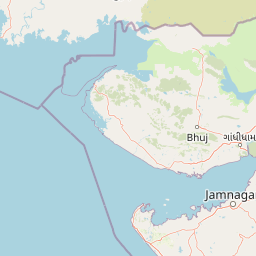
Map view of Khijadiya Bird Sanctuary

Use this park location map to pinpoint Khijadiya Bird Sanctuary in India, understand its exact geographic position, and read its mapped placement within the surrounding landscape more clearly.

Pigeon | © OpenStreetMap contributors

Location context for Khijadiya Bird Sanctuary

Gujarat
Recorded earthquake history

Explore the Historical Earthquake Catalogue for Khijadiya Bird Sanctuary

Examine the record of past seismic events linked to the geography of Khijadiya Bird Sanctuary. This catalogue facilitates a deeper understanding of regional activity through verified historical data points, organized for clear geographic reference within the broader Jamnagar landscape.

Khijadiya Bird Sanctuary Earthquake History

Catalogued events

4 events

Strongest magnitude

Magnitude 4.2

Most recent event

Jun 15, 2020

This history includes earthquakes recorded inside the park or within 50 km of its borders

Examine the freshwater lakes, salt marshes, and mangrove-fringed tidal creeks defining this coastal wetland.

Khijadiya Bird Sanctuary Photos and Visual Scenery Explorer

Visual records capture the striking ecological contrast between freshwater lakes and saltwater creeks across the protected wetland. Photographic observation reveals the distinct terrain, vegetation zones, and coastal habitats supporting large migratory bird populations.

A black-necked stork with black and white wings in mid-flight above a body of water, with several smaller dark birds swimming in the background.

A large flock of white pelicans standing on a muddy riverbank with their reflections visible in the water.

A group of pink flamingos flying in a scattered formation across a bright blue sky.

Park atlas

Compare adjacent coastal habitats, regional sanctuaries, and connected wildlife reserves

Parks Near Khijadiya Bird Sanctuary and Surrounding Protected Wetland Landscapes

Browse protected areas and wetland reserves located near Khijadiya Bird Sanctuary across the coastal terrain of western India. Exploring adjacent regional parks helps place local marine and freshwater ecosystems into a broader geographical context.
National parkGujarat
About 52 km away#1 closest

West

Marine National Park, Gulf of Kutch: A Protected Coastal Landscape in Gujarat, India

Explore its mapped boundaries and regional geography.

Marine National Park, Gulf of Kutch is a designated national park located in the Gujarat region of India. This page serves as an atlas-centric resource for understanding the park's protected landscape, its position within the broader geography of Western India, and its mapped natural features. Discover the distinct protected-area characteristics and regional context that define this important Indian national park.

Area
162.89 km²
Established
1982
IUCN
II
Relief
Lowland
National parkGujarat
About 165 km away#2 closest

Southeast

Gir National Park: Gujarat's Key National Park with Protected Landscape Identity

Understanding the geography and mapped boundaries of this Indian protected area

Gir National Park represents a crucial protected landscape within the Gujarat region of western India. This MoriAtlas entry focuses on its role as a national park, detailing its geographic setting and the mapped extent of its protected area. Users can delve into the specific landscape character and regional context that defines Gir National Park, making it a vital point for structured exploration of India's protected lands and natural geography.

Area
1,410.3 km²
Established
1965
IUCN
IV
Visitors
60.1K annual
Wildlife reserveGujarat
About 191 km away#3 closest

East

Nal Sarovar Bird Sanctuary: Geographic Analysis of Gujarat's Largest Wetland Wildlife Reserve

Mapping the freshwater ecosystems and migratory corridors of western India

The landscape of Nal Sarovar Bird Sanctuary is shaped by an expansive shallow lake and surrounding marshland, creating a productive mosaic of freshwater habitats. As a designated Ramsar site, it serves as a critical focus for understanding regional bird migration and the interplay between human heritage and conservation in the alluvial plains of Gujarat.

Area
120.82 km²
Established
1969
Relief
Lowland
Climate
Subtropical
National parkBhavnagar District
About 199 km away#4 closest

East

Blackbuck National Park: Gujarat's Grassland Protected Landscape and Wildlife Atlas

Mapped semi-arid terrain and endangered species habitat.

Blackbuck National Park in Bhavnagar District, India, presents a unique focus on semi-arid grassland ecosystems and their protection. This national park showcases a flat, expansive landscape that borders coastal tidal zones, offering a distinct geographic context for its rich biodiversity. As a critical habitat for the blackbuck antelope and the endangered lesser florican, its protected area status is paramount. Exploring this park through its mapped boundaries and regional geography reveals its importance within India's network of conservation landscapes.

Area
34.08 km²
Established
1976
IUCN
II
Relief
Lowland
Wildlife reserveSindh
About 202 km away#5 closest

North

Rann of Kutch Wildlife Sanctuary: Protected Desert Wetlands and Salt Flats of Sindh

Regional geography and wetland conservation boundaries

Located in the Badin District of Sindh, Rann of Kutch Wildlife Sanctuary spans a unique convergence of desert and wetland environments. The sanctuary serves as a major Ramsar site, preserving large-scale salt flats and seasonal marshlands that support threatened species including the great Indian bustard and migratory flamingo populations, while highlighting the complex ecological interface of the Indus delta region.

Area
5,663.75 km²
Established
1980
Relief
Lowland
Access
Access unknown
Wildlife reserveSindh
About 251 km away#6 closest

Northwest

Jubho Lagoon Wildlife Reserve: Coastal Wetland Geography and Regional Map Context

Mapping brackish lagoons and migratory bird habitats in Sindh

Investigate the protected landscape of Jubho Lagoon, a shallow brackish wetland in southern Sindh. The area features a complex mosaic of tidal inlets, exposed mudflats, and freshwater-influenced marshes that serve as a primary regional habitat for migratory flamingos and pelicans.

Area
7.06 km²
Established
2001
Relief
Lowland
Scope
Terrestrial
Nature reserveGujarat
About 266 km away#7 closest

East

Thol Lake Wildlife Sanctuary: A Deep Dive into Gujarat's Protected Freshwater Wetland Landscape

Geographic overview of irrigation-fed wetlands and seasonal bird habitats

Thol Lake Wildlife Sanctuary stands as a vital inland wetland within the semi-arid terrain of Gujarat. This reserve provides a significant habitat mosaic, ranging from open water and marshy shorelines to surrounding thorny scrub and agricultural plains. Learn about its function as an irrigation reservoir and its role in protecting local and migratory waterbird populations through its distinct seasonal water fluctuations.

Area
6.99 km²
Established
1912
Relief
Lowland
Climate
Arid
Watercolor painting of a calm lake with grassy foreground, small islands, and distant hills under a soft light.
Wildlife reserveSindh
About 343 km away#8 closest

Northwest

Keenjhar Lake Wildlife Reserve: Sindh Province Protected Wetland and Geographic Atlas

Mapped freshwater wetland and regional wildlife sanctuary

Keenjhar Lake is a prominent freshwater wetland and wildlife reserve in the Thatta District of Sindh. This expansive basin serves as a key ecological anchor for migratory waterbirds and a central feature of the regional landscape. The area combines significant hydrological value with distinct cultural history, providing a unique look into the protected geography of southeastern Pakistan.

Area
134.68 km²
Relief
Lowland
Scope
Terrestrial
Water
Water-dominated

Common questions about visiting, size, designation, and location context for Khijadiya Bird Sanctuary

Khijadiya Bird Sanctuary FAQs for park facts, access, geography, and protected area context

Find quick answers about Khijadiya Bird Sanctuary, including protected-area facts, park geography, trail and visitor context, and how the park fits into its surrounding country and regional landscape.
MoriAtlas Explorer

Continue Your Protected Areas Search Across the Global Atlas

Deepen your exploration by continuing the structured search for national parks and protected areas worldwide. Utilize the comprehensive filtering capabilities to compare different conservation landscapes and refine your understanding of global park geography. Discover more about the distribution and characteristics of protected natural areas.

Global natural geography