
Why Lake Piso stands out
Lake Piso is best known as Liberia's largest lake and as a coastal tidal lagoon of substantial ecological value. The lake is closely associated with internationally recognized biodiversity: its islands and fringing wetlands make it an Important Bird Area under BirdLife International, while the broader Lake Piso wetlands are Liberia's only Ramsar wetland of international importance, designated in 2003. The lake is also widely known as a cultural landmark of the Vai people, whose traditional homeland surrounds its shores.
Lake Piso history and protected-area timeline
Lake Piso has played a varied role in the modern history of western Liberia. During the Second World War, the lagoon was used as a military base for Allied seaplanes, a function that drew on the lake's sheltered waters and direct connection to the sea. The lake later acted as a temporary refuge for Liberians displaced during the country's civil conflict.
The lake's environmental and human history include several difficult episodes. In 1998, the lake overflowed its banks at least twice. The first event was triggered by a blockage of the narrow inlet, or bar mouth, that connects Lake Piso to the Atlantic Ocean, and the second was driven by heavy seasonal rains. Combined, these floods affected more than twenty settlements, caused multiple deaths, and displaced thousands of people, leading the Liberian government to declare the area a disaster zone.
In December 2002, the wooden ferry _Papa Friends 2000_ capsized at the confluence of the lake and the Mafa River while carrying approximately 200 passengers returning from the funeral of a local footballer. Of those aboard, only about fifteen were rescued, and the remainder drowned or were presumed lost. The lake's conservation trajectory began to take shape in 1999, when a nature reserve was designated nearby. The wetlands, covering more than 76,000 hectares, were subsequently listed under the Ramsar Convention as a wetland of international importance in 2003, the first such designation in Liberia.
Lake Piso landscape and geographic character
The landscape of Lake Piso is one of broad, quiet water framed by the low ridges of the Cape Mount peninsula. The lake itself is long and oval, with a rough maximum extent of about 31 kilometers in length and 16 kilometers in width, lying nearly parallel to the Atlantic coastline. Its surface area of roughly 103 square kilometers makes it the dominant water feature of western Liberia.
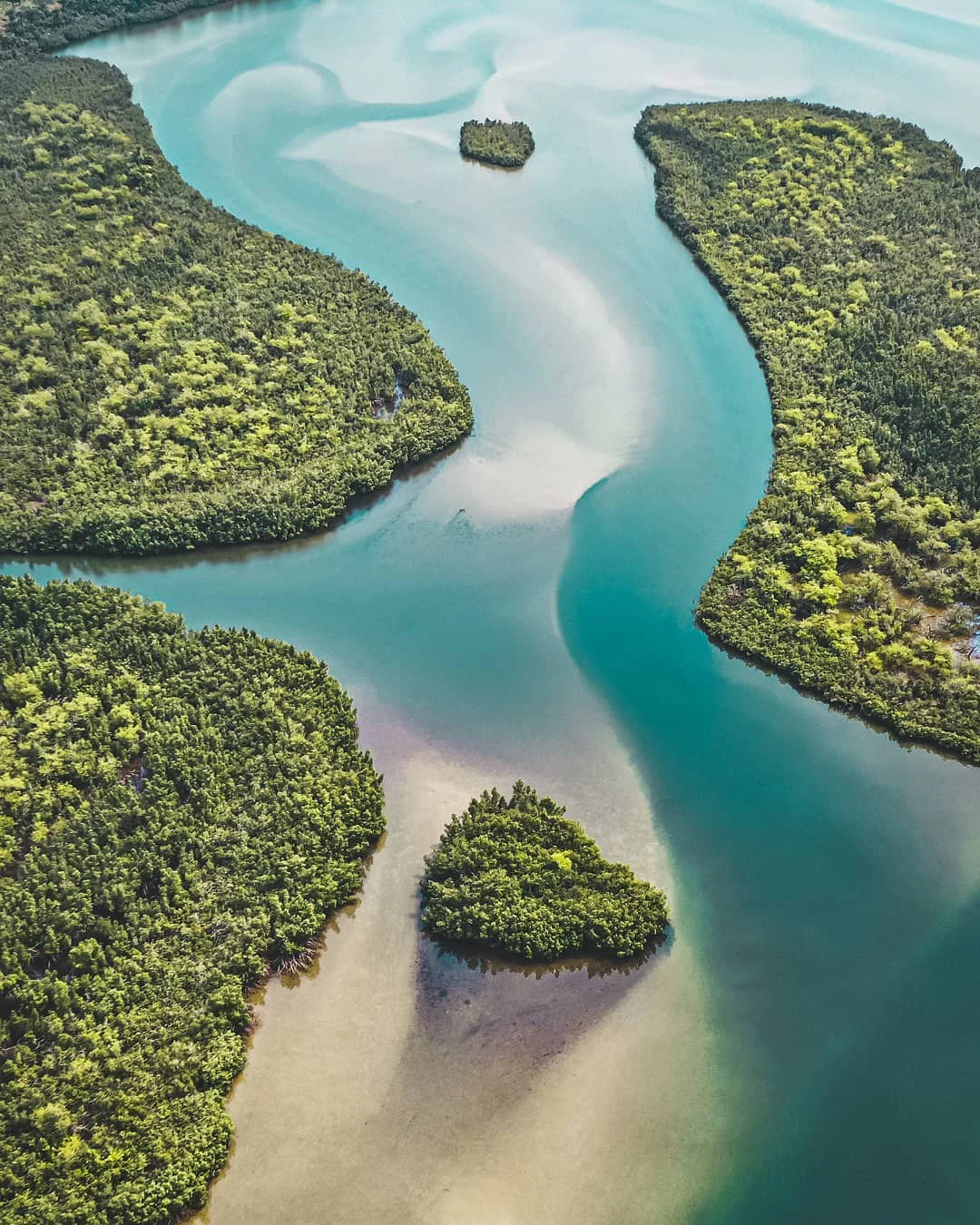
Between the lake and the ocean lies a narrow strip of coastal land, shaped by the peninsula and broken by the single tidal inlet, or bar mouth, through which the lake exchanges water with the sea. The lake's shoreline blends into surrounding wetlands of mangroves, reedbeds, and seasonally inundated forest, while small islands rise from the water within the basin. Several rivers, among them the Mafa River and Mole Creek, flow into the lake, adding to the diversity of its margins and shaping its brackish, mixed-salinity character.
The result is a coastal wetland landscape that shifts between open water, river channels, tidal flats, mangrove stands, and low forested islands, forming a transitional environment between Liberia's interior forests and its Atlantic shoreline.
Lake Piso ecosystems, habitats, and plant life
Lake Piso represents one of the most ecologically important coastal wetland complexes in Liberia. Its combination of open brackish water, mangrove margins, reedbeds, river deltas, and forested islands creates a mosaic of habitats along the Atlantic coast.
The lake supports a wide range of birdlife and has been formally recognized as an Important Bird Area by BirdLife International because of the significant populations it sustains. Several small islands within the lake serve as refuges for primates, including monkeys, as well as for breeding and roosting birds. The fringing wetlands extend well beyond the lake's shoreline, and the larger Lake Piso wetland system covers tens of thousands of hectares of ecologically connected habitat.
The brackish character of the water, caused by the mixing of freshwater inflows from rivers like the Mafa and Mole Creek with tidal inflow from the Atlantic, shapes the lake's distinctive vegetation and fauna. Salt-tolerant mangrove communities line parts of the shore, while freshwater and tidal plant communities occupy the upper reaches of inflowing rivers.
Lake Piso wildlife and species highlights
Lake Piso's wildlife profile is anchored by its birdlife, which has brought the lake international recognition. Designated as an Important Bird Area by BirdLife International, the lake and its surrounding wetlands support populations of many bird species, drawing on its mix of open water, mangroves, reedbeds, and forested islands for feeding and breeding habitat.
The lake's islands provide an additional wildlife refuge. Monkeys are known to shelter on features such as Massatin Island within the lake, where vegetation cover and isolation from the mainland offer some protection. The surrounding wetlands extend habitat value beyond the lake itself, supporting migratory and resident waterbirds along the broader coastal wetland gradient.
The wildlife of the lake is bound up with local livelihoods: fish and other aquatic resources from Lake Piso support both subsistence and commercial fishing for the communities along its shores.
Lake Piso conservation status and protection priorities
Lake Piso holds a unique place in Liberia's conservation framework as the country's only Ramsar Wetland of International Importance, designated in 2003 under the international convention on wetlands.
The lake's protected status began to take formal shape in 1999, when a nature reserve was established nearby in recognition of the area's ecological value. BirdLife International has independently designated Lake Piso as an Important Bird Area, citing its role in supporting populations of numerous bird species. Together, these recognitions underline the lake's importance for regional biodiversity, particularly along Liberia's western coast, where natural wetland habitat has come under increasing pressure from human activity.
Conservation challenges in the area include the vulnerability of the lake's narrow tidal inlet, whose blockage in 1998 contributed to severe flooding, and the broader pressures on coastal wetlands from settlement, fishing, and resource extraction in the catchment. The lake's Ramsar designation reflects an intention to manage these competing pressures for long-term ecological integrity.
Lake Piso cultural meaning and human context
Lake Piso is central to the cultural identity of the Vai people, whose traditional homeland lies along the shores of the lagoon in Grand Cape Mount County. For generations, the lake has supported community life through fishing, transport, and trade, and the surrounding settlements have developed around its resources and rhythms.
The lagoon has also long served as a site of leisure and gathering. Before the disruption caused by the civil war years, Lake Piso was a popular destination for visitors from across Liberia and beyond, drawn to its setting for swimming, canoeing, and water-based recreation. Local events, including funerals and other communal gatherings, brought people together on the lake's waters, a pattern tragically highlighted by the 2002 _Papa Friends 2000_ ferry disaster. The lake's continued role in local cultural life remains intimately tied to its condition as a working waterway.
Top sights and standout views in Lake Piso
Lake Piso is distinguished by its scale, its ecological recognition, and its cultural depth. As the largest lake in Liberia and its only Ramsar Wetland of International Importance, it anchors conservation efforts across the country's western coast.
Its recognition as an Important Bird Area by BirdLife International, its mangrove- and island-rich brackish ecosystem, and its role as the cultural heartland of the Vai people together make it a natural landmark of national significance, while its layered modern history, from wartime seaplanes to wartime refuge and present-day fishing economy, gives it a distinctive place in Liberia's broader narrative.
Best time to visit Lake Piso
Lake Piso has a tropical coastal climate, with conditions shaped by proximity to the Atlantic Ocean and seasonal rainfall patterns typical of West Africa. The drier months tend to offer calmer conditions on the lagoon, clearer views of its islands and shoreline, and generally more comfortable conditions for activities such as canoeing, swimming, and other water-based recreation. Heavier rainfall periods can bring elevated water levels to the lagoon's rivers and wetlands, which may affect accessibility around the margins, while the lake's birdlife remains a year-round attraction.
Travelers should be aware that flooding events have historically been associated with periods of particularly heavy rainfall and disturbances to the bar mouth that regulates the lake's outflow into the Atlantic. Planning around the generally drier windows of the regional climate can help in experiencing the lagoon under more stable conditions.