A 7,000-year-old basalt mining landscape reborn as a bat sanctuary and geotourism site in the eastern Vulkaneifel.
Mayener Grubenfeld
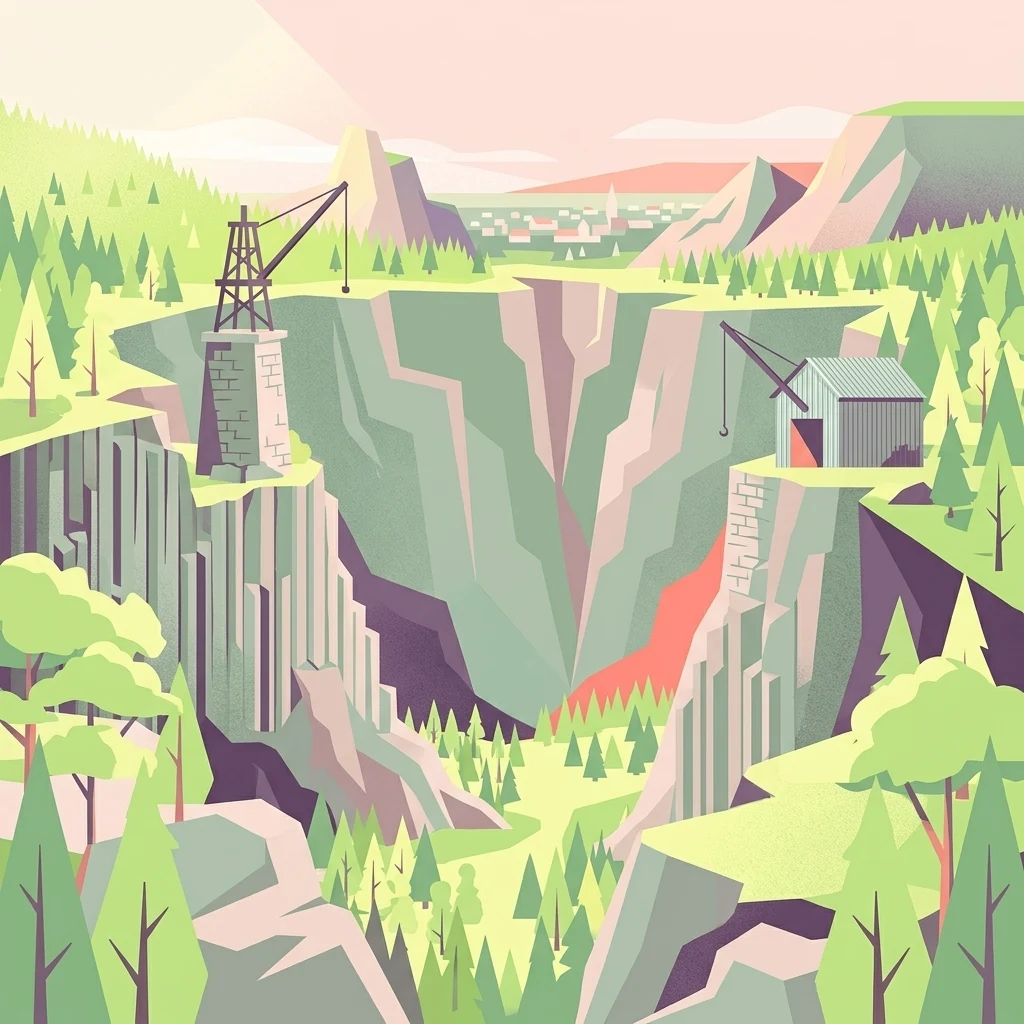
The Mayener Grubenfeld is a historic basalt quarrying district on the northeastern edge of the town of Mayen, in the eastern Vulkaneifel region of Rhineland-Palatinate, Germany. It preserves the visible and underground traces of more than 7,000 years of continuous extraction of the dense, porous Mayener Basaltlava, a volcanic rock laid down by lava flows from the Bellerberg volcano roughly 140,000 to 200,000 years ago.
Mined first for prehistoric quern stones and Roman millstones, and later for paving, railway ballast, and building material, the field produced an interlinked network of open pits, vertical shafts, and vaulted underground chambers known as Geglöcks. After industrial basalt extraction finally ended in the 1970s, nature reclaimed the surface, leaving shrub-covered quarry hollows, small lakes such as the Silbersee, and disused galleries whose constant cool temperature made them ideal for traditional brewery cellars.
Today the area stands out as one of the most important bat hibernation sites in Central Europe, sheltering an estimated 50,000 to 100,000 bats, and is protected within the Natura 2000 site 'Unterirdische stillgelegte Basaltgruben Mayen und Niedermendig', a formally designated German Naturschutzgebiet since 2014, and a stop on the Vulkanpark route within the Nationaler Geopark Laacher See.