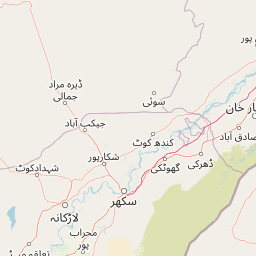
Why Mehrano Wildlife Sanctuary stands out
Mehrano is best known as one of the few large, privately preserved riverine forests in Sindh, where centuries of royal stewardship have produced a refuge for blackbuck, Indian gazelle, hog deer, and wild boar. It is also recognized for a forest lake that hosts migratory birds arriving from Siberian and European flyways, and for its unusual position as a green, water-fed sanctuary bordering the dry Cholistan desert.
Mehrano Wildlife Sanctuary history and protected-area timeline
Mehrano's origins as a protected landscape stretch back to the late 18th century. The sanctuary is associated with an initial protection date of 1790, long before the modern Pakistani wildlife protection framework, when the forest was first set aside and managed, likely under local rulers of the era. This early beginning makes Mehrano one of the older surviving protected landscapes in Sindh.
The defining chapter in the sanctuary's modern history is its management by the Talpur Mir royal family, the rulers of the former princely state of Khairpur. Across generations, the family has treated Mehrano as a private reserve, actively conserving the riverine forest and the wildlife it shelters rather than allowing it to be cleared for agriculture or settlement. In 1974, this longstanding stewardship was formally recognized when the area received official wildlife sanctuary designation, placing it within the legal framework of Sindh's conservation system while preserving the family's central management role.
The family continues to oversee the reserve into the present day. Under the leadership of figures such as Mir Ali Murad Khan Talpur II, head of the royal house, strict rules have been enforced for decades. All hunting is prohibited except for jackals and an annual cull of wild boar, the latter being permitted only when populations rise to a level that threatens farmers living next to the forest. This combination of dynastic tradition and modern wildlife management has shaped Mehrano's identity as a sanctuary rooted in both history and ongoing practical conservation.
Mehrano Wildlife Sanctuary landscape and geographic character
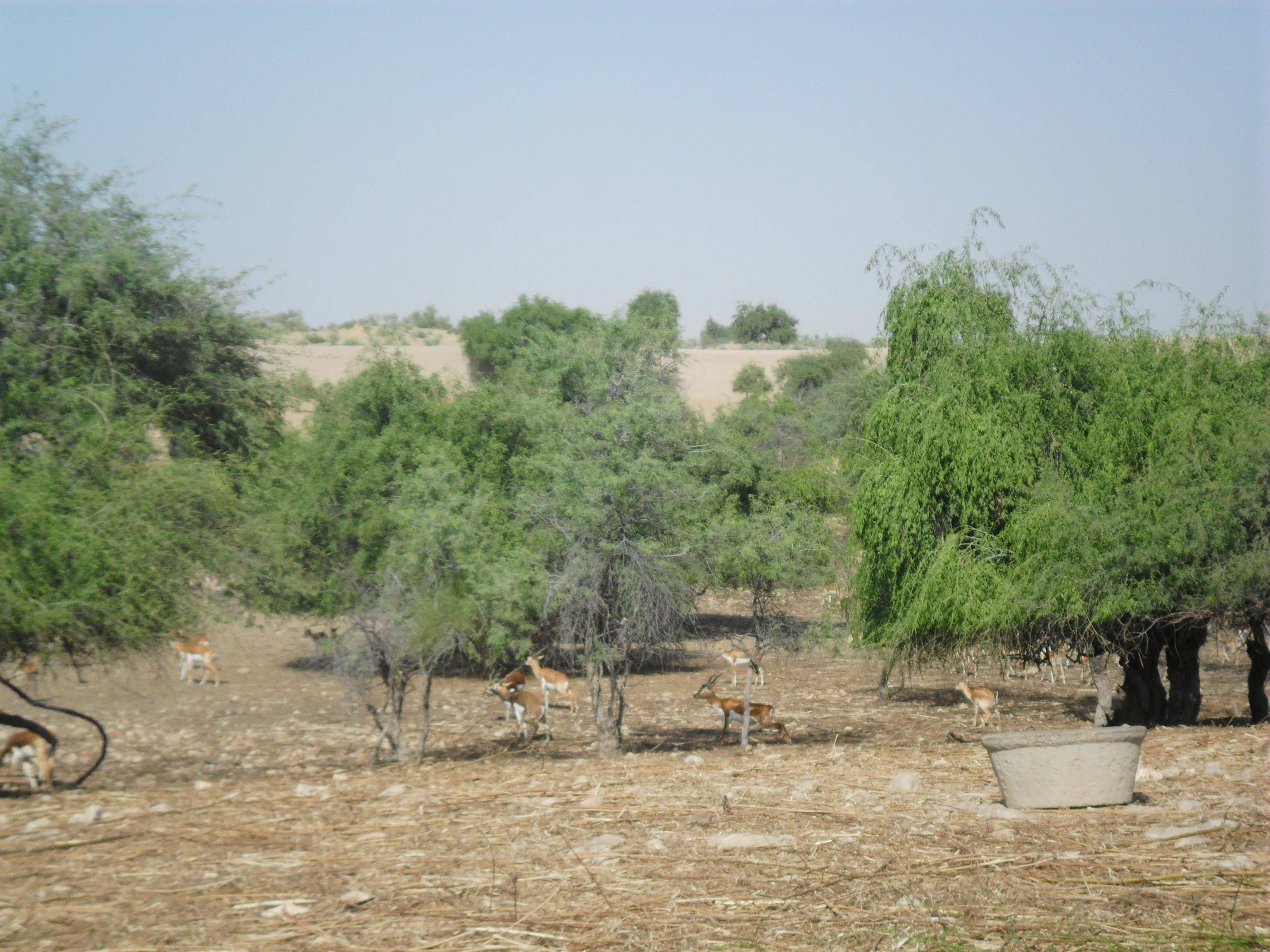
Mehrano takes the form of a compact riverine forest embedded within a broader arid landscape. Its interior is dominated by dense tree cover, broken up by clearings used for agriculture and open areas serving as hunting grounds and wildlife viewing zones. The presence of a forest lake introduces standing water into an otherwise dry regional setting, creating a local microclimate that supports richer vegetation and more varied wildlife than the surrounding lands.
The sanctuary's most striking geographic feature is its position at the boundary between two very different ecosystems. To one side lies the Cholistan desert, a vast and largely treeless expanse that extends deep into southeastern Pakistan and into neighboring India. To the other side, Mehrano's green, water-influenced forest represents an island of habitat sustained by the Indus river system and centuries of active management. This ecological contrast between forest and desert is one of the defining visual and environmental features of visiting or studying the area.
Terrain within the sanctuary is broadly flat, typical of the Indus floodplain, with elevations at or near 188 feet above sea level. The relatively uniform topography places greater emphasis on vegetation cover, water availability, and habitat edges as the main drivers of the landscape's character.
Mehrano Wildlife Sanctuary ecosystems, habitats, and plant life
Mehrano supports a layered riverine ecosystem that combines woodland, wetland, farmland, and dry scrub elements within a relatively small area. The forest is dominated by native riverine tree species typical of the Sindh Indus plain, with understory vegetation and grasslands that provide forage for the reserve's large herbivores. The forest lake and seasonal water features add a wetland dimension, supporting aquatic plants and the invertebrates and fish that underpin the lake's food web.
Because of this habitat diversity, Mehrano functions as a transitional zone between fully aquatic, agricultural, and desert environments. The trees and shaded forest interior contrast with sunlit clearings and the dry, sandy fringes where the reserve meets the Cholistan desert, allowing different plant communities to thrive within short distances.
The sanctuary's ecological value is amplified by its long history of protection. Generations of limited hunting and active habitat management have allowed the riverine forest to retain a structure and density that mirrors historical conditions, rather than the heavily degraded patches often seen elsewhere in the Indus plain. This persistence makes Mehrano an important reference point for understanding what intact Sindh riverine forest can look like.
Mehrano Wildlife Sanctuary wildlife and species highlights
Mehrano's wildlife profile is defined by a remarkable density of large mammals for a reserve of its size. The forest is estimated to host around 4,000 big game animals, a figure that reflects the success of long-term protection and habitat management. The most visible species include blackbuck, an elegant antelope often associated with open grasslands and forest clearings; the chinkara, or Indian gazelle, which favors drier, more open terrain; Indian hog deer, typically associated with denser cover near water; and wild boar, which thrives in the moist, sheltered environment the forest provides.
Wild boar play a particularly important role in the reserve's management. Because the population can grow beyond what the forest can sustain, posing risks to neighboring farmland and local families, an annual cull is permitted under the sanctuary's rules. Aside from this controlled measure and the hunting of jackals, no other hunting is allowed, which has helped maintain stable populations of other species.
The sanctuary's lake and surrounding wetlands add a fundamentally different wildlife dimension. Resident waterbirds are joined by migratory species that travel from breeding grounds in Siberia and across Europe, using Mehrano as a wintering or stopover site along broader flyways. Birdwatchers and naturalists visit specifically for this intersection of resident and migratory avifauna, while tourists can observe wild boar from a designated viewing area, providing direct access to one of the sanctuary's most charismatic large mammals.
Mehrano Wildlife Sanctuary conservation status and protection priorities
Mehrano represents an unusual and historically significant model of conservation in Pakistan. Its origins in 1790 and its formal wildlife sanctuary designation in 1974 demonstrate an unusually long timeline of effective habitat protection, bridging precolonial stewardship with modern state recognition. The combination of private management by the Talpur Mir royal family and endorsement by the Sindh wildlife department has created a hybrid model that has, in practice, sustained one of the region's most important riverine forests.
The sanctuary's conservation importance extends beyond its own borders. By maintaining a large block of forested habitat and high densities of blackbuck, chinkara, hog deer, and wild boar, Mehrano helps preserve the genetic viability and population resilience of species that have declined or disappeared from much of their former range in Sindh. The reserve also serves as a refuge for migratory birds whose broader flyway conditions are under increasing pressure elsewhere.
Strict hunting rules, including the prohibition on all hunting except for jackals and a managed boar cull, reflect a conservation-first approach. Active family-led management, combined with formal recognition, positions Mehrano as both a functioning protected area and a living example of how dynastic land stewardship can align with modern wildlife protection goals.
Mehrano Wildlife Sanctuary cultural meaning and human context
Mehrano is closely interwoven with the cultural and political history of Sindh. The sanctuary has been preserved across generations by the Talpur Mir royal family, the rulers of the former princely state of Khairpur, one of several princely states that existed in the region before the consolidation of modern Pakistan. This long dynastic stewardship gives Mehrano a heritage dimension that complements its ecological role, linking the forest to centuries of local history and to the identity of Khairpur District itself.
The reserve's location near Kot Diji, an archaeological site associated with one of the earliest fortified settlements of the Indus region, situates Mehrano within a landscape of deep historical significance. The forest's name itself, drawn from the broader Sindh region, reflects how strongly the area is tied to local identity and place. The Talpur family's ongoing management of the sanctuary, with the current head of the royal house continuing to enforce its conservation rules, keeps this cultural continuity alive into the present.
Top sights and standout views in Mehrano Wildlife Sanctuary
Among its standout qualities, Mehrano combines an unusually old protection timeline, dating to 1790, with a formal 1974 designation, giving it both historical depth and modern legal standing. Its estimated 4,000 big game animals, including blackbuck, Indian gazelle, hog deer, and wild boar, represent some of the densest large-mammal populations in any comparable reserve in Sindh.
The sanctuary's lake draws migratory birds from Siberia and Europe alongside resident species, giving it importance far beyond its local context. Set against the Cholistan desert on one side and shaped by the Indus river system on the other, Mehrano offers a vivid example of how a small, well-managed patch of riverine forest can produce outsized ecological and cultural value.
Best time to visit Mehrano Wildlife Sanctuary
Mehrano's climate follows the broader rhythm of Sindh, with mild winters and very hot summers. The cooler months, roughly from late autumn through early spring, are typically the most comfortable for being outdoors in the forest and for viewing wildlife at close range, when animals are more active and water sources, including the forest lake, attract larger numbers of birds.
Migratory waterbirds are most visible during the winter months, when species from Siberia and Europe join the resident birdlife around the lake. Summer brings intense heat that can make extended outdoor activity difficult and concentrate wildlife activity around shade and water. Visiting earlier in the day during warmer periods generally offers better chances of seeing mammals such as blackbuck and wild boar before the heat of the afternoon.