
Why Meßhagen bei Niedermeiser stands out
Meßhagen bei Niedermeiser is best known for its species-rich, extensively managed grassland set within an old beech forest landscape. The reserve forms a characteristic mosaic of meadows, pastures, woodland edges, and Waldmeister-Buchenwälder (woodruff beech forest), a habitat type that defines much of the low-mountain forests of northern Hesse. The grassland harbors a notable diversity of meadow wildflowers, including several orchid and saxifrage species, as well as butterflies and grasshoppers that depend on traditional, low-intensity grassland management. The combination of former military open land now under conservation mowing and grazing, and surrounding old forest with deadwood-rich stands, gives Meßhagen its distinctive ecological character within the Reinhardswald region.
Meßhagen bei Niedermeiser history and protected-area timeline
The protected area was formally designated as a Naturschutzgebiet on 5 March 1996, receiving the official area number 1633042. The decision to place it under nature protection reflected the growing recognition in Hesse, and across Germany, of the importance of small open habitats embedded in large forest tracts, especially where such openings support meadow flora and fauna that depend on traditional, low-intensity land management.
The grassland at the heart of the reserve has a more recent and unusual origin. Between 1976 and 1992 the area, together with parts of the surrounding Kelzer Holz, functioned as a Standortübungsplatz, a military training ground. When this use ended in the early 1990s, the open land was not returned to conventional intensive agriculture or reforestation but instead integrated into the broader conservation framework of the region. The transformation from a heavily disturbed training site to a managed nature reserve is a central part of the site's history.
The protection status of Meßhagen was later strengthened through its incorporation into the European Natura 2000 network as part of the FFH site "Kelzer Holz und Meßhagen". This linkage to EU-level habitat protection underlines the regional and transnational significance of what is, at the local scale, a small and easily overlooked nature reserve.
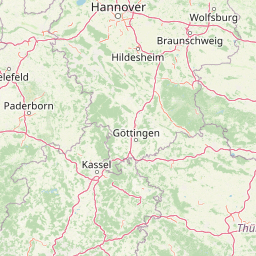
Meßhagen bei Niedermeiser landscape and geographic character
The landscape of Meßhagen bei Niedermeiser is typical of the southern edge of the Reinhardswald: a gently rolling, forested terrain with small clearings, woodland fringes, and historically maintained open ground. The reserve is not a remote or wild area but rather a well-integrated part of a long-settled woodland landscape, where fields, pastures, and forest have alternated over centuries.
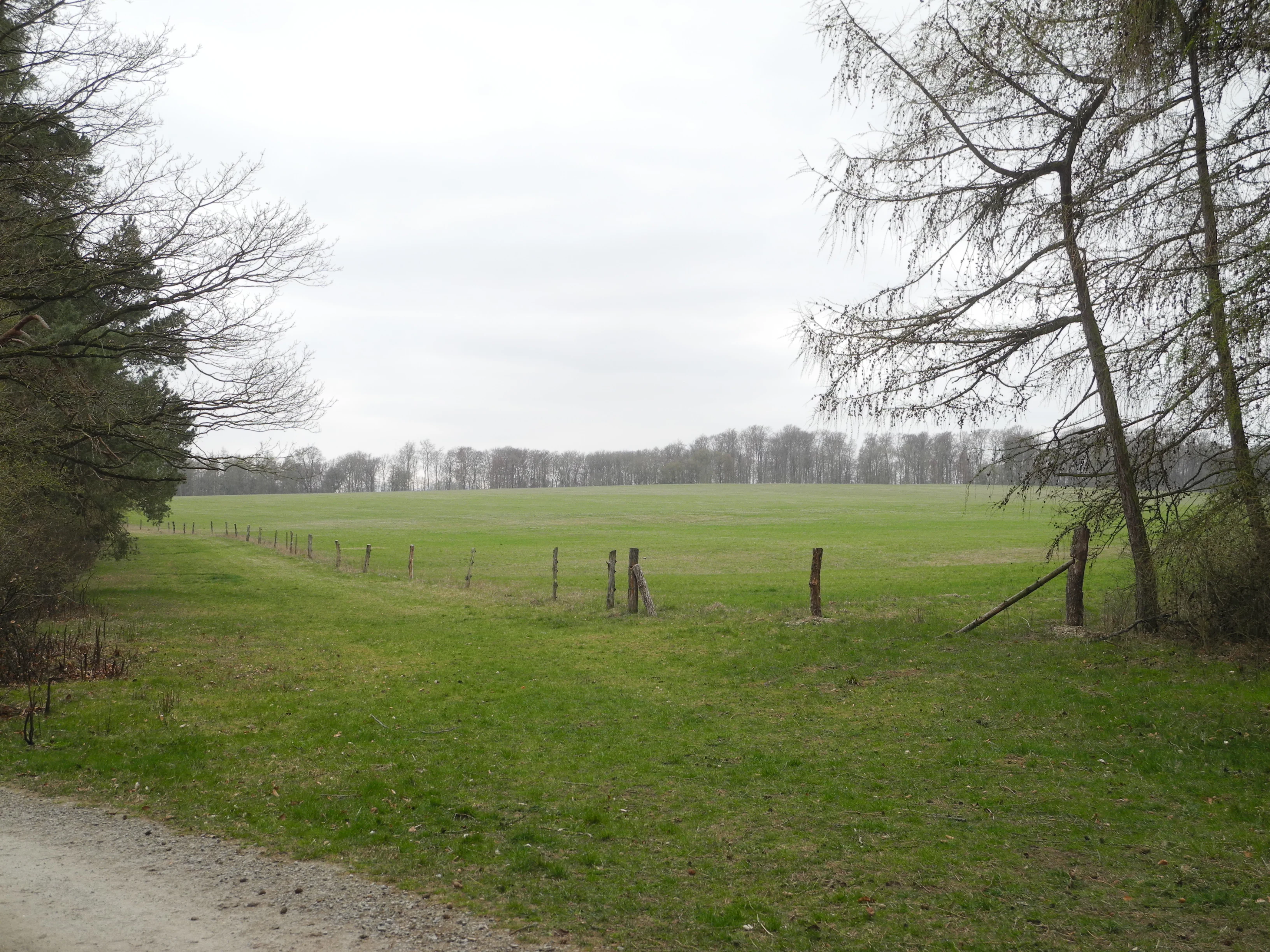
The defining landscape feature is the contrast between enclosing forest and open grassland. The surrounding woodland, primarily beech forest, frames the meadows and pastures on several sides, creating a sheltered, sheltered-in feel. Along the boundaries between open and wooded ground, richly structured woodland edges and shrubby transition zones add visible depth and complexity to the scene, with scattered trees and bushes breaking the edge between field and forest.
Within this general setting, the protected area itself is small but visually distinctive from the air or from higher vantage points because of its open, light, grassy core, contrasting with the darker, denser forest around it. The terrain is flat to gently sloping rather than dramatic, and the visual interest lies as much in habitat texture, woodland edges, and seasonal meadow color as in topographic relief.
Meßhagen bei Niedermeiser ecosystems, habitats, and plant life
Ecologically, Meßhagen bei Niedermeiser is a textbook example of how small-scale habitat diversity can support rich biodiversity in a fragmented landscape. The reserve combines three principal habitat types. The first is open, extensively used grassland, including meadows and pastures subject to varying intensities of management. The second is the surrounding and partially included forest, predominantly Waldmeister-Buchenwälder, characterized by high proportions of old trees and substantial deadwood. The third is the structural transition between these two, comprising woodland edges, shrub fringes, and scattered in-field trees and bushes.
The open ground is by far the most botanically distinctive element. The extensively used meadows and pastures are described as species-rich and flower-rich, especially in the southern part of the reserve. The species mix suggests calcareous or at least base-rich grassland influenced by the underlying geology, with typical meadow species such as knolliger Hahnenfuß (Ranunculus bulbosus), Echtes Labkraut (Galium verum), Kleiner Wiesenknopf (Sanguisorba minor), Kleine Bibernelle (Pimpinella saxifraga), Hopfenklee (Medicago lupulina), Gewöhnlicher Hornklee (Lotus corniculatus), and Feld-Hainsimse (Luzula campestris).
More conspicuous or regionally noteworthy species include Stängellose Kratzdistel (Cirsium acaule), Pyramidenschillergras (Koeleria pyramidata), Frühlingsfingerkraut (Potentilla neumanniana or similar spring cinquefoil), Purgierlein (Linum catharticum), Purpurknabenkraut (Orchis purpurea or a related purple orchid), Genfer Günsel (Ajuga genevensis), Fiederzwenke (Brachypodium pinnatum), Großer Ehrenpreis (Veronica teucrium), and, in some patches, Mittleres Zittergras (Briza media) and Kleines Habichtskraut (Hieracium pilosella). The presence of orchids and a range of calcicole meadow indicators underlines the botanical quality of the grassland.
The forest habitat is dominated by Galio-Fagenion beech forest, often associated in Hesse with woodruff, melica, and other characteristic herbs in spring, and structurally enriched by old trees and deadwood. The deadwood element is particularly important for invertebrates, fungi, and cavity-using species, while the old trees themselves provide habitat structure for woodland birds and bats.
Meßhagen bei Niedermeiser wildlife and species highlights
Wildlife in Meßhagen bei Niedermeiser reflects the mix of open grassland and old beech forest. Surveys of the reserve have documented at least 31 species of butterflies and 6 species of grasshoppers within the protected area, highlighting the importance of open, warm, flower-rich meadows and structurally rich edges for insect communities.
The grassland and surrounding forest together provide breeding and foraging habitat for several bird species typical of the transition between open country and woodland. Notable species mentioned include Feldlerche (skylark), which favors open ground, and Baumpieper (tree pipit), which uses the interface between trees and open meadow. The woodland component supports the typical bird community of central European beech forests, including species that benefit from old trees, deadwood, and cavity-rich stands.
Mammals are not specifically enumerated in the source material, but the combination of deadwood-rich forest, edge habitats, and open meadows is favorable for small woodland mammals, bats, and typical species of the Hessian low-mountain forest landscape such as roe deer and various mustelids. Reptiles and amphibians are not detailed, but the structural diversity of the site offers habitat for woodland and edge-dwelling species common in the region.
Meßhagen bei Niedermeiser conservation status and protection priorities
Conservation is the central purpose of Meßhagen bei Niedermeiser. The area's status as a Naturschutzgebiet under Hessian nature protection law provides the strongest level of habitat safeguarding available at the regional level. The March 1996 designation formalized protection for the grassland-forest mosaic and established the regulatory framework for ongoing management.
A key element of the conservation framework is integration into the European Natura 2000 network. The reserve forms part of the FFH site "Kelzer Holz und Meßhagen", which connects Meßhagen to broader conservation objectives for habitat types and species under the EU Habitats Directive. This linkage means that the area is not judged only on its local importance but also on its contribution to the conservation of European habitat types, in particular the Galio-Fagenion beech forests and related meadow-edge complexes.
Habitat management is an essential part of conservation at Meßhagen. The open meadows and pastures are maintained through agricultural use at varying intensities, with particular emphasis on extensive forms of mowing and grazing that preserve botanical diversity and the associated insect fauna. The retention of old trees and a substantial deadwood component in the beech forest, combined with structurally rich woodland edges, adds a further conservation dimension focused on forest interior biodiversity rather than open-ground species.
The post-military land use trajectory, from disturbed training ground to ecologically valuable nature reserve, gives Meßhagen particular significance as a case of successful habitat regeneration. It illustrates how abandoned or disturbed land, when given appropriate protection and management, can develop into a refuge for species-rich meadow and forest communities.
Meßhagen bei Niedermeiser cultural meaning and human context
The cultural context of Meßhagen bei Niedermeiser is shaped by its position on the southwest edge of the Reinhardswald, an old forest and hunting landscape of northern Hesse with deep historical resonance. The Reinhardswald has long been associated with the fairy tale tradition of the Brothers Grimm, who lived and worked nearby in Kassel, and although Meßhagen itself is not a famous cultural site, it sits within a region where folklore, medieval forest use, and noble hunting traditions have shaped local identity.
The grassland of the reserve has its own, more modern cultural layer: it emerged from a former military training ground that was active from 1976 to 1992. The reversion of that land to nature conservation is a small but locally significant example of post-Cold War land repurposing in Germany, where many former Standortübungsplätze were converted into nature reserves, creating new open habitats within otherwise closed forest landscapes.
Traditional agricultural land use continues to shape the area in the form of extensive hay meadow and pasture management. These practices, while primarily economic, also carry cultural weight as continuations of long-standing regional farming traditions that have, over centuries, helped create the small-scale mosaic of woodland, meadow, and village that still characterizes the Hessian countryside around Hofgeismar and Liebenau.
Top sights and standout views in Meßhagen bei Niedermeiser
Meßhagen bei Niedermeiser stands out for the close integration of species-rich grassland, structurally rich woodland edges, and old, deadwood-rich beech forest within a single compact reserve. The presence of orchid species such as the Purpurknabenkraut and a long list of characteristic calcareous or base-rich meadow plants gives the area real botanical quality, while the documented butterfly and grasshopper fauna underlines its value for invertebrates.
Equally important is the reserve's role within larger conservation networks. Its incorporation into the FFH site "Kelzer Holz und Meßhagen" and its position within the Naturpark Reinhardswald connect a small local site to regional and European conservation frameworks, increasing both its protection and its relevance beyond the immediate area.
Best time to visit Meßhagen bei Niedermeiser
As an extensively managed grassland and beech forest reserve, Meßhagen bei Niedermeiser shows its strongest visual character from late spring through summer, when the meadows reach peak flowering. The presence of orchids, spring cinquefoils, and a range of meadow herbs means that late May to early July is likely to be the most rewarding period for visitors interested in wildflowers and butterflies.
Late spring and early summer also coincide with the most active period for the butterflies and grasshoppers that the reserve protects, and with the breeding season for birds such as skylark and tree pipit that use the open ground and woodland edges. Autumn brings classic beech forest color and fungal abundance in the wooded parts of the reserve, while winter offers quieter visits with clearer views into the open meadows from adjoining paths.