Mori Atlas logo
Nature reserveRezerwat przyrody Młochowski Grąd

Examining the ecological boundaries and mature oak-pine terrain of this central Polish nature reserve

Rezerwat przyrody Młochowski Grąd: Protected Forest Landscapes in Masovian Voivodeship, Poland

Rezerwat przyrody Młochowski Grąd provides a focused look at the natural lowland forest communities characteristic of the Równina Łowicko-Błońska plain. This nature reserve serves as a vital anchor for mapping the oak-hornbeam and mixed coniferous woodland remnants found within the Masovian Voivodeship. Explore the structural integrity of its 180-year-old tree stands and the surrounding agricultural landscape that frames this important protected woodland site.

forest reserveoak-hornbeam woodlandmixed forestlowland forestgrądprotected woodland

Rezerwat przyrody Młochowski Grąd

Nature reserve

Park overview

Structured park overview, official facts, and landscape profile for Młochowski Grąd Nature Reserve

Młochowski Grąd Nature Reserve park facts, protected area profile, and essential visitor context

Review the core facts for Młochowski Grąd Nature Reserve, including designation, size, terrain, visitor scale, habitats, and operating context in one park-focused overview.

About Młochowski Grąd Nature Reserve

Młochowski Grąd is a forest nature reserve in central Poland, situated in the Mazovian Voivodeship not far west of Warsaw. The reserve sits within the administrative boundaries of Nadarzyn commune, in a part of the Równina Łowicko-Błońska, a wide, gently undulating lowland plain that stretches across much of the historic Mazovia region. Despite its modest size of around 27 hectares, the reserve represents a concentrated effort to preserve what remains of the area's natural woodland character in a region otherwise dominated by agriculture and scattered settlements.

The reserve was formally established on 24 November 1983. Its protection order, published in the Polish legal gazette Monitor Polski, identifies the conservation aim as safeguarding fragments of natural forest communities, with a particular focus on two complementary woodland types: high oak-hornbeam forest, known in Polish as grąd wysoki, and continental mixed coniferous forest. These two community types together reflect the transitional ecological character of the area, where broadleaf-dominated lowland forest meets more drought-tolerant pine-influenced stands on lighter soils.

Inside the reserve, the tree stands are dominated by oak and pine, with the oldest individuals reaching an age of approximately 180 years. Beneath this main canopy, hornbeam and oak form a lower tree layer, while the shrub layer is dominated by alder buckthorn (Frangula alnus), a species typical of moist, slightly acidic forest edges and clearings. The vertical structure of these stands, with mature canopy trees, an active understory, and a well-developed shrub layer, is one of the reserve's most distinctive ecological features.

Młochowski Grąd is linked by a marked green hiking trail that runs from the village of Żelechów, through the nearby Młochowski Łęg reserve, and past Młochowski Grąd itself to the village of Młochów. An educational trail inside the reserve, with information boards along its route, helps visitors interpret the forest communities and the reasons for protection. Although small and easily overlooked, the reserve is a meaningful element of the broader network of protected forest fragments that dot the lowlands west of Warsaw.

Quick facts and research context for Młochowski Grąd Nature Reserve

Młochowski Grąd is a forest nature reserve located in the Masovian Voivodeship of Poland, within Nadarzyn commune in Pruszków County. It was established on 24 November 1983 by official publication in the Polish Monitor (Monitor Polski). The reserve covers about 27 hectares and lies in the Równina Łowicko-Błońska mesoregion, a section of the broader Central European lowlands west of Warsaw.

The reserve's declared conservation purpose is to safeguard natural forest communities, specifically high oak-hornbeam woodland (grąd wysoki) and continental mixed coniferous forest. Its oldest trees, dominated by oak and pine, are around 180 years old, with hornbeam and pedunculate oak forming the lower tree layer and alder buckthorn present in the understory. A group of fallow deer was introduced into the area in 2003 as part of acclimatization.

Protection and recognition

Examine documented terrestrial conservation frameworks and administrative scope for Rezerwat przyrody Młochowski Grąd

Rezerwat przyrody Młochowski Grąd Protection Status and Designated Area Record

Rezerwat przyrody Młochowski Grąd maintains a documented terrestrial protection scope within its designated natural landscape. Formal designation records outline the established conservation framework and associated administrative parameters for the protected area.

Protection details

Protection scope
Terrestrial
Transboundary protection
No
Park context

Deeper park guide and search-rich context for Młochowski Grąd Nature Reserve

Młochowski Grąd Nature Reserve history, landscape, wildlife, and travel context

Explore Młochowski Grąd Nature Reserve through its history, landscape character, ecosystems, wildlife, conservation priorities, cultural context, and seasonal travel timing in a structured park guide built for atlas discovery and search intent.

Why Młochowski Grąd Nature Reserve stands out

Młochowski Grąd is best known for preserving a representative fragment of the natural oak-pine forest landscape typical of central Poland's lowlands. Its oldest oak and pine stands, dating back roughly 180 years, give the reserve an unusually mature character for such a small protected forest patch. It is also recognized as an example of the grąd, the classic deciduous oak-hornbeam woodland that has become increasingly rare in heavily cultivated Central European lowlands. The reserve illustrates how even modest, intensively managed countryside near a major capital can retain pockets of ecologically valuable old-growth forest when specifically protected. Its combination of high oak-hornbeam community and continental mixed coniferous elements makes it a useful reference site for understanding how these forest types once extended across the Równina Łowicko-Błońska.
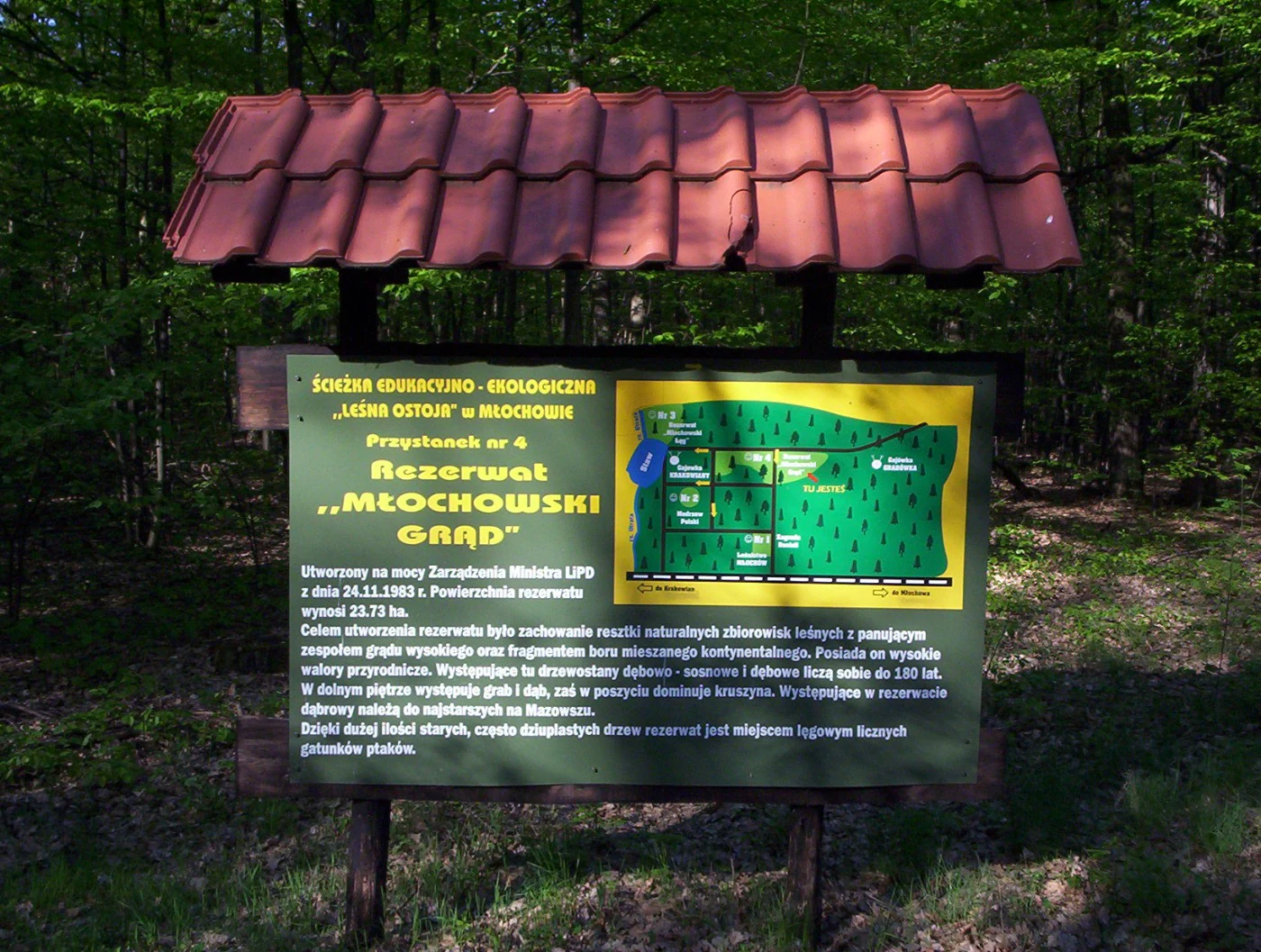
A rectangular outdoor educational information sign with a red tile roof, standing in a forest. The sign features Polish text and a small green map of the nature reserve.
An educational information board at the Młochowski Grąd Nature Reserve.

Młochowski Grąd Nature Reserve history and protected-area timeline

Młochowski Grąd was officially designated as a nature reserve on 24 November 1983. The legal basis for its protection was published in the Polish gazette Monitor Polski (issue 39 of 1983, item 230), and the underlying regional jurisdiction is the Masovian Voivodeship, with the reserve falling within Nadarzyn commune in what is now Pruszków County. The reserve's original designation was already focused on conserving forest communities rather than on geological, hydrological, or landscape features, reflecting a deliberate emphasis on woodland ecology from the outset.

Beyond its formal establishment, the reserve has two notable later events in its history. In 2003, a group of fallow deer was released into the broader area as part of an acclimatization effort, contributing an additional mammal species to the local forest context. In 2016, six of the reserve's forest compartments were used as ground-truth data for testing an automated algorithm designed to estimate tree species diversity from RGB canopy photographs, an example of how small Polish forest reserves have been incorporated into applied ecological research.

No major expansion of the reserve's boundaries is documented in the available source material, and its present-day extent remains close to the original 27-hectare footprint. The reserve's relatively stable boundaries and continuous forest cover since the 1980s give it value as a long-running, undisturbed reference site within an otherwise heavily cultivated lowland region.

Młochowski Grąd Nature Reserve landscape and geographic character

The reserve lies on the Równina Łowicko-Błońska, a broad, flat lowland mesoregion of central Poland characterized by gently rolling terrain, agricultural plains, and patches of woodland. Unlike mountainous or coastal national parks, Młochowski Grąd does not feature dramatic relief, cliffs, or large water bodies. Instead, its landscape value lies in the continuity and maturity of its forest cover within an otherwise open agricultural plain.

Inside the reserve, the ground is relatively level, with soils that support both oak-hornbeam communities and mixed pine forests. Drainage patterns and microtopography influence where oak and hornbeam thrive on richer, moister sites and where pine becomes more dominant on lighter, drier patches. The mosaic of these two forest types within a single small area is one of the defining features of the site's landscape character.

Beyond the reserve itself, the surrounding countryside consists of fields, small villages such as Młochów, and other protected forest fragments like the adjacent Młochowski Łęg reserve. The result is a landscape in which Młochowski Grąd reads as an island of older, structurally complex woodland set within a larger matrix of farmland and managed forest.

Młochowski Grąd Nature Reserve ecosystems, habitats, and plant life

Ecologically, Młochowski Grąd belongs to the broad category of Central European lowland forest reserves. Its central habitat is the grąd wysoki, the high form of oak-hornbeam forest considered one of the most characteristic natural woodland communities of the Polish and broader Central European lowlands. This community typically develops on mesotrophic, well-drained brown soils and is dominated by oak, with hornbeam, lime, and other broadleaves forming an important secondary layer.

Alongside the grąd, the reserve also protects an element of continental mixed coniferous forest, introducing pine and a more open canopy character into the mosaic. The mixture of these two woodland types is ecologically significant because it captures the natural transition that occurs across the region's soils and moisture gradients. The continuity of these communities, rather than their species richness alone, is the main reason for the reserve's protection.

The presence of alder buckthorn in the understory indicates a healthy shrub layer and a forest interior microclimate that supports shade-tolerant and edge-tolerant species. The whole composition reflects a forest that has had time to develop its vertical structure without being reset by intensive harvesting, which is increasingly unusual in such a densely populated lowland region of Europe.

Młochowski Grąd Nature Reserve wildlife and species highlights

The reserve is primarily valued for its forest communities rather than for charismatic large-mammal populations, but wildlife still plays a meaningful role in its character. Among mammals, the most notable feature is the presence of fallow deer, a herd of which was introduced into the broader forest area in 2003 as part of an acclimatization program. Fallow deer have since become a recognizable part of the local forest fauna and can sometimes be encountered in or near the reserve.

The mature mixed stands of oak, pine, and hornbeam provide habitat for typical Central European lowland forest species, including woodland birds, small mammals such as rodents and shrews, and a range of forest-floor invertebrates that depend on leaf litter and decaying wood. The structural complexity of the older trees, with cavities, deadwood, and layered canopy, increases the diversity of breeding sites for cavity-nesting and shrub-nesting birds, although specific inventories are not documented.

The understory of alder buckthorn and the mixture of broadleaf and coniferous foliage also support a varied insect community, which in turn sustains bats and many bird species. Although Młochowski Grąd is not one of Poland's headline wildlife reserves, it functions as a quiet but functioning sanctuary for ordinary but important woodland fauna typical of the western Mazovian lowlands.

Młochowski Grąd Nature Reserve conservation status and protection priorities

From a conservation perspective, Młochowski Grąd's significance lies in its role as a refuge for near-natural lowland forest in an intensively used agricultural region. The reserved 27 hectares are small in absolute terms, but they protect a forest community structure, particularly the oak-hornbeam grąd, that has become rare across the Central European lowlands because of historical deforestation, agricultural expansion, and forestry intensification.

The reserve is managed as a forest nature reserve with a relatively strict protection regime, focused on allowing natural forest processes to continue without major human disturbance. The official protection objective explicitly emphasizes preserving both the high oak-hornbeam community and the continental mixed coniferous forest as integrated examples of the region's original woodland cover. Its long-term value is tied less to any single rare species and more to the maintenance of an entire forest community type under lowland conditions.

The reserve has also served a research-supporting role, supplying forest stand data used in 2016 to validate an automated method for estimating tree species diversity from RGB canopy imagery. This kind of applied use reinforces the conservation value of Młochowski Grąd as a well-characterized natural reference site within the Polish lowland forest network.

Młochowski Grąd Nature Reserve cultural meaning and human context

Młochowski Grąd is situated in a region of central Poland with a long tradition of lowland farming and small-village life. The name itself, Młochowski Grąd, ties the reserve to the nearby settlement of Młochów, a village that has shaped the local cultural and historical landscape for centuries. The reserve's existence reflects the regional recognition that even small remaining woodlands carry cultural and ecological value within this traditional rural setting.

The educational trail and information boards inside the reserve are part of a broader Polish tradition of using small nature reserves as outdoor classrooms, connecting local communities and visitors with the natural heritage that surrounds them. Although the reserve itself does not contain notable man-made structures, its integration into the walking route connecting Żelechów, Młochowski Łęg, and Młochów places it within a wider cultural landscape of small rural settlements, forests, and protected woodlands typical of the Mazovian countryside.

Top sights and standout views in Młochowski Grąd Nature Reserve

The reserve's strongest point of distinction is the age and natural composition of its oak-pine tree stands, with the oldest trees approaching 180 years in age. The coexistence of the grąd wysoki oak-hornbeam community and continental mixed coniferous forest within such a compact area makes it an unusually complete representation of natural lowland woodland types in central Poland.

Equally notable is the reserve's accessibility. A green marked hiking trail passing through Żelechów, the neighboring Młochowski Łęg reserve, and the village of Młochów allows visitors to combine a visit to Młochowski Grąd with a broader exploration of the surrounding lowland forest landscape, while an internal educational trail provides interpretive context for the forest communities being protected.

Best time to visit Młochowski Grąd Nature Reserve

Młochowski Grąd is a lowland deciduous and mixed forest reserve, so seasonal changes are most visible in its foliage and atmosphere rather than in dramatic weather or altitude-related variation. Late spring and early summer are typically a good time to experience the full freshness of the broadleaf canopy, when hornbeam, oak, and understory shrubs are in leaf and bird activity in the reserve is at its peak. Autumn brings strong color in the broadleaf layer, with oaks and hornbeams turning yellow and brown against the more persistent green of the pines, and is often a rewarding period for walking the marked trail along the edge of the reserve and its neighbors.

Winter visits offer a quieter, more open view of the reserve's structure, when the leafless broadleaf canopy reveals the age and spacing of the older oak and pine trees. Because the site is small and low-lying, snowy or wet conditions can make some paths harder to walk, so appropriate footwear is sensible in colder months. There is no strong seasonal constraint on visiting, but the most evocative periods tend to coincide with the broadleaf growing season and the autumn color change.

Monthly climate preview

Long term representative temperature and precipitation patterns across the year

Rezerwat przyrody Młochowski Grąd Climate Normals and Annual Temperature Rhythm

Representative coordinate measurements trace the annual progression of average temperatures and daily precipitation rates for Rezerwat przyrody Młochowski Grąd. Detailed monthly records and complete climatological baselines provide deeper insight into long term environmental conditions.
Annual mean8 °C
-3 °C20 °C
Jan-3°
Feb-2°
Mar
Apr
May14°
Jun18°
Jul20°
Aug20°
Sep14°
Oct
Nov
Dec-2°
Warmest month
July

20.2 °C

Coolest month
January

-3.5 °C

Wettest month
July

2.5 mm/day

Driest month
March

1.3 mm/day

Park location guide

Geography guide, regional context, and park location map for Młochowski Grąd Nature Reserve

Młochowski Grąd Nature Reserve park geography, regions, and map view in Poland

Understand where Młochowski Grąd Nature Reserve sits in Poland through a broader geographic reading of the surrounding landscape, nearby location context, and its mapped position within the national park landscape.

How Młochowski Grąd Nature Reserve fits into Poland

Poland, officially the Republic of Poland, is a Central European country spanning from the Baltic Sea in the north to the Carpathian Mountains in the south. It borders Germany, Czech Republic, Slovakia, Ukraine, Belarus, Lithuania, and Kaliningrad Oblast. The country has a temperate climate, diverse landscapes, and is known for its rich history, cultural heritage, and strong economic position within the EU.

Wider geography shaping Młochowski Grąd Nature Reserve in Poland

Poland occupies 312,696 km2 in Central Europe, extending from the Baltic Sea coast in the north to the Sudetes and Carpathian Mountains in the south. It borders Germany to the west, Czech Republic and Slovakia to the south, Ukraine and Belarus to the east, and Lithuania and Kaliningrad Oblast to the northeast. The landscape includes lowland plains, uplands, and mountain ranges.

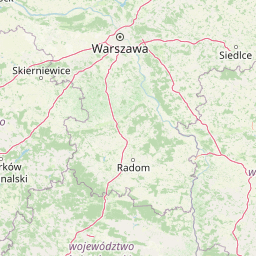
Map view of Młochowski Grąd Nature Reserve

Use this park location map to pinpoint Młochowski Grąd Nature Reserve in Poland, understand its exact geographic position, and read its mapped placement within the surrounding landscape more clearly.

Pigeon | © OpenStreetMap contributors

Location context for Młochowski Grąd Nature Reserve

Masovian Voivodeship

Visual reference collection showcasing mature oakhornbeam woodland habitats and lowland Polish forest terrain.

Rezerwat przyrody Młochowski Grąd Photos, Landscapes, and Protected Forest Scenery

Visual documentation captures the mature oak and pine tree stands defining the protected lowland forest character of Rezerwat przyrody Młochowski Grąd. Detailed photography reveals the structure of rare hornbeam communities and mixed woodland patches across the Mazovian plain.

A rectangular outdoor educational information sign with a red tile roof, standing in a forest. The sign features Polish text and a small green map of the nature reserve.

Park atlas

Discover related lowland forest reserves and regional woodland ecosystems across the surrounding plains.

Explore Protected Areas and Parks Near Rezerwat przyrody Młochowski Grąd

Compare Rezerwat przyrody Młochowski Grąd with adjacent forest reserves and protected landscapes across the surrounding lowland terrain. Examining these connected woodland patches provides deeper context into regional oak-hornbeam habitats and central Polish nature conservation.
Nature reserveMasovian Voivodeship
About 1.1 km away#1 closest

South

Młochowski Łęg Nature Reserve: Mapping Floodplain Forests in Masovian Voivodeship

A protected wetland woodland sanctuary along the Utrata River.

Located within the flat terrain of the Łowicz-Błonie Plain, this nature reserve conserves a representative ash-alder floodplain forest. The site serves as a vital wetland woodland refugium, featuring a complex mosaic of riparian vegetation that highlights the regional ecological character of central Poland's river valleys.

Area
0.12 km²
Established
1984
Relief
Lowland
Climate
Temperate
Nature reserveMasovian Voivodeship
About 16 km away#2 closest

West

Dąbrowa Radziejowska Nature Reserve: Protected Forest Geography in Masovian Voivodeship

An atlas entry for unique light oakwood forest landscapes and protected terrain.

Located in the Masovian Voivodeship, Dąbrowa Radziejowska Nature Reserve is a managed forest entity centered on the preservation of light-demanding oakwood habitats. This reserve provides important ecological insight into the forest composition and botanical diversity typical of the lowland plains in central Poland, offering a clear view of how small protected zones influence regional geography.

Area
0.517 km²
Established
1984
Relief
Lowland
Scope
Terrestrial
Nature reserveMasovian Voivodeship
About 21 km away#3 closest

South

Modrzewina Nature Reserve: Geographic Analysis of a Protected Polish Larch Forest

Protected forest landscape in the Masovian Voivodeship, Poland

Gain insights into the geographic and ecological structure of Modrzewina Nature Reserve. This protected area on the Wysoczyzna Rawska plateau serves as a critical site for the Polish larch, offering a unique window into the natural history and morainic terrain of central Poland.

Area
3.322 km²
Established
1959
Relief
Upland
Climate
Temperate
Protected landscapeMasovian Voivodeship
About 24 km away#4 closest

East

Chojnowski Park Krajobrazowy: Atlas of Protected Landscapes and Forested Terrain

Geographic overview of the Masovian Voivodeship forest belt

Investigate the topographical complexity of Chojnowski Park Krajobrazowy, where flat glacial plains meet the dramatic Vistula escarpment. This protected area offers detailed mapping of forest stands, aquatic habitats, and riparian zones within the Masovian landscape, providing an essential look at the ecological connectivity of the region south of Warsaw.

Area
67.96 km²
Established
1993
Relief
Lowland
Climate
Temperate
Watercolor painting of a meandering river landscape with gentle hills, light green foliage in the foreground, and soft washes of color.
Protected landscapeLodz Voivodeship
About 25 km away#5 closest

West

Bolimowski Park Krajobrazowy: Geography of a Central Polish Protected Landscape Area

Rawka River valley mapping and Puszcza Bolimowska forest terrain

Bolimowski Park Krajobrazowy encompasses a unique mosaic of postglacial plains and riverine ecosystems in central Poland. The area is defined by the Rawka River, which forms a network of meanders, oxbow lakes, and terraces, while surrounding forests retain historical links to the vast primeval woods of Puszcza Bolimowska. This protected territory offers a significant habitat for diverse wildlife, including moose and beaver, within a landscape characterized by its shifting transition between deep forest, wet meadows, and light oak groves.

Area
205.123 km²
Established
1986
Relief
Lowland
Climate
Temperate
National parkMasovian Voivodeship
About 27 km away#6 closest

North

Kampinos National Park: Geographic Profile and Protected Forest Landscape Map

Inland dune formations and wetland habitats in Masovian Voivodeship

The expansive woodland of Kampinos National Park represents a critical protected area in Poland, characterized by its parabolic sand dunes and low-lying marshes. Gain insights into the geomorphological features of this UNESCO biosphere reserve and trace the complex hydrological network that defines its unique forest environment.

Area
385.44 km²
Established
1959
IUCN
II
Relief
Lowland
A soft watercolor illustration of a marshy landscape with low rolling hills, scattered trees, and a winding stream, rendered in light green and yellow tones on a white background.
National parkMasovian Voivodeship
About 27 km away#7 closest

Northwest

Kampinoski Park Narodowy: Mapping the Inland Dune and Wetland Landscapes of Central Poland

A vital protected area in Masovian Voivodeship

The landscape of Kampinoski Park Narodowy is defined by the Grochalskie Piachy dune complex and diverse riparian habitats. This atlas entry covers the geological history and protected boundaries of this significant lowland forest, tracing the Vistula river valley's influence on the surrounding terrain and ecological character.

Area
385.443 km²
Established
1959
Visitors
1M annual
Relief
Lowland
A soft watercolor illustration of a winding river flowing through a green valley with forested hills in the background.
Nature reserveMazowieckie
About 28 km away#8 closest

Northeast

Rezerwat przyrody Morysin: Protected Floodplain Landscapes and Historic Forest Reserves

A riparian heritage site in the Mazowieckie region

Situated in the Vistula floodplain, Rezerwat przyrody Morysin stands as a significant protected area defined by its massive old-growth trees and layered cultural history. The terrain incorporates diverse wetland features, including the Sobieski Canal and Wilanówka stream, creating a vital habitat for cavity-nesting species and a rare example of integrated natural and historic preservation.

Area
0.535 km²
Established
1996
Relief
Lowland
Climate
Temperate

Common questions about visiting, size, designation, and location context for Młochowski Grąd Nature Reserve

Młochowski Grąd Nature Reserve FAQs for park facts, access, geography, and protected area context

Find quick answers about Młochowski Grąd Nature Reserve, including protected-area facts, park geography, trail and visitor context, and how the park fits into its surrounding country and regional landscape.
MoriAtlas Explorer

Continue Your Protected Areas Search Across the Global Atlas

Deepen your exploration by continuing the structured search for national parks and protected areas worldwide. Utilize the comprehensive filtering capabilities to compare different conservation landscapes and refine your understanding of global park geography. Discover more about the distribution and characteristics of protected natural areas.

Global natural geography