Mori Atlas logo
Nature reserveRezerwat przyrody Jezioro Orchowe

Analyzing the ecological boundaries and terrain of this significant nature reserve in Województwo lubelskie.

Rezerwat przyrody Jezioro Orchowe: Protected Wetland Geography and Peatland Landscape Map

Rezerwat przyrody Jezioro Orchowe serves as a critical node for wetland conservation within the Bug river valley of eastern Poland. This nature reserve protects a mosaic of dystrophic open water, transitional mires, and bog forests, forming a coherent ecological system within the Polesie landscape. The mapped area provides essential insights into the complex hydrology and diverse vascular flora that characterize the broader regional geography of Województwo lubelskie.

peatland reservedystrophic laketransitional mirebog forestwetland conservationBug valley
A flat-style digital illustration of a lake surrounded by grassy reeds and dead tree trunks in the foreground, with pine forests and distant mountain peaks under a sunset sky in the background.

Rezerwat przyrody Jezioro Orchowe

Nature reserve

Park overview

Structured park overview, official facts, and landscape profile for Jezioro Orchowe Nature Reserve

Jezioro Orchowe Nature Reserve park facts, protected area profile, and essential visitor context

Review the core facts for Jezioro Orchowe Nature Reserve, including designation, size, terrain, visitor scale, habitats, and operating context in one park-focused overview.

About Jezioro Orchowe Nature Reserve

Jezioro Orchowe Nature Reserve is a compact but ecologically rich protected area in the Lublin region of eastern Poland, focusing on the conservation of a dystrophic lake and the peatland habitats that surround it. It is administered as a peatland nature reserve (rezerwat torfowiskowy), a designation that signals both the dominant habitats on the site and the management priority given to preserving intact mire processes.

The reserve lies within the Sobiborski Landscape Park, in an area managed by the Sobibór Forest District and located near the village of Żłobek. Although its surface area is modest, the site sits within the larger Polesie Zachodnie Biosphere Reserve, which means it contributes to international frameworks for wetland and forest conservation in the Polish-Belarusian borderland. The landscape around the reserve belongs to the broader Polesie region, an area historically defined by extensive peatlands, wet forests, and slow-moving river systems, of which the Bug valley is a defining element.

The ecological character of the reserve is shaped by its position in a long, narrow depression in the Bug river valley. The lake occupying this depression is shallow, reaching at most about one meter in depth, and is fed primarily by rainwater and runoff, giving its waters a dystrophic character, meaning they are acidic, dark, and low in nutrients. A thick layer of gyttja, an organic lake-bottom sediment estimated at roughly ten meters, has accumulated under these conditions. This combination of water chemistry and sediment history has created conditions that are very favorable to specialized aquatic and wetland vegetation, while the surrounding terrain, dominated by podzol soils on sands and by peat soils in wetter hollows, has supported the development of transitional mires and bog forest communities at the edges of the open water.

Altogether, the reserve functions as a representative example of dystrophic-lake and peatland ecology in the western Polesie region, and it has been studied as such since at least the 1987 botanical surveys that catalogued 34 distinct plant communities within it. Its combination of open-water habitats, transitional mires, bog forests, and wet alder woodland in a single compact protected area makes it a useful site for understanding how these systems interact at a relatively small spatial scale.

Quick facts and research context for Jezioro Orchowe Nature Reserve

Jezioro Orchowe Nature Reserve is a peatland-type nature reserve (rezerwat torfowiskowy) situated in the Włodawa rural commune, Włodawa County, Lublin Voivodeship, in eastern Poland. It lies within the Sobiborski Landscape Park, on the territory of Sobibór Forest District, near the village of Żłobek, and falls inside the Polesie Zachodnie Biosphere Reserve.

Established on 12 November 1996 by order of the Minister of Environmental Protection, Natural Resources, and Forestry, the reserve covers approximately 58 hectares, of which the lake itself occupies about 8.4 hectares. Its stated purpose is the conservation, for scientific and educational reasons, of the lake and surrounding peatlands together with their unique vascular flora. Surveys conducted in 1987, before establishment, identified 34 distinct plant communities on the site, making it a recognized reference area for peatland and dystrophic-lake vegetation studies in the region.

Protection and recognition

Examining documented protection scope and international recognition records.

Rezerwat przyrody Jezioro Orchowe Protection Status and Territorial Designation

Rezerwat przyrody Jezioro Orchowe maintains a documented terrestrial protection scope within the regional conservation network. Structured facts outline the recorded designation history and administrative management framework associated with the protected landscape.

Protection details

Protection scope
Terrestrial
Transboundary protection
No
Park context

Deeper park guide and search-rich context for Jezioro Orchowe Nature Reserve

Jezioro Orchowe Nature Reserve history, landscape, wildlife, and travel context

Explore Jezioro Orchowe Nature Reserve through its history, landscape character, ecosystems, wildlife, conservation priorities, cultural context, and seasonal travel timing in a structured park guide built for atlas discovery and search intent.

Why Jezioro Orchowe Nature Reserve stands out

The reserve is best known for protecting a small dystrophic lake set within a long depression of the Bug river valley, together with the transitional peat bogs, floating mats, alder carrs, and boggy coniferous forests that surround it. Field studies here have documented an unusually diverse mosaic of plant communities, including rare and protected species such as sundews, bladderworts, scheuchzeria, and dwarf birch, all set against the backdrop of a classic Polesie peatland landscape. Equally significant is the reserve's role within the larger conservation architecture of eastern Poland. Its position inside the Sobiborski Landscape Park and the Polesie Zachodnie Biosphere Reserve gives it value not just as an isolated site but as a node within a broader network of protected wetland and forest habitats, helping to maintain ecological continuity across one of the country's most important mire landscapes.
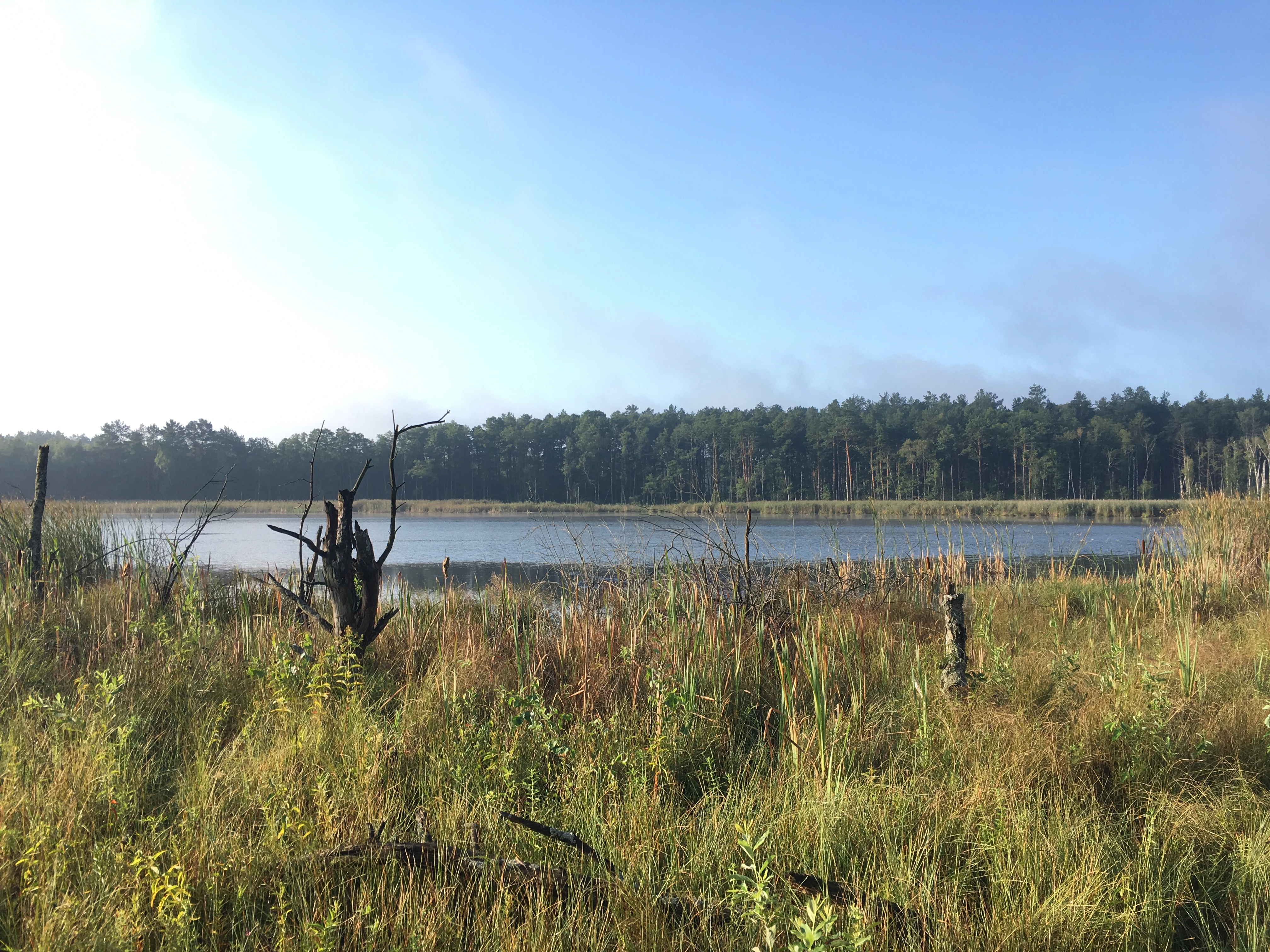
A wide, eye-level view of a calm lake in Poland, with tall grasses and a weathered, leafless tree in the foreground, and a dense line of trees across the far bank under a hazy blue sky.
A view of Jezioro Orchowe, featuring the tranquil waters of the dystrophic lake framed by wetlands and surrounding forest.

Jezioro Orchowe Nature Reserve history and protected-area timeline

The reserve was created relatively recently in formal terms, but its ecological significance had already been recognized well before its designation. Botanical surveys carried out in 1987 documented the lake and surrounding peatlands as a site of considerable scientific and conservation interest, identifying an unusually large number of distinct plant communities and a suite of rare and protected species across a small area.

On 12 November 1996, the Polish Minister of Environmental Protection, Natural Resources, and Forestry signed an order formally recognizing the area as a nature reserve, published in the official Polish legal monitor (Monitor Polski, 1996, no. 75, item 680). The designation was justified explicitly by the need to preserve, for scientific and educational purposes, the dystrophic lake and the surrounding peat bogs together with their unique vascular flora.

Since its establishment, the reserve has been administered as part of the Sobiborski Landscape Park and managed, at the forestry level, by the Sobibór Forest District. Its inclusion within the broader Polesie Zachodnie Biosphere Reserve ties its history into the larger international effort to preserve the contiguous wetland and forest complexes of the western Polesie region along the Bug river basin.

Jezioro Orchowe Nature Reserve landscape and geographic character

The landscape of the reserve is defined by a long, narrow depression in the Bug river valley, in which the lake sits as a roughly elongated open-water body with low, easily accessible shores. The southern edge of the lake has a sandy shoreline, while the rest of the basin gradually transitions into peatlands, floating mires, and wet vegetation zones. The terrain around the lake is generally flat and low-lying, characteristic of the Polesie region's broad glacial and post-glacial landforms.

Soils in the surrounding area reflect this transition from open water to dry land. Podzol soils developed on weakly loamy and loose sands dominate the better-drained ground, while mucky and bog soils have developed in the wetter zones over low and transitional peat deposits. Small patches of murszic and silty-bog soils also occur in places, marking further micro-gradients in moisture and peat decomposition.

The visual character of the reserve is therefore a mosaic: open dark water bordered by reeds and sedges, giving way to floating and transitional mires, then to wet alder woodland, and finally to bog conifer forests on the better-drained sandy rises. This compact layering of open water, mire, and forest is one of the defining landscape features of the site.

Jezioro Orchowe Nature Reserve ecosystems, habitats, and plant life

Ecologically, the reserve is dominated by a complex interplay between the dystrophic lake itself, transitional peatlands along its margins, and the forested wetlands that encircle them. The lake waters are poor in nutrients and acidic, which has historically supported sensitive aquatic vegetation. Although dense underwater meadows of brittle stonewort once occupied parts of the lake in the 1970s, these later disappeared, and today the lake supports more open patches of common reed (Phragmition alliance), particularly in the central areas, transitioning into sedge-dominated reedswamp toward the east and into transitional mire communities toward the west.

The seasonally flooded fringes of the lake support wet alder woodland and shrub communities of the Alnetea glutinosae class, with fragments of boggy and moist mixed conifer forests (Vaccinio-Piceetea). Drier micro-sites support moist mixed conifer forest (bór mieszany wilgotny), while transitional zones between the mire and mineral groundwater carry bog conifer forest (bór bagienny) and trembling-grass (trzęślicowe) woodland types.

Botanical surveys have recorded 34 distinct plant communities within the reserve, an unusually high figure for a site of this size. The flora includes rare and protected species characteristic of both intact peatlands and oligotrophic aquatic habitats, with notable records including low birch, bearberry willow, Lapland willow, bog willow, juniper and fir clubmosses, yellow water-lily, long-leaved and round-leaved sundews, common butterwort, marsh ragwort, white beak-sedge, common and bog cranberry, bog-rosemary, northern white water-lily, common bladderwort, and several sedge species including string, slender, marsh, and dioecious sedges. Together, these communities represent a layered transition from open dystrophic water through floating vegetation, reedswamp, transitional mire, bog forest, and into moist conifer forest on mineral soil.

Jezioro Orchowe Nature Reserve wildlife and species highlights

The reserve's wildlife profile is closely tied to its wetland and forest mosaic. Dystrophic lakes of this type in the Polesie region typically support communities of aquatic invertebrates, amphibians, and dragonflies adapted to acidic, nutrient-poor conditions, while the surrounding peatlands and alder carrs provide breeding and foraging habitat for wetland-associated birds. The bog conifer forests and moist mixed forests add a forest fauna component, including typical lowland woodland bird species and small mammals.

The source material, however, is centered on the botanical value of the site rather than on its fauna, so detailed wildlife information beyond this general character should not be inferred.

Jezioro Orchowe Nature Reserve conservation status and protection priorities

The reserve's conservation significance lies in its role as a protected representative of dystrophic-lake and transitional-peatland ecosystems within the broader Polesie landscape. By formally safeguarding the lake and surrounding peat bogs along with their vascular flora, the reserve protects habitat types that have been substantially reduced elsewhere in Poland and that depend on the maintenance of intact hydrology and traditional low-impact land use.

The site's layered protection, sitting inside both the Sobiborski Landscape Park and the Polesie Zachodnie Biosphere Reserve, means it benefits from regional landscape-level planning as well as its own reserve-level strictness. Its small size is offset by the unusual concentration of plant communities, including 34 recorded plant assemblages and a suite of protected species, making it disproportionately valuable for conservation research, monitoring, and education. The reserve is also recognized for its scientific and didactic importance, which was explicitly cited as a purpose of its establishment in 1996.

Top sights and standout views in Jezioro Orchowe Nature Reserve

The reserve's distinguishing features include its dystrophic lake set in a Bug valley depression, the surrounding transitional mires, and the unusually high number of plant communities packed into a small protected area. Its inclusion within the Sobiborski Landscape Park and the Polesie Zachodnie Biosphere Reserve strengthens its conservation profile beyond what its modest size would suggest.

Equally distinctive is the lake's hydrological and ecological history, from the now-vanished stonewort meadows documented in the 1970s to the present-day mosaic of reedswamp, transitional mire, alder carr, and bog conifer forest. This layered structure, combined with the presence of protected species such as sundews, bladderworts, dwarf birch, and several rare willows, gives the reserve a strong identity as a compact reference site for Polesie peatland ecology.

Best time to visit Jezioro Orchowe Nature Reserve

The reserve can be appreciated across the warmer months, when access is easier and the wetland habitats are biologically most active. Late spring and early summer are typically the best period for observing flowering wetland plants and the layering of vegetation zones from open water into reedswamp and bog forest. Late summer and early autumn tend to highlight berries and the contrasting coloration of mires, reeds, and bog woodland.

Spring visits can also reveal high water levels and wet trails around the lake's edge, while visits during late autumn and winter may be more difficult given the soft, waterlogged ground, with the lake and surrounding peatlands often looking stark and quiet. The site should generally be approached in conditions when the fragile peat soils are not heavily disturbed by foot traffic.
Monthly climate preview

Long-term representative temperature ranges and monthly precipitation patterns for Rezerwat przyrody Jezioro Orchowe

Rezerwat przyrody Jezioro Orchowe Climate Normals and Annual Weather Rhythms

Rezerwat przyrody Jezioro Orchowe records measured average temperatures spanning from sub-zero winter minimums to warm summer maximums alongside consistent multi-year precipitation rates. Examining the full twelve-month dataset clarifies the complete long-term meteorological profile mapped across representative coordinate elevations.
Annual mean8 °C
-4 °C21 °C
Jan-4°
Feb-3°
Mar
Apr
May14°
Jun18°
Jul21°
Aug20°
Sep14°
Oct
Nov
Dec-3°
Warmest month
July

20.6 °C

Coolest month
January

-4.5 °C

Wettest month
July

2.6 mm/day

Driest month
January

1.2 mm/day

Park location guide

Geography guide, regional context, and park location map for Jezioro Orchowe Nature Reserve

Jezioro Orchowe Nature Reserve park geography, regions, and map view in Poland

Understand where Jezioro Orchowe Nature Reserve sits in Poland through a broader geographic reading of the surrounding landscape, nearby location context, and its mapped position within the national park landscape.

How Jezioro Orchowe Nature Reserve fits into Poland

Poland, officially the Republic of Poland, is a Central European country spanning from the Baltic Sea in the north to the Carpathian Mountains in the south. It borders Germany, Czech Republic, Slovakia, Ukraine, Belarus, Lithuania, and Kaliningrad Oblast. The country has a temperate climate, diverse landscapes, and is known for its rich history, cultural heritage, and strong economic position within the EU.

Wider geography shaping Jezioro Orchowe Nature Reserve in Poland

Poland occupies 312,696 km2 in Central Europe, extending from the Baltic Sea coast in the north to the Sudetes and Carpathian Mountains in the south. It borders Germany to the west, Czech Republic and Slovakia to the south, Ukraine and Belarus to the east, and Lithuania and Kaliningrad Oblast to the northeast. The landscape includes lowland plains, uplands, and mountain ranges.

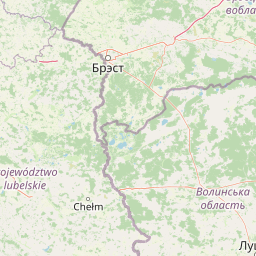
Map view of Jezioro Orchowe Nature Reserve

Use this park location map to pinpoint Jezioro Orchowe Nature Reserve in Poland, understand its exact geographic position, and read its mapped placement within the surrounding landscape more clearly.

Pigeon | © OpenStreetMap contributors

Location context for Jezioro Orchowe Nature Reserve

Województwo lubelskie

Visualizing the peatlands, dystrophic waters, and wetland habitats of eastern Poland

Rezerwat przyrody Jezioro Orchowe Photos and Landscape Scenery

Examine detailed photographs of the dystrophic lake, floating mires, and bog forests that define the protected landscape of Rezerwat przyrody Jezioro Orchowe. Visual documentation reveals the distinct terrain, transitional vegetation zones, and ecological structure of this lowland wetland ecosystem.

A wide, eye-level view of a calm lake in Poland, with tall grasses and a weathered, leafless tree in the foreground, and a dense line of trees across the far bank under a hazy blue sky.

Park atlas

Compare adjacent wetland reserves and connected lowland habitats across the regional ecosystem.

Parks Near Rezerwat przyrody Jezioro Orchowe and Surrounding Protected Landscapes

Continue exploring regional conservation areas and nearby protected landscapes after reviewing Rezerwat przyrody Jezioro Orchowe. Comparing adjacent wetland habitats and lowland nature reserves provides deeper geographic context for eastern Poland river valleys.
Protected areaLublin Voivodeship
About 9.8 km away#1 closest

South

Poleska Dolina Bugu Protected Landscape: Mapped Atlas and Geographic Overview

Key Natura 2000 river valley site in Lublin Voivodeship

Poleska Dolina Bugu is a regionally vital protected area comprising six connected enclaves along the Bug River. The site features a mosaic of oxbow lakes, alkaline fens, molinia meadows, and riparian woodlands that define the lowland geography of eastern Poland. Access structured data on this Habitats Directive site to understand its surface composition, floodplain connectivity, and specialized conservation habitats.

Area
81.732 km²
Relief
Lowland
Scope
Terrestrial
Water
Major water bodies
Nature reserveLubelskie Voivodeship
About 14 km away#2 closest

South

Rezerwat przyrody Małoziemce: Nature Reserve Protected Areas and Geographic Map Context

A faunal reserve within the Łęczna-Włodawa Lake District

Rezerwat przyrody Małoziemce represents a specialized faunal protected area in Lubelskie Voivodeship. Established for the preservation of heron breeding colonies, the site is defined by its lowland, marshy terrain and its strategic inclusion within the larger Sobiborski Landscape Park. This entry provides detailed geographic perspective on how this forest and wetland complex fits into the regional network of protected landscapes near the Polish-Ukrainian border.

Area
0.38 km²
Established
1988
Scope
Terrestrial
Watercolor depiction of a lake with reeds, forested shoreline, and distant mountains
National parkUkraine
About 17 km away#3 closest

East

Shatsk National Natural Park: Ukraine's Deepest Lake and Wetland Protected Area Atlas

Mapped landscape and protected geography of a premier Ukrainian national park.

Shatsk National Natural Park in Ukraine is a significant protected area featuring a remarkable cluster of over thirty lakes, most notably Svitiaz Lake, the nation's deepest. This park protects vital wetland and forest ecosystems within the Polissia region, offering a rich geographic context for atlas exploration. Understanding its mapped boundaries and terrain provides insight into its importance as a Ramsar site and a key corridor for migratory birds, making it a cornerstone of conservation geography in Eastern Europe.

Area
489.77 km²
Established
1983
IUCN
II
Relief
Lowland
National parkPoland
About 18 km away#4 closest

West

Polesie National Park: Protected National Park in Poland's Eastern Lowlands

Explore its mapped wetland geography and unique glacial terrain.

Polesie National Park represents a key protected landscape within eastern Poland, notable for its vast wetland complexes, including extensive peat bogs and marshes interspersed with pine forests on sandy dunes. This national park showcases a distinct geography shaped by glacial processes, offering a unique perspective on lowland ecosystems and their conservation. MoriAtlas allows for a structured discovery of its protected boundaries and the surrounding regional context, providing an atlas-driven understanding of this vital natural territory.

Area
97.52 km²
Established
1979
IUCN
II
A watercolor painting showing a panoramic view of a marshy landscape with green grasses, light-colored water, and distant trees on a white background.
National parkLublin Voivodeship
About 19 km away#5 closest

West

Poleski Park Narodowy: Protected Wetlands and Glacial Geography in Lublin Voivodeship

Exploration of peatlands, kettle lakes, and boreal-style marshes

Poleski Park Narodowy encompasses a diverse mosaic of fens, transitional bogs, and dense marsh forests within the Lublin Voivodeship. This protected area serves as a primary reference for understanding the glacial-relict biodiversity and flat, water-defined terrain characteristic of the historic Polesie region in eastern Poland.

Area
97.6 km²
Established
1990
Visitors
41K annual
Relief
Lowland
Nature reservePoland
About 23 km away#6 closest

Southwest

Rezerwat przyrody Bachus: Protected Nature Reserve and Forest Atlas in Eastern Poland

Mapping sessile oak woodlands and protected landscape boundaries

Rezerwat przyrody Bachus is a notable nature reserve in Poland, recognized for its role in preserving sessile oak within the broader Chełmski Landscape Park. This atlas entry provides geographic context on the reserve, detailing its position within the lowland terrain of the Lubelskie region and its importance as an edge-of-range forest sanctuary.

Area
0.826 km²
Established
1958
Relief
Lowland
Climate
Temperate
Nature reserveLubelskie Voivodeship
About 24 km away#7 closest

Northwest

Las Ochoża imienia Marka Kellera: Forest Nature Reserve and Landscape Mapping in Poland

A study of protected wetland forests and early medieval archaeological terrain.

Las Ochoża imienia Marka Kellera protects a critical 193-hectare mosaic of alder swamps and riparian habitats situated in the Zaklęsłość Sosnowicka mesoregion. This nature reserve, integrated into the Natura 2000 Uroczysko Mosty-Zahajki bird protection area, provides a rare window into the natural forest processes of eastern Poland. The site serves as a vital hydrological nexus and features a preserved medieval hillfort on a secluded forest island.

Area
1.929 km²
Established
2024
Relief
Lowland
Scope
Terrestrial
A watercolor illustration showing a soft, stylized landscape of rolling green hills, distant mountains, and coniferous trees against a white background.
Protected landscapeLublin Voivodeship
About 31 km away#8 closest

South

Chełmski Park Krajobrazowy: A Detailed Atlas of the Protected Landscape in Lublin Voivodeship

Exploring the calcareous peatlands and diverse wetland topography

Located in eastern Poland, Chełmski Park Krajobrazowy is a protected landscape shaped by unique geological features and rich botanical habitats. This overview explores the park's transition from upland hills to lowland depressions, its internal nature reserves, and its function as a critical biodiversity center within the Lublin Voivodeship landscape.

Area
164.57 km²
Established
1983
Relief
Upland
Climate
Temperate

Common questions about visiting, size, designation, and location context for Jezioro Orchowe Nature Reserve

Jezioro Orchowe Nature Reserve FAQs for park facts, access, geography, and protected area context

Find quick answers about Jezioro Orchowe Nature Reserve, including protected-area facts, park geography, trail and visitor context, and how the park fits into its surrounding country and regional landscape.
MoriAtlas Explorer

Continue Your Protected Areas Search Across the Global Atlas

Deepen your exploration by continuing the structured search for national parks and protected areas worldwide. Utilize the comprehensive filtering capabilities to compare different conservation landscapes and refine your understanding of global park geography. Discover more about the distribution and characteristics of protected natural areas.

Global natural geography