

Mori Atlas logo
National parkSantubong National Park

Detailed park boundaries and regional context for Santubong National Park in Borneo

Santubong National Park: Explore Sarawak's Protected Landscape and Geographic Atlas

(Taman Negara Santubong)

Santubong National Park represents a key protected area within the Malaysian state of Sarawak, located on the island of Borneo. This page offers a deep dive into the park's mapped geography, providing essential context for understanding its protected landscape and its place within the broader regional atlas. Engage with the specific boundaries and natural terrain that define this important conservation area, supporting detailed geographic discovery and landscape exploration.

Rainforest national parksCoastal protected areasBornean ecosystemsMount SantubongDipterocarp forestsHornbill habitat

Santubong National Park

National park

Park overview

Structured park overview, official facts, and landscape profile for Santubong National Park

Santubong National Park park facts, protected area profile, and essential visitor context
Review the core facts for Santubong National Park, including designation, size, terrain, visitor scale, habitats, and operating context in one park-focused overview.

About Santubong National Park

Santubong National Park occupies a strategic position on the Santubong Peninsula along Sarawak's coastline, approximately 35 kilometres north of Kuching. The park's defining feature is Mount Santubong, a 810-metre peak whose steep, rainforest-covered slopes dominate the landscape and create a dramatic backdrop visible from much of the surrounding region. Established in 2007, the park covers 14.1 square kilometres and functions as an important catchment area, supporting hydrological processes that benefit the broader peninsula ecosystem. The protected area sits within a landscape characterized by scenic coastal and mountainous terrain, where traditional fishing villages coexist with nature-based tourism facilities. The park's accessibility from Kuching, combined with its natural and cultural assets, has established it as a key destination for both local and international visitors seeking to experience Borneo's rainforest landscapes without extensive travel into more remote wilderness areas.

Quick facts and research context for Santubong National Park

Santubong National Park occupies the Santubong Peninsula in coastal Sarawak, East Malaysia. The park was officially gazetted in 2007 under the management of the Sarawak Forestry Corporation and holds IUCN Category II protected area status. The landscape is dominated by Mount Santubong, a 810-metre peak that serves as the park's most recognizable feature. The surrounding region includes traditional fishing villages such as Kampung Santubong, Kampung Buntal, and Kampung Pasir Pandak, as well as cultural attractions like the Sarawak Cultural Village and several beach resorts.

Park context

Deeper park guide and search-rich context for Santubong National Park

Santubong National Park history, landscape, wildlife, and travel context
Explore Santubong National Park through its history, landscape character, ecosystems, wildlife, conservation priorities, cultural context, and seasonal travel timing in a structured park guide built for atlas discovery and search intent.

Why Santubong National Park stands out

Santubong National Park is best known for its dramatic rainforest-covered mountain backdrop and its role as a nature recreation area near Kuching. The park protects important dipterocarp forest ecosystems and serves as habitat for the rhinoceros hornbill, Sarawak's state bird. The prominent peak of Mount Santubong provides a distinctive visual landmark that defines the peninsula and can be seen from Kuching, making the park a recognizable feature of the regional landscape. The combination of coastal scenery, accessible rainforest trails, and cultural heritage sites nearby makes it a popular destination for visitors to the Kuching area.

Santubong National Park history and protected-area timeline

The scientific significance of the Santubong region was first recognized during the mid-19th century when Alfred Russel Wallace conducted his pioneering voyage to Sarawak between November 1854 and January 1856. Wallace carried out extensive biological sampling during his stay, focusing particularly on the slopes of Mount Santubong and the Sarawak River valley. His research in the area contributed substantially to the early scientific understanding of biodiversity in coastal ecosystems of northern Borneo and helped establish the region's reputation as an area of significant ecological interest. Mount Santubong was officially gazetted as a national park in 2007, formalizing protection for the area's natural values. Since its establishment, the park has developed as a destination for nature tourism, attracting visitors to experience its rainforest trails, wildlife viewing opportunities, and the distinctive landscape defined by the mountain peak.

Santubong National Park landscape and geographic character

The park is situated on the Santubong Peninsula, a coastal landform where the slopes of Mount Santubong meet the surrounding marine and wetland environments. The terrain is dominated by the steep, forested slopes of Mount Santubong, which rises to 810 metres and forms the peninsula's highest point. The mountain's prominent peak creates a distinctive silhouette that is visible from Kuching and serves as a navigational landmark for the region. The park's land area of 14.1 square kilometres encompasses the lower and mid elevations of the mountain, with the terrain transitioning from coastal beach areas through lower slopes to the higher rainforest-covered ridges. The park is partially bordered by privately owned forest, creating a mosaic of protected and managed landscapes within the broader peninsula area.

Santubong National Park ecosystems, habitats, and plant life

The vegetation of Santubong National Park is characterized primarily by mixed dipterocarp forest, which covers the majority of the park's area and represents the dominant forest type of lowland Borneo. Smaller patches of kerangas forest, also known as heath forest, occur in areas with more acidic, nutrient-poor soils, adding ecological diversity to the park's plant communities. Beach forest is found along the coastal margins where salt-tolerant species adapted to sandy substrates and maritime conditions contribute to the park's botanical variety. This combination of forest types creates a heterogeneous landscape that supports different ecological communities across the elevation gradient from coast to mountain peak.

Santubong National Park wildlife and species highlights

Santubong National Park provides habitat for diverse wildlife, including several notable species of conservation concern. The rhinoceros hornbill, once widely distributed across southern Thailand, Peninsular Malaysia, Sumatra, Java, and Borneo but now believed to be extinct in Singapore, has been recorded within the park. This species inhabits various forest types including tall secondary forests, mixed dipterocarp forests, and swamp forests. Despite being recognized as Sarawak's state bird and having threatened status, detailed information about its current population distribution and ecology within the park remains limited. The broader wildlife community includes species typical of Bornean dipterocarp forests, though comprehensive species inventories for the park are not extensively documented in available sources.

Santubong National Park conservation status and protection priorities

The establishment of Santubong National Park in 2007 formalised protection for an area of ecological significance within Sarawak's coastal zone. The park's designation as an IUCN Category II protected area reflects its primary objective of conserving natural ecosystems while allowing for sustainable nature-based recreation. The protected area serves important watershed functions as a catchment zone, supporting hydrological processes that benefit the broader peninsula environment. The forest ecosystems, particularly the dipterocarp forest that dominates the park, store carbon and provide habitat for wildlife including threatened species such as the rhinoceros hornbill. The park's location adjacent to populated fishing villages and tourism facilities also creates opportunities for demonstrating compatible land use and promoting conservation awareness among local communities and visitors.

Santubong National Park cultural meaning and human context

The Santubong Peninsula has been home to traditional fishing communities for generations, with villages such as Kampung Santubong, Kampung Buntal, and Kampung Pasir Pandak located in the surrounding area. These communities maintain livelihoods linked to marine resources and contribute to the cultural character of the landscape. The proximity of the Sarawak Cultural Village, a heritage complex showcasing the traditions of Sarawak's diverse ethnic groups, provides additional cultural context for visitors to the area. The blend of natural landscapes with cultural attractions has helped establish the Santubong region as a destination that offers both outdoor recreation and insight into local heritage.

Top sights and standout views in Santubong National Park

The most distinctive highlight of Santubong National Park is the iconic silhouette of Mount Santubong, a 810-metre rainforest-covered peak that dominates the peninsula and can be seen from Kuching. The park offers accessible rainforest exploration through its trail network, allowing visitors to experience Bornean dipterocarp forest ecosystems within a relatively short distance from the state capital. The presence of the rhinoceros hornbill, Sarawak's state bird, provides wildlife viewing opportunities for interested visitors, though observations require patience and运气. The combination of mountain, forest, and coastal settings creates a varied landscape that supports different recreational activities and ecological experiences within a compact protected area.

Best time to visit Santubong National Park

The park can be visited throughout the year as it lies in a tropical climate where rainfall occurs in all seasons. The dry period typically falls between March and October, when visitor numbers tend to be higher and outdoor activities are more comfortable. The southwest monsoon season from November to February brings increased rainfall, which can affect trail conditions and visibility but also creates a greener, more lush landscape. Visitors interested in wildlife viewing may find that different seasons offer varying opportunities, though the rhinoceros hornbill and other forest species can be encountered year-round. The proximity to Kuching makes Santubong suitable for both day trips and longer stays at nearby resorts.

Park location guide

Geography guide, regional context, and park location map for Santubong National Park

Santubong National Park park geography, regions, and map view in Malaysia
Understand where Santubong National Park sits in Malaysia through a broader geographic reading of the surrounding landscape, nearby location context, and its mapped position within the national park landscape.

How Santubong National Park fits into Malaysia

Malaysia is a federal constitutional monarchy located in Southeast Asia. The country consists of 13 states and three federal territories, divided by the South China Sea into Peninsular Malaysia on the Indochinese Peninsula and East Malaysia on the island of Borneo. With a population of over 34 million, it achieved independence from Britain in 1957 and became a modern federation in 1963. The country is recognized for its multicultural population, tropical climate, and significant economic role in the region.

Wider geography shaping Santubong National Park in Malaysia

Malaysia occupies a strategic position in Southeast Asia, split by the South China Sea into two distinct regions. Peninsular Malaysia lies on the Indochinese Peninsula, sharing a land border with Thailand to the north and maritime borders with Singapore, Vietnam, and Indonesia. East Malaysia occupies the northern portion of Borneo, sharing land borders with Brunei and Indonesia, and maritime borders with the Philippines and Vietnam. The country's terrain includes coastal plains, mountain ranges such as the Titiwangsa in the peninsula, and extensive tropical rainforests.

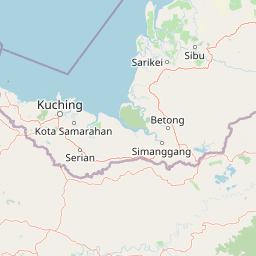
Map view of Santubong National Park

Use this park location map to pinpoint Santubong National Park in Malaysia, understand its exact geographic position, and read its mapped placement within the surrounding landscape more clearly.

Pigeon | © OpenStreetMap contributors

Location context for Santubong National Park

Sarawak
Park atlas

Trace the geographic spread of Bornean rainforests and coastal reserves across Sarawak, Malaysia, for detailed comparison.

Discover Other National Parks and Protected Areas Near Santubong National Park in Sarawak
Continue exploring the network of national parks and protected areas surrounding Santubong National Park, including other rainforest reserves and significant conservation landscapes across the Santubong Peninsula. Compare geographic features, habitat types, and conservation efforts across the region to deepen your understanding of Borneo's diverse protected ecosystems and their spatial relationships.
National parkSarawak

Kuching Wetlands National Park: Sarawak's Protected National Park Landscape and Geography

Explore the mapped wetland boundaries and regional context.

Gain a structured understanding of Kuching Wetlands National Park, a key protected area in Sarawak, Malaysia. This detailed entry provides insights into its specific geographic identity, mapped park boundaries, and its significance as a national park within the Borneo region's extensive natural landscapes. Discover the atlas value of this protected wetland environment for comprehensive geographic exploration.

Area
84.95 km²
Established
1992
IUCN
II
Relief
Lowland
Watercolor illustration of a coastal landscape with a distinctive rock formation, green vegetation, and calm water under a soft sky with distant mountains
National parkKuching Division

Bako National Park: Sarawak's Oldest National Park and Coastal Protected Landscape

Explore diverse ecosystems and dramatic mapped geology near Kuching Division.

Bako National Park, the oldest national park in Sarawak, Malaysia, offers a profound study in ecological concentration and geological drama. Covering a mere 27 square kilometers on the Muara Tebas peninsula, it encapsulates seven distinct ecosystem types, from coastal heath forest to mangrove areas, supporting significant biodiversity. The park's protected landscape is defined by its stunning sandstone coastline, carved by the sea into cliffs, arches, and seastacks, providing a unique geographic context. This makes Bako an essential destination for understanding Borneo's environmental diversity and the mapped boundaries of its conservation areas.

Area
27.27 km²
Established
1957
IUCN
II
Relief
Mixed relief
National parkSarawak

Talang Satang National Park: Protected Landscape and Sarawak Geography

Explore its mapped boundaries and regional context.

Delve into the protected landscape of Talang Satang National Park, a key national park situated in the dynamic geography of Sarawak, Malaysia. This entry provides essential context for understanding its specific protected boundaries and its contribution to the broader regional natural landscape. Discover its atlas-relevant details to enrich your understanding of Borneo's protected areas and their geographic distribution.

Area
194.14 km²
Established
1999
IUCN
II
Relief
Lowland
National parkSarawak

Kubah National Park: National Park Status and Mapped Landscape in Sarawak

Explore its protected boundaries and geographic context within Borneo.

Kubah National Park is a protected national park located in Sarawak, Malaysia, representing a crucial element of the region's conservation landscape. This detailed entry focuses on its identity as a national park, its specific geographic placement within Sarawak, and its significance for map-based exploration. Users can investigate the mapped boundaries and understand how Kubah National Park fits into the larger atlas of protected areas in East Malaysia, providing a factual foundation for geographic discovery without travel advice.

Area
22.3 km²
Established
1989
IUCN
II
Visitors
45K annual
National parkSarawak

Gunung Gading National Park: Sarawak's Protected Landscape and Geographic Context

Discover mapped terrain and protected area boundaries.

Gunung Gading National Park is an important national park located in Sarawak, Malaysia, offering critical insights into the region's geography and protected lands. This park serves as a key entity for exploring its specific mapped terrain and understanding its place within the diverse landscapes of Borneo. Examining Gunung Gading National Park aids in comprehending the distribution and character of protected areas in East Malaysia through a structured, atlas-oriented approach.

Area
43.6 km²
Established
1983
IUCN
II
Relief
Mountain
National parkKuching Division

Tanjung Datu National Park: Protected Landscape and Regional Geography

Explore its mapped boundaries within Kuching Division.

Tanjung Datu National Park is a protected natural area offering insight into regional conservation and geographic patterns within Malaysia. This entry provides a detailed look at the park's identity as a national park, focusing on its mapped boundaries and its contribution to the broader landscape context of the Kuching Division. It is designed for users seeking structured information about protected areas and their geographical distribution.

Area
7.3 km²
Established
1994
IUCN
II
Climate
Tropical
National parkMalaysia

Maludam National Park: Southeast Asian Protected Landscape and National Park Geography

Mapped boundaries and natural terrain in Malaysia.

Maludam National Park offers a focused exploration of protected landscape identity and geographic context within Malaysia. As a designated national park, it serves as a vital component for understanding the distribution of protected areas and their mapped terrain. This detailed entry allows for an appreciation of the park's specific environmental character and its contribution to the broader atlas of natural landscapes in Southeast Asia, facilitating structured discovery for researchers and explorers.

Area
432 km²
Established
2000
IUCN
II
Relief
Lowland
National parkSarawak

Rajang Mangroves National Park: Borneo's Premier Mangrove Protected Landscape

Explore the mapped geography and wetland conservation of this Sarawak national park.

Rajang Mangroves National Park is a significant protected area dedicated to preserving the intricate mangrove swamp ecosystems of Sarawak's Rajang River delta. Encompassing a vast expanse of tidal channels and riverine forests, this national park serves as a critical habitat for unique wildlife and plays a vital role in coastal ecological health. Its landscape is defined by the dynamic interface between riverine and marine environments, offering a prime example of wetland conservation within Borneo's broader natural geography and atlas context.

Area
107 km²
Established
2000
IUCN
II
Relief
Lowland

Common questions about visiting, size, designation, and location context for Santubong National Park

Santubong National Park FAQs for park facts, access, geography, and protected area context
Find quick answers about Santubong National Park, including protected-area facts, park geography, trail and visitor context, and how the park fits into its surrounding country and regional landscape.
MoriAtlas Explorer

Continue Your Protected Areas Search Across the Global Atlas

Deepen your exploration by continuing the structured search for national parks and protected areas worldwide. Utilize the comprehensive filtering capabilities to compare different conservation landscapes and refine your understanding of global park geography. Discover more about the distribution and characteristics of protected natural areas.

Global natural geography