Why Sian Kaan Biosphere Reserve stands out
Sian Kaan is best known for its extraordinary combination of tropical wetlands, mangrove forests, and the offshore section of the Mesoamerican Barrier Reef, the second largest coral reef system in the world after Australia's Great Barrier Reef. It also protects the petenes, rare circular tree islands that rise out of the marshland where freshwater springs emerge through saline swamps. Equally defining is its cultural heritage. The reserve contains dozens of archaeological sites of the ancient Maya, including the major site of Muyil (Chunyaxché) and the smaller Xlahpak temple overlooking Chunyaxché lagoon, giving the natural landscape a deep human-history dimension that stretches from the Classic Maya period through the Postclassic and into the early colonial era.
Sian Kaan Biosphere Reserve history and protected-area timeline
Sian Kaan was established as a national biosphere reserve by presidential decree on 20 January 1986, becoming the first large tropical protected area in Mexico. The reserve was quickly recognized internationally: UNESCO inscribed it on the World Heritage List in 1987 and included it in the Man and the Biosphere (MaB) programme, and later, in 2003, it was designated as a Ramsar site for its wetland importance.
The reserve's origin was rooted in scientific work. In early 1981, the Centro de Investigaciones de Quintana Roo (CIQRO) launched studies aimed at identifying a candidate biosphere reserve that could bring together the institution's various research, conservation, and regional development goals. The team settled on the area encompassing Ascension Bay, Espiritu Santo Bay, the offshore reef barrier, and surrounding forests in what are now the municipalities of Tulum, Felipe Carrillo Puerto, and Bacalar. Their surveys demonstrated that the area contained largely intact examples of nearly all Yucatan Peninsula biomes, with a sparse human population made up mainly of Maya fishing and farming communities.
CIQRO produced the scientific, socioeconomic, and biodiversity baseline data that justified the reserve's creation, and the project director, Dr. Alfredo Careaga, led the political and administrative negotiations with the Presidency of Mexico, the Quintana Roo state government, UNESCO, and various federal agencies between 1978 and 1986. When the reserve was formally created, its management plan was published in 1993, organizing conservation, sustainable development, public use, archaeological heritage, environmental education, and research into a coordinated framework that still shapes management today.
The reserve's more recent history also reflects environmental pressure. Tourism growth across Quintana Roo, deforestation driven by the extraction of timber species, the spread of introduced plants such as casuarina, and increased maritime traffic have all threatened its ecosystems, pushing conservation organizations and the federal protected areas agency to expand monitoring, restoration, and community-based management programs within the reserve.
Sian Kaan Biosphere Reserve landscape and geographic character
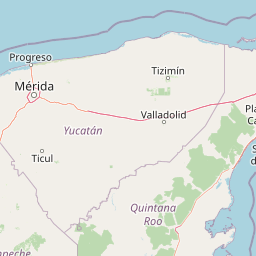
Sian Kaan's landscape is shaped by the flat limestone geology of the Yucatan Peninsula. Surface rivers are virtually absent because rainwater disappears quickly into the porous bedrock, and the terrain instead expresses itself through a mosaic of low, water-filled depressions, swamps, and a dense network of cenotes, the natural sinkholes that punctuate much of the region. This low-relief geography produces an unusually wide coastal plain where freshwater, saltwater, and terrestrial habitats meet.
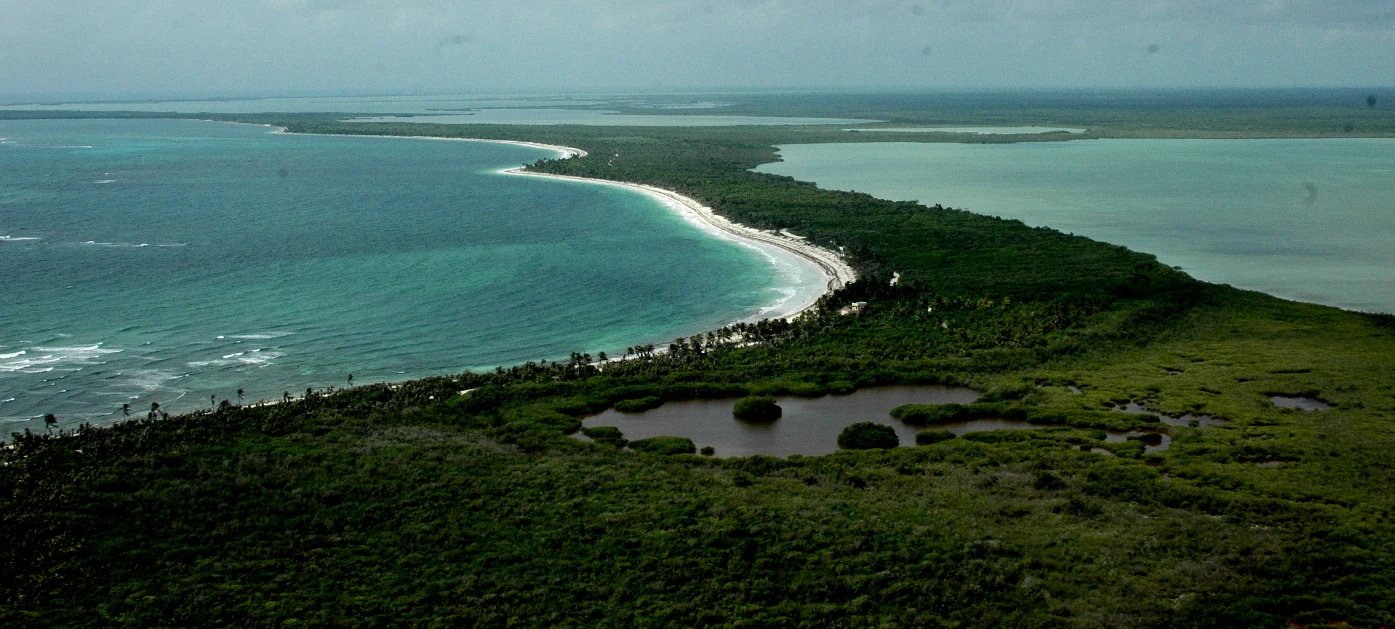
Along the Caribbean shoreline, the reserve features long stretches of white sand beach, small sheltered bays, and the Boca Paila peninsula, a long, narrow sandy ridge that runs parallel to the coast and separates the protected lagoon system from the open sea. Halfway along the peninsula, a tidal channel about 20 meters wide cuts across, dividing Boca Paila into two sections, with the small fishing community of Punta Allen sitting at its southern end.
Inland from the coast, the terrain rises only slightly into broad belts of mangrove forest, freshwater marsh, and flooded savanna. Within these wetlands, the petenes form the most visually distinctive feature: oval or circular islands of tall forest, sometimes growing to nearly two kilometers across, that rise abruptly from the surrounding marsh. They owe their existence to hidden freshwater springs that emerge beneath saline swamp, allowing large trees to flourish where they otherwise could not survive.
Further inland, the wet lowlands give way to semi-evergreen tropical forest, transitioning into the broader wooded landscapes of central Quintana Roo. Throughout the reserve, the geography is defined less by dramatic relief than by subtle transitions between water and land, with vegetation shifting distance by distance as salinity, drainage, and soil depth change.
Sian Kaan Biosphere Reserve ecosystems, habitats, and plant life
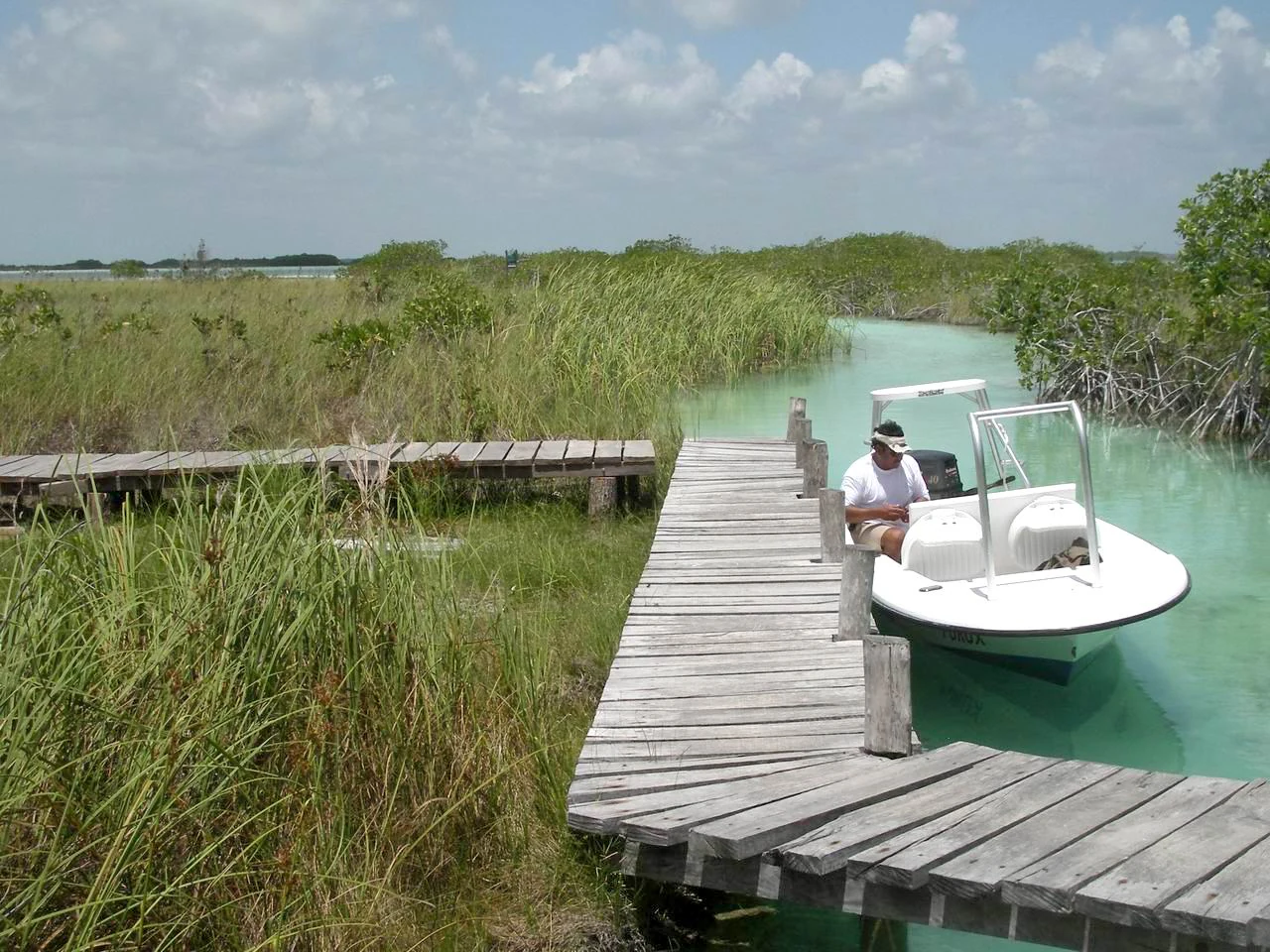
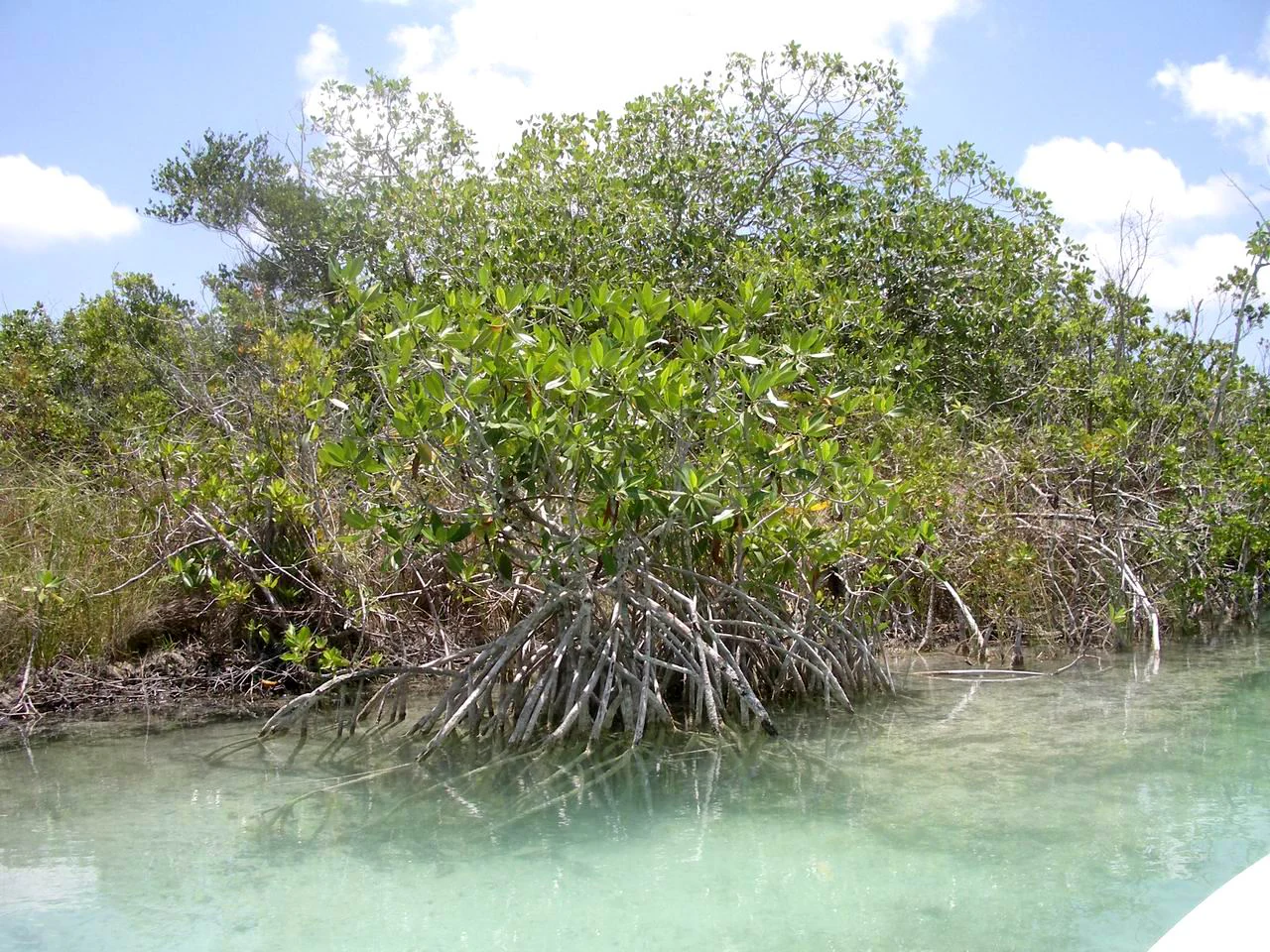
Sian Kaan protects an unusually compressed sequence of tropical ecosystems arranged along the eastern edge of the Yucatan Peninsula. Close to the coast, four species of mangrove, including red, black, white, and gray mangroves, line the lagoons, bays, and tidal channels, forming the foundation of the reserve's coastal productivity. Behind them, freshwater springs emerging through the limestone create the conditions for the rare petenes, which act as biodiversity hotspots within an otherwise uniform marsh.
Further inland, low-lying tropical semi-evergreen forests cover much of the western reserve, with seasonal inundated grasslands and savannas creating a transitional zone between the wet coastal systems and the drier interior forests of the peninsula. This combination of habitats produces one of the highest concentrations of endemic and migratory species in Mesoamerica.
According to Mexico's National Biodiversity Information System, the biosphere reserve as a whole supports more than 2,500 species of plants and animals, of which a substantial number fall within Mexican risk categories. The reef portion of the reserve hosts an additional distinct marine community, including hard and soft corals such as Acropora and Porites, along with the reef fish and invertebrates that depend on them. Together, these systems make Sian Kaan one of the leading examples of integrated tropical and marine conservation in Mexico.
Sian Kaan Biosphere Reserve wildlife and species highlights
Wildlife is central to Sian Kaan's identity. The reserve's mammal community includes several species that depend on continuous forest cover, including the jaguar, the Baird's tapir, the white-lipped peccary, the collared peccary, and the Yucatan black howler monkey. Spider monkeys and howler monkeys also play an important ecological role, dispersing seeds that help regenerate the forest.
The birdlife is equally significant. The reserve supports a mix of resident and migratory species, including the Yucatan woodpecker, the ocellated turkey, the crested guan, the great curassow, the jabiru stork, the American flamingo, and the roseate spoonbill. Wading birds such as the great egret, the little blue heron, and the great blue heron hunt the mangrove shallows and lagoons, helping to maintain balance in the fish and invertebrate populations of these systems.
Coastal and marine wildlife includes the American crocodile and Morelet's crocodile, sea turtles, manatees, and a rich reef community supported by the Mesoamerican Barrier Reef. The reef's hard and soft corals shelter large populations of reef fish and invertebrates, while the mangrove systems nursery many of the same species, creating a continuous ecological corridor from the inland forest all the way out to the open Caribbean.
Sian Kaan Biosphere Reserve conservation status and protection priorities
Sian Kaan's conservation significance is recognized at both the national and international levels. Inscribed as a UNESCO World Heritage Site in 1987 and designated a Ramsar wetland site in 2003, it stands as a flagship example of integrated terrestrial and marine protection in Mexico. Its World Heritage status is based on the criteria that recognize both its ecological importance and its role in protecting representative examples of Yucatan Peninsula ecosystems.
The reserve functions as a refuge for several species that have declined elsewhere in the Yucatan, including the jaguar, Baird's tapir, ocellated turkey, and both native crocodile species, and it maintains key populations of the Yucatan black howler monkey and Geoffroy's spider monkey, both vital to forest regeneration through their seed-dispersal role.
At the same time, conservationists have flagged the growing pressures on the reserve. Rising tourism across the Quintana Roo coast, deforestation linked to timber extraction, the introduction of invasive species such as casuarina, boat traffic that damages the reef, and the broader impacts of climate change, including ocean warming, acidification, and coral bleaching, all threaten the long-term health of the system. Management of the reserve, coordinated through Mexico's National Commission of Natural Protected Areas in cooperation with NGOs, research institutions, and local producers, focuses on scientific monitoring, ecological restoration, controlled public use, and community engagement to address these pressures.
Sian Kaan Biosphere Reserve cultural meaning and human context
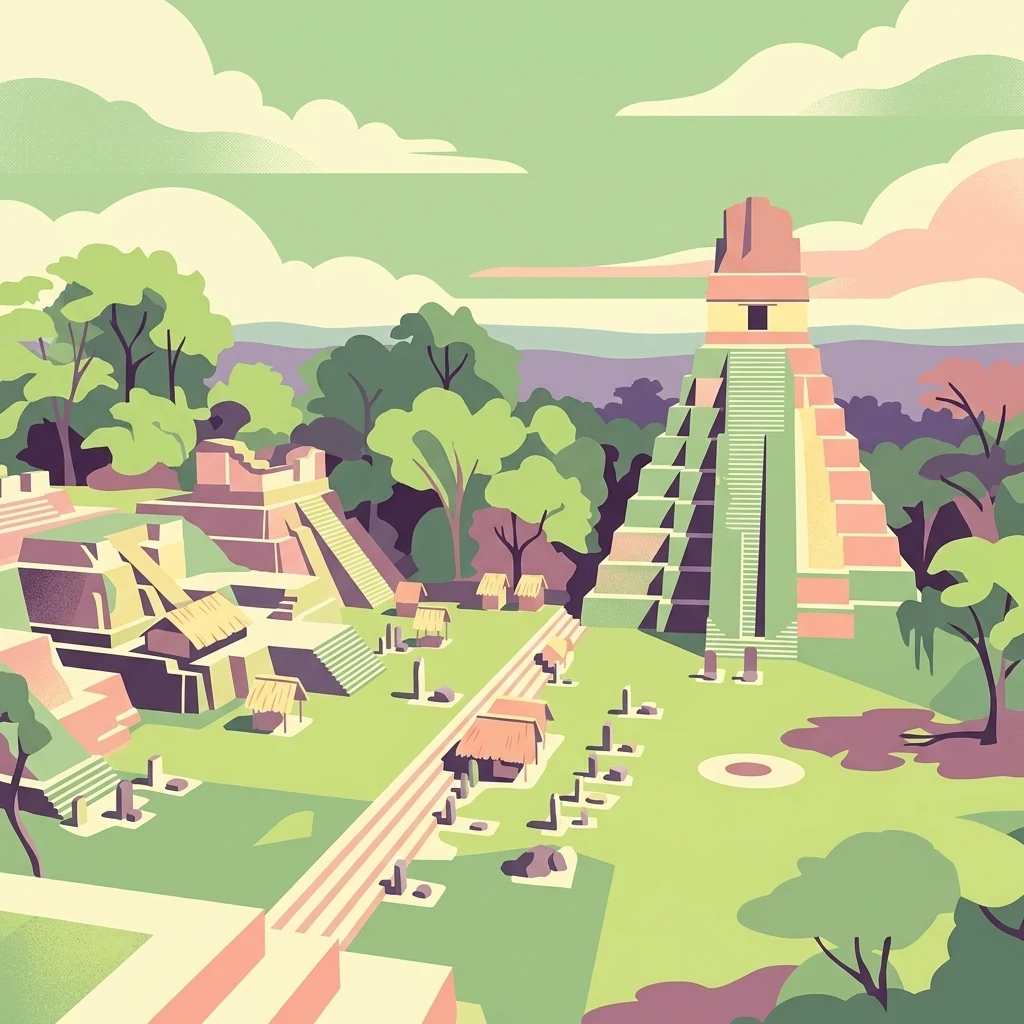
Sian Kaan sits in a region with a continuous human presence stretching back to the ancient Maya. Within and around the reserve, around two dozen archaeological sites reflect the depth of this history, with the largest and most prominent being Muyil, also known as Chunyaxché, located about 20 km southwest of Tulum along the highway between Cancun and Chetumal. Muyil was inhabited during the Classic Maya period and reached its height during the Postclassic, with many of its standing buildings dating from that later era. Like nearby Tulum, the ceremonial precinct at Muyil appears to have been enclosed by walls. The city remained inhabited until the Spanish extended their conquest of the Caribbean coast around 1550.
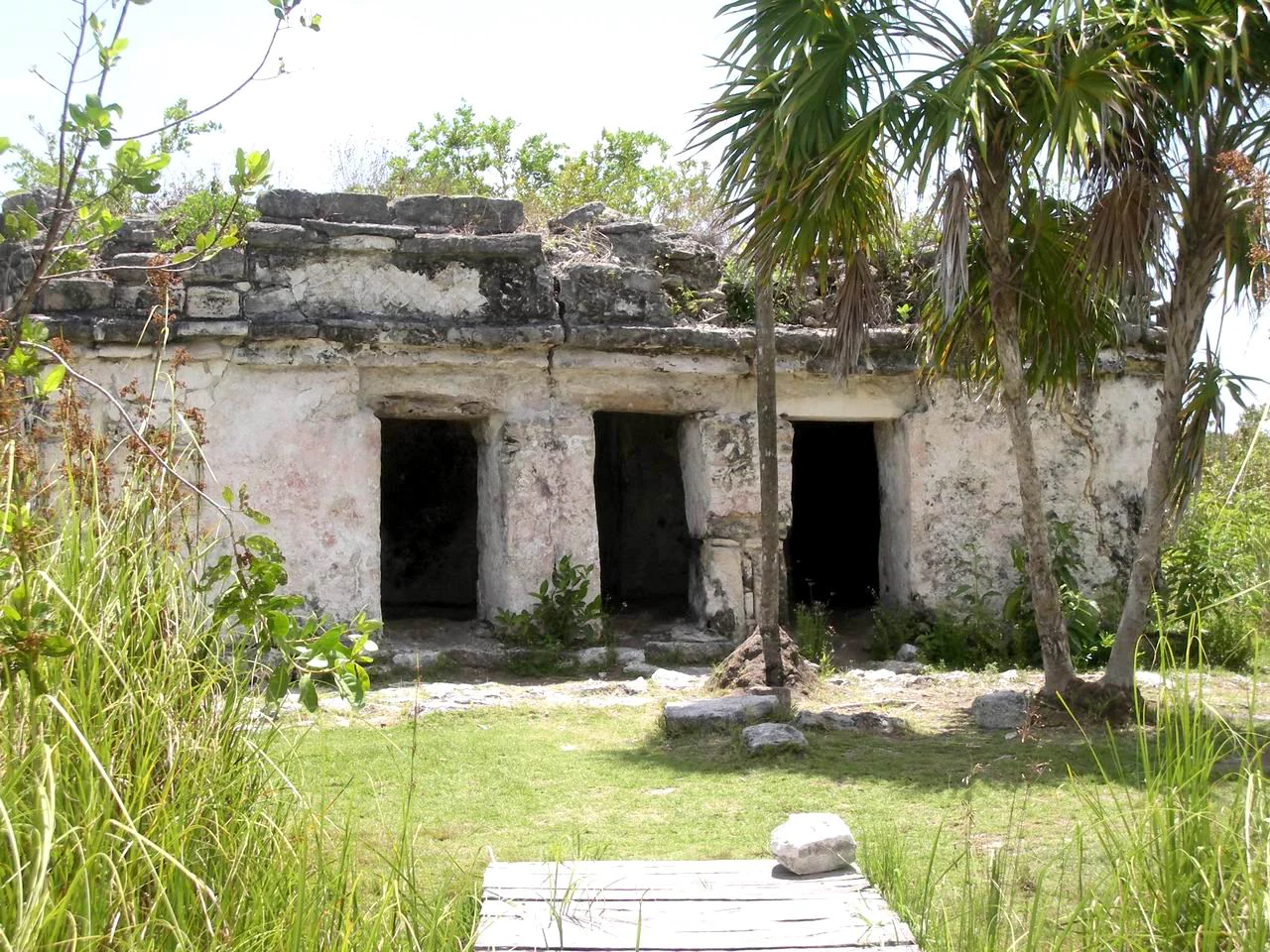
A smaller but distinctive site is the Xlahpak temple, a modest structure overlooking Chunyaxché lagoon near the point where freshwater flows into the lagoon system. Other archaeological remains have been identified along the Boca Paila peninsula, where the long, narrow strip of land splits the protected lagoon from the open sea.
Beyond prehistory, the reserve's contemporary cultural fabric remains strongly Maya. Local communities of Maya fishermen and farmers have lived in and around the reserve for generations, and modern conservation efforts have emphasized their involvement, drawing on traditional ecological knowledge alongside scientific research. The reserve's community-based forestry, fishing, and tourism initiatives reflect this blended cultural and ecological identity.
Top sights and standout views in Sian Kaan Biosphere Reserve
Maya archaeological sites around Muyil and Chunyaxché lagoon, including the walls-enclosed ruins of Muyil and the lakeside Xlahpak temple.
The petenes, rare freshwater tree islands surrounded by saline marsh, found almost nowhere else outside Florida, Cuba, and the Yucatan Peninsula.
A pristine line of Mesoamerican Barrier Reef offshore, recognized as the second largest coral reef system in the world.
Extensive mangrove belts of all four regional mangrove species, supporting crocodiles, sea turtles, and a wide range of nesting and migratory birds.
One of Mexico's largest tropical protected areas, where the Yucatan's classic low-lying geography of cenotes, flooded savanna, semi-evergreen forest, and Caribbean coast all meet within a single reserve.
Best time to visit Sian Kaan Biosphere Reserve
The climate of Sian Kaan is warm subhumid, and the character of the landscape shifts with the seasons. The dry months, broadly from late autumn through spring, tend to offer calmer seas, clearer skies, and easier access to inland trails and lagoons. Wildlife viewing remains rewarding throughout this period, with both resident and migratory birds active across the mangroves and coastal flats.
The rainy season, concentrated in the summer months, transforms much of the reserve. Heavy rainfall combines with the flat, poorly drained limestone terrain to flood large areas of the savanna and low-lying forest, expanding wetlands and concentrating wildlife around the patches of higher ground. This is also the time when hurricanes and tropical storms moving across the Caribbean can affect the area, bringing dramatic but occasionally disruptive weather. Despite the rain, the summer season brings the lushest landscapes and the most dynamic wetland scenery.