Why Swatzke and Skabyberge Nature Reserve stands out
The reserve is best known for its inland dune complex, a large tract of former military training ground that has become an extensive area of sand heath with broom and gorse, dry grasslands, and natural Central European lichen pine forests. These dry, acid sand habitats are uncommon in Brandenburg and form the defining ecological identity of the site, complemented by small transitional mire and bog woodland margins along the lower ground.
Swatzke and Skabyberge Nature Reserve history and protected-area timeline
The modern history of the Swatzke and Skabyberge landscape is inseparable from its long use as a military training area. During the Cold War period the area served as a Truppenübungsplatz, a troop training ground, for the Western Group of Soviet Forces (WGT) stationed in East Germany, and vehicle movements, track laying, and other training activity kept the sandy ground open at a time when much of the surrounding region was being afforested.
The end of that military use marked a turning point for conservation. After German reunification and the withdrawal of Soviet forces, the property's biological value became apparent. The Brandenburg state authorities placed the area under formal protection through the Verordnung über das Naturschutzgebiet "Swatzke- und Skabyberge" of 11 October 1999, assigning it designation number 1537. Shortly afterwards it was incorporated into the Natura 2000 network as an FFH site (site code 3649-301), under the Habitats Directive (Council Directive 92/43/EEC). The reserve is now administered by the Brandenburg State Office for the Environment as a Habitat/Species Management Area, classified at IUCN Category IV, with active management to restore and maintain open sand habitats.
Swatzke and Skabyberge Nature Reserve landscape and geographic character
The landscape of Swatzke and Skabyberge is a classic Brandenburg inland dune terrain, with gentle sandy ridges, dry valleys, and shallow peat-filled depressions. The ground rises only modestly: the Swatzkeberge reach about 51 meters above sea level and the Kleine Skabyberge about 50.8 meters, but even these small heights cast the ecological template of the area, because the sandy slopes dry out quickly while the hollows between them remain moist.
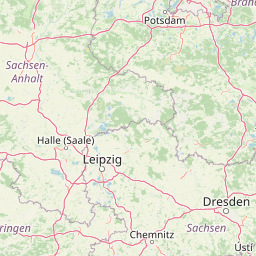
To the north of the reserve lies the Oder-Spree Canal and, further north, the Spree river itself. The eastern edge runs along the L23 state road, and the southern boundary is defined in part by the A12 motorway. To the northwest lies the Triebschsee, another nature reserve, while the Skabyer Torfgraben rises south of the hills and flows north and east to eventually empty into the Dahme river downstream. The result is a small but ecologically rich land parcel that sits inside a broader matrix of lowland Brandenburg forest, canal systems, and former military grounds.
Swatzke and Skabyberge Nature Reserve ecosystems, habitats, and plant life
Ecologically, Swatzke and Skabyberge is remarkable for the way a small piece of ground packs together an unusually complete sequence of inland sand habitats. The dune ridges carry dry, acid, leached soils that support sand heath communities with heather and broom-gorse scrub, and open silver-grass and bent-grass dry grasslands (the Cornephorus-Agrostis grasslands), all recognized as priority inland dune habitats in the European Habitats Directive.
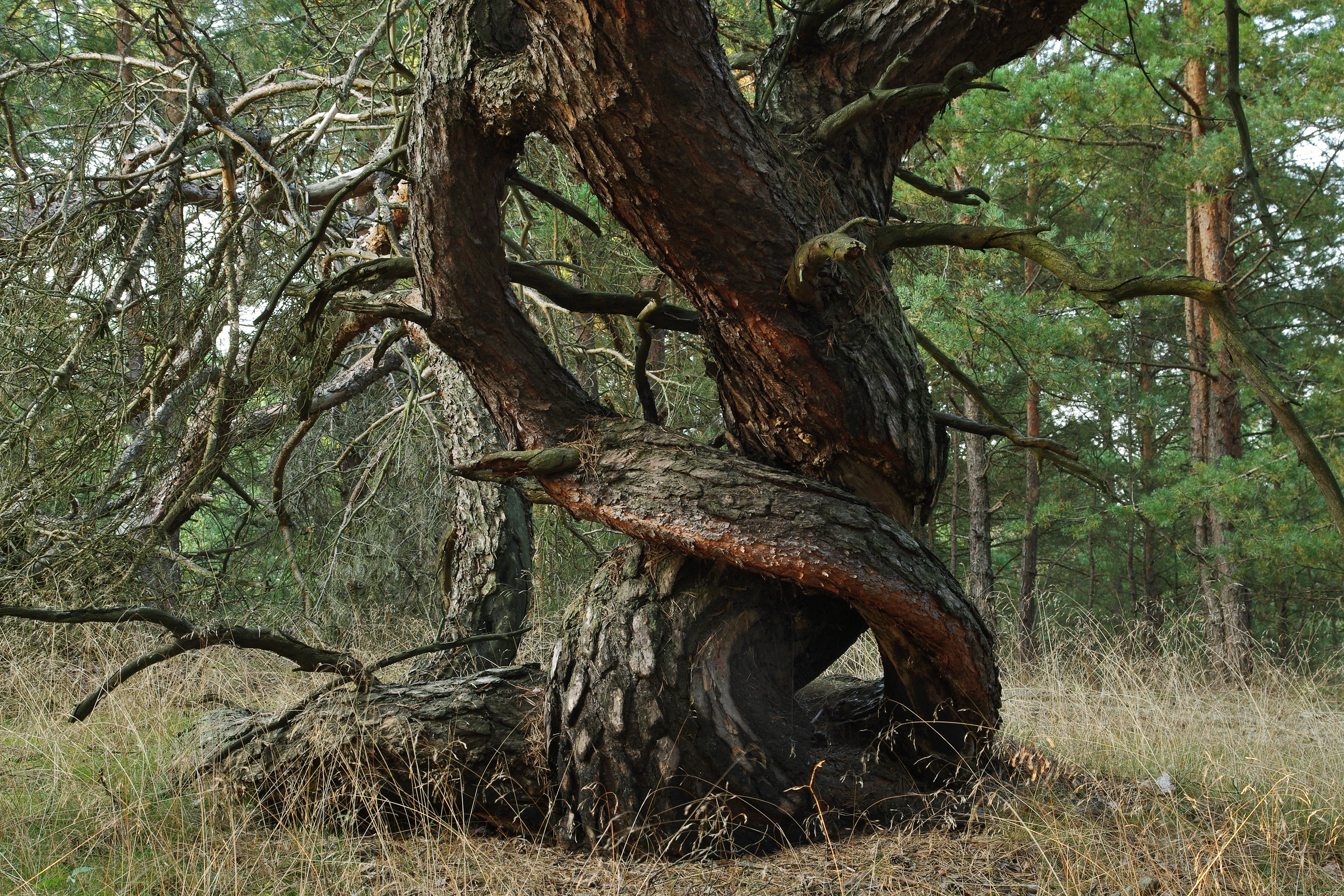
Open sand and heath here grade naturally into Central European lichen pine forests, a special forest community shaped by long-term ecological continuity, dry conditions, and nutrient-poor soil. In the wetter depressions and along the margins, the habitat mix shifts sharply: the site includes transitions into floating bog and quaking mires (Caricion lasiocarpae and Rhynchosporion albae vegetation, coded 7140 in the Natura 2000 system) and patches of bog woodland (coded 91D0). The reserve's five listed habitat types therefore range from very dry to very wet, producing a tight ecological mosaic that is unusually complete for this part of Germany.
Swatzke and Skabyberge Nature Reserve wildlife and species highlights
While the reserve is best characterized by its habitats rather than by headline species, its ecological integrity supports characteristic assemblages of dry-sand and pine-forest fauna. Among mammals, the reserve lists Myotis myotis, the greater mouse-eared bat, as a species protected under Annex II of the Habitats Directive along with its important foraging, breeding, migration, and wintering habitats.
Swatzke and Skabyberge Nature Reserve conservation status and protection priorities
Swatzke and Skabyberge holds a clear conservation significance that extends well beyond its modest size. The site is part of the coherent European Natura 2000 ecological network, formally recognized as a Fauna-Flora-Habitat site of approximately 459 hectares, and designated as a national nature reserve (Naturschutzgebiet) with a larger buffer area of about 520 hectares in total.
Its conservation value rests on the unusual completeness of its inland-dune ecosystem: dry inland dune heaths, dry grasslands, natural Central European lichen pine forests, and small bog and mire communities all occur within a compact block once shaped by military use but now allowed to develop toward a more natural state. As an IUCN Category IV Habitat/Species Management Area, the site is actively managed to maintain and restore these open sand habitats, preventing succession toward uniform closed forest and preserving the mosaic that gives the reserve its distinctiveness.
Swatzke and Skabyberge Nature Reserve cultural meaning and human context
The reserve's identity is closely bound up with the regional history of eastern Brandenburg and the legacy of late twentieth-century military use. For decades the sandy ridges of the Swatzkeberge and Kleine Skabyberge functioned as a Soviet training ground, and the disturbance regime that resulted, compacted ground, vehicle tracks, and artificially maintained open sand, paradoxically preserved the open character of the dunes that now anchors their ecological value.
Today the site sits within the rural landscape around Spreenhagen, bordered by reclaimed military land, canals constructed and modified during the period of industrial waterway use, and the small agricultural settlements of the Oder-Spree region. The transformation from restricted military zone to public nature reserve fits a broader pattern across the former East German military belt, where former training areas have become some of the most important refuges for open sand and heath ecosystems in central Europe.
Top sights and standout views in Swatzke and Skabyberge Nature Reserve
The Swatzke and Skabyberge reserve concentrates five protected habitat types within a compact 459-hectare Natura 2000 block: dry inland dune heaths of heather and gorse, natural silver-grass dry grasslands, Central European lichen pine forests, and small transitional mire and bog woodland on the wetter ground. It is also one of a small set of Brandenburg reserves whose contemporary ecological identity was directly shaped by the area's past as a Soviet training ground.
Best time to visit Swatzke and Skabyberge Nature Reserve
The reserve is most rewarding in late spring through early autumn, when dry sand heaths and open grasslands are at their most diverse, woodland paths are dry underfoot, and birds and insects associated with open dune habitats are most active. Cooler months still offer quiet, contemplative pine-forest walking, but the dune grasslands and heaths are at their visual and ecological peak in the warmer half of the year.