

Mori Atlas logo
Nature reserveThol Lake

Mapping the seasonal waterbird habitats, marshland boundaries, and semi-arid terrain of this protected nature reserve

Thol Lake Wildlife Sanctuary: A Comprehensive Atlas of Gujarat Freshwater Wetland Geography

Thol Lake Wildlife Sanctuary serves as a critical freshwater wetland node within the semi-arid landscape of Gujarat. This protected nature reserve features a complex mosaic of open water, marshy edges, and surrounding dry deciduous scrub that supports significant migratory bird populations. By examining the sanctuary map and surrounding catchment, one can understand the interplay between the irrigation reservoir and the regional agricultural plains of the Mehsana District.

freshwater lakebird sanctuarywaterbirdsmigratory birdsflamingossarus crane

Thol Lake

Nature reserve

Park overview

Structured park overview, official facts, and landscape profile for Thol Lake Wildlife Sanctuary

Thol Lake Wildlife Sanctuary park facts, protected area profile, and essential visitor context

Review the core facts for Thol Lake Wildlife Sanctuary, including designation, size, terrain, visitor scale, habitats, and operating context in one park-focused overview.

About Thol Lake Wildlife Sanctuary

Thol Lake Wildlife Sanctuary is one of Gujarat's most distinctive inland wetland reserves, occupying a man-made reservoir set within the dry agricultural landscape of northern Gujarat. The lake itself was created in 1912 as an irrigation tank during the rule of Sayajirao Gaekwad III of Baroda, an era when large-scale water infrastructure shaped the agricultural expansion of the princely states. Its original purpose was to provide reliable irrigation to farmers in the surrounding villages, and user rights established at that time still structure how the water is managed today by the Irrigation Department of Gujarat.

Over time, the lake's open water, fringing marshes, and seasonally inundated shoreline evolved into a productive habitat for waterbirds, and in November 1988 the area was formally notified as a sanctuary under Section 18 of the Indian Wildlife (Protection) Act, 1972. Administration now involves both the Forest Department, which oversees wildlife protection, and the Irrigation Department, which maintains water flows for agriculture. The sanctuary has also been proposed as an Eco-Sensitive Zone under the Environment (Protection) Act, 1986, with a draft notification prepared to formalise additional safeguards around its catchment.

Geographically, the sanctuary sits in Mehsana District near the village of Thol, about 25 kilometres northwest of Ahmedabad and roughly 20 kilometres from Kalol. Its catchment spans around 15,500 hectares of semi-arid terrain dominated by cropland, fallow fields, and dry deciduous scrub. Within this setting, the lake itself covers approximately 699 hectares, with a stored volume on the order of 84 million cubic metres and a shore reaching around 5.6 kilometres. The climate is strongly seasonal, with most of the roughly 600 millimetres of annual rainfall arriving during the southwest monsoon and temperatures ranging from cool winter mornings near 8°C to scorching summer highs around 43°C.

This combination of open freshwater, marshy margins, and dry thorny forest makes Thol an unusually rich birding site so close to a major city. Visitors and researchers describe it as the most popular birdwatching location near Ahmedabad after the larger Nal Sarovar, and it serves as a key node in Gujarat's network of inland wetland habitats supporting both resident and migratory waterbirds.

Quick facts and research context for Thol Lake Wildlife Sanctuary

Thol Lake Wildlife Sanctuary lies near Thol village in Kadi taluka, Mehsana District, northern Gujarat, about 25 kilometres northwest of Ahmedabad and 22 kilometres from Kadi. The artificial lake spreads across roughly 699 hectares and drains a catchment of about 15,500 hectares within a semi-arid zone dominated by dry deciduous vegetation.

Constructed in 1912 by the Gaekwad regime as an irrigation tank, the lake was formally designated a sanctuary in November 1988 under Section 18 of the Wildlife (Protection) Act, 1972. It is jointly administered by the Forest and Irrigation departments of the Government of Gujarat. Annual rainfall averages around 600 millimetres, concentrated in the monsoon, with temperatures ranging from roughly 8°C in winter to 43°C in summer, shaping the seasonal cycles of the wetland and its birdlife.

Protection and recognition

Terrestrial protected area records established in the designated year 1988.

Thol Lake Protection Status and Documented Conservation Designation History

Thol Lake preserves documented terrestrial protection status and historical designation records established in 1988. Structured conservation metrics outline management scope and official recognition details for this protected habitat.

Protection details

Protection scope
Terrestrial
Designated year
1988
Transboundary protection
No
Park context

Deeper park guide and search-rich context for Thol Lake Wildlife Sanctuary

Thol Lake Wildlife Sanctuary history, landscape, wildlife, and travel context

Explore Thol Lake Wildlife Sanctuary through its history, landscape character, ecosystems, wildlife, conservation priorities, cultural context, and seasonal travel timing in a structured park guide built for atlas discovery and search intent.

Why Thol Lake Wildlife Sanctuary stands out

Thol Lake Wildlife Sanctuary is best known for its spectacular gatherings of flamingos on the open water and its significant breeding population of sarus cranes, the tallest of the world's flying birds. At peak season counts have reached five to six thousand flamingos on the lake margins, while sarus cranes nest in large numbers in the surrounding marshes and fields. The sanctuary also earns recognition for its concentration of waterbirds more broadly, with around 90 of the roughly 150 recorded species linked to aquatic and wetland habitats. It carries particular conservation weight for hosting globally threatened species such as the Dalmatian pelican, Greater spotted eagle, Indian skimmer, White-rumped vulture, and Indian vulture, alongside the keystone presence of large flocks of greater flamingos during the winter months.
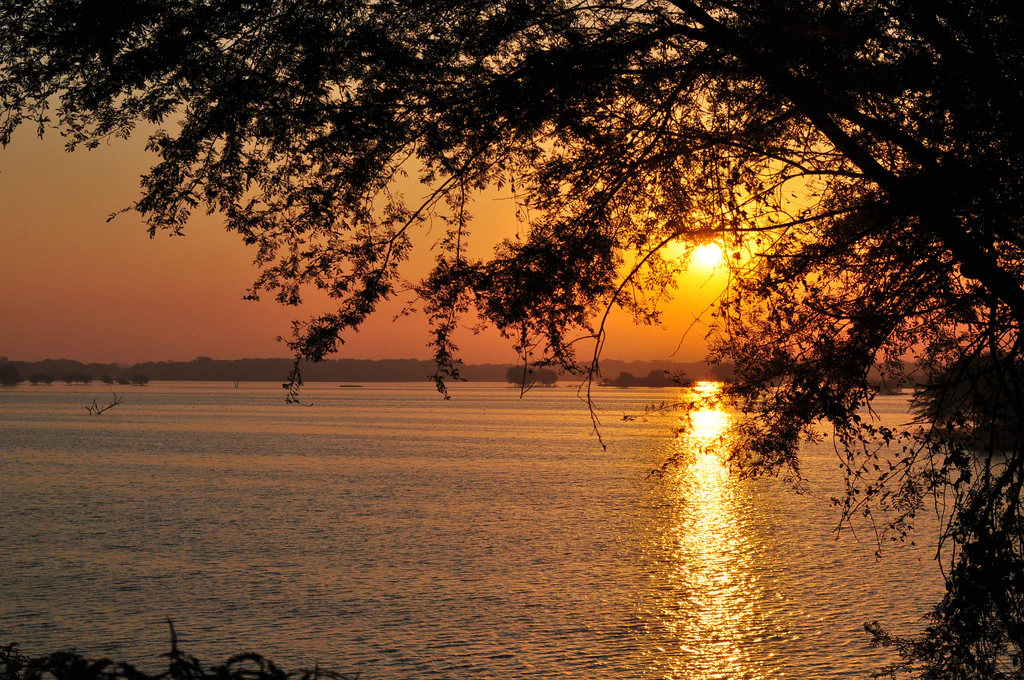
A silhouetted tree branch hangs over a calm lake at sunset, with the sun low on the horizon casting a golden reflection on the water.
Sunset over Thol Lake, a key habitat for migratory bird species in Gujarat.

Thol Lake Wildlife Sanctuary history and protected-area timeline

The origins of Thol Lake date to 1912, when the Gaekwad rulers of Baroda, under Sayajirao Gaekwad III, constructed a large irrigation tank to support agriculture in the dry lands around Thol village. The project established long-standing user rights over the lake's water, and these traditional entitlements continue to influence how the resource is shared between irrigation and wildlife needs.

Nearly three quarters of a century later, in November 1988, the lake and its surrounding marshes were officially notified as Thol Wildlife Sanctuary under Section 18 of the Wildlife (Protection) Act, 1972. From that point the area received formal legal protection, and the responsibility for its stewardship came to be shared between the Forest Department of Gujarat, which manages wildlife and habitat, and the Irrigation Department, which oversees the water regime. The sanctuary's ecological importance has since been further recognised by a proposal to designate it an Eco-Sensitive Zone under the Environment (Protection) Act, 1986, with a draft notification prepared for that purpose.

Thol Lake Wildlife Sanctuary landscape and geographic character

Thol Lake lies within the semi-arid zone of northern Gujarat, where flat agricultural plains, scattered thorny woodlands, and seasonal wetlands characterise the regional terrain. The lake is essentially a shallow, lentic waterbody ringed by marshes and bordered by cultivated fields, fallow land, and patches of dry deciduous scrub, producing a mosaic of open water, wet edges, and dry upland habitats within a relatively compact area.

The catchment feeding the lake extends across roughly 15,500 hectares of gently undulating countryside in Mehsana District. Surrounding the shoreline, thorny acacia and similar drought-resistant species form a low, open canopy that gradually gives way to emergent and floating aquatic vegetation at the water's edge. The shore itself stretches for about 5.6 kilometres, and because the reservoir is shallow, fluctuations in water level visibly reshape the transition between water, marsh, and dry land through the seasons.

Climate strongly defines the landscape's character. With annual rainfall averaging around 600 millimetres, concentrated almost entirely in the monsoon, the lake and its marshes swell during and after the rainy season and contract through the dry months. Winter temperatures can drop near 8°C while summer highs reach about 43°C, intensifying the seasonal contrast between a lush, bird-filled wetland and a drier, quieter shoreline later in the year.
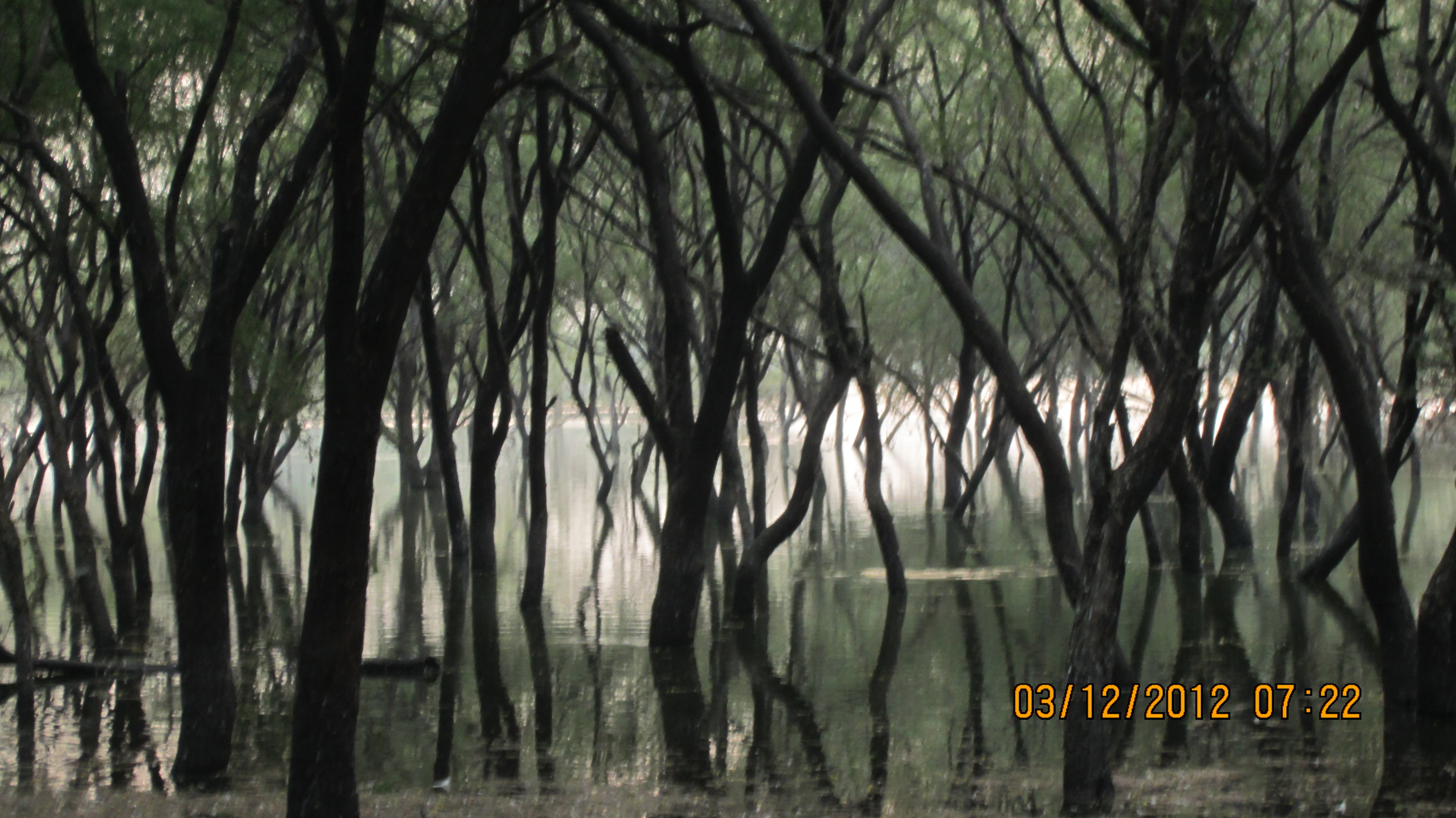
A grove of trees growing in shallow water at Thol Lake, with thin dark trunks and green foliage visible in a misty or overcast atmosphere.
Trees partially submerged in the waters of Thol Lake.

Thol Lake Wildlife Sanctuary ecosystems, habitats, and plant life

Thol Lake Sanctuary's ecological identity is shaped by the meeting of freshwater wetland with semi-arid dryland. The open water habitat dominates the core of the reserve, while the margins support emergent and floating aquatic plants, and the surrounding uplands carry drought-resistant thorn forest. This ecological intersection, classified within Bio-geographic Zone IV, produces unusually high habitat diversity for a small reserve.

Vegetation on the periphery and within the wetland draws on both aquatic and terrestrial floras. Trees and shrubs typical of arid Gujarat, such as Acacia nilotica, Acacia leucoploea, Zizyphus, Azadirachta indica, Ficus species, Salvadora species, Prosopis chilensis, and Capparis species, thrive in the dry deciduous surroundings. Within and along the water, a mixed community of emergent and marshy plants adds structural complexity, providing cover and food resources for waterbirds and other aquatic life.

The richness of this habitat mosaic lies less in its total size than in the concentration of ecological functions packed into a relatively small area: storage of freshwater in a dry region, a permanent refuge for waterbirds, breeding grounds for species like the sarus crane, and seasonal foraging habitat for migratory flocks arriving with the monsoon and winter.

Thol Lake Wildlife Sanctuary wildlife and species highlights

The wildlife profile of Thol Lake is dominated by birds. The sanctuary hosts about 150 species, of which roughly 60 percent, around 90 species, are waterbirds, making it one of the most important inland wetlands for waterfowl in Gujarat. Both resident species and winter migrants are well represented, with the monsoon and winter months bringing a noticeable expansion in the bird population.

Flamingos are the most prominent feature of the sanctuary's birdlife, and historical counts have recorded flocks of five to six thousand individuals on or near the lake. Sarus cranes, the tallest of the world's flying birds, nest in large numbers around the marshes and adjacent croplands, reinforcing the sanctuary's importance for breeding waterbirds. Other regularly recorded winter visitors and residents include great white pelicans, Dalmatian pelicans, mallards, geese, and a wide variety of waders, alongside raptor species that hunt over the wetlands and surrounding fields.

Conservation interest in the sanctuary's avifauna is sharpened by the presence of globally threatened species. Under IUCN categorisation, the greater flamingo is listed as least concern, while the Dalmatian pelican, Greater spotted eagle, sarus crane, and Indian skimmer are classified as vulnerable, and the White-rumped vulture and Indian vulture fall within the critically endangered category. Mammal life is less conspicuous but includes bluebull, golden jackal, and blackbuck in the drier habitats around the lake, adding another layer of biodiversity to the reserve.

Thol Lake Wildlife Sanctuary conservation status and protection priorities

Thol Lake Wildlife Sanctuary holds notable conservation value as a freshwater refuge embedded within a semi-arid landscape where standing water and intact marshes are scarce. By protecting a waterbody and its associated wetland edge, the sanctuary secures breeding, staging, and wintering habitat for a wide range of waterbirds, including several globally threatened species such as the sarus crane, Dalmatian pelican, Greater spotted eagle, Indian skimmer, White-rumped vulture, and Indian vulture.

The site's formal protection status, established under Section 18 of the Wildlife (Protection) Act, 1972 and administered jointly by the Forest and Irrigation departments of the Government of Gujarat, gives it legal standing as a regulated habitat rather than simply a productive farmland feature. Its inclusion in discussions about being designated an Eco-Sensitive Zone under the Environment (Protection) Act, 1986, with a draft notification already prepared, reflects an effort to extend protection beyond the lake itself to its wider catchment.

This conservation profile is reinforced by the site's role in regional ecological networks. As one of the closest substantial freshwater wetlands to Ahmedabad and a key complement to the larger Nal Sarovar Bird Sanctuary, Thol supports migratory bird movements and waterbird populations across northern Gujarat. Protecting the lake also safeguards the drought-resistant thorn and acacia vegetation that frames the wetland, sustaining habitat for mammals such as blackbuck and bluebull that depend on the same mosaic of dry forest, cropland, and seasonal water.

Top sights and standout views in Thol Lake Wildlife Sanctuary

The standout qualities of Thol Lake Wildlife Sanctuary centre on the scale and variety of its waterbird life set against a stark semi-arid backdrop. The sight of thousands of flamingos gathered on a shallow freshwater lake, framed by thorn scrub and farmland, defines the sanctuary's most memorable character, while the presence of large numbers of breeding sarus cranes adds a rare element of long-term residence and nesting to the wetland.

Equally distinctive is the sanctuary's accessibility from a major urban centre. Located just 25 kilometres from Ahmedabad, Thol brings a concentrated freshwater wildlife experience within easy reach of one of Gujarat's largest cities. Combined with its legal protection, its proposed Eco-Sensitive Zone status, and its role alongside Nal Sarovar in the state's waterbird network, these qualities make the sanctuary a significant node for both conservation and birdwatching in the region.

Best time to visit Thol Lake Wildlife Sanctuary

The most rewarding time to experience Thol Lake is during the cooler dry months from November to February, when winter visitors have arrived in force and waterbird numbers on the lake are at their peak. Flamingos, pelicans, and large flocks of geese and ducks are easiest to observe during this period, and the milder temperatures make extended time around the marshes more comfortable.

The monsoon, typically from June to September, transforms the surrounding landscape, replenishing the catchment and swelling the marshes, and it is a productive time to see local breeding activity. Summer, by contrast, brings intense heat and lower water levels, concentrating wildlife in smaller areas but making outdoor conditions demanding for visitors.

Monthly climate preview

Long-term representative coordinate records of monthly temperature and precipitation rhythm

Thol Lake Climate Normals and Measured Annual Temperature Patterns

Thol Lake records measured monthly climate normals spanning multi-year NASA coordinate datasets, capturing long-term temperature ranges and precipitation rhythms across the protected area. Examining the complete twelve-month profile provides deep analytical insight into regional meteorological variations and annual thermal shifts.
Annual mean27 °C
20 °C35 °C
Jan20°
Feb23°
Mar28°
Apr32°
May35°
Jun34°
Jul30°
Aug28°
Sep28°
Oct27°
Nov24°
Dec21°
Warmest month
May

34.7 °C

Coolest month
January

19.8 °C

Wettest month
July

8.4 mm/day

Driest month
February

0 mm/day

Park location guide

Geography guide, regional context, and park location map for Thol Lake Wildlife Sanctuary

Thol Lake Wildlife Sanctuary park geography, regions, and map view in India

Understand where Thol Lake Wildlife Sanctuary sits in India through a broader geographic reading of the surrounding landscape, nearby location context, and its mapped position within the national park landscape.

How Thol Lake Wildlife Sanctuary fits into India

India is a South Asian country bordered by the Indian Ocean, Arabian Sea, and Bay of Bengal. It shares land borders with Pakistan, China, Nepal, Bhutan, Bangladesh, and Myanmar. The country has a population of over 1.4 billion people and operates as a federal parliamentary republic with its capital in New Delhi.

Wider geography shaping Thol Lake Wildlife Sanctuary in India

India occupies the Indian subcontinent in South Asia, bordered by the Arabian Sea to the southwest, the Bay of Bengal to the southeast, and the Indian Ocean to the south. It shares land borders with Pakistan to the west, China, Nepal, and Bhutan to the north, and Bangladesh and Myanmar to the east. The territory also includes the Andaman and Nicobar Islands in the Indian Ocean.

Map view of Thol Lake Wildlife Sanctuary

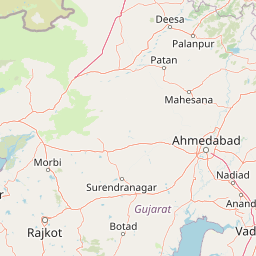
Use this park location map to pinpoint Thol Lake Wildlife Sanctuary in India, understand its exact geographic position, and read its mapped placement within the surrounding landscape more clearly.

Pigeon | © OpenStreetMap contributors

Location context for Thol Lake Wildlife Sanctuary

Gujarat

Explore photographic records of open waters, thorny scrub zones, and seasonal wetland terrain.

Thol Lake Photos and Scenery: Visualizing the Wetland Landscape and Wildlife Habitats

Visual records capture the distinctive terrain of open water habitats, marshy edges, and surrounding agricultural plains. Examining these natural environments reveals the physical characteristics of the protected area and its regional ecology.

A silhouetted tree branch hangs over a calm lake at sunset, with the sun low on the horizon casting a golden reflection on the water.

A large flock of flamingos wading in the shallow water of a lake with a sandy shoreline in the background.

A grove of trees growing in shallow water at Thol Lake, with thin dark trunks and green foliage visible in a misty or overcast atmosphere.

Park atlas

Compare adjacent wetland habitats and surrounding semi-arid conservation landscapes.

Explore Other Parks Near Thol Lake and Related Regional Protected Areas

Continue exploring regional protected areas and neighboring wetland sanctuaries after viewing Thol Lake. Comparing adjacent reserves helps reveal the broader ecological connectivity and diverse terrain of northern Gujarat.
Wildlife reserveGujarat
About 91 km away#1 closest

Southwest

Nal Sarovar Bird Sanctuary: Geographic Analysis of Gujarat's Largest Wetland Wildlife Reserve

Mapping the freshwater ecosystems and migratory corridors of western India

The landscape of Nal Sarovar Bird Sanctuary is shaped by an expansive shallow lake and surrounding marshland, creating a productive mosaic of freshwater habitats. As a designated Ramsar site, it serves as a critical focus for understanding regional bird migration and the interplay between human heritage and conservation in the alluvial plains of Gujarat.

Area
120.82 km²
Established
1969
Relief
Lowland
Climate
Subtropical
National parkBhavnagar District
About 160 km away#2 closest

South

Blackbuck National Park: Gujarat's Grassland Protected Landscape and Wildlife Atlas

Mapped semi-arid terrain and endangered species habitat.

Blackbuck National Park in Bhavnagar District, India, presents a unique focus on semi-arid grassland ecosystems and their protection. This national park showcases a flat, expansive landscape that borders coastal tidal zones, offering a distinct geographic context for its rich biodiversity. As a critical habitat for the blackbuck antelope and the endangered lesser florican, its protected area status is paramount. Exploring this park through its mapped boundaries and regional geography reveals its importance within India's network of conservation landscapes.

Area
34.08 km²
Established
1976
IUCN
II
Relief
Lowland
National parkMadhya Pradesh
About 249 km away#3 closest

Southeast

Dinosaur Fossils National Park: Protected Area and National Park in Madhya Pradesh

Explore mapped boundaries and regional geography.

Dinosaur Fossils National Park stands as a distinct national park within Madhya Pradesh, offering a unique focus for geographic exploration. This entry provides essential details about its protected status, mapped landscape features, and its place within India's network of conservation areas. Engage with structured data that details the park's regional context and natural terrain for comprehensive atlas-based understanding.

Area
0.894 km²
Established
2011
IUCN
II
Relief
Lowland
Wildlife reserveGujarat
About 266 km away#4 closest

West

Khijadiya Bird Sanctuary: Protected Wetland Landscapes and Coastal Geography in Gujarat, India

A Ramsar-recognized haven for migratory waterfowl and estuarine biodiversity

Khijadiya Bird Sanctuary protects a rare wetland environment on the edge of the Gulf of Kutch. The site is defined by a distinct bund that separates freshwater lake systems from saline tidal creeks and mangrove vegetation, resulting in a complex, high-value habitat for hundreds of migratory and resident bird species across the coastal plains.

Area
6.05 km²
Established
1982
IUCN
IV
Relief
Lowland
Wildlife reserveSindh
About 283 km away#5 closest

Northwest

Rann of Kutch Wildlife Sanctuary: Protected Desert Wetlands and Salt Flats of Sindh

Regional geography and wetland conservation boundaries

Located in the Badin District of Sindh, Rann of Kutch Wildlife Sanctuary spans a unique convergence of desert and wetland environments. The sanctuary serves as a major Ramsar site, preserving large-scale salt flats and seasonal marshlands that support threatened species including the great Indian bustard and migratory flamingo populations, while highlighting the complex ecological interface of the Indus delta region.

Area
5,663.75 km²
Established
1980
Relief
Lowland
Access
Access unknown
National parkNavsari District
About 305 km away#6 closest

South

Vansda National Park: Protected Deciduous Forest Landscape within the Western Ghats

Explore the mapped geography and biodiversity of this Navsari District national park.

Vansda National Park stands as a crucial protected area in Navsari District, Gujarat, preserving the characteristic dense deciduous forests and extensive bamboo groves of the Western Ghats. The park's geography is shaped by its location along the Ambika River, presenting a landscape of rolling hills and forested valleys within this significant biodiversity hotspot. Users can delve into its protected land status, mapped terrain, and the unique ecological attributes that make it a noteworthy national park for geographic and conservation exploration.

Area
23.99 km²
Established
1979
IUCN
II
Relief
Highland
National parkGujarat
About 312 km away#7 closest

Southwest

Gir National Park: Gujarat's Key National Park with Protected Landscape Identity

Understanding the geography and mapped boundaries of this Indian protected area

Gir National Park represents a crucial protected landscape within the Gujarat region of western India. This MoriAtlas entry focuses on its role as a national park, detailing its geographic setting and the mapped extent of its protected area. Users can delve into the specific landscape character and regional context that defines Gir National Park, making it a vital point for structured exploration of India's protected lands and natural geography.

Area
1,410.3 km²
Established
1965
IUCN
IV
Visitors
60.1K annual
National parkGujarat
About 325 km away#8 closest

West

Marine National Park, Gulf of Kutch: A Protected Coastal Landscape in Gujarat, India

Explore its mapped boundaries and regional geography.

Marine National Park, Gulf of Kutch is a designated national park located in the Gujarat region of India. This page serves as an atlas-centric resource for understanding the park's protected landscape, its position within the broader geography of Western India, and its mapped natural features. Discover the distinct protected-area characteristics and regional context that define this important Indian national park.

Area
162.89 km²
Established
1982
IUCN
II
Relief
Lowland

Common questions about visiting, size, designation, and location context for Thol Lake Wildlife Sanctuary

Thol Lake Wildlife Sanctuary FAQs for park facts, access, geography, and protected area context

Find quick answers about Thol Lake Wildlife Sanctuary, including protected-area facts, park geography, trail and visitor context, and how the park fits into its surrounding country and regional landscape.
MoriAtlas Explorer

Continue Your Protected Areas Search Across the Global Atlas

Deepen your exploration by continuing the structured search for national parks and protected areas worldwide. Utilize the comprehensive filtering capabilities to compare different conservation landscapes and refine your understanding of global park geography. Discover more about the distribution and characteristics of protected natural areas.

Global natural geography