Mori Atlas logo
National parkUdegeyskaya Legenda National Park

Discover the geographic boundaries and natural landscape context of this vital protected area.

Udegeyskaya Legenda National Park: A Protected National Park in Primorsky Krai

Udegeyskaya Legenda National Park stands as a significant national park within the Primorsky Krai region of Russia. This page offers a detailed atlas-style view of the park's protected boundaries and its place within the surrounding natural geography. Users can explore the mapped landscape context, understanding how this protected area contributes to the regional natural heritage and offers a unique perspective for geographic discovery.

National ParksRussian Far EastSikhote-Alin MountainsAmur Tiger HabitatConiferous-Deciduous ForestsUdege People
Illustration of a river flowing through a forested mountain valley with autumn-colored trees and rocky shoreline

Udegeyskaya Legenda National Park

National park

Park overview

Structured park overview, official facts, and landscape profile for Udegeyskaya Legenda National Park

Udegeyskaya Legenda National Park park facts, protected area profile, and essential visitor context
Review the core facts for Udegeyskaya Legenda National Park, including designation, size, terrain, visitor scale, habitats, and operating context in one park-focused overview.

About Udegeyskaya Legenda National Park

Udegeyskaya Legenda National Park occupies a strategically important position in the Sikhote-Alin mountain range of the Russian Far East. The park spans the western slope of the Central Sikhote-Alin, protecting some of the most ecologically diverse forests in Russia. This region represents a remarkable biological crossroads where the continental climate of Eurasian landmass meets the maritime influence of the Pacific Ocean, creating conditions that support an extraordinary diversity of plant and animal life. The park's river valleys, particularly those of the Armu River and Bolshaya Ussurka River, form the hydrological backbone of the protected area, creating habitats that support both aquatic wildlife and the larger mammals that depend on riparian corridors. The park serves a dual purpose of biodiversity conservation and cultural preservation, as it encompasses territory that has been the traditional homeland of the Udege people, an indigenous group whose hunting-fishing culture has shaped the relationship between humans and this landscape for generations.

Quick facts and research context for Udegeyskaya Legenda National Park

Udegeyskaya Legenda National Park spans 103,744 hectares in Krasnoarmeysky District of Primorsky Krai, Russian Far East, at coordinates 45.817°N 135.417°E. The park was established in 2007 and is managed as an IUCN Category II protected area. Elevations range from 180 meters in river lowlands to 1,330 meters at the mountain crest. The park protects river valleys feeding the Armu River and Bolshaya Ussurka River, which flow westward to the Ussuri River and ultimately the Amur River system. The climate is humid continental with warm summers (Dfb Köppen classification), featuring cold snowy winters and mild summers with average precipitation of about 800 mm annually.

Park context

Deeper park guide and search-rich context for Udegeyskaya Legenda National Park

Udegeyskaya Legenda National Park history, landscape, wildlife, and travel context
Explore Udegeyskaya Legenda National Park through its history, landscape character, ecosystems, wildlife, conservation priorities, cultural context, and seasonal travel timing in a structured park guide built for atlas discovery and search intent.

Why Udegeyskaya Legenda National Park stands out

Udegeyskaya Legenda is most notably known as a refuge for the endangered Amur tiger, one of the rarest big cats in the world, which inhabits the forests of the western Sikhote-Alin slope. The park protects some of the most biodiverse forests in Russia, where continental and maritime ecological zones converge, creating a unique mixing ground for temperate and subtropical species. The area is also celebrated for its abundant fishing and boating opportunities on the streams and rivers that traverse the protected valleys, as well as for its cultural significance as the ancestral homeland of the Udege people, an indigenous group with a traditional hunting-fishing culture now numbering under 1,500 individuals.
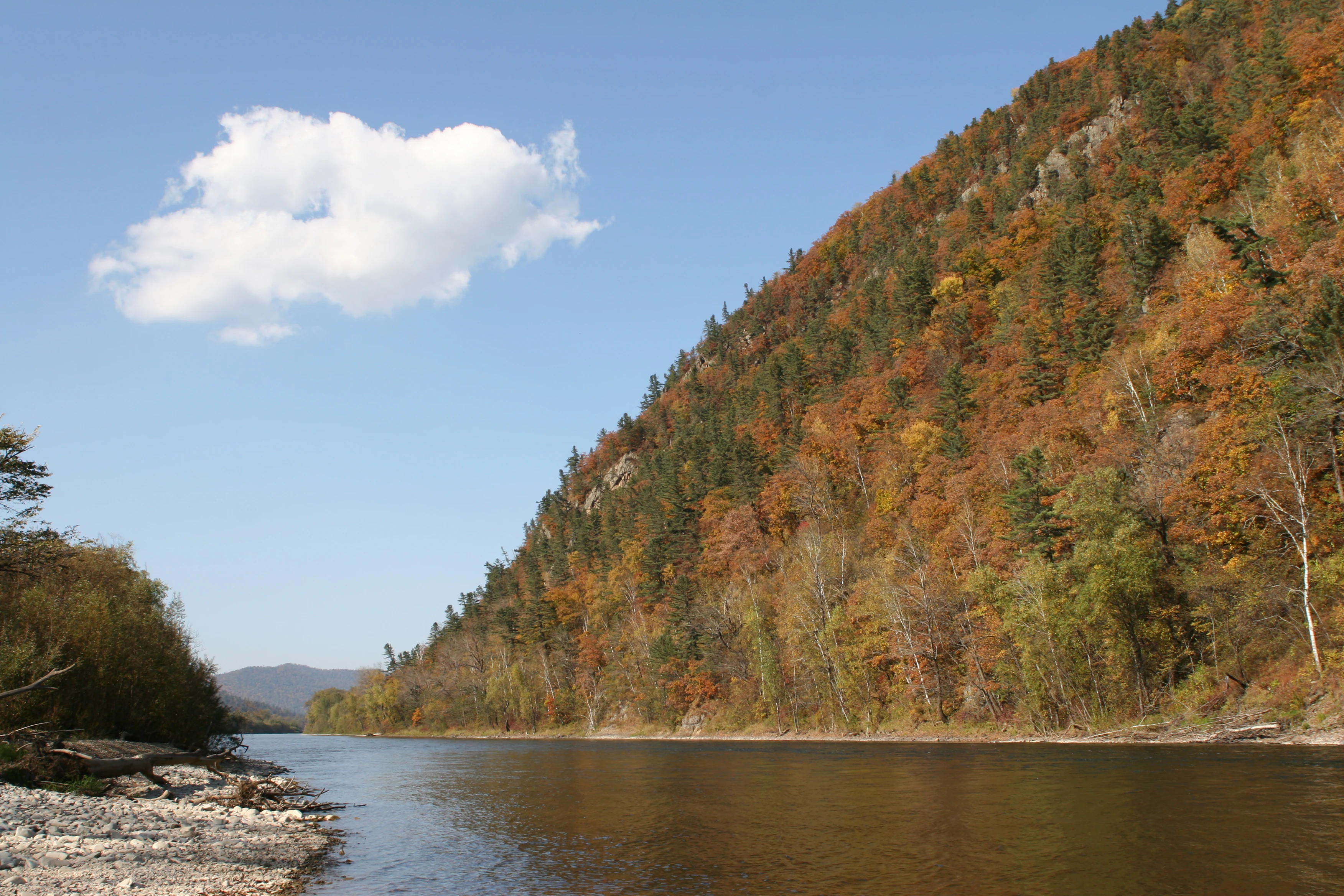
Calm river with rocky shoreline, surrounded by steep forested hills covered in orange and red autumn foliage under a clear blue sky with one cloud
Bolshaya Ussurka River flows through autumn-colored forested hills in Udegeyskaya Legenda National Park

Udegeyskaya Legenda National Park history and protected-area timeline

Udegeyskaya Legenda National Park was established in 2007 as part of Russia's expanding network of protected areas in the ecologically rich Primorsky Krai region. The creation of the park reflected growing recognition of the Sikhote-Alin region's global significance for biodiversity conservation, particularly for the endangered Amur tiger population. The park boundaries encompass the historic homeland of the Udege people, an indigenous group whose traditional territory spans this portion of the Sikhote-Alin mountains. A 2010 census recorded fewer than 1,500 Udege individuals remaining, making the community one of Russia's smallest indigenous peoples. The park was specifically designed to support both the conservation of natural ecosystems and the cultural continuation of the Udege way of life, incorporating zones that allow for sustainable traditional activities alongside strict wildlife protection areas.

Udegeyskaya Legenda National Park landscape and geographic character

The topography of Udegeyskaya Legenda is characterized by mountain valleys and steep forested slopes that descend from the central Sikhote-Alin crest toward the Amur River basin. Elevations within the park range from 180 meters in the river lowlands to 1,330 meters at the mountain crest, creating distinct altitudinal zones that support varied forest types. The river valleys are narrow and winding, following the geological fault lines of the Sikhote-Alin. The main valley of the Ussurka runs north-northeast along this fault system, passable to small boats in its lower regions where oxbow lakes and marshy banks create complex wetland habitats. Slope angles average 10 to 15 degrees but can reach 15 to 25 degrees on steeper terrain. In contrast to the meandering lowland rivers, the Armu River features rocky and steep banks with frequent rapids and waterfalls. Three small settlements exist within the park: Far Kut, Dersu, and Ostovnoe, representing the human presence within this largely wild landscape.

Udegeyskaya Legenda National Park ecosystems, habitats, and plant life

Udegeyskaya Legenda lies within the Ussuri broadleaf and mixed forests ecoregion, one of the most botanically diverse areas in Russia. The park is situated at a remarkable ecological crossroads, combining continental and maritime influences while marking the boundary between ancient stable base rocks to the west and more active tectonic formations to the east. This positioning, along with the area's location on major animal migration routes and its escape from both recent glaciation and extensive human development, has resulted in exceptionally high biodiversity. The park supports distinct altitudinal vegetation zones: deciduous forests of elm, ash, and Manchurian walnut in the lowlands, transitioning through cedar pine and spruce forests to spruce-fir forests with birch at higher elevations. Thirty species of vascular plants require protection within the park, including Japanese mountain yam, fox nut, Pacific saxifrage, ginseng, and yew. The freshwater ecosystems belong to the Lower Amur freshwater ecoregion, characterized by stream systems with strongly eroded river valleys and well-developed floodplains.

Udegeyskaya Legenda National Park wildlife and species highlights

The wildlife of Udegeyskaya Legenda is remarkable for its diversity and the presence of flagship species. The park provides critical habitat for the endangered Amur tiger, one of the world's rarest big cats, which roams the forests of the western Sikhote-Alin slope. Large mammals are well represented, with both brown bears and Asian black bears common throughout the forested terrain. The smaller forest mammals include sable, marten, badger, weasels, lynx, and leopard cat. River environments support minks and otters along the banks, while the lowland rivers and surrounding wetlands provide habitat for elk and moose. The region is exceptionally rich in insects, with over 10,000 species estimated to inhabit the territory, including a species of longhorn beetle believed to be the largest in Russia. This extraordinary insect diversity contributes to the park's status as one of the most biodiverse protected areas in the country.

Udegeyskaya Legenda National Park conservation status and protection priorities

Udegeyskaya Legenda plays a crucial role in the conservation network of the Russian Far East, serving as a connecting protected area between the Sikhote-Alin Nature Reserve to the east and the Amur River basin to the west. The park forms part of a larger constellation of protected areas that includes Zov Tigra National Park and Lazovsky Nature Reserve to the south and Anyuysky National Park to the north, creating corridors that allow wildlife movement across the Sikhote-Alin region. The protection of the Amur tiger population represents a particularly significant conservation priority, as this subspecies has been reduced to a tiny population living primarily in the Sikhote-Alin mountains. The park's design also addresses the conservation needs of the Udege people, incorporating support for their traditional land use practices alongside strict protection zones for sensitive ecosystems.

Udegeyskaya Legenda National Park cultural meaning and human context

Udegeyskaya Legenda encompasses the ancestral homeland of the Udege people, an indigenous group whose traditional culture centers on hunting and fishing. The Udege have inhabited the Sikhote-Alin region for generations, developing intimate knowledge of the forest ecosystems and maintaining cultural practices that are closely tied to the natural environment. A 2010 census recorded fewer than 1,500 Udege individuals, making this one of Russia's smallest indigenous communities. The park's establishment acknowledged both the ecological significance of the region and the cultural importance of preserving the Udege connection to their ancestral lands. Traditional elements such as the gabled yurt dwellings, as documented in early 20th-century photography, represent the cultural heritage that the park aims to protect alongside its natural values.

Top sights and standout views in Udegeyskaya Legenda National Park

Udegeyskaya Legenda National Park offers visitors access to some of the most pristine and biodiverse forests in the Russian Far East, with the opportunity to explore ancient yew groves, paddle rivers through scenic valleys, and witness habitats that support the endangered Amur tiger. The park's position on the western slope of the Sikhote-Alin makes it more accessible from the main transportation routes than many other protected areas in the region, while its ecological significance stems from the remarkable convergence of continental and maritime influences that create Russia's most biodiverse landscape. The park's geological museum, ecological trails including the path to Kovalevskaya yew grove, and guided tour options provide interpretive opportunities for understanding both the natural and cultural dimensions of this unique protected area.

Best time to visit Udegeyskaya Legenda National Park

The park experiences a humid continental climate with warm summers and cold, snowy winters, offering distinct seasons that each provide different visit conditions. Summer months bring mild temperatures ideal for river-based activities such as fishing and boating on the streams and rivers that the park is known for. Autumn in the region is celebrated as a clear, warm, dry season with gradually declining temperatures, a period locals call the golden Far East Autumn, when the forest colors create particularly striking scenery. Winter brings heavy snowfall and cold conditions suitable for snowmobile-based exploration, which the park offers as an activity option. The best overall conditions for hiking and wildlife observation typically occur in the shoulder seasons of late spring through early summer or during the favored autumn period.

Park location guide

Geography guide, regional context, and park location map for Udegeyskaya Legenda National Park

Udegeyskaya Legenda National Park park geography, regions, and map view in Russia
Understand where Udegeyskaya Legenda National Park sits in Russia through a broader geographic reading of the surrounding landscape, nearby location context, and its mapped position within the national park landscape.

How Udegeyskaya Legenda National Park fits into Russia

Russia is a transcontinental nation spanning eleven time zones, bordered by fourteen countries. It is the world's largest country by area, covering 17,098,246 km². Moscow is the capital and largest city, while Saint Petersburg is the second-largest and a major cultural centre.

Wider geography shaping Udegeyskaya Legenda National Park in Russia

Russia spans Eastern Europe and North Asia, covering 17,098,246 km². It shares land borders with fourteen countries, more than any other nation, and spans eleven time zones. The landscape includes vast plains, mountain ranges such as the Urals and Caucasus, and extensive coastlines along the Arctic Ocean, Pacific Ocean, Baltic Sea, Black Sea, and Caspian Sea.

Map view of Udegeyskaya Legenda National Park

Use this park location map to pinpoint Udegeyskaya Legenda National Park in Russia, understand its exact geographic position, and read its mapped placement within the surrounding landscape more clearly.

Pigeon | © OpenStreetMap contributors

Location context for Udegeyskaya Legenda National Park

Primorsky Krai

Explore the Diverse Habitats, Rugged Terrain, and Pristine Forests of this Russian Far East Protected Area

Udegeyskaya Legenda National Park Photos: Visual Guide to Landscapes and Protected Area Scenery
Explore detailed imagery of Udegeyskaya Legenda National Park to understand its characteristic landscapes, from the extensive coniferous-deciduous forests to the winding mountain river valleys. The photographs provide valuable visual context for the park's unique topography, its critical Amur tiger habitats, and the broader ecological significance of the Sikhote-Alin region.

Calm river with rocky shoreline, surrounded by steep forested hills covered in orange and red autumn foliage under a clear blue sky with one cloud

Park atlas

Compare protected areas, exploring the regional landscape context of Udegeyskaya Legenda National Park and the broader Sikhote-Alin mountain range.

Explore Nearby National Parks and Protected Areas Beyond Udegeyskaya Legenda National Park
Explore nearby national parks and other protected areas contextually related to Udegeyskaya Legenda National Park, focusing on the Sikhote-Alin mountain landscapes. Use this geographic overview to trace interconnected conservation efforts, identify shared ecological zones, and understand the regional distribution of protected territories.
National parkPrimorsky Krai

Bikin National Park: A Vast Protected Landscape in Primorsky Krai's Sikhote-Alin Mountains

Explore Russia's largest old-growth forest and Amur tiger stronghold.

Bikin National Park is a monumental protected area safeguarding the largest remaining tract of old-growth temperate rainforest in the Northern Hemisphere. Situated within Primorsky Krai, it serves as a vital refuge for an estimated 10% of the world's wild Amur tigers, making its mapped boundaries essential for conservation. Recognized as a World Heritage Site, the park's extensive forests and complex terrain offer a unique glimpse into one of Asia's last great wilderness areas, supporting unparalleled biodiversity and crucial ecological processes.

Area
11,600 km²
Established
2015
IUCN
II
Relief
Mountain
National parkPrimorsky Krai

Zov Tigra National Park: National Park Protected Area and Mapped Landscape

Explore the protected lands and regional geography of Primorsky Krai.

Zov Tigra National Park represents a vital protected area within Russia's Primorsky Krai region. This detailed atlas entry provides specific insights into its mapped boundaries, geographic setting, and status as a national park. Understand the park's landscape context and its role within the broader regional geography, facilitating structured discovery for geographers and park explorers alike.

Area
834 km²
Established
2007
IUCN
II
Relief
Mountain
Watercolor painting of a river flowing through green hills with pink flowering trees and distant mountains under a light sky
National parkKhabarovsk Krai

Anyuysky National Park: Mapped Protected Landscape and Geographic Setting in Khabarovsk Krai

Explore its unique terrain and ecological corridor status.

Delve into Anyuysky National Park, a crucial protected area in Khabarovsk Krai known for its role as an ecological corridor linking the Amur River floodplain to the Sikhote-Alin mountains. This page provides detailed insight into the park's mapped landscape, from its western alluvial plains to its eastern mountain canyons, highlighting its distinct geographic features and the diverse habitats it safeguards. Understand its significance as a protected zone and its place within the regional geography for atlas-based discovery.

Area
4,294 km²
Established
1999
IUCN
II
Relief
Mixed relief
Watercolor illustration of rolling green hills, scattered trees, and distant mountains under a pale sky.
National parkPrimorsky Krai

Land of the Leopard National Park: Protected Area Map and Geographic Context in Primorsky Krai

Atlas exploration of Russia's critical Amur leopard habitat.

Investigate Land of the Leopard National Park, a nationally significant protected area situated in Primorsky Krai, Russia. This park is celebrated as the exclusive remaining sanctuary for the critically endangered Amur leopard, making it a focal point for global conservation efforts. Its varied landscape, characterized by forested slopes and mountainous terrain, serves as essential habitat not only for leopards but also for Siberian tigers. The park provides a rich geographic setting for understanding protected land distribution and regional ecosystems within the Russian Far East.

Area
2,799 km²
Established
2012
IUCN
II
Relief
Mixed relief
National parkKhabarovsk Krai

Shantar Islands National Park: Remote Archipelago Atlas with Rugged Terrain

Mapping protected marine and island geography in Khabarovsk Krai.

Shantar Islands National Park represents a significant protected landscape within Khabarovsk Krai, notable for its dramatic coastal geography, mountainous terrain, and rich marine ecosystems. This national park, encompassing a chain of islands in the Sea of Okhotsk, is a vital habitat for marine mammals and seabird colonies. Explore its mapped boundaries and unique regional atlas context, understanding its role as a protected coastal area in the Russian Far East.

Area
5,155 km²
Established
2013
IUCN
II
Relief
Mountain
National parkAmur Oblast

Tokinsko-Stanovoy National Park: Protected Landscape Geography and Atlas Context

National Park in Amur Oblast, Russia

Delve into the specifics of Tokinsko-Stanovoy National Park, a designated national park within Amur Oblast. This entry provides essential context on its protected landscape characteristics and its place in the regional geography. Understand the park's mapped boundaries and discover its natural terrain as part of a larger atlas-driven exploration of protected areas in the Russian Far East.

Area
2,430 km²
Established
2019
IUCN
II
National parkZabaykalsky Krai

Kodar National Park: Protected National Park with Zabaykalsky Krai Geographic Context

Atlas exploration of mapped boundaries and regional landscape.

Delve into the protected landscape of Kodar National Park, a significant national park located in Zabaykalsky Krai, Russia. This resource provides detailed insights into its geographic setting, offering users a clear view of its mapped boundaries and its position within the regional atlas. Understand the protected-area nature of Kodar National Park and its contribution to the mapped natural landscapes of its geographical vicinity.

Area
4,917 km²
Established
2016
IUCN
II
Relief
Mountain
Watercolor illustration depicting layered mountains, green hills, and forested areas with purple and pink tones
National parkZabaykalsky Krai

Alkhanay National Park

Sacred Mountain & Forest Steppe

Alkhanay National Park in Russia protects a landscape where Siberian taiga meets Mongolian steppe. Explore its sacred Mount Alkhanai, diverse terrain, and protected natural features within a unique geographic setting.

Area
1,382 km²
Established
1999
IUCN
II

Common questions about visiting, size, designation, and location context for Udegeyskaya Legenda National Park

Udegeyskaya Legenda National Park FAQs for park facts, access, geography, and protected area context
Find quick answers about Udegeyskaya Legenda National Park, including protected-area facts, park geography, trail and visitor context, and how the park fits into its surrounding country and regional landscape.
MoriAtlas Explorer

Continue Your Protected Areas Search Across the Global Atlas

Deepen your exploration by continuing the structured search for national parks and protected areas worldwide. Utilize the comprehensive filtering capabilities to compare different conservation landscapes and refine your understanding of global park geography. Discover more about the distribution and characteristics of protected natural areas.

Global natural geography