
Why Waipoua Forest stands out
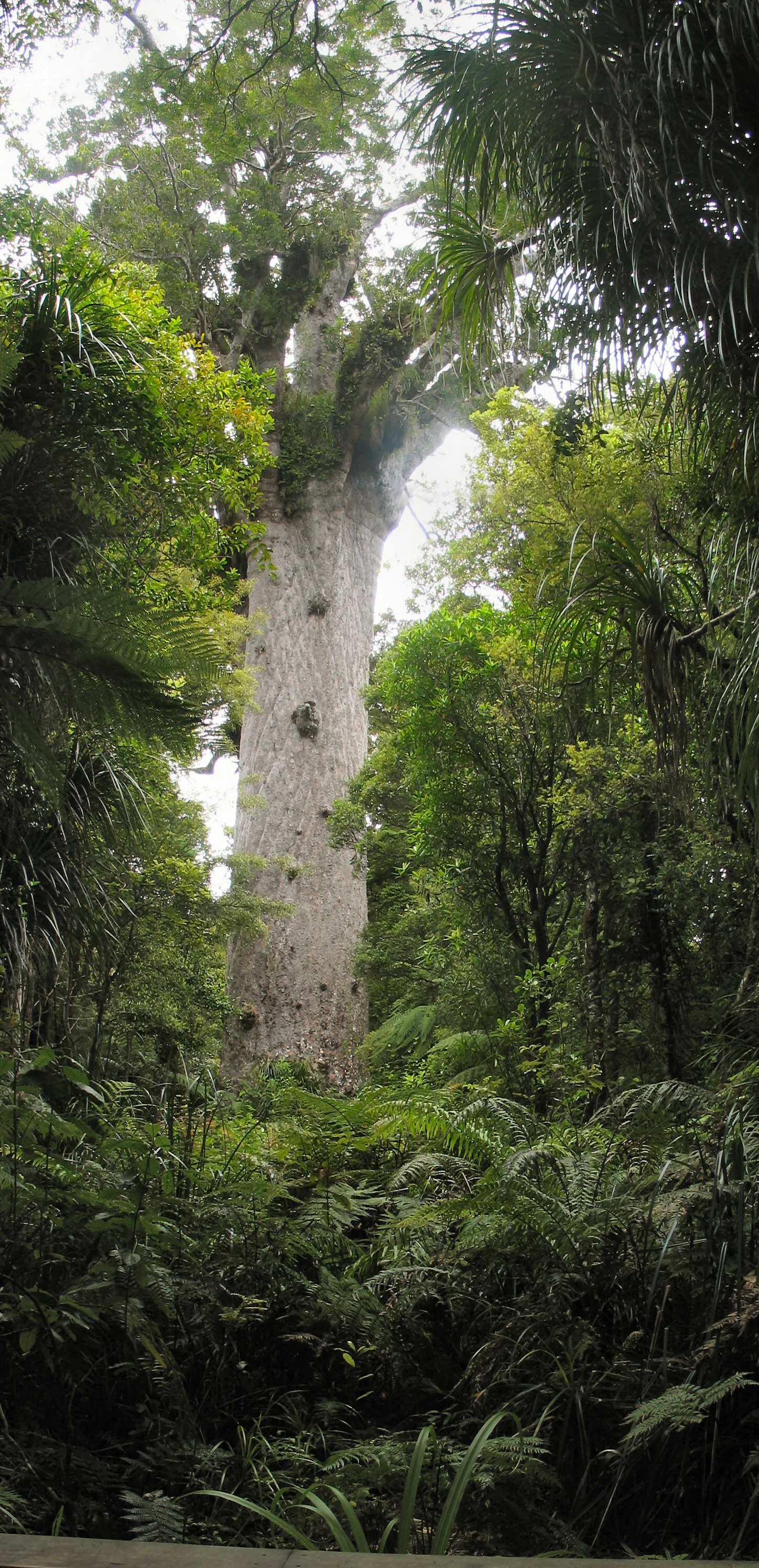
Waipoua Forest is best known as the guardian of New Zealand's most iconic ancient kauri trees. Tāne Mahuta, often called the Lord of the Forest, is the largest living kauri in the country, while Te Matua Ngahere is the oldest and stoutest, with an estimated age of two to three thousand years. Together these trees have become symbols of New Zealand's natural heritage and draw large numbers of visitors into what is otherwise a dense, atmospheric rainforest. Beyond its giants, the forest is recognised as the single most important stronghold for mature kauri in the country. It is also notable for its unusually large population of North Island brown kiwi and for its protected status, which has shielded a slice of West Coast Northland rainforest from the clearing and burning that destroyed much of the surrounding kauri landscape in the nineteenth and twentieth centuries.
Waipoua Forest history and protected-area timeline
The land that is now Waipoua Forest was purchased from Māori in 1876, when Tiopira Kinaka of Te Roroa and Parore Te Awha of Te Kuihi sold the Waipoua Block No. 1 for just over two thousand pounds. At that time the block covered roughly eighty square kilometres of mostly untouched kauri forest. In 1885 the area was brought under the State Forests Act, and about ninety square kilometres were constituted as a State Forest Reserve, but the difficult terrain and abundant rainfall kept the forest largely out of reach of early loggers.
By 1907 Waipoua, together with Warawara and a handful of smaller reserves, represented almost the only virgin kauri forest left in public ownership. A Royal Commission on Forestry recommended in 1913 that specially selected areas of Waipoua and all of Warawara be set aside as national kauri forests. Logging nevertheless continued, and in the 1940s it became clear that the State Forest Service was again cutting kauri within Waipoua itself.
A powerful public campaign followed. Led by the Whangarei Progressive Society, the Royal Forest and Bird Protection Society, the Waipoua Preservation Society, and the zoologist William Roy McGregor, the campaign gathered more than forty-three thousand signatures presented to Parliament in a wheelbarrow in 1947. Further petitions resulted in the proclamation of over eighty square kilometres of forest as a sanctuary on 2 July 1952. A road through the forest was opened by Prime Minister Gordon Coates in 1928, but the sanctuary decision effectively ended milling within the reserve.
In the late 1960s, against the spirit of the 1913 recommendations, the National Government allowed clear felling in the adjacent Warawara forest, a practice halted only in 1972 after public outcry from an incoming Labour administration. In 2007 a fire sparked by mussels being cooked on a nearby beach burned more than two square kilometres near the iconic Tāne Mahuta and threatened the forest's core. The Waipoua Forest Trust was established in 1999 as a partnership between the Native Forests Restoration Trust and Te Roroa to coordinate conservation, restoration, and land protection in and around the sanctuary, including the southern McGregor Reserve and the Millennium Kauri Forest created in 2000.
Waipoua Forest landscape and geographic character
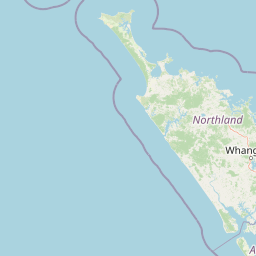
Waipoua Forest occupies hilly country on the wet, western flank of New Zealand's North Island, between the Hokianga and the Kaipara. Its terrain is gently to moderately steep, deeply dissected by streams that drain into the Waima and Waipoua catchments and ultimately toward the Tasman Sea. The result is a landscape of ridgelines, sheltered valleys, and a generally broken topography, all cloaked in continuous forest cover.
The climate underpinning this landscape is mild and extremely wet. Long-term rainfall at the Waipoua Visitor Centre exceeds fourteen hundred millimetres a year, with the winter months of June and July bringing the heaviest falls. Temperatures are temperate year round, with mean daily maxima ranging from around fifteen degrees Celsius in winter to the mid twenties in summer, and only occasional light frosts in the coldest months. This combination of consistent moisture, mild conditions, and sheltered topography produces the dense, multi-layered evergreen rainforest for which Waipoua is famous.
Above the ridgelines the high plateau country of the wider forest area provides an interior zone of cooler and more exposed terrain, home to some of the rarer wildlife in the catchment. Patchy wetlands occur along drainages and margins, especially where modified land has been restored, while logged and replanted areas along the boundaries contrast with the relatively intact interior of the sanctuary.
Waipoua Forest ecosystems, habitats, and plant life
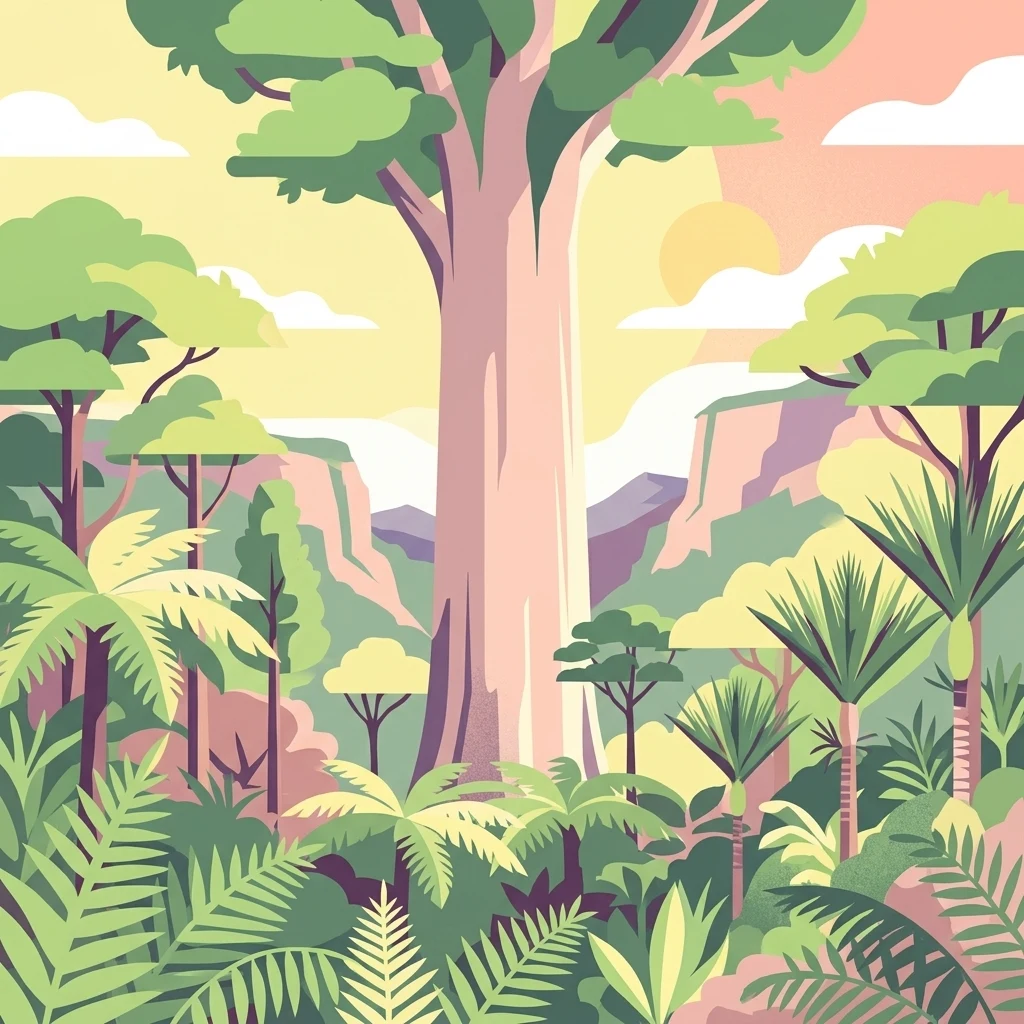
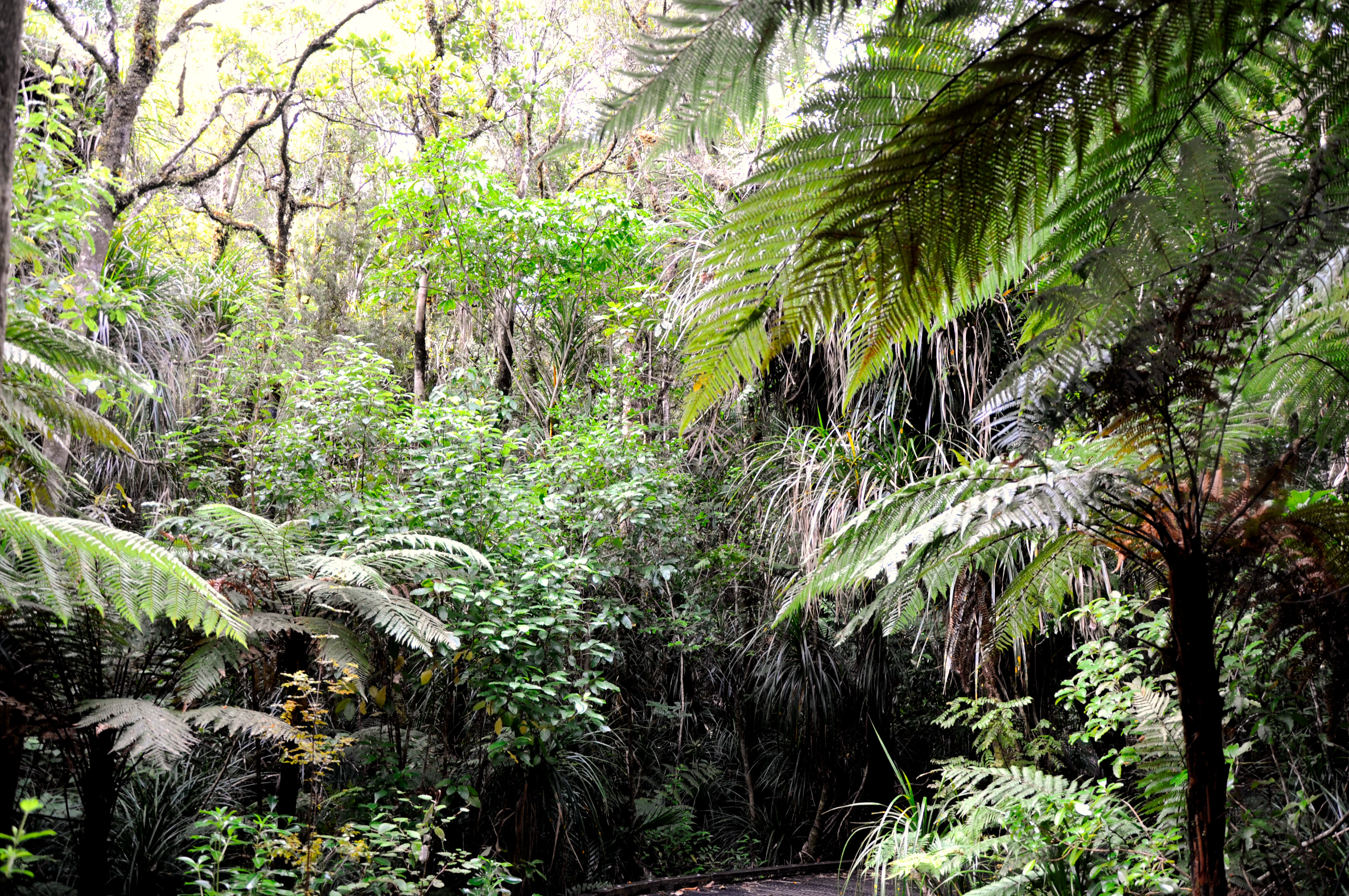
The dominant ecosystem of Waipoua Forest is mature kauri rainforest, a distinctive formation in which emergent kauri tower above a rich canopy and understory of broadleaf trees, tree ferns, palms, and ground ferns. The kauri itself, Agathis australis, is a long-lived conifer endemic to the upper North Island, and Waipoua contains the largest single concentration of mature individuals of this species left in the country. Together with the neighbouring Warawara and Puketi forests it represents roughly three quarters of New Zealand's remaining old-growth kauri.
Beneath the kauri canopy the forest is a layered, almost tropical-looking community. Rimu, rata, taraire, and other broadleaf species mingle with tree ferns and the nikau palm, New Zealand's only native palm. The forest floor is largely shaded and moist, supporting a dense cover of ferns and mosses, while epiphytes drape from branches in damper pockets. Wetland and stream-fringe vegetation adds further diversity at lower elevations and along restoration margins.
The surrounding landscape context shapes the forest's ecology. Because of Waipoua's remoteness and reliable rainfall, it escaped the nineteenth century fires that swept through kauri forest elsewhere in Northland, leaving a comparatively intact example of what was once a far more extensive forest type. Restoration work by the Waipoua Forest Trust and partners is gradually extending this habitat by replanting former farmland and logged margins, helping knit the sanctuary together with adjoining protected areas.
Waipoua Forest wildlife and species highlights
Waipoua Forest is particularly important for its population of North Island brown kiwi, which is recognised as the largest in the Northland region. The forest's dense understory, moist conditions, and relative freedom from heavy predation pressure have helped sustain this population, although occasional events such as the 2007 fire have shown how vulnerable the birds can be when disaster strikes. The trust has also explored establishing a kiwi hatchery as part of efforts to bolster the local population.
Other birdlife is present in the upper forest zones as well, including the endangered North Island kōkako, which inhabits the more remote high plateau country within and around the reserve. Introduced mammals, especially rats and brushtail possums, are an ongoing concern, and the Waipoua Forest Trust runs volunteer programmes to monitor and control these pests. Invertebrate life in the leaf litter, in rotting kauri logs, and on the textured bark of mature trees contributes to a forest ecosystem that is unusually intact for a lowland North Island setting.
Waipoua Forest conservation status and protection priorities
Waipoua Forest's conservation significance is unusually high. The forest safeguards the largest remaining stand of mature kauri trees anywhere in New Zealand, a habitat type that has shrunk dramatically since European settlement due to logging, fire, and land conversion. Although the sanctuary is smaller than the 1913 Royal Commission had recommended, its proclamation in 1952 effectively ended kauri milling within its core and remains one of the landmark outcomes of New Zealand's twentieth-century conservation movement.
Modern management is shared between the Department of Conservation, Te Roroa as mana whenua, and the community-based Waipoua Forest Trust, founded in 1999. The trust has invested heavily in land protection along the southern boundary, most notably through the Millennium Kauri Forest launched in 2000, and operates the adjoining Professor W. R. McGregor Reserve together with the Native Forests Restoration Trust. Volunteers are active in pest control, revegetation, replanting of former farmland, and seed collection.
The forest's biggest current threat is kauri dieback, a disease caused by the fungus-like organism Phytophthora taxon Agathis, which is spread through soil and is difficult to control at sites receiving heavy visitor pressure. Around two hundred thousand people a year visit Tāne Mahuta alone, and managing that foot traffic without further spreading the disease is a central concern of park managers. Fire is another recurrent risk, illustrated by the 2007 blaze that destroyed ecologically significant wetland vegetation and came within three kilometres of Tāne Mahuta.
Waipoua Forest cultural meaning and human context
Waipoua Forest holds deep significance for Te Roroa, the iwi whose ancestral home includes the Waipoua catchment. The land was originally purchased from Te Roroa ancestors in the nineteenth century, and Te Roroa have continued to act as kaitiaki, with representation on the Waipoua Forest Trust alongside conservation partners. The Māori names of the forest's most famous trees carry spiritual weight: Tāne Mahuta is revered as the Lord of the Forest, a reference to the atua Tāne, and Te Matua Ngahere, meaning Father of the Forest, is similarly honoured.
The broader Northland kauri landscape has long been central to Māori identity, with kauri timber historically used for waka and carving, and kauri gum shaping the regional economy. The forest today plays an important role in continuing that relationship between local communities and the land, and educational and visitor programmes frequently work with Te Roroa to interpret the forest's cultural layers alongside its ecological ones. International partnerships, such as the Family of Ancient Trees project linking Waipoua with Yakushima in Japan, have also brought a wider cultural dimension to the forest's conservation story.
Top sights and standout views in Waipoua Forest
Waipoua Forest contains two of the most celebrated trees in the Southern Hemisphere: Tāne Mahuta, the largest living kauri by volume, and Te Matua Ngahere, the largest by girth and an estimated two to three thousand years old. The forest forms part of the largest surviving cluster of mature kauri in New Zealand, alongside Warawara and Puketi, and offers one of the most intact kauri rainforest experiences in the country.
Beyond its giants, Waipoua is notable for the scale of its kiwi population, the cultural significance of the forest to Te Roroa, and the success of the community-led Waipoua Forest Trust in extending protection along its boundaries. Combined with its position on the wild, wet west coast of Northland, it delivers a rainforest experience that contrasts strongly with the more open landscapes elsewhere in the region.
Best time to visit Waipoua Forest
Waipoua Forest can be visited year round, but weather strongly shapes the experience. Summer and early autumn tend to bring drier tracks and warmer temperatures, making walking to Tāne Mahuta and Te Matua Ngahere more comfortable, while winter brings heavier rain, cooler temperatures, and a more atmospheric, misty forest interior. The very high annual rainfall of around fourteen hundred millimetres means wet conditions are possible at any time of year.
Wildlife viewing, particularly of kiwi, is generally easier at night and in quieter seasons when visitor pressure is lower. Visitors should expect to manage around seasonal access and current track conditions rather than peak wildlife seasons.