
Mori Atlas logo
Protected landscapeWdecki Park Krajobrazowy

A diverse geographic expanse within Kuyavian-Pomeranian Voivodeship featuring glacial terrain and wetland ecosystems.

Wdecki Park Krajobrazowy: Mapping the Protected Forest and Riverine Landscapes of Poland

Located in the heart of the Bory Tucholskie forest complex, Wdecki Park Krajobrazowy serves as a vital protected landscape in northern Poland. This region is shaped by the drainage basin of the Wda River, creating a complex mosaic of sandy outwash plains, post-glacial lakes, peatlands, and floodplains. The park maintains a distinct ecological character through its dense pine-dominated forests and specialized wetland habitats that host rare botanical species and diverse birdlife.

Polish landscape parkBory Tucholskiepine forestspost-glacial lakesriver valleyWda river
A digital illustration of a park landscape featuring a calm river in the foreground with water lilies and cattails, leading to a rocky cliffside with a waterfall, surrounded by dense evergreen trees under a soft, pastel-colored sky.

Wdecki Park Krajobrazowy

Protected landscape

Park overview

Structured park overview, official facts, and landscape profile for Wdecki Landscape Park

Wdecki Landscape Park park facts, protected area profile, and essential visitor context

Review the core facts for Wdecki Landscape Park, including designation, size, terrain, visitor scale, habitats, and operating context in one park-focused overview.

About Wdecki Landscape Park

Wdecki Landscape Park is a sizeable protected landscape area in northern Poland, positioned within the central-eastern reaches of the Bory Tucholskie, one of the largest forest complexes in the country. The park stretches across parts of two counties in Kuyavian-Pomeranian Voivodeship and seven communes, with the majority of its territory and of its protective buffer falling within the commune of Osie, where the park's administrative headquarters is located.

The park's identity is closely tied to the Wda river and its tributaries, the Prusina, Ryszka, and Sobińska Struga. The Wda, the park's central watercourse, was dammed at Żur in 1930, creating a 440-hectare reservoir that flooded the lower reaches of its tributaries and merged them with natural depressions now occupied by Lake Wierzchy and Lake Mukrza. This engineering project transformed the local landscape, producing numerous small islands, the most famous of which is the island known as Madera, and turning the site into a popular area for water-based recreation.

Ecologically, Wdecki Landscape Park reflects the broader character of Bory Tucholskie: vast pine forests developed on sandy outwash plains, interspersed with lakes, peatlands, and river valleys. Forests dominate roughly seventy percent of its area. Although once of a more primeval mixed-forest character, the woodland has been shaped by human activity into the typical pine-dominated forest of the region. In river valleys, on steep slopes, and in spring-fed depressions, fragments of deciduous forest and exceptional spring mires have been preserved, providing habitat for relict species that recall the cold conditions of past glacial periods.

The park's conservation framework is reinforced by five strict nature reserves protecting particularly valuable ecosystems: Brzęki named after Zygmunt Czubiński, Dury, Lake Ciche, Miedzno, and Lake Piaseczno. These reserves safeguard raised bogs, lakes, marshlands, and old coniferous stands. Several natural-landscape complexes protect river valleys within the park, including the valleys of the Prusina, Ryszka, and Sobińska Struga rivers. Together, these designations establish Wdecki Landscape Park as an ecological stronghold in the broader Bory Tucholskie region.

Quick facts and research context for Wdecki Landscape Park

Wdecki Landscape Park lies entirely within Kuyavian-Pomeranian Voivodeship in northern Poland, covering about 19,177 hectares with an additional protective buffer of roughly 4,609 hectares around it.

Established on 16 February 1993 through a regulation of the Bydgoszcz Voivode, it is one of the younger Polish landscape parks. The park falls within the mesoregions of Bory Tucholskie and Wysoczyzna Świecka, in the drainage basin of the Wda river and its tributaries.

Approximately seventy percent of the park is forested, dominated by fresh pine and birch communities, while the remainder consists of lakes, peatlands, river valleys, and post-glacial terrain. Five strict nature reserves are located within its boundaries, and the park administration is based in Osie.

Protection and recognition

Examine the terrestrial protection scope and documented conservation status for Wdecki Park Krajobrazowy.

Wdecki Park Krajobrazowy Protection Status and Recognition Data

Terrestrial protection records for Wdecki Park Krajobrazowy outline the documented conservation scope and regulatory framework governing the terrain. Official designation parameters provide clear reference data for evaluating management context and international recognition details.

Protection details

Protection scope
Terrestrial
Transboundary protection
No
Buffer area
46.09 km²
Park context

Deeper park guide and search-rich context for Wdecki Landscape Park

Wdecki Landscape Park history, landscape, wildlife, and travel context

Explore Wdecki Landscape Park through its history, landscape character, ecosystems, wildlife, conservation priorities, cultural context, and seasonal travel timing in a structured park guide built for atlas discovery and search intent.

Why Wdecki Landscape Park stands out

Wdecki Landscape Park is best known for its extensive pine-dominated forests, its chain of post-glacial lakes along the Wda river, and its rich birdlife associated with wetland and lakeside habitats. A defining feature of the park is the Żur Reservoir, created in 1930 by damming the Wda, which formed numerous islands including the well-known island called Madera. The park also stands out for harboring a remarkable cluster of rare plant species. Among its most notable botanical highlights is one of the largest concentrations of wild service tree (jarząb brekinia) in Central Europe, nested within an oak grove surrounded by pine forest. It is also recognized for accommodating relict plant species typically associated with cold northern or mountainous environments, including three species of sundew, and rare orchids, lichens, and wetland plants. On the conservation side, the park includes multiple strict nature reserves and natural-landscape complexes that protect peatlands, lakes, river valleys, and old-growth stands of yew and other native trees, contributing to its standing as a key biodiversity area within Bory Tucholskie.
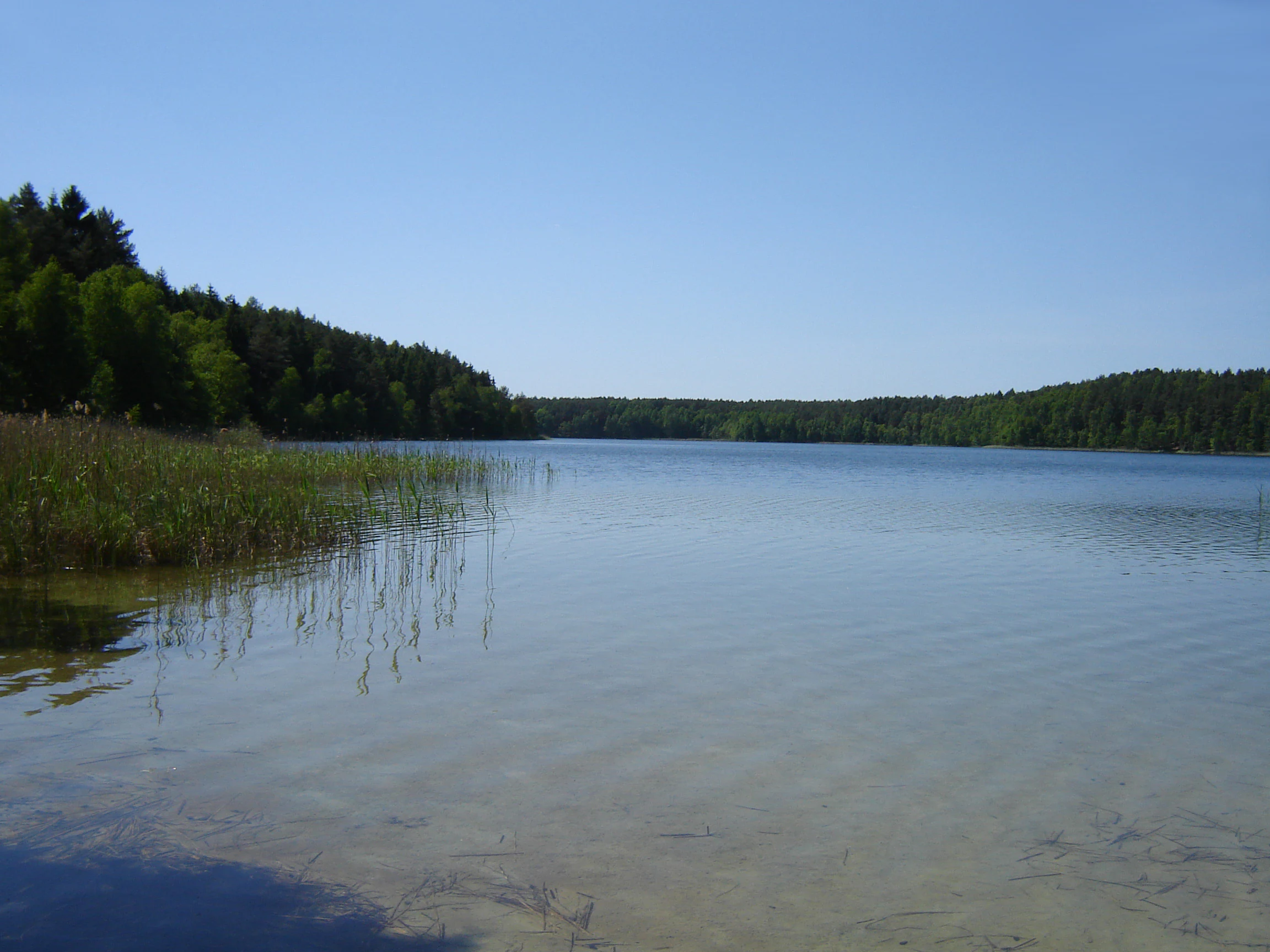
A wide view of a calm lake surrounded by dense pine forests under a clear blue sky, with reeds visible along the shoreline.
Piaseczno Lake within the Tuchola Forest region of Wdecki Landscape Park.

Wdecki Landscape Park history and protected-area timeline

The history of the present-day landscape of Wdecki Park is closely tied to the construction of a hydroelectric power station at Żur in 1930. The damming of the Wda river led to the creation of the Żur Reservoir, covering about 440 hectares, and resulted in elevated water levels across the river's lower tributaries. This flooding merged the Wda with natural depressions, forming Lake Wierzchy and Lake Mukrza, and producing the small islands that today contribute much of the area's scenic character. The best-known of these is the island called Madera.

These hydrological changes reshaped the local ecosystem, opening new habitats for plants and animals and giving the area enhanced value for water-based recreation. Despite this long-preceding transformation, the area did not receive formal landscape protection until the late twentieth century.

Wdecki Park Krajobrazowy was established on 16 February 1993 through Regulation No. 52/93 of the Bydgoszcz Voivode. It was the recognition of a landscape that, while shaped by earlier human intervention, retained strong ecological and scenic qualities. The park's later governance framework was further defined by Regulation No. 29/2004 of the Kuyavian-Pomeranian Voivode, addressing the park's organizational and protective arrangements in more detail.

Wdecki Landscape Park landscape and geographic character

The landscape of Wdecki Park is shaped by the post-glacial geography of the Bory Tucholskie and the wider South Pomeranian Lakeland. Sandy outwash plains and rolling moraine terrain form the base of the region, while the Wda river and its tributaries create a network of valleys and water features that give the park its distinctive scenic character. The drainage area of the Wda, including the Prusina, Ryszka, and Sobińska Struga rivers, defines much of the park's hydrological framework.

One of the most striking landscape features is the Żur Reservoir. Formed by damming the Wda at Żur, the reservoir spans about 440 hectares and incorporates the natural lakes Wierzchy and Mukrza. Its irregular shoreline, combined with flooded tributary valleys, has produced numerous small islands, including the well-known Madera, which lend the reservoir an unusual, picturesque appearance for an inland water body in this region.

Beyond the river valleys and reservoirs, the park's landscape includes a mosaic of lakes, peatlands, and forest cover. Raised bogs and spring-fed mires occupy low-lying sections, while steep river slopes along the Wda and its tributaries offer viewpoints and varied terrain. Notable relief features include the area around Leosia, where a tall brick-and-concrete railway bridge rises above the Wda valley and offers scenic views. Among the park's protected inanimate natural monuments are the large erratic boulders known locally as the Stone of Saint Adalbert near Leosia and another large erratic near Tleń, both reminders of the glacial origins of the surrounding terrain.
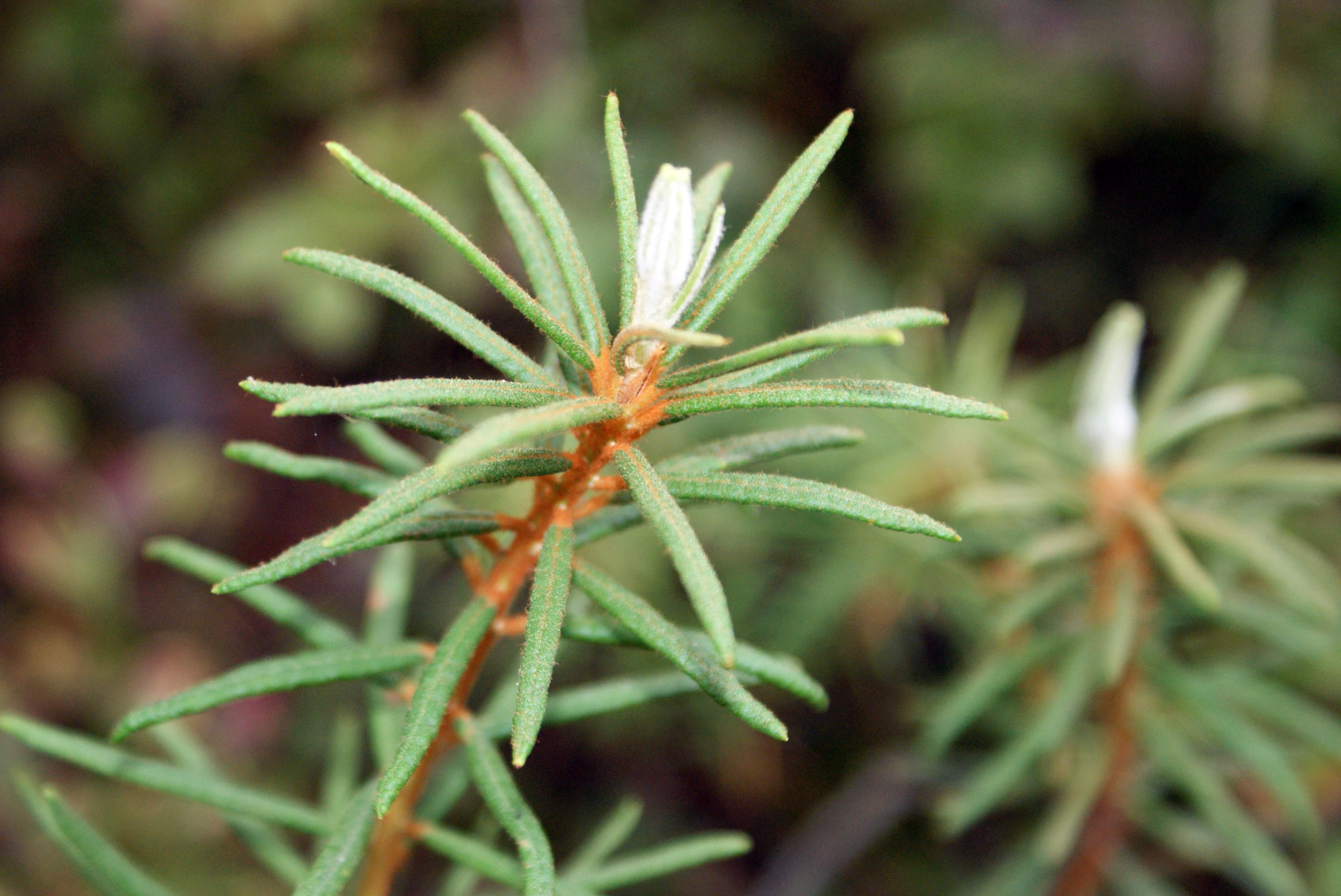
A close-up photograph of the needle-like leaves and budding white flowers of the Ledum palustre plant.
Wild rosemary, Ledum palustre, found in the wetlands of Wdecki Landscape Park.

Wdecki Landscape Park ecosystems, habitats, and plant life

The natural character of Wdecki Park is defined by the ecological patterns of Bory Tucholskie, a vast region of pine-dominated forests growing on sandy, often nutrient-poor glacial outwash soils. Forests cover about seventy percent of the park, with fresh pine forests strongly dominated by Scots pine and silver birch forming the typical woodland type. Within these extensive pine forests, a notable oak grove shelters one of the largest concentrations of wild service tree in Central Europe, while subcontinental dry pine lichen forests and boggy pine forests occupy specific niches across the terrain.

Although much of the original primeval character of the woodland has been altered by past human use, ecologically valuable fragments remain. Deciduous and mixed forests survive in river valleys, on steep slopes, and in spring-influenced depressions, where groundwater conditions differ from the surrounding sandy plains. Particularly rare are the spring-fed peatlands that develop in these topographically sheltered positions, harboring communities more typical of cold conditions or montane habitats.

The park's flora is unusually rich for a lowland Polish landscape. Among its botanical highlights are relict species from the late glacial period, including bog bilberry, marsh Labrador tea, and bearberry. Protected woodland species, such as mezereon (wawrzynek wilczełyko) and yellow Turk's-cap lily (lilia złotogłów), contribute to the understory. Several species listed in the Polish Red Book of Plants can be found here, including three species of sundew (long-leaved, round-leaved, and intermediate), spotted orchid, sedge, common columbine, and juniper clubmoss. More recently documented, the angelica species arcydzięgiel litwor, usually associated with mountainous areas such as the Sudetes and Carpathians, has also been recorded in the park.

Wetland and peatland ecosystems are equally significant. Raised bogs, spring mires, bog birch stands, and boggy pine forests collectively form a network of habitats that supports rare plants and serves as a refuge for distinctive ecological communities. Old-growth patches, including stands of yew within the Cisy Staropolskie reserve, add further ecological depth to the park's vegetation mosaic.
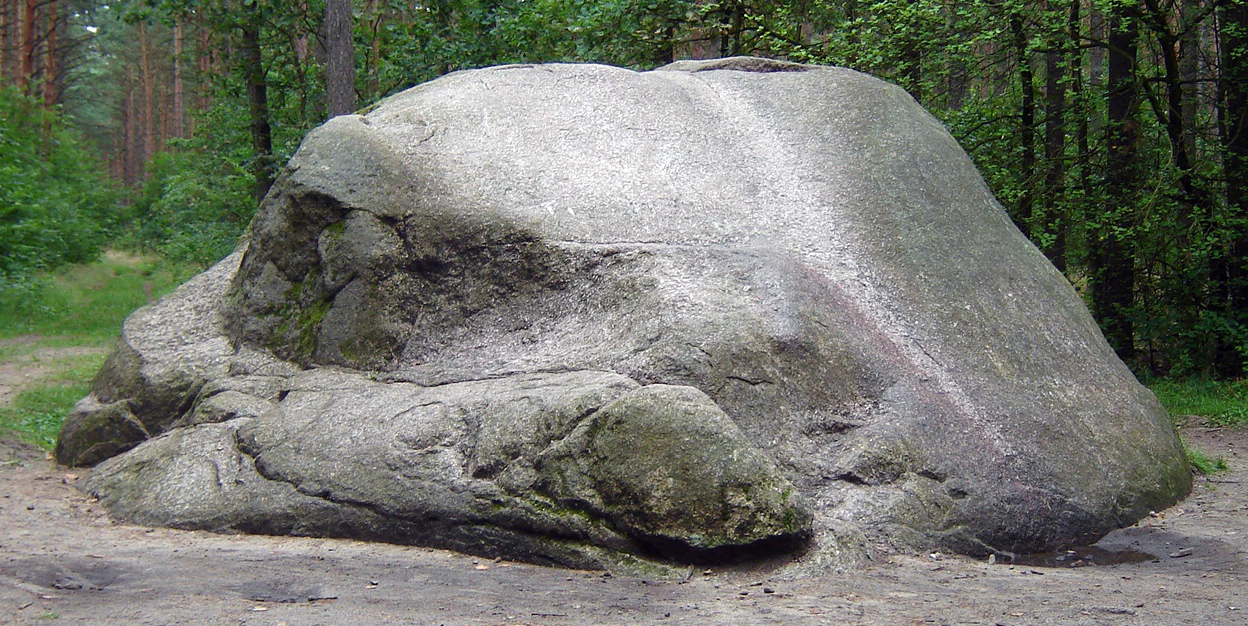
A large, smooth, gray glacial erratic boulder sitting on a sandy path within a pine forest.
The Saint Adalbert stone, a large glacial erratic boulder located in Wdecki Landscape Park.

Wdecki Landscape Park wildlife and species highlights

The diversity of habitats within Wdecki Park supports a rich and varied animal community. Aquatic environments along the Wda river and its tributaries host fish species such as brown trout, grayling, wels catfish, pike, and lake trout, reflecting the relatively clean, well-oxygenated conditions of these waters.

Wetland and forest environments sustain a notable amphibian fauna, with thirteen recorded species of amphibians in the park. Among the protected representatives are the great crested newt, the common spadefoot toad, the fire-bellied toad, and the European tree frog, the latter reflecting the presence of deciduous and mixed forest stands with suitable water bodies for breeding.

Reptile diversity includes five protected species of reptiles, such as the slow worm, sand lizard, viviparous lizard, grass snake, and common European adder. These species occupy varied microhabitats across forest clearings, peatland edges, and riverbanks.

The park's birdlife is particularly notable, with 149 bird species recorded, of which 113 are protected. Bird communities reflect the park's combination of extensive wetlands, lakes, river valleys, and mature forest stands. Among the protected species are the black stork, common goldeneye, white-tailed eagle, spotted crake, curlew sandpiper, red kite, common kingfisher, marsh harrier, Eurasian sparrowhawk, and common merganser. Strewn deadwood near Lake Miedzno supports nesting white-tailed eagles, illustrating the importance of mature trees and shorelines as breeding habitat.

Mammalian fauna includes 42 recorded species, with sixteen under protection. Among these are the Eurasian beaver, otter, common shrew, whiskered bat, greater noctule bat, and brown long-eared bat. While the open pine forests host comparatively few vertebrates, the park's deciduous and mixed forests, along with its wetlands, provide shelter for larger ungulates such as roe deer, red deer, fallow deer, and wild boar.
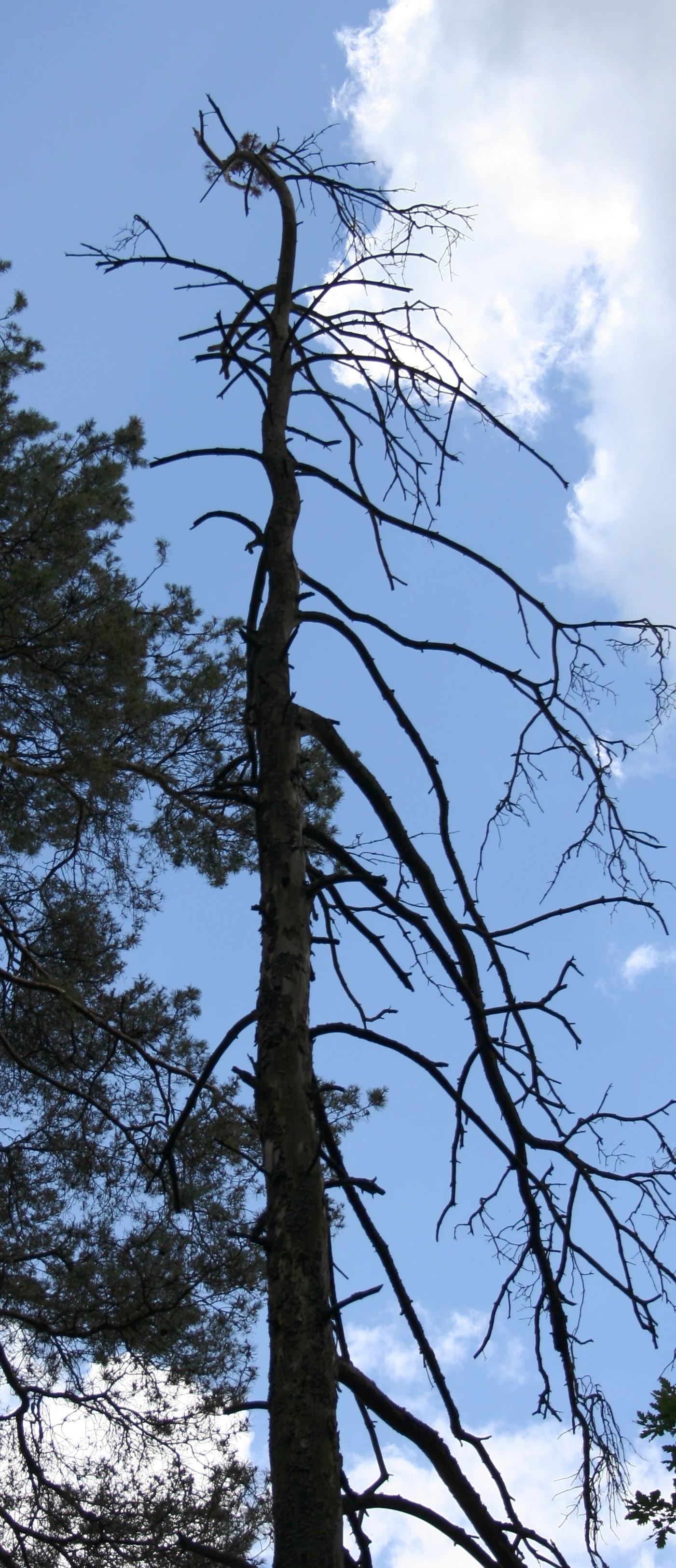
A tall, leafless, dead tree trunk stands against a bright blue sky with light clouds, with green pine needles visible on the left side of the frame.
A standing dead tree, or snag, in the Tuchola Forest, which serves as a valuable ecological habitat.

Wdecki Landscape Park conservation status and protection priorities

Wdecki Landscape Park was created to protect a representative section of the Bory Tucholskie forest landscape and the ecological systems associated with the Wda river basin. Its conservation significance lies in preserving a balanced combination of extensive pine forests, post-glacial lakes, raised bogs, spring mires, and river valleys that together represent a near-complete cross-section of habitats typical of this part of northern Poland.

A central element of the park's conservation framework is its system of five strict nature reserves. These reserves protect particularly valuable ecological features. The Brzęki reserve, named after Zygmunt Czubiński, the Dury strict nature reserve, Lake Ciche, Miedzno (associated with white-tailed eagle nesting), and Lake Piaseczno together safeguard raised bogs, lakes, marshlands, and old-growth forest stands. Beyond the strict reserves, the park includes designated natural-landscape complexes that protect the river valleys of the Prusina, Ryszka, and Sobińska Struga.

The park also protects particularly notable geological and glacial features as natural monuments, including some of the largest erratic boulders in the Pomeranian region, such as the Stone of Saint Adalbert near Leosia. These monuments sit alongside a broader conservation focus on glacial relict flora, rare bog communities, and old-growth tree stands. From a conservation perspective, Wdecki Landscape Park functions as a stronghold connecting larger protected areas across Bory Tucholskie, contributing to ecological continuity across the region and safeguarding species and habitats that have become rare elsewhere in lowland Poland.

Top sights and standout views in Wdecki Landscape Park

Wdecki Landscape Park combines the stillness of vast pine forests with the dynamic character of a dam-era reservoir and a network of post-glacial lakes. The Żur Reservoir, with its small islands including the island called Madera, gives the park a distinctive scenic profile, while the mosaic of peatlands, river valleys, and forest stands provides a rich interpretive landscape for nature-focused visitors.

The park's botanical significance is a central part of its identity. From the largest concentration of wild service tree in Central Europe to relict flora such as sundews, orchids, and mezereon, and to large erratic boulders that record the area's glacial past, the park offers a layered story of ecological and geological heritage. Its birdlife, including nesting white-tailed eagles and many protected wetland species, adds another dimension to its conservation profile.
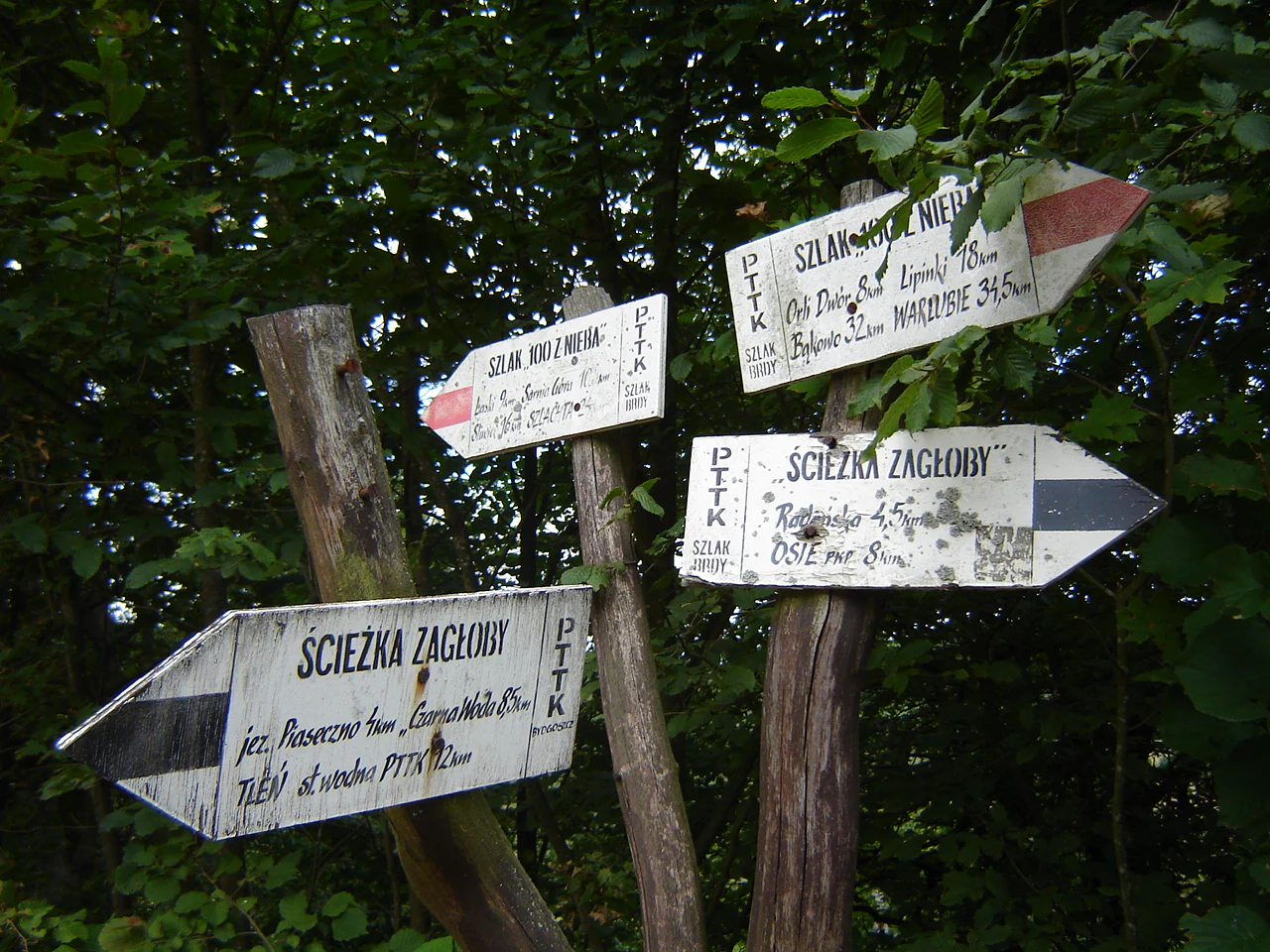
A cluster of worn wooden trail signs mounted on wooden posts in a forest setting, showing directions for Sciezka Zagloby and other PTTK-marked paths.
Wooden trail signage for the Sciezka Zagloby and PTTK trails in Stara Rzeka.

Best time to visit Wdecki Landscape Park

Wdecki Landscape Park's appeal shifts with the seasons in ways typical of Bory Tucholskie. Late spring and early summer bring active birdlife, blooming forest understory, and warming lake waters suitable for kayaking and other water-based recreation.

Summer is the most active season for water tourism on the Wda river and the Żur Reservoir, while autumn offers quieter forest conditions, berry and mushroom foraging opportunities, and vivid forest colors. Winter brings a slower, more contemplative atmosphere, with frozen or partially frozen water bodies, snow-dusted pine forests, and a sharp contrast between open peatlands and dense woodland, though visitors should expect limited access to some trail networks during the colder months.

Monthly climate preview

Long-term representative averages tracking temperature and precipitation spread across the year

Wdecki Park Krajobrazowy Climate Normals and Monthly Temperature Rhythm

Representative coordinate records show monthly mean temperatures shifting from sub-zero winter lows to warm summer peaks alongside steady precipitation. Examining the full twelve-month dataset clarifies long-term meteorological patterns and multi-season climate norms.
Annual mean8 °C
-3 °C19 °C
Jan-3°
Feb-2°
Mar
Apr
May13°
Jun17°
Jul19°
Aug19°
Sep14°
Oct
Nov
Dec-1°
Warmest month
July

19.4 °C

Coolest month
January

-3 °C

Wettest month
July

2.6 mm/day

Driest month
April

1.2 mm/day

Park location guide

Geography guide, regional context, and park location map for Wdecki Landscape Park

Wdecki Landscape Park park geography, regions, and map view in Poland

Understand where Wdecki Landscape Park sits in Poland through a broader geographic reading of the surrounding landscape, nearby location context, and its mapped position within the national park landscape.

How Wdecki Landscape Park fits into Poland

Poland, officially the Republic of Poland, is a Central European country spanning from the Baltic Sea in the north to the Carpathian Mountains in the south. It borders Germany, Czech Republic, Slovakia, Ukraine, Belarus, Lithuania, and Kaliningrad Oblast. The country has a temperate climate, diverse landscapes, and is known for its rich history, cultural heritage, and strong economic position within the EU.

Wider geography shaping Wdecki Landscape Park in Poland

Poland occupies 312,696 km2 in Central Europe, extending from the Baltic Sea coast in the north to the Sudetes and Carpathian Mountains in the south. It borders Germany to the west, Czech Republic and Slovakia to the south, Ukraine and Belarus to the east, and Lithuania and Kaliningrad Oblast to the northeast. The landscape includes lowland plains, uplands, and mountain ranges.

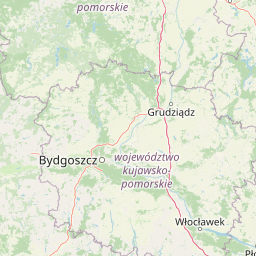
Map view of Wdecki Landscape Park

Use this park location map to pinpoint Wdecki Landscape Park in Poland, understand its exact geographic position, and read its mapped placement within the surrounding landscape more clearly.

Pigeon | © OpenStreetMap contributors

Location context for Wdecki Landscape Park

Kuyavian-Pomeranian Voivodeship

Explore protected area views, pine forests, and post-glacial lake terrain

Wdecki Park Krajobrazowy Photos and Landscapes: Visualizing Bory Tucholskie Scenery

Visual records capture the distinctive character of Wdecki Park Krajobrazowy through extensive pine forests, winding river valleys, and post-glacial lakes. Photographic documentation reveals the intricate habitats, peatlands, and reservoir topography defining this northern Polish conservation zone.

A wide view of a calm lake surrounded by dense pine forests under a clear blue sky, with reeds visible along the shoreline.

A wide view of a bright green meadow leading up to a dense, tall pine forest under a sky with scattered white clouds.

A close-up photograph of the needle-like leaves and budding white flowers of the Ledum palustre plant.

A large, smooth, gray glacial erratic boulder sitting on a sandy path within a pine forest.

A tall, leafless, dead tree trunk stands against a bright blue sky with light clouds, with green pine needles visible on the left side of the frame.

Side view of a tall, arched railway bridge constructed of red brick and concrete, partially obscured by dense green trees and vegetation in a forest.

A cluster of worn wooden trail signs mounted on wooden posts in a forest setting, showing directions for Sciezka Zagloby and other PTTK-marked paths.

A calm lake surrounded by a dense green forest, viewed from the shoreline with pine branches in the upper foreground.

A large, dark grey glacial erratic boulder resting in a grassy clearing with scattered trees in the background.

Park atlas

Compare adjacent forest reserves, river valleys, and post-glacial regional parks

Parks Near Wdecki Park Krajobrazowy and Surrounding Protected Landscapes

Browsing other protected areas near Wdecki Park Krajobrazowy allows visitors to compare similar forest ecosystems and post-glacial lake basins across northern Poland. Expanding the geographic scope helps connect regional conservation corridors, river networks, and glacial terrain within the broader Bory Tucholskie territory.
A watercolor painting showing a soft, atmospheric landscape with a winding body of water, green treelines, and patches of pinkish bog vegetation against a pale, warm sky.
Nature reserveKuyavian-Pomeranian Voivodeship
Mapped location lies within the park boundary#1 closest

Northeast

Dury Nature Reserve: Protected Wetland and Peatland Geography in Kuyavian-Pomeranian Voivodeship

Strictly protected dystrophic lake and bog habitats

Dury Nature Reserve is a specialized botanical and hydrological site in the Tuchola Forest. It preserves a distinct mosaic of four dystrophic lakes surrounded by peat bogs. The reserve is a core component of local wetland conservation, protecting rare bog species and maintaining the integrity of northern Polish forest ecosystems.

Area
0.13 km²
Established
1975
Relief
Lowland
Climate
Temperate
A horizontal watercolor illustration showing a calm lake surrounded by greenery and distant rolling hills, with reeds in the foreground.
Nature reserveKuyavian-Pomeranian Voivodeship
Mapped location lies within the park boundary#2 closest

Northwest

Rezerwat przyrody Jezioro Piaseczno: Nature Reserve and Regional Landscape Geography

Protected post-glacial lake habitats within the Bory Tucholskie region.

Located in the Kuyavian-Pomeranian Voivodeship, this nature reserve protects a rare, high-purity glacial lake and its dense woodland surroundings. The area offers a detailed view of post-glacial landscape formation, featuring a complex mix of mires, alder-ash riparian forests, and dry coniferous stands that define the natural character of the Polish northern lake district.

Area
1.59 km²
Established
2001
Relief
Lowland
Climate
Temperate
A panoramic watercolor illustration showing a calm lake bordered by pine trees and patches of pink shrubs under a pale sky.
Nature reservePoland
Mapped location lies within the park boundary#3 closest

East

Rezerwat przyrody Miedzno: Wetland and Peatland Protected Area in Northern Poland

Geographic atlas of the Miedzno nature reserve and its glacial valley.

Rezerwat przyrody Miedzno represents a vital ecological corridor in Poland, defined by its flow-through lake, alder-birch swamp forests, and rare marshland flora. This nature reserve, situated within the Wdecki Landscape Park, provides a detailed view into the post-glacial topography and avian conservation landscapes of the Bory Tucholskie mesoregion.

Area
0.885 km²
Established
1968
Relief
Lowland
Climate
Temperate
A minimalist watercolor painting showing a calm lake or wetland surrounded by soft green trees and gentle hills under a light sky.
Protected areaKuyavian-Pomeranian Voivodeship
Park boundaries overlap#4 closest

East

Sandr Wdy Protected Area: Glacial Geography and Wetland Habitats in Northern Poland

An essential reference area for Bory Tucholskie forest ecology.

Sandr Wdy is a distinctive Natura 2000 protected area shaped by post-glacial processes. The landscape features a flat outwash plain punctuated by lake basins, river valleys, and diverse mire systems. With multiple strict nature reserves integrated into its boundaries, the site provides a comprehensive view of how hydrological and soil conditions influence habitat distribution within the broader forest landscape of Poland.

Area
63.21 km²
Established
2011
Relief
Lowland
Climate
Temperate
Nature reserveKuyavian-Pomeranian Voivodeship
About 1 km away#5 closest

Northeast

Rezerwat przyrody Jezioro Łyse: Protected Peatland and Bog Lake Geography in Poland

Wetland ecosystems of the Tuchola Forest region

Rezerwat przyrody Jezioro Łyse represents a preserved 20.55 hectare peatland basin in the Kuyavian-Pomeranian Voivodeship. This nature reserve highlights the intersection of open water, bog pine forests, and sphagnum-dominated peatlands, providing a critical study of lowland wetland terrain and protected plant communities in northern Poland.

Area
0.206 km²
Established
2006
Relief
Lowland
Climate
Temperate
Protected landscapeKuyavian-Pomeranian Voivodeship
6.2 km away#6 closest

West

Tuchola Landscape Park: Mapped Protected Area and Riverine Geography in Poland

Pine-covered outwash plains and the meandering Brda River corridor

Covering a significant portion of northern Poland, Tuchola Landscape Park protects a distinctive postglacial landscape of sandy plains and dense pine forests. The park geography is anchored by the Brda River, which flows through a series of rapids and breakthroughs before reaching deep into the surrounding pine-clad outwash plain. Detailed map data provides insight into the park's eight nature reserves, which preserve critical wetland, bog, and riverine habitats.

Area
369.83 km²
Established
1985
Relief
Lowland
Climate
Temperate
Nature reservePomeranian Voivodeship
About 6.7 km away#7 closest

East

Rezerwat przyrody Jezioro Udzierz Nature Reserve Geographic and Ecological Overview

Wetland habitat mosaic in the Pomeranian Voivodeship

Rezerwat przyrody Jezioro Udzierz protects a compact yet biodiverse wetland mosaic centered on Lake Udzierz. Located in the heart of the Bory Tucholskie forest, the reserve integrates open water, reedbeds, peatlands, and wet meadows into a single, cohesive ecological unit. This detailed view examines the reserve's protected status, landscape composition, and its vital role as a refuge for bird species within the wider geography of northern Poland.

Area
2.299 km²
Established
2000
Relief
Lowland
Climate
Temperate
Watercolor painting of a wide, soft-focus river valley landscape with gentle hills, green vegetation, and a winding waterway.
Protected landscapeKuyavian-Pomeranian Voivodeship
12 km away#8 closest

Southeast

Chełmiński Park Krajobrazowy: Geographic Overview of Protected Lands in Kuyavian-Pomeranian

Glacial moraine terrain and Vistula valley protected landscapes

Chełmiński Park Krajobrazowy preserves a compact, high-contrast landscape where glacial moraine hills meet the active river corridors of the Lower Vistula. The area is defined by its five distinct nature reserves that safeguard unique slope habitats, island-like floodplain forests, and post-glacial lake basins, offering an essential reference for studying the geomorphology of the Polish lowlands.

Area
223.36 km²
Established
1998
Scope
Terrestrial
Water
Major water bodies

Common questions about visiting, size, designation, and location context for Wdecki Landscape Park

Wdecki Landscape Park FAQs for park facts, access, geography, and protected area context

Find quick answers about Wdecki Landscape Park, including protected-area facts, park geography, trail and visitor context, and how the park fits into its surrounding country and regional landscape.
MoriAtlas Explorer

Continue Your Protected Areas Search Across the Global Atlas

Deepen your exploration by continuing the structured search for national parks and protected areas worldwide. Utilize the comprehensive filtering capabilities to compare different conservation landscapes and refine your understanding of global park geography. Discover more about the distribution and characteristics of protected natural areas.

Global natural geography