Mori Atlas logo
National parkBosque de Fray Jorge National Park

Discover the mapped boundaries and regional atlas significance of this protected area in Coquimbo Region.

Bosque de Fray Jorge National Park: National Park Protected Landscape & Geographic Context

(Parque Nacional Bosque Fray Jorge)

Bosque de Fray Jorge National Park stands as a significant protected area within Chile's Coquimbo Region. This MoriAtlas entry focuses on its role as a key national park, detailing its geographic scope and the unique landscape context it offers for atlas-based exploration. Users can delve into the mapped boundaries and understand its place within the broader regional geography, providing a factual foundation for protected-area discovery.

Temperate Rain ForestBiosphere ReserveFog-fed ForestCoastal Protected AreaRelict ForestValdivian Ecosystem

Bosque de Fray Jorge National Park

National park

Park overview

Structured park overview, official facts, and landscape profile for Bosque de Fray Jorge National Park

Bosque de Fray Jorge National Park park facts, protected area profile, and essential visitor context
Review the core facts for Bosque de Fray Jorge National Park, including designation, size, terrain, visitor scale, habitats, and operating context in one park-focused overview.

About Bosque de Fray Jorge National Park

Bosque de Fray Jorge National Park occupies a unique position in Chile's protected area system as an ecological island of remarkable biodiversity within an otherwise arid landscape. The park's location along the Pacific coast in the Coquimbo Region places it at the interface between two vastly different worlds: the lush, moisture-laden forests of the Temperate Rain Forest biome and the stark, sun-baked expanses of the Atacama Desert. This contrast defines the park's character and significance. The forest exists thanks to the camanchaca, a dense coastal fog that forms when the cold Humboldt Current meets warm inland air masses, creating persistent mist that condenses on the mountain slopes and provides the essential moisture that sustains the hydrophilic vegetation. This fog-based water supply allows the forest to thrive despite receiving only about 113 millimeters of rainfall annually, a quantity that would otherwise support only the sparsest desert scrub. The park's forest is not merely a recent adaptation but represents a ancient lineage of vegetation that has survived here since the Paleogene period, making it a remnant of forests that once covered much of this region before progressive aridification reduced their range. Today, visitors to Fray Jorge encounter a landscape of extraordinary botanical interest, with the dominant Olivillo trees creating a dense canopy above a rich understory of shrubs, ferns, and epiphytes that would be impossible to predict given the surrounding desert environment.

Quick facts and research context for Bosque de Fray Jorge National Park

Bosque de Fray Jorge National Park occupies a coastal mountain setting in the Limarí Province of Chile's Coquimbo Region, near the city of Ovalle. The park is distinguished by its status as the world's northernmost occurrence of Valdivia temperate rain forest, a biome typically found much further south in Chile. This ecological anomaly is made possible by the coastal fog system known as camanchaca, which provides essential moisture to sustain the forest despite annual rainfall of only approximately 113 millimeters. The forest represents a biological relic dating back over 20 million years to the Paleogene and Neogene periods, surviving as an isolated pocket of ancient vegetation amid a fundamentally arid landscape. In 2020, the lower reaches of the bordering Limarí River were additionally designated as a Ramsar Wetland of international importance.

Park context

Deeper park guide and search-rich context for Bosque de Fray Jorge National Park

Bosque de Fray Jorge National Park history, landscape, wildlife, and travel context
Explore Bosque de Fray Jorge National Park through its history, landscape character, ecosystems, wildlife, conservation priorities, cultural context, and seasonal travel timing in a structured park guide built for atlas discovery and search intent.

Why Bosque de Fray Jorge National Park stands out

Bosque de Fray Jorge is best known for preserving the northernmost remnants of the Valdivia temperate rain forest, an ecosystem that typically thrives in southern Chile's wetter climates. The park's fog-fed forests represent a striking ecological phenomenon where a moist, subtropical-influenced woodland survives within the shadow of the Atacama Desert. The park contains the tree species Olivillo (Aextoxicon punctatum), epiphytic plants like Sarmienta scandens, and serves as the northern range limit for numerous Chilean plant species. It also holds distinction as South America's only certified Starlight dark sky reserve. The forest's extraordinary age, with genetic evidence suggesting divergence from southern forests over 20 million years ago, makes it a living laboratory for understanding forest evolution and climate-driven contraction.
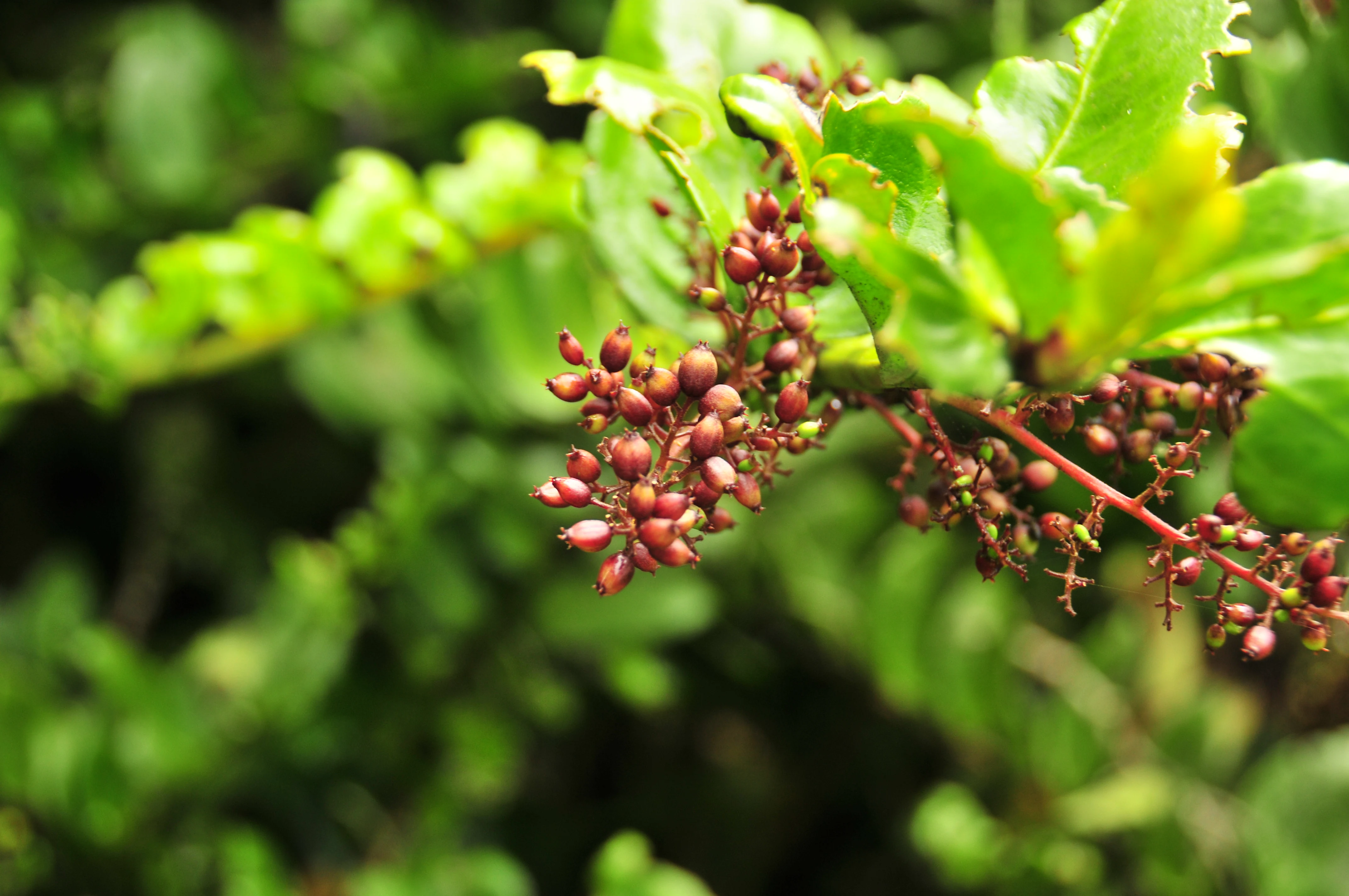
A close-up image of a plant branch with small red berries and glossy green leaves against a blurred green background
Close-up of red berries and green foliage in Fray Jorge National Park

Bosque de Fray Jorge National Park history and protected-area timeline

The history of Bosque de Fray Jorge reflects both ecological isolation and human discovery. The forest that would become the park's centerpiece was first documented in 1627 when a Franciscan priest from La Serena, searching for timber in a region where construction materials were scarce, embarked on a search with the help of mules. According to accounts, the priest miraculously discovered this forest and returned with timber used to construct portions of the bell tower of the Church of San Francisco in La Serena, one of the city's historic religious buildings. This discovery introduced the forest to European settlement records and eventually led to recognition of its ecological importance. The park was formally established in 1941 during the administration of President Juan Antonio Ríos, making it one of Chile's older protected areas. Management of the park was entrusted to the Corporación Nacional Forestal (CONAF), the national forest authority. In 1977, UNESCO recognized the park's global significance by incorporating it into the World Network of Biosphere Reserves, acknowledging its role as a conservation site of international importance. More recently, in 2020, the lower reaches of the Limarí River, which forms the park's southern boundary, were designated as a Ramsar Wetland, extending international protection to the riparian ecosystems connected to the park.

Bosque de Fray Jorge National Park landscape and geographic character

The physical landscape of Bosque de Fray Jorge is defined by its location within the Cordillera de Talinay, a coastal mountain range that forms part of the broader Chilean Coastal Range. The terrain consists of steep mountain slopes descending toward the Pacific Ocean, with elevations varying across the park's extent. The landscape presents a dramatic visual contrast between the dark, dense canopy of the forest and the surrounding hillsides of semiarid scrubland that characterize the broader region. The park's forest-covered areas are concentrated in valleys and on slopes where fog moisture accumulates, creating distinct patches of green amid the otherwise brown and tan terrain. The Limarí River flows along the park's southern boundary, its lower reaches protected as part of the Ramsar-designated wetland area. The park's elevation and coastal position create a unique setting where the influences of the ocean, including fog and maritime air masses, interact with the continental climate patterns of north-central Chile.
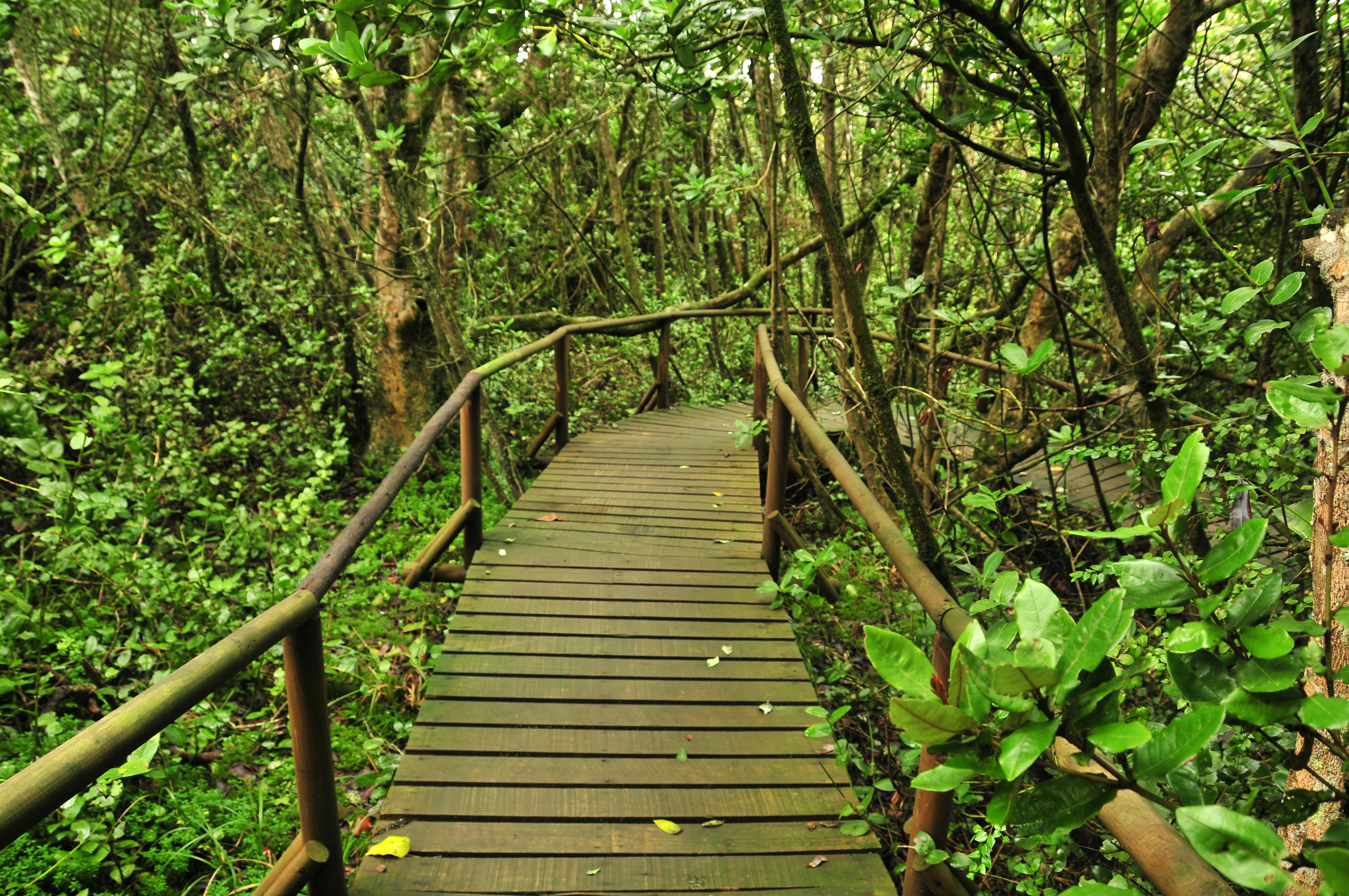
Wooden boardwalk trail with railings through dense green forest
Wooden boardwalk trail through dense forest vegetation in Bosque de Fray Jorge National Park

Bosque de Fray Jorge National Park ecosystems, habitats, and plant life

The ecological character of Bosque de Fray Jorge is defined by its status as a relictual fragment of the Valdivia temperate rain forest, an ecosystem type that normally extends from roughly the Biobío Region southward. This makes Fray Jorge the northernmost occurrence of this forest type anywhere in the world, creating an island of temperate biodiversity within a subtropical to arid matrix. The forest's survival depends entirely on the camanchaca fog system, which provides the majority of moisture through direct condensation rather than precipitation. The vegetation structure includes the endemic Olivillo (Aextoxicon punctatum) as a dominant canopy species, accompanied by various shrub and understory plants adapted to the moisture-rich but nutrient-limited conditions. Epiphytes are particularly well-represented, with species like Sarmienta scandens and Griselinia scandens growing on tree branches and trunks. The forest represents a remarkable example of ecological persistence, having survived as a refugium while surrounding areas transformed into arid scrubland over millions of years. Recent genetic research based on metazoans indicates that the forest's lineage diverged from southern populations over 20 million years ago, during the Paleogene and Neogene periods, making this forest a living record of ancient ecological conditions.
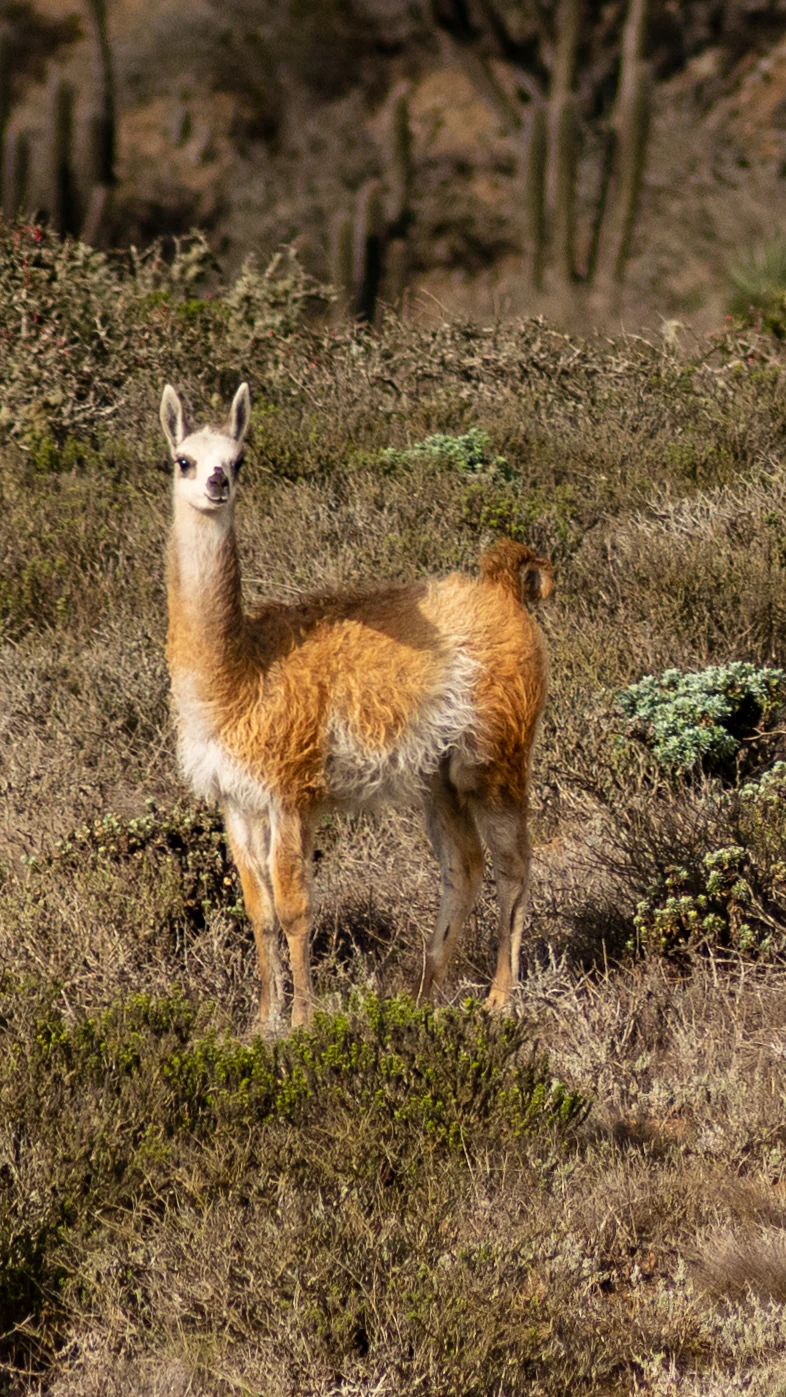
Guanaco standing among dry bushes and low vegetation in a semi-arid landscape
Guanaco in Bosque de Fray Jorge National Park

Bosque de Fray Jorge National Park wildlife and species highlights

Bosque de Fray Jorge supports a diverse community of wildlife despite its relatively small forest area, a result of the unique habitat conditions created by the fog-fed forest in an otherwise arid region. Mammals found in the park include the common degu, a small rodent that lives in colonies within the forest understory, as well as foxes and the more elusive puma that ranges through the broader landscape. Guanacos, South American camelids, are also present in the park and can often be observed grazing in more open areas. The bird community is particularly noteworthy, with species adapted to both forest and scrubland habitats. The Chilean tinamou and the long-tailed meadowlark are among the commonly observed bird species. Additional avian residents include the picaflor, a small hummingbird that feeds on nectar from the park's flowering plants, and the tucúquere, a Magellanic horned owl that inhabits the forest and surrounding areas. The diverse avifauna reflects the park's position as a transition zone between different ecological communities.
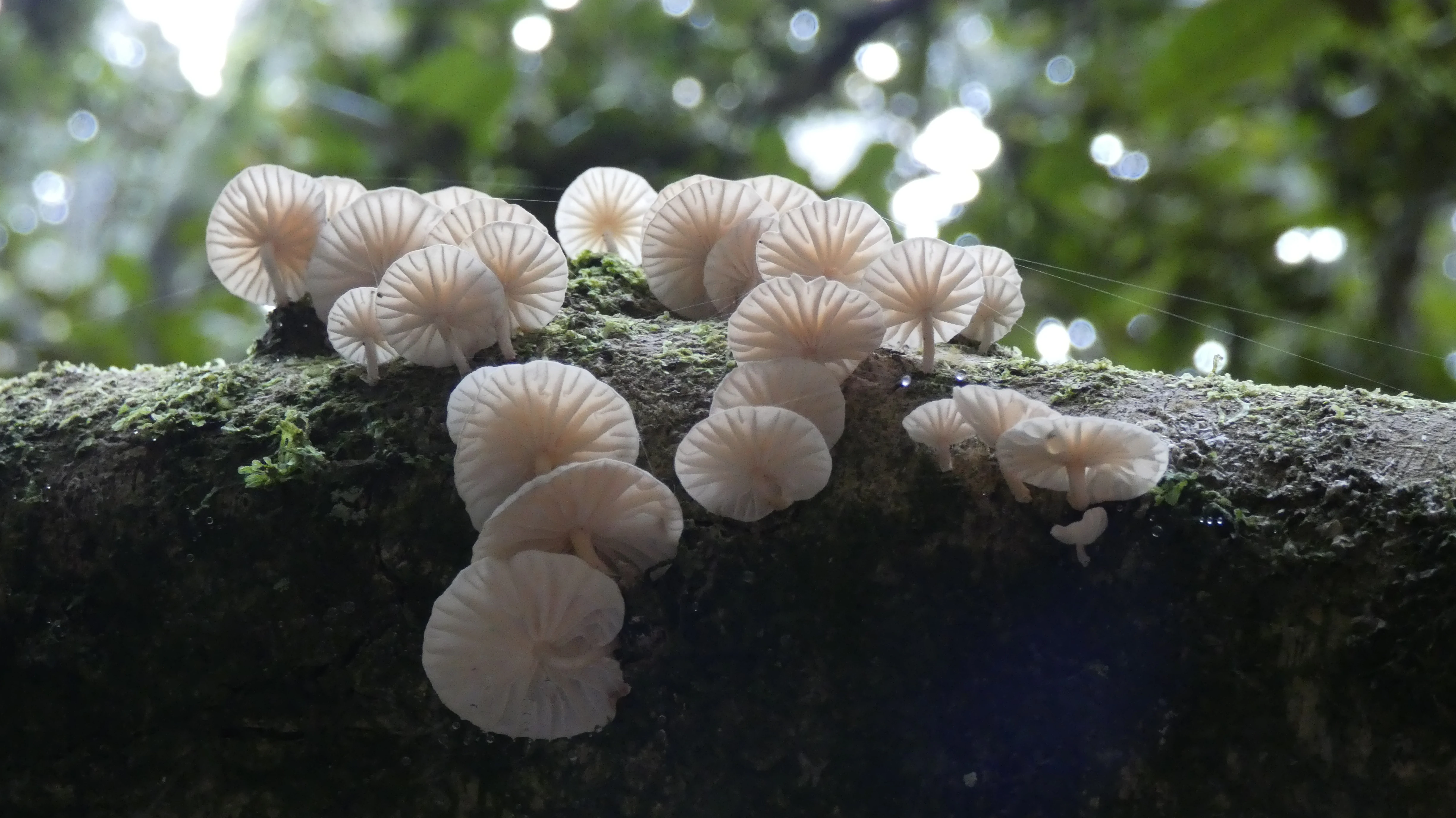
Close-up of light-colored mushrooms growing on a moss-covered tree branch in a forest setting
Mushrooms growing on a moss-covered branch in the forest

Bosque de Fray Jorge National Park conservation status and protection priorities

Bosque de Fray Jorge holds exceptional conservation significance as one of Chile's oldest protected areas and as a UNESCO Biosphere Reserve since 1977. The park's designation as a biosphere reserve recognizes its dual role in preserving biodiversity and supporting scientific research into forest ecology and climate change impacts. The forest's status as the northernmost remnant of the Valdivia temperate rain forest makes it irreplaceable, as similar conditions cannot be replicated elsewhere due to the specific climatic and geographic requirements of the fog-fed system. Conservation efforts focus on protecting the existing forest cover and managing the impacts of visitor use on the sensitive ecosystem. The 2020 designation of the Limarí River's lower reaches as a Ramsar Wetland has expanded protection to include the riparian corridor that connects to the park. Additionally, the park has subsurface protection as a place of scientific interest for mining purposes, established by Supreme Decree in 1989, which provides an additional layer of legal protection against potential mineral extraction.

Bosque de Fray Jorge National Park cultural meaning and human context

While Bosque de Fray Jorge is primarily valued for its ecological significance, the park also carries historical importance tied to the human history of the Coquimbo Region. The forest's discovery in 1627 by a Franciscan priest seeking timber for the Church of San Francisco represents the earliest documented interaction between European settlers and this unique ecosystem. This connection to the religious and colonial history of La Serena, one of Chile's oldest cities, provides cultural context for understanding why this particular forest gained recognition when other similar ecosystems might have been exploited for resources. The park's location within the territory historically inhabited by indigenous communities adds potential depth to its cultural context, though the primary narrative in available sources focuses on the discovery and subsequent conservation history rather than deeper indigenous heritage connections.
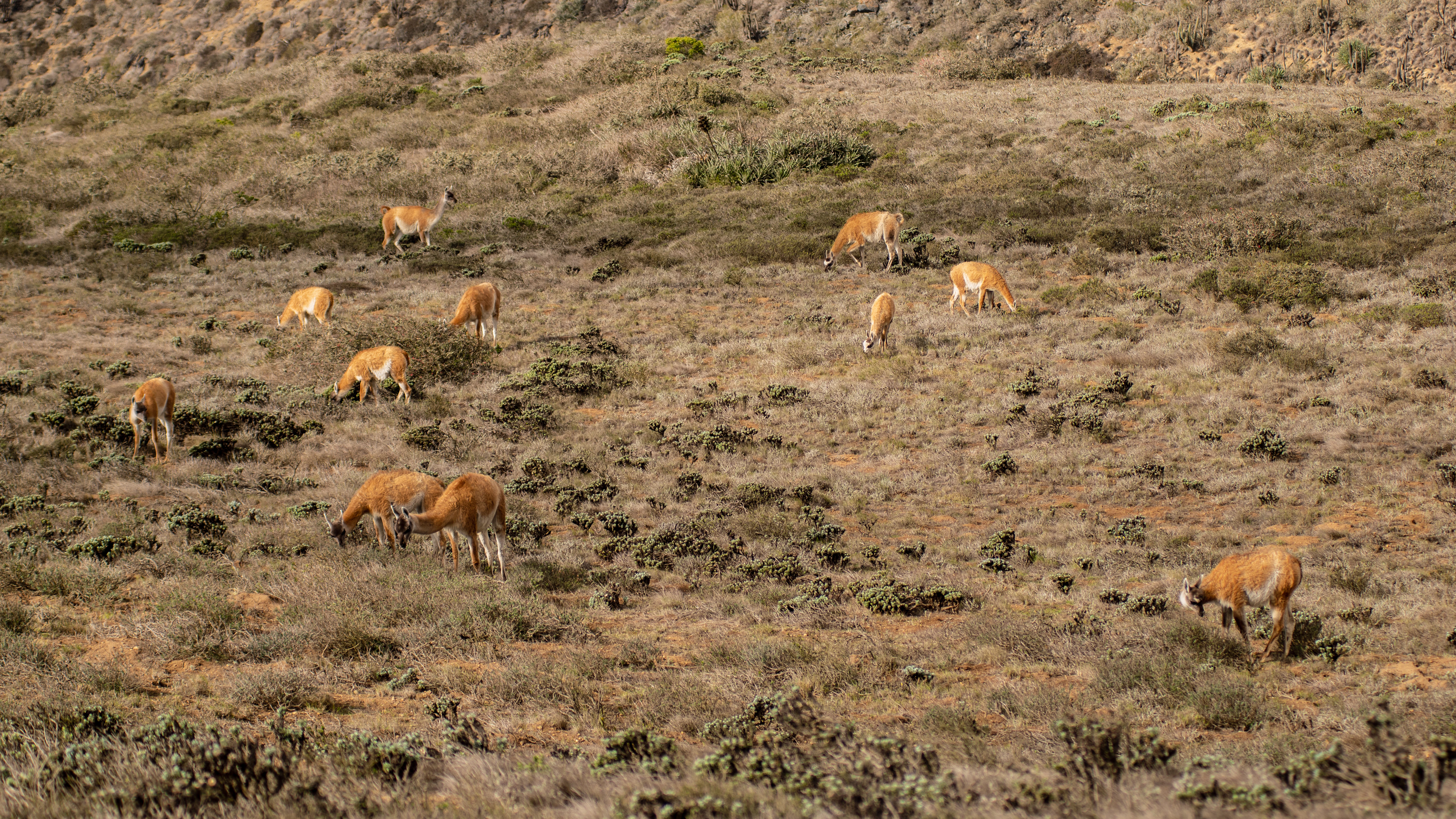
Multiple guanacos grazing in a dry, hilly landscape with sparse vegetation
Guanacos grazing in the dry landscape of Bosque de Fray Jorge National Park

Top sights and standout views in Bosque de Fray Jorge National Park

The most compelling highlights of Bosque de Fray Jorge include its extraordinary status as the world's northernmost Valdivia temperate rain forest, a living relic of ancient forest systems that survived millions of years of regional aridification. The fog-fed forest ecosystem, sustained by the camanchaca phenomenon, creates an unlikely oasis of biodiversity at the edge of the Atacama Desert. The park's UNESCO Biosphere Reserve status since 1977 and Ramsar Wetland designation for associated riverine ecosystems reflect its international recognition. The presence of Olivillo-dominated forest, the diversity of epiphytic plants, and the northern range limits of numerous species make it botanically significant. The distinction as South America's only certified Starlight dark sky reserve adds an astronomical dimension to the park's attractions, offering exceptional conditions for stargazing in a region renowned for clear skies.
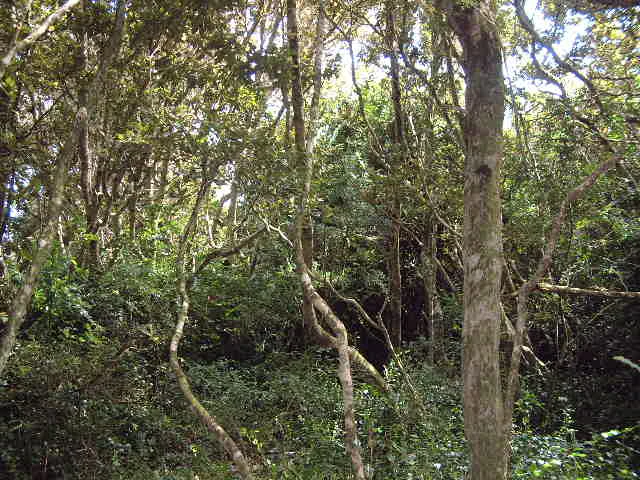
Dense forest with twisted tree trunks and lush green foliage under a dappled light canopy
Dense forest with distinctive Olivillo trees and lush green foliage in Bosque de Fray Jorge National Park

Best time to visit Bosque de Fray Jorge National Park

The optimal time to visit Bosque de Fray Jorge depends on what visitors hope to experience, though the fog system that sustains the forest operates year-round and creates consistent conditions throughout the seasons. The coastal fog tends to be most persistent during the cooler months from late autumn through winter and into early spring, typically providing reliable moisture for the forest. Summer months may see slightly less fog but can still offer good conditions for exploration. Temperature differences between seasons are moderate given the coastal location, with cooler conditions in winter and warmer but not extreme temperatures in summer. The park remains accessible throughout the year, though visitors should be aware that some trails and interior areas may have varying conditions depending on recent weather patterns. The dry season from November through March typically offers more comfortable conditions for hiking, while the cooler winter months may provide more dramatic fog displays within the forest.
Park location guide

Geography guide, regional context, and park location map for Bosque de Fray Jorge National Park

Bosque de Fray Jorge National Park park geography, regions, and map view in Chile
Understand where Bosque de Fray Jorge National Park sits in Chile through a broader geographic reading of the surrounding landscape, nearby location context, and its mapped position within the national park landscape.

How Bosque de Fray Jorge National Park fits into Chile

Chile is a presidential republic in western South America, extending as a narrow strip along the western edge of the continent between the Andes Mountains and the Pacific Ocean. It is the southernmost country in the world and the closest to Antarctica. The country is bordered by Peru, Bolivia, and Argentina, and administers several Pacific islands including Easter Island. Chile is a major copper producer and has a population of approximately 19.6 million.

Wider geography shaping Bosque de Fray Jorge National Park in Chile

Chile occupies a narrow strip of land along the western edge of South America, extending approximately 4,300 km north to south but only about 350 km east to west at its widest point. The country is sandwiched between the Andes Mountains to the east and the Pacific Ocean to the west. It shares borders with Peru to the north, Bolivia to the northeast, and Argentina to the east. Southern Chile borders the Drake Passage. Chile also administers several Pacific islands including Juan Fernández Islands, Isla Salas y Gómez, Desventuradas Islands, and Easter Island, plus the Chilean Antarctic Territory.

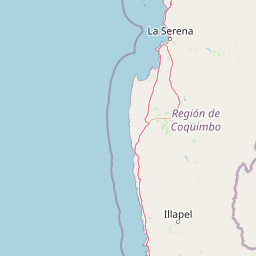
Map view of Bosque de Fray Jorge National Park

Use this park location map to pinpoint Bosque de Fray Jorge National Park in Chile, understand its exact geographic position, and read its mapped placement within the surrounding landscape more clearly.

Pigeon | © OpenStreetMap contributors

Location context for Bosque de Fray Jorge National Park

Coquimbo Region

Discover the distinctive scenery, relict Valdivian temperate rainforest habitats, and coastal terrain of this protected Chilean oasis.

Bosque de Fray Jorge National Park Photos: Explore its Unique Fog Forest and Arid Landscapes
Browse a visual collection of Bosque de Fray Jorge National Park photos, highlighting its extraordinary fog-fed Valdivian temperate rainforests amidst the semiarid Chilean Coastal Range. These images provide essential insight into the park's unique ecological identity, diverse habitats, and the dramatic geographic contrast of this protected area.

A close-up image of a plant branch with small red berries and glossy green leaves against a blurred green background

Spectacled owl perched on a tree branch with dry leaves and green foliage

Wooden boardwalk trail with railings through dense green forest

Guanaco standing among dry bushes and low vegetation in a semi-arid landscape

Close-up of light-colored mushrooms growing on a moss-covered tree branch in a forest setting

Pink Fuchsia lycioides flowers with green buds on a branch against a blurred blue sky and tree branches

Multiple guanacos grazing in a dry, hilly landscape with sparse vegetation

Dense forest with twisted tree trunks and lush green foliage under a dappled light canopy

A scenic view showing a forested hillside leading to a coastal area with the ocean under a partly cloudy sky

Wooden boardwalk trail with wooden railings surrounded by dense green foliage

Small hummingbird partially obscured by thin branches in a dense forest area

Park atlas

Browse surrounding protected landscapes, comparing diverse ecosystems and regional park geography.

Explore Other National Parks and Protected Areas Near Bosque de Fray Jorge National Park
Continue your exploration beyond Bosque de Fray Jorge National Park by discovering other national parks and protected areas across Chile's Coquimbo Region. Compare diverse ecosystems, from relict fog-fed forests to expansive arid landscapes, tracing the geographic spread of regional conservation efforts.
National park

El Leoncito National Park: High-Altitude Andean Puna and Steppe Protected Landscape

Explore mapped boundaries and unique geographic context in San Juan Province.

El Leoncito National Park in Argentina's San Juan Province preserves critical high-altitude ecosystems, including the Central Andean Puna and Southern Andean steppe. This protected landscape spans dramatic mountain terrain, with elevations reaching over 6,000 meters, providing a unique geographic setting. The park's conservation value is underscored by its representative ecological samples and stark natural beauty, offering a distinct regional geography for exploration.

Area
897.06 km²
Established
2002
IUCN
II
Relief
Mountain
Watercolor painting of a coastal landscape featuring palm trees, mountains, and a body of water
National parkValparaíso Region

La Campana National Park: Protected Landscape of Chilean Wine Palms

Explore its mapped terrain and regional geographic context.

La Campana National Park represents a significant protected landscape within Chile, celebrated for its exceptional concentration of Chilean Wine Palms (Jubaea chilensis). As a national park situated in the Valparaíso Region, it showcases a diverse range of Mediterranean ecosystems and dramatic coastal mountain terrain. This page provides detailed atlas-style context, highlighting the park's unique botanical heritage, its distinct geographic setting, and its importance as a mapped natural area for regional landscape studies.

Area
80 km²
Established
1967
IUCN
II
Visitors
39.6K annual
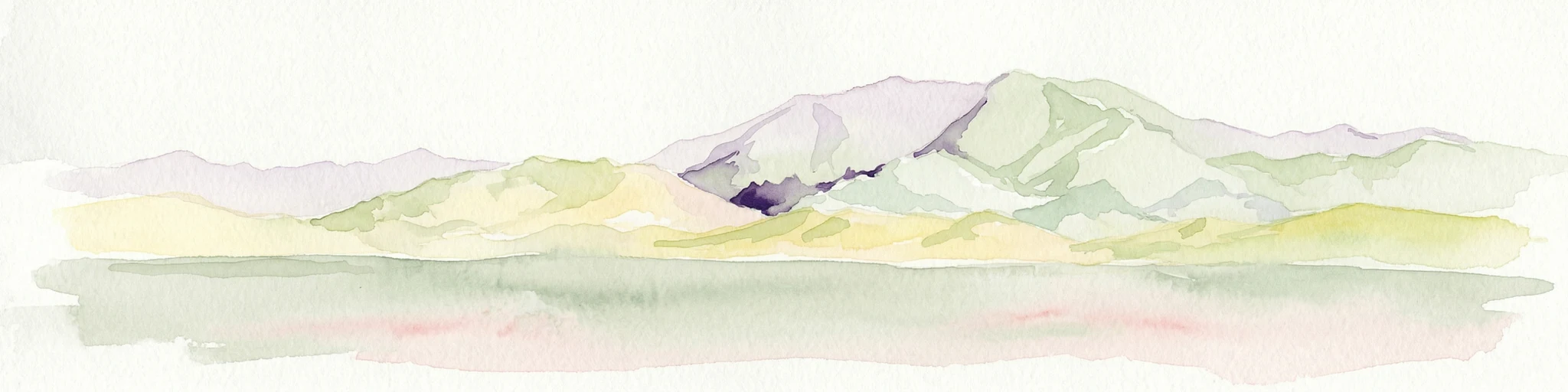
Watercolor illustration of mountain ranges with green and yellow hills, a central dark peak, and pinkish foreground
National park

San Guillermo National Park: High Andes Protected Landscape & Vicuña Conservation Area

Explore its rugged terrain and arid mountain ecosystem.

San Guillermo National Park, a key national park in Argentina's San Juan Province, protects over 166,000 hectares of high-altitude Andean wilderness. Its landscape is defined by arid mountain ranges and expansive puna grasslands, serving as a critical sanctuary for vicuñas and other high-Andean wildlife. This page offers detailed geographic context for understanding the park's protected boundaries, unique terrain, and its importance as a mapped conservation area.

Area
1,660 km²
Established
1998
IUCN
II
Relief
Mountain
National parkAtacama Region

Llanos de Challe National Park: Unique Coastal Desert and Lomas Ecosystem

Atacama Region National Park with Dramatic Terrain and Wildlife

Llanos de Challe National Park presents a rare protected coastal desert environment within the Atacama Region. Its unique lomas ecosystem, sustained by coastal fog, supports a surprising diversity of life. The park encompasses striking geographic features, from unspoiled white-sand beaches to rugged mountainous terrain, offering a clear example of a vital protected landscape with significant guanaco populations and unique flora, all mapped within its regional context.

IUCN
II
Relief
Mixed relief
Climate
Arid
Scope
Mixed
National parkLa Rioja Province

Talampaya National Park: Argentinian National Park with Dramatic Desert Canyons

Explore protected landscape and mapped geography in La Rioja Province.

Talampaya National Park, a significant national park in Argentina's La Rioja Province, offers a profound exploration of a dramatic desert canyon environment. This protected area is renowned for its rich paleontological sites, yielding crucial dinosaur fossils, and for its well-preserved indigenous petroglyphs carved into ancient rock formations. Understanding Talampaya National Park provides vital context for the region's geography and its place within Argentinian protected lands and mapped natural landscapes.

Area
2,150 km²
Established
1997
IUCN
II
Relief
Mountain
National parkLibertador General Bernardo O'Higgins Region

Las Palmas de Cocalán National Park: Chile's National Park Protected Landscape Atlas

Explore geographic boundaries and regional context.

Delve into the protected landscape identity of Las Palmas de Cocalán National Park, situated within the Libertador General Bernardo O'Higgins Region. This page provides detailed atlas-style information, focusing on the park's geographic features and its role as a national park. Understand the mapped natural terrain and the regional importance of this conserved area for comprehensive geographic discovery.

Area
3.709 km²
Established
1971
IUCN
II
Relief
Mixed relief
National parkAtacama Region

Nevado Tres Cruces National Park: National Park in Atacama Region's Mapped Geography

Explore protected landscapes and regional park context.

Nevado Tres Cruces National Park is a significant protected national park situated within the Atacama Region of Chile. This entry provides essential geographic context, detailing the park's mapped boundaries and its contribution to the region's conservation landscape. Understand its place within the broader atlas of protected areas, focusing on the natural terrain and the distinct geography that characterize this important national park.

Area
591 km²
IUCN
II
Relief
Mountain
Climate
Alpine
National park

Sierra de las Quijadas National Park: Protected Landscape & Geographic Atlas in Argentina

Explore the unique Chaco-Monte ecotone and dramatic sandstone terrain.

Sierra de las Quijadas National Park in San Luis Province, Argentina, is a protected area recognized for its critical role as a biodiversity bridge between the Semiarid Chaco and High Monte ecoregions. Its landscape is marked by rugged mountains, vivid red sandstone cliffs, and significant paleontological sites, offering a unique look at Cretaceous-era geology. This park provides a rich opportunity for atlas exploration, allowing discovery of its distinctive protected landscape and the regional geography it inhabits.

Area
735.33 km²
Established
1991
IUCN
II
Relief
Mountain

Common questions about visiting, size, designation, and location context for Bosque de Fray Jorge National Park

Bosque de Fray Jorge National Park FAQs for park facts, access, geography, and protected area context
Find quick answers about Bosque de Fray Jorge National Park, including protected-area facts, park geography, trail and visitor context, and how the park fits into its surrounding country and regional landscape.
MoriAtlas Explorer

Continue Your Protected Areas Search Across the Global Atlas

Deepen your exploration by continuing the structured search for national parks and protected areas worldwide. Utilize the comprehensive filtering capabilities to compare different conservation landscapes and refine your understanding of global park geography. Discover more about the distribution and characteristics of protected natural areas.

Global natural geography