Why Chiloé National Park stands out
Chiloé National Park is best known for its remarkable marine mammal populations, particularly the resident population of pygmy blue whales in the Gulf of Corcovado, one of only four or five known feeding grounds for this species globally. The park also protects exceptional examples of Valdivia temperate rain forest, including ancient alerce trees, and features dramatic coastal landscapes with dunes, rocky shores, and islets. The combination of terrestrial and marine biodiversity makes this park a critical conservation area, with whales, including humpbacks, finbacks, and potentially critically endangered southern right whales, frequently observable from the island's southern shores.
Chiloé National Park history and protected-area timeline
Chiloé National Park was established in 1983 through Supreme Decree N° 734, a direct consequence of the controversy surrounding the Chiloé Chip Project of the previous decade. This industrial forestry initiative had proposed massive tree harvesting on Chiloé Island and generated significant public opposition, ultimately leading to the creation of this protected area as a conservation response. Originally encompassing a larger territory, the park's surface area has been reduced by more than 45 square kilometers due to the removal of inhabited lands. Several Huilliche communities that had been included within the initial park boundaries could not exercise property rights or conduct legal resource extraction activities. Over time, zones including the Huelde Lake area near Chanquín, coastal strips between Huentemó and the Colecole River, and areas between the Colecole and Anay Rivers were removed from the protected status and placed under the management of local indigenous communities. These excised areas now host joint conservation and tourism initiatives between CONAF and the Huilliche communities, representing a model of collaborative land management.
Chiloé National Park landscape and geographic character
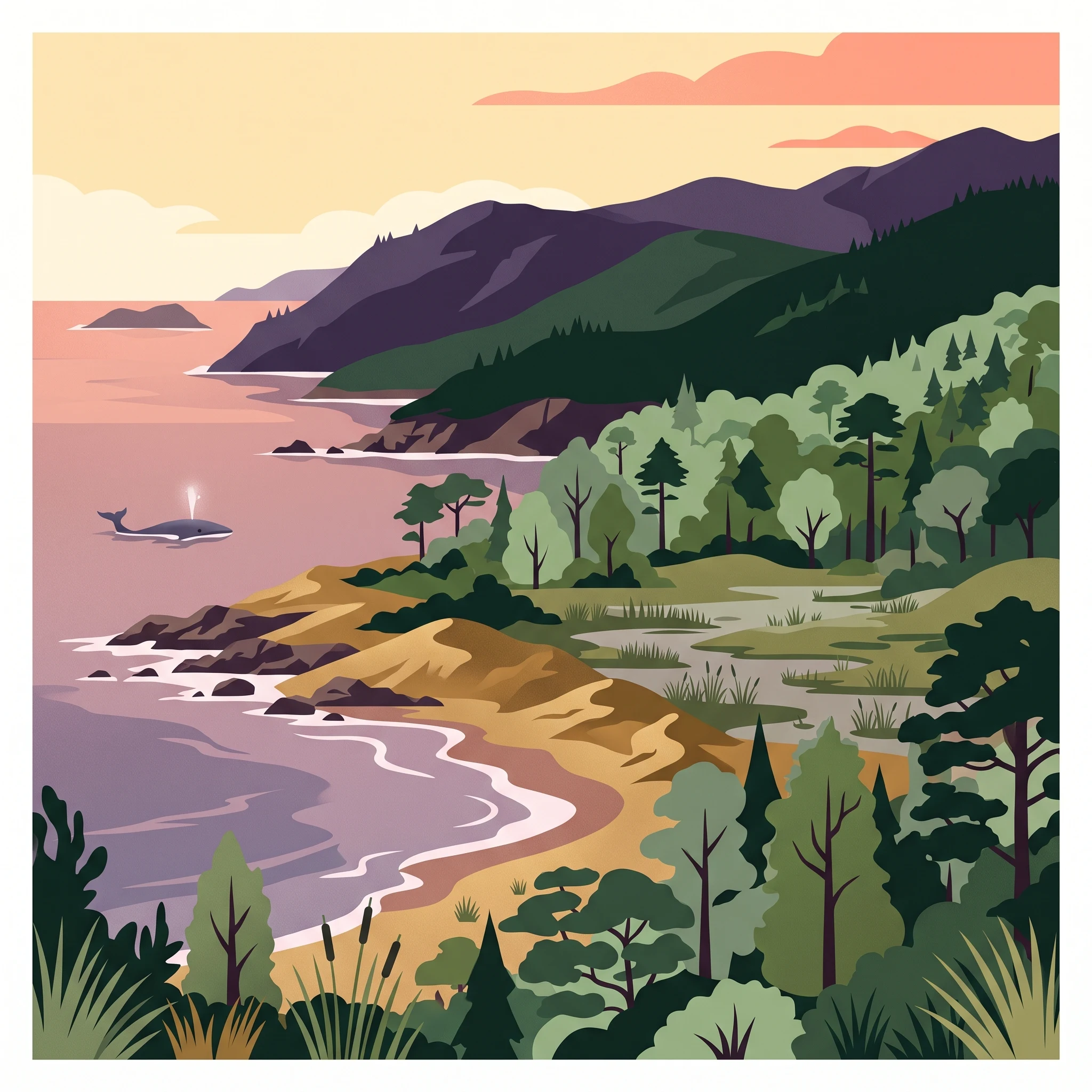
The landscape of Chiloé National Park is defined by the meeting of the Pacific Ocean with the lush forests of the Chilean Coastal Range. The park encompasses a remarkable variety of terrain, from the sandy beaches and coastal dunes that line the western shores to the steep foothills of the Cordillera del Piuchén that rise inland. Along the coast, rocky headlands alternate with stretches of sand, while small islets such as Metalqui provide nesting habitat for seabirds and marine mammals. The interior features a terrain of rounded hills covered in dense forest, interspersed with wetlands, peat bogs, and the valleys carved by rivers like the Abtao, Anay, and Chepu. The contrast between the rain-shadowed eastern slopes and the wetter western exposures creates distinct ecological zones within relatively short distances. This topographic and ecological diversity, compressed into a relatively compact area, makes the park a remarkably complete representation of the Chiloé island environment.
Chiloé National Park ecosystems, habitats, and plant life
The nature of Chiloé National Park is characterized by the globally significant Valdivia temperate rain forest ecosystem, one of the world's most distinctive and threatened forest types. This dense forest ecosystem is composed of evergreen trees, shrubs, and climbing plants, with southern beech (Nothofagus) species forming the dominant canopy. Among the most notable trees is the alerce (Fitzroya cupressoides), a long-lived conifer that can live for thousands of years and which forms nearly pure stands or associates with other species in the wettest areas. The forest understory is rich with native bamboo (Chusquea quila), myrtles, and epiphytes. At higher elevations and in areas with poor drainage, extensive peat bogs and swamps develop, supporting specialized plant communities adapted to waterlogged conditions. The tepual forest formation, a dense thicket of tepú trees with interlaced trunks, creates a maze-like environment where mosses and epiphytes form false soil layers several meters above the ground, making navigation hazardous for the unwary. Coastal dune communities feature specialized vegetation adapted to nutrient-poor, saline conditions.
Chiloé National Park wildlife and species highlights
The wildlife of Chiloé National Park is notable for both its terrestrial and marine components. The park's waters have become internationally famous as one of the few regular feeding grounds for pygmy blue whales, with the Cetacean Conservation Center's Blue Whale Project documenting these gatherings. Humpback whales, fin whales, and sei whales also frequent the area, while the critically endangered Peru/Chile stock of southern right whales, with only around 30 remaining individuals, may occasionally be observed. On land, the park supports the pudú, one of the world's smallest deer species, and the endangered Darwin's fox, found only on Chiloé Island. River otters hunt in the estuaries, while the coastal islets host colonies of South American sea lions. As an Important Bird Area, the park supports significant populations of the Chilean pigeon, slender-billed parakeet, black-throated huet-huet, and chucao tapaculo, all species characteristic of the southern Chilean forests.
Chiloé National Park conservation status and protection priorities
Chiloé National Park plays a crucial role in conserving one of Earth's most distinctive temperate rain forest ecosystems and some of the world's most endangered marine mammals. The park protects significant portions of the Valdivia forest, including old-growth alerce stands, some of which have been declared National Monuments. The designation as an Important Bird Area by BirdLife International recognizes its importance for endemic bird species. The marine waters, though not formally part of the park boundary, are intimately connected to its conservation mission, providing critical habitat for pygmy blue whales whose presence has brought international attention to the region. The park's management involves collaboration with Huilliche communities in former park areas, demonstrating a model for integrating indigenous land use with conservation objectives. The excision of community lands from the park highlights the ongoing challenge of balancing strict protection with the rights and livelihoods of traditional inhabitants.
Chiloé National Park cultural meaning and human context
Chiloé National Park exists within the cultural landscape of Chiloé Island, a place with deep indigenous heritage and strong cultural identity. The Huilliche communities whose lands were incorporated into and subsequently removed from the park represent the original inhabitants of this region. Their traditional relationship with the landscape includes activities such as resource extraction that were incompatible with strict protected area management. The collaborative conservation and tourism projects now underway in former park areas represent an evolution in how Chile approaches protected area management, recognizing that effective conservation must consider the needs and rights of local communities. The park's creation itself was driven by community opposition to industrial development, reflecting the strong connection between Chiloé's residents and their natural environment. The landscape contains places of cultural significance, and the park boundaries traverse areas where human communities and wild nature have co-existed for generations.
Top sights and standout views in Chiloé National Park
The park offers several standout features that distinguish it within Chile's protected area network. The pygmy blue whale population of the Gulf of Corcovado represents one of the most remarkable marine mammal spectacles in the Southern Hemisphere, with these enormous animals often entering narrow fiords to feed. The ancient alerce forests, some of the oldest living organisms on Earth, provide a tangible connection to the prehistoric past. The coastal landscapes with their dunes, beaches, and islets create dramatic scenery where the Pacific Ocean meets the forest. The biodiversity of the Valdivia rain forest, with its endemic species and complex ecological relationships, represents a globally important ecosystem. The opportunity to observe whales from shore, particularly near Caleta Zorra on the island's southern side, provides visitors with encounters with some of the ocean's most magnificent creatures without needing boat excursions.
Best time to visit Chiloé National Park
The park can be visited throughout the year, with each season offering distinct experiences. The wet temperate climate means rainfall is common in all seasons, though the amount varies with elevation and exposure. Summer months (December to March in the Southern Hemisphere) generally bring more stable weather and longer daylight hours, making this the most popular time for visitors. Winter months offer a different character, with moody landscapes, fewer visitors, and the opportunity to experience the forest in its wettest, most lush condition. The whale watching opportunity is not strictly seasonal, as pygmy blue whales and other species can be observed throughout the year, though the probability of sightings may vary. The park's rain forest character means that visitors should be prepared for wet conditions regardless of when they visit, with appropriate clothing and footwear essential for enjoying the trails and coastal areas.