Why Copeland Tops State Conservation Area stands out
Copeland Tops is best known for its unusual pairing of wet sclerophyll eucalyptus forest with a dry rainforest community that contains very tall red cedar, massive Moreton Bay figs, and impressive epiphytic ferns such as bird's nest, staghorn, and elkhorn ferns. The area is also recognised for the surviving relics of the Mountain Maid gold mine, a late nineteenth century operation that briefly supported a population of around one thousand people. The reserve draws additional attention for its abundant marsupial fauna, including koalas, eastern grey kangaroos, red-necked wallabies, wombats, and greater gliders, alongside microbats that roost in the abandoned gold mine shafts. Together, these rainforest pockets, tall forest tiers, and industrial-era relics give the park a character that distinguishes it from neighbouring Barrington Tops reserves.
Copeland Tops State Conservation Area history and protected-area timeline
The contemporary history of Copeland Tops begins with European gold discovery. Prospecting traces back to 1875, when timber collectors working in the forest found gold in the area. The find triggered a local rush, and by 1878 the population around the workings had risen to around one thousand people, with mining settlements springing up in what had previously been dense forest.
Two mines came to dominate the field. The Mountain Maid mine had yielded around 8,819 ounces of gold by the end of 1886, while the Hidden Treasure mine produced about 9,501 ounces over the same general period. Despite the richness of these early returns, most mining activity had ceased by 1890, and the landscape gradually returned to a quiet forested state. The Mountain Maid mine remains the most prominent surviving relic of this era and can still be visited with a tour guide.
In the modern era, the forested landscape around the old mine workings was recognised for its conservation value and formally protected as the Copeland Tops State Conservation Area on 1 July 2003. The reserve is now managed by the NSW National Parks and Wildlife Service, and the abandoned mine shafts have become an unlikely ecological asset, serving as daytime roosts for microbat colonies. This transition from short-lived mining frontier to protected landscape marks the defining arc of the area's human history.
Copeland Tops State Conservation Area landscape and geographic character
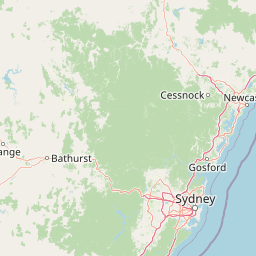
The landscape of Copeland Tops lies on the lower foothills and sheltered valleys between Gloucester and the higher Barrington Tops plateau. The terrain is undulating and forest-covered, with creek lines that cut through tall stands of eucalyptus and rainforest. Although elevation is modest compared with the higher peaks of the Barrington range, the topography provides the sheltered, humid microclimates that allow subtropical rainforest species to persist alongside wet eucalypt forest.
Water plays a quiet but important role in shaping the landscape. Drainage from the surrounding ranges feeds the creeks that wind through the reserve, sustaining the moisture-loving plant communities and contributing to the dense ground cover typical of wet sclerophyll forest. Steeper slopes and rocky outcrops add structural diversity to the terrain.
The old gold mining workings are themselves a landscape feature. Cut into hillsides and now partially overgrown, the diggings and shafts of the Mountain Maid mine and associated operations are signs of the area's nineteenth century industrial history, now softened by regrowing forest and integrated into the broader scenery of the reserve.
Copeland Tops State Conservation Area ecosystems, habitats, and plant life
Copeland Tops supports two ecologically distinct forest types that meet in a relatively small area. The dominant vegetation is wet sclerophyll eucalyptus forest, characterised by tall eucalypt trees with a moist, fern-rich understorey. This forest type is widespread across the wetter eastern slopes of the Barrington range and forms a baseline habitat across much of the reserve.
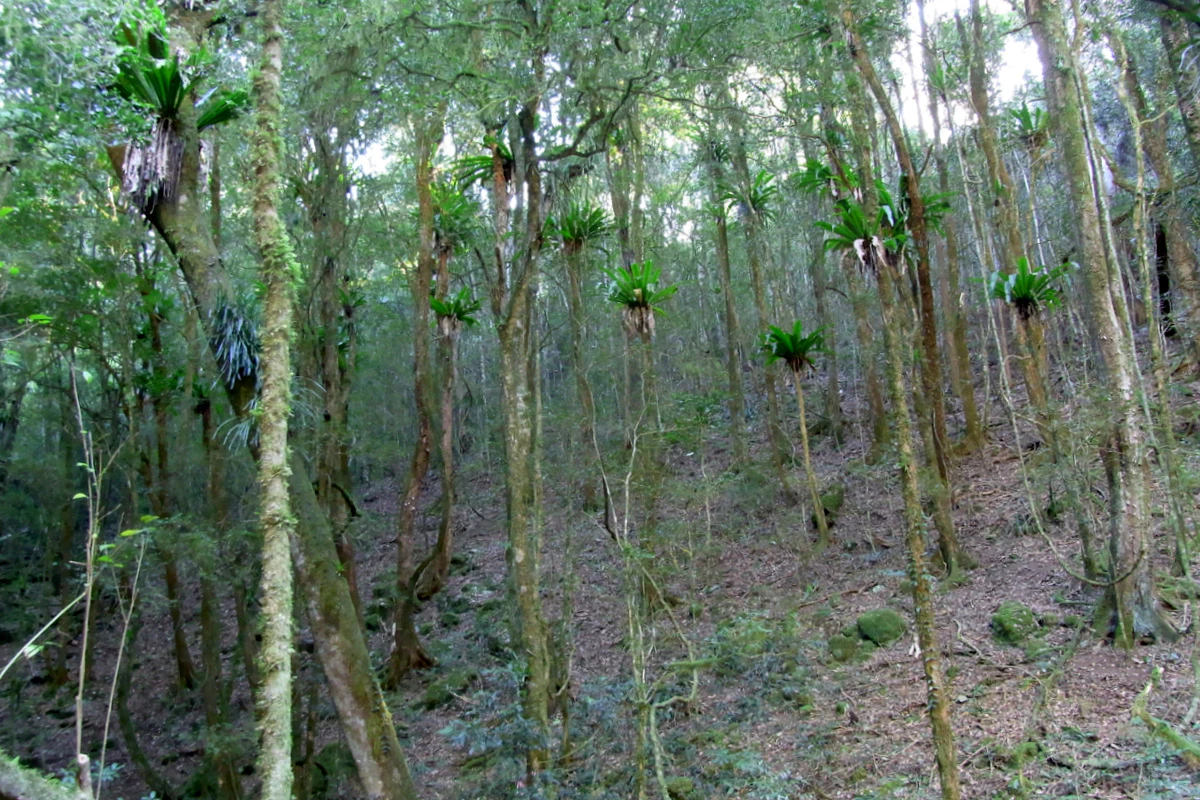
The most ecologically distinctive feature of Copeland Tops is its dry rainforest community. Within the wet eucalypt matrix, sheltered pockets of drier rainforest host a suite of typically subtropical species, including shatterwood, black booyong, Moreton Bay fig, and white cedar. Some red cedar specimens within the rainforest exceed forty metres in height, making them among the most striking trees in the reserve.
The rainforest canopy supports a rich epiphytic flora, including large bird's nest ferns, staghorn ferns, and elkhorn ferns that perch on trunks and branches. The combination of wet eucalypt forest, dry rainforest patches, and abundant moisture from local creek systems gives Copeland Tops an unusually layered vegetation profile for an inland Hunter Region reserve.
Copeland Tops State Conservation Area wildlife and species highlights
Wildlife is one of the strongest draws of Copeland Tops, with a rich assemblage of marsupials inhabiting both the eucalypt forest and the rainforest pockets. Koalas are present in the eucalypt forest, while eastern grey kangaroos are commonly seen in more open areas. Red-necked wallabies, wombats, and greater gliders, the last of which is a large gliding marsupial dependent on tall trees with hollows, round out the headline fauna.
The abandoned gold mine shafts provide an additional, less obvious wildlife habitat. Microbats use the dark, sheltered spaces inside the old workings as daytime roosts, turning relics of the 1870s mining rush into modern conservation assets for insectivorous bat species.
Together, the mix of canopy-dwelling mammals, ground-dwelling marsupials, and cave-roosting bats gives Copeland Tops a broad faunal profile that complements its botanically diverse forest.
Copeland Tops State Conservation Area conservation status and protection priorities
Copeland Tops is significant for conservation because it protects an unusual mosaic of wet sclerophyll eucalyptus forest and dry rainforest on the foothills of the Barrington range. The persistence of dry rainforest species such as shatterwood, black booyong, Moreton Bay fig, and very tall red cedar within a wet eucalypt landscape is uncommon in the Hunter Region, and the reserve helps safeguard rainforest species at the margins of their typical range.
The reserve also delivers fauna conservation outcomes through habitat protection. Continuous forest cover supports populations of koalas, eastern grey kangaroos, red-necked wallabies, wombats, and greater gliders, while the presence of very tall trees with hollows is particularly important for hollow-dependent species such as greater gliders. The unexpected conservation value of the abandoned gold mine shafts as microbat roosts adds a further dimension to the site's ecological importance.
Copeland Tops State Conservation Area cultural meaning and human context
The cultural identity of Copeland Tops is closely tied to the late nineteenth century gold rush that briefly transformed the area. Gold discovered by timber collectors in 1875 drew around one thousand people to what had been a quiet forested landscape by 1878, and the Mountain Maid mine in particular became a defining local landmark.
Although most mining activity ceased by 1890, the physical relics of that era, especially the Mountain Maid workings and their associated infrastructure, remain visible within the conservation area. The mine is now visited with a guide and interpreted as part of the area's heritage layer, allowing modern visitors to engage with both the natural and industrial past of the Barrington foothills.
Top sights and standout views in Copeland Tops State Conservation Area
Copeland Tops offers a layered combination of rainforest, tall eucalypt forest, and nineteenth century mining heritage within a single protected area. Standout highlights include the dry rainforest pockets with their towering red cedar and mature Moreton Bay fig, the visually arresting epiphytic fern colonies, and the interpretive tour of the Mountain Maid gold mine.
The reserve's accessibility from Gloucester and its proximity to the larger Barrington Tops also make it a practical anchor for exploring the broader Hunter Region forests. Its wildlife profile, particularly koalas, red-necked wallabies, greater gliders, and the microbats that roost in the old mine shafts, rounds out a set of features that distinguish Copeland Tops from neighbouring reserves.
Best time to visit Copeland Tops State Conservation Area
Because Copeland Tops sits in a wet, forested part of the Hunter Region, the cooler months of late autumn, winter, and early spring tend to offer a quieter atmosphere, comfortable walking conditions, and good visibility in the tall forests for both birdwatching and general wildlife observation. The rainforest pockets with their epiphytic ferns are most striking in the wetter part of the year, when moisture levels are high and the ferns are at their most lush.
Summer can be warm and humid, and visitors should be prepared for variable terrain and creek-side conditions year-round. The Mountain Maid gold mine site can be visited with a tour guide, and guided mine tours are typically easiest to plan around the cooler and drier months, when access to the workings and surrounding tracks is generally most comfortable.