Why Thap Lan National Park stands out
Thap Lan is best known for its extensive dry evergreen forest ecosystem, which is among the most intact in mainland Southeast Asia, and its significant tiger population that researchers believe may exceed China's. The park contains rare fan palm forests near Ban Thap Lan, one of the few remaining in Thailand, with these ancient trees producing the largest inflorescence in the plant kingdom. The park also protects critical watershed areas and serves as an ecological corridor connecting several of Thailand's most important national parks within the Dong Phayayen-Khao Yai Forest Complex.
Thap Lan National Park history and protected-area timeline
Thap Lan National Park was established on December 23, 1981, becoming Thailand's 40th national park. The creation of the park reflected growing recognition in Thailand during the late 1970s and early 1980s of the need to protect remaining intact forest areas in the eastern regions of the country. The park was designated as part of the Dong Phayayen-Khao Yai Forest Complex, which received UNESCO World Heritage status in 2005, recognizing its outstanding universal value as a complex of protected areas supporting significant biodiversity.
The park has faced ongoing challenges with illegal encroachment, particularly from resort developments. In May 2012, authorities discovered three illegal buildings constructed on 20 rai of park land at a resort, leading to charges of forest encroachment. A follow-up raid in 2017 found the same resort had expanded to occupy 34 rai with 18 buildings. The failure to prosecute the resort operator in 2018 highlighted persistent enforcement challenges facing Thailand's national park system.
Thap Lan National Park landscape and geographic character
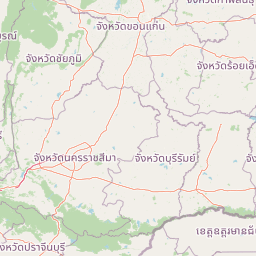
Thap Lan National Park encompasses the Sankamphaeng Range, a mountainous area in eastern Thailand characterized by steep ridges, deep valleys, and dramatic chasms. The highest peak within the park is Khao Lamang at 992 meters above sea level. The terrain varies from rugged mountain slopes to valley floors where streams have carved channels through the forest. Numerous waterfalls cascade down the mountain sides, including Namtok Thap Lan (Thap Lan Waterfall), also known as Namtok Heo Nok Kok, and Namtok Huai Yai. The park also contains the Thap Lan Reservoir and Lam Mun Bon Dam, which provide water storage and habitat within the protected area. The landscape supports extensive forest cover across the elevation gradient, with dry evergreen forest dominating the lower slopes and transitioning to other forest types at higher elevations.
Thap Lan National Park ecosystems, habitats, and plant life
The park's dominant forest type is dry evergreen forest, which covers most of Thap Lan's lower mountain slopes. This forest ecosystem is characterized by tall trees from the Dipterocarpaceae family and Hopia species, creating a dense canopy that supports the park's rich biodiversity. Bamboo thickets occur in drier forest areas throughout the park. Near the villages of Ban Thap Lan, Ban Khun Sri Bupram, and Ban Wang Mued, the park contains rare forests of fan palm or Talipot palm (Corypha umbraculifera), representing one of the few remaining such forests in Thailand. These ancient palms once dominated much of northeastern Thailand before agricultural expansion reduced their range. The fan palm holds particular cultural significance in Thai tradition, as its large leaves historically served as parchment for inscribed Buddhist texts. These remarkable trees produce a single massive inflorescence containing up to 60 million flowers, the largest in the plant kingdom, after which the tree completes its life cycle and dies.
Thap Lan National Park wildlife and species highlights
Thap Lan National Park supports an impressive array of wildlife, thanks to its large size and connectivity to other protected areas within the Dong Phayayen-Khao Yai Forest Complex. The park is home to tigers, elephants, buffaloes, serow, black bears, and sun bears, along with crown gibbons, hornbills, pheasants, and lorikeets. Researchers have noted that the park may harbor more tigers than any location in China, making it one of the most significant tiger conservation areas in Asia. The park has confirmed 149 bird species within its boundaries, including several rare species restricted to lowland evergreen forest such as the green imperial pigeon, stork-billed kingfisher, scaly-crowned babbler, collared kingfisher, and Jerdon's baza. There is ongoing hope that the kouprey, one of the world's most endangered mammals and a primitive cattle species not sighted in Thailand for over 30 years, may still survive in Thap Lan and adjacent Pang Sida National Park. In dense forest areas near water, green dragontail butterflies (Lamproptera meges) can be observed.
Thap Lan National Park conservation status and protection priorities
Thap Lan National Park forms the core of the Queen Sirikit's Dong Phayayen-Khao Yai Forest Complex, a UNESCO World Heritage Site that includes five other protected areas. This recognition reflects the park's outstanding significance for biodiversity conservation in mainland Southeast Asia. The park provides critical habitat for large mammals including elephants and tigers, with better protection for elephants in Thap Lan compared to the Dangrek Range where hunting remains common. However, the park has faced persistent challenges with illegal encroachments on its boundaries, a problem that has persisted for nearly 40 years. The enforcement difficulties illustrate broader tensions between development pressures and conservation priorities in Thailand's rapidly modernizing society. Despite these challenges, Thap Lan remains one of the most important conservation areas in Thailand and Southeast Asia, protecting intact forest ecosystems and supporting populations of endangered species.
Thap Lan National Park cultural meaning and human context
The fan palm forests within Thap Lan hold particular significance in Thai cultural heritage. The large leaves of the Talipot palm were traditionally used as parchment for inscribing Buddhist texts, connecting the park's natural resources to centuries of religious tradition in Thailand. These ancient palms, which produce the largest inflorescence in the plant kingdom, represent a living link to historical practices of textual preservation. While much of northeastern Thailand was converted to agricultural use, Thap Lan has preserved one of the few remaining fan palm forests in the country, maintaining both ecological and cultural value.
Top sights and standout views in Thap Lan National Park
Thap Lan National Park stands as Thailand's second-largest protected area and a cornerstone of the Dong Phayayen-Khao Yai Forest Complex World Heritage Site. The park protects extensive dry evergreen forest supporting what may be Asia's highest tiger population, along with elephants, bears, and over 149 bird species. Rare fan palm forests near Ban Thap Lan represent one of the last remaining in Thailand, with cultural ties to Buddhist textual traditions. The Sankamphaeng Range provides dramatic mountain scenery with peaks reaching 992 meters, while numerous waterfalls including Namtok Thap Lan and Namtok Huai Yai add to the park's natural attractions. The park's role as an ecological corridor connecting multiple national parks enhances its conservation significance across the region.
Best time to visit Thap Lan National Park
Thap Lan experiences three distinct seasons that affect the visitor experience. The rainy season from May to October brings regular rainfall, with October being the wettest month, creating lush green landscapes and full waterfalls though some trails may be more difficult. The cold season from November to February offers comfortable temperatures with average daily maximums around 24 degrees Celsius in December, making this period popular for hiking and wildlife viewing. The hot season in March and April sees temperatures rising to around 31 degrees Celsius, which while warm, can be suitable for visitors who prefer drier conditions. The mean annual temperature is approximately 28 degrees Celsius throughout the year.