Why Alania National Park stands out
Alania National Park is best known for its dramatic mountain scenery at the convergence of major Caucasian ranges, combined with extensive pine-birch forests and a strong presence of traditional Ossetian cultural sites. Its most distinctive trait is the combination of vertical relief, with valley entrances near 1,350 meters and summits above 4,600 meters, that compresses dozens of microclimates and ecosystems into one protected area. The park's Urukh basin and surrounding uplands hold more than fifty glaciers, a network of glacial lakes, and prominent cascades such as the Galdoridon and Taymazi waterfalls. It is equally known for the rich blending of European, Siberian, Mediterranean, and Central Asian faunal and floral elements that the Caucasus supports. Endemic and narrowly regional plants such as dolomite bellflower, Digoria rye, and Caucasian gentian grow here alongside the East Caucasian tur and chamois in its alpine reaches. The protected area's mix of inhabited medieval villages, defensive towers, sanctuaries, and wild high-mountain terrain is another defining characteristic that visitors often associate with the park's identity.
Alania National Park history and protected-area timeline
The idea of creating a national park in North Ossetia emerged in the late 1950s, when local scientists and conservationists began arguing that the republic's mountain ecosystems deserved formal federal protection. An early practical step was taken in 1958 with the organization of the Tseyskiy refuge in the submontane and mountain zone, covering roughly thirty hectares and accompanied by a network of species-oriented hunting reserves at Zamankul, Zmeysko-Nikolayevsky, Turmon, Saur, and Mahcheskiy. In 1967, the federal North Ossetian State Nature Reserve was established to provide a higher level of protection for selected species and habitats, further strengthening the case for an additional category of reserve.
Throughout the following decades, the campaign for a national park gathered momentum through academic publications and newspaper advocacy. T. Basiev, deputy chairman of the North Ossetian branch of the All-Russian Society for Nature Conservation, and H. Gobeev, deputy head of the republic's forestry administration, championed the idea in professional circles, while articles in the newspaper Sotsialisticheskaya Osetiya, including A. S. Budun's piece on whether a national park was a luxury or a necessity and B. M. Beroev's repeated essays pressing for its creation, kept the discussion in the public eye. Students and faculty of the geography department at North Ossetian State University developed diploma projects on possible park designs, comparing options in the inter-river zone between the Ardon and Urukh rivers against locations on the lower ridges of the Greater Caucasus.
By the mid-1990s, the strongest consensus had formed around establishing the park in the westernmost, most mountainous corner of the republic, in the historical region of Mountain Digoría. On 18 February 1998 the Russian government signed the decree officially creating National Park Alania, defining it as an environmental education and scientific research institution whose territory also safeguards many natural, historical, and cultural monuments. The first director, with strong support from the republic's forestry minister K. D. Khetagurov, assembled staff, exchanged experience with operators of existing parks in neighboring Russian regions, and launched conservation campaigns such as the early "Fir Tree Campaign" against illegal logging.
Subsequent years brought the development of the park's scientific and zoning framework, including the project "Biogeographic Foundations for the Functional Zoning of National Park Alania," supported by the republic's ministry of ecology and the regional environmental fund. In April 1999 the park participated in the national "March of Parks" campaign, hosting journalists, environmental clubs, and excursion programs. Research institutions, university ecologist clubs, and environmental organizations such as the "Viola" club at North Ossetian State University contributed to defining the park's internal zoning systems. Since then, the park has continued to expand its environmental education, ecological trail development, and mountaineering infrastructure, while working with local communities on cultural heritage preservation across the protected zone.
Alania National Park landscape and geographic character
Alania National Park is essentially a vertical landscape, climbing from the narrow forested gorge of the Urukh River near 1,350 meters to the summit of Mount Uilpata at 4,646 meters, a vertical span that compresses an enormous variety of terrain into a compact area. The single road into the park climbs through the Akhsinte Canyon, a narrow and unusually dramatic limestone gorge that serves as the reserve's main gateway and visually establishes the wild character of the territory beyond. From there, the Urukh River basin opens into broader valleys, flanked by tributary gorges of Bilagidon, Kharesskoye, Gebidonskoye, Karaugomskoye, and Uallagkomskoye, each with its own side ridges and glacial cirques.
Above the forested valley walls, the relief transitions into a subalpine belt of birch woodlands, then into short-grass alpine plateaus, rock fields, and snow-and-ice terrain of the high Caucasus. Glacial activity has shaped much of the upper landscape, leaving behind steep cirque walls, moraines, hanging valleys, and a series of glacial lakes including the Mikhelai, Gularskie, Bartuiskoye, and Madzaskatsad lakes. More than fifty active glaciers remain in the park, distributed across the basins of the Urukh, Khaznidon, and Aigamugidon rivers, with named examples such as the Karaugomskiy and Tana glaciers contributing to the area's defining sense of cold and high relief.
Water is a constant feature of the terrain, expressed in powerful cascading rivers and tall waterfalls that plunge from glacial sources down through the gorge walls. Named cascades in the park and its buffer zone include Galdoridon, Taymazi, the Soldier waterfall on the Orsdon River, the Devil's Mill on Kharessodon, and the Gavized waterfall. Mountain peatlands such as Chifandzar, Kharesskiy, and Kubusskiy occupy flatter sections where meltwater accumulates, while the Donifars-Zadalessk basin hosts drier slopes with a more steppe-like character. Throughout the park, larger boulders and residual glacial erratics hint at the scale of Pleistocene glaciation that produced these forms.
Alania National Park ecosystems, habitats, and plant life
The ecological character of Alania National Park is defined by steep environmental gradients, from low-elevation canyon forests to alpine meadows, subnival rock habitats, and glacial surfaces, supporting an exceptionally diverse flora. More than a thousand plant species have been recorded within the park, including endemic and narrowly regional taxa such as dolomite bellflower, Digoria rye, Akinfiyev's kharezia, and Caucasian gentian. The forest cover, occupying roughly sixty percent of the area, is dominated by Koch pine along with grey alder and Litvinov birch, frequently forming mixed stands where rowan and aspen appear in the understory.
Above the closed canopy, the slopes give way to subalpine birch crooked woodland on northern aspects, with patches of Caucasian rhododendron adding an evergreen shrub layer. Where the forests yield to open ground at around 1,900 to 2,200 meters, classic subalpine meadows develop, populated by Alpine aster, mountain poppy, saxifrage, and gentian-like speedwell. Even higher, the Donifars-Zadalessk basin harbors a contrasting xerophytic flora of wormwood, thyme, fescue, and burnt astragalus, with juniper, wild rose, and barberry appearing as scattered shrubs in drier pockets.
Riverine environments add another layer to the park's ecological mosaic, with thickets of sea buckthorn and myricaria following stream channels and stabilizing banks. More than fifty species of medicinal plants are used locally, including burnet, shrubby cinquefoil, oregano, and common caraway. The combination of Caucasian, European, Mediterranean, and Central Asian botanical influences gives the flora a mixed identity that mirrors the geographic position of the broader Caucasus region, making the park an important refuge for plants that may be retreating elsewhere under climate pressure.
Alania National Park wildlife and species highlights
The animal life of Alania National Park reflects the same vertical and biogeographic diversity that defines its vegetation. About thirty-four mammal species have been recorded in the park, the most iconic being the East Caucasian tur, an endemic mountain goat that inhabits the cliff bands and alpine meadows of the higher ranges, and the chamois, represented here by a Caucasian subspecies. Roe deer forage through the mixed forest belts, while wild boar and brown bear make use of the more sheltered forested slopes. Smaller carnivores are common, with red fox as the most visible small predator, supported by pine and stone martens in forested and rocky habitats respectively.
The park's minority mammals include adapted specialists in cold environments such as an endemic subspecies of stoat on the boulder fields of the subalpine belt and an introduced population of Altai squirrel in the pine forests, the result of mid-twentieth-century acclimatization efforts. Shrews patrol the moist hay meadows and clearings of deciduous forests, while the attics of mountain villages in the gorges provide roosts for bats including the grey long-eared bat. More than 116 bird species have so far been recorded, including forty-two breeding species and nearly forty year-round residents, with strong representation of predator species, alpine ground birds, and forest songbirds.
Avifauna at Alania has a particular Caucasian character because the Caucasus acts as a meeting point between European, taiga, Mediterranean, and Central Asian faunas. Songbirds like the song thrush represent European influences, while Siberian taiga elements such as Tengmalm's owl, crossbill, and bullfinch extend down from the north. The red-fronted serin represents Mediterranean influences, while bearded vulture, Caucasian snowcock, and Alpine accentor descend from the Central Asian alpine avifauna. Mammals and birds together make the park a regionally important area for tracking species' range shifts and climate-driven ecological change in the North Caucasus.
Alania National Park conservation status and protection priorities
Alania National Park was explicitly established to preserve the unique natural complexes at the southwestern edge of the Republic of North Ossetia in the face of growing pressure on mountain ecosystems from logging, grazing, and unregulated tourism. Its IUCN management category is II, the standard classification for national parks, indicating that its primary purpose is to protect ecological integrity while still permitting compatible forms of public enjoyment and scientific use. The park is paired with the older, strictly protected North Osettian Nature Reserve along its southern boundary, creating a continuous gradient of protection from wilderness core to semi-developed visitor area.
Because the park's territory contains forested canyons, alpine meadows, peatlands, glacial lakes, and active glaciers, it plays an important role in protecting a wide spectrum of Caucasian habitats, including those that are sensitive to climate change. Important refuges for the East Caucasian tur, Caucasian chamois, brown bear, and Caucasian red deer lie within or adjacent to the park, giving it regional significance for the conservation of these ungulate populations. The mixed flora, including more than fifty medicinal and many narrowly endemic species, also represents a genetic reservoir that is poorly represented elsewhere in Europe and Asia.
The park has supported active environmental education and outreach from its earliest years, running public campaigns such as the fir tree conservation initiative and participating in national programs like "March of Parks". Scientific zoning of the park, developed in partnership with North Ossetian State University and various research institutions, helps direct human use away from ecologically sensitive areas. Financial support from the republic's environmental fund and the federal ministry of natural resources has underwritten both research projects and public awareness work. Over time, this combination of formal protection, scientific study, and active public engagement has positioned the park as an important conservation node within the broader Caucasus ecoregion.
Alania National Park cultural meaning and human context
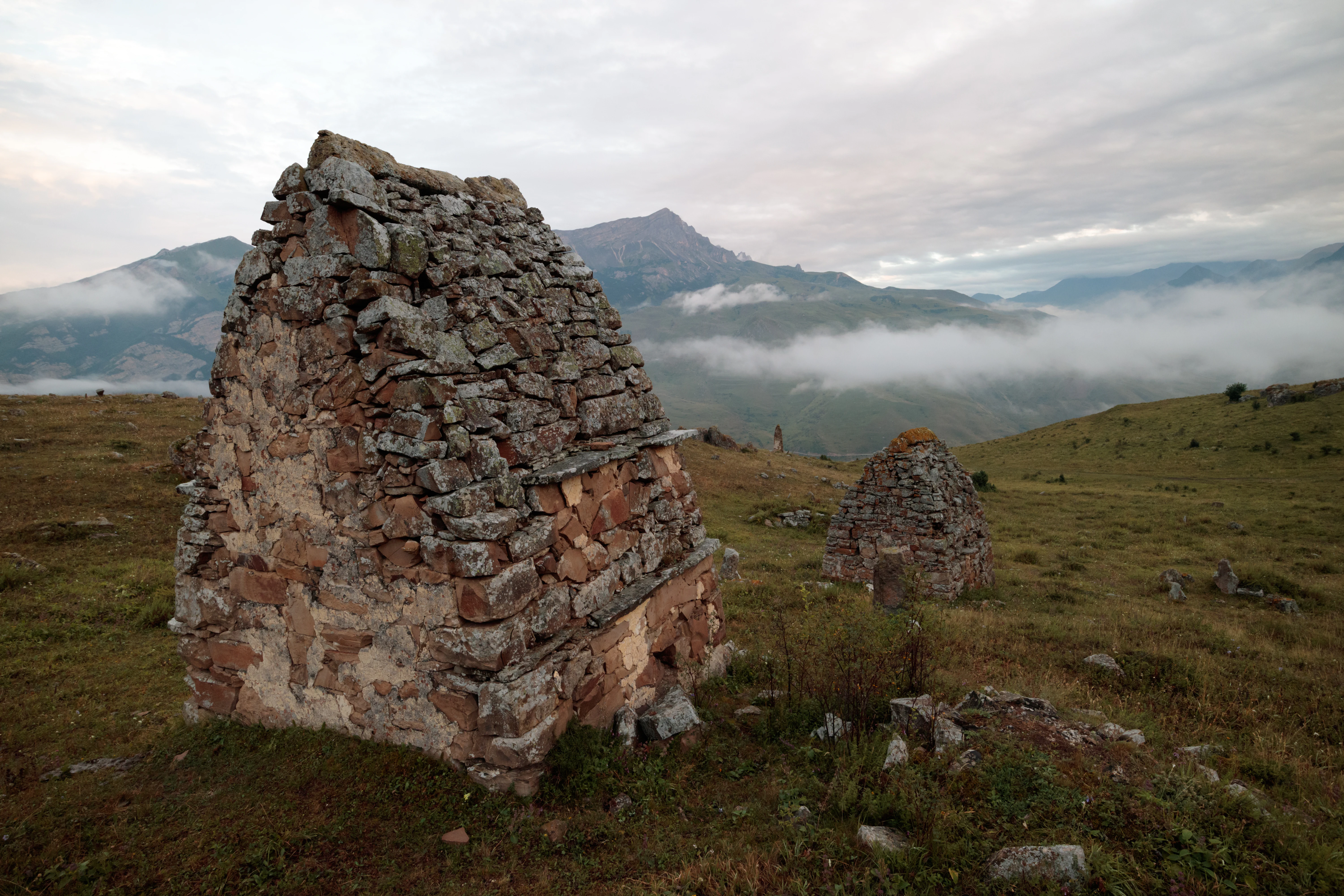
Alania National Park is deeply intertwined with the culture and history of the Ossetian people, whose medieval and pre-medieval settlements, sanctuaries, and burial sites lie within and around its territory. The historical region of Mountain Digoría, the heart of the park, has been inhabited continuously for millennia, leaving behind cave shelters, fortified caves, catacomb burial grounds, sanctuaries, stone defensive towers, and crypt-tombs still visible across the landscape. Cave sites such as Digorí-izad near Zadalesks contain important paleozoological material and reflect the long continuity of human presence in these deep mountain valleys.
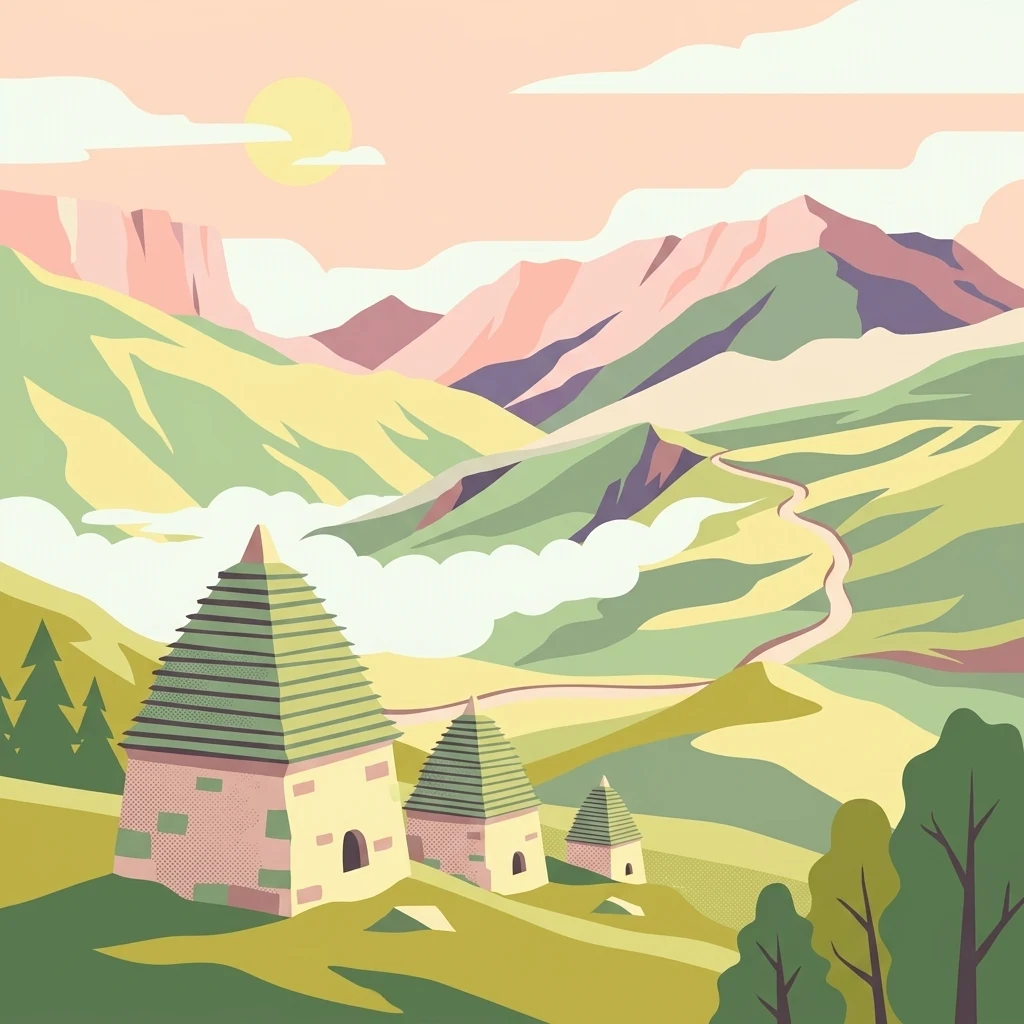
Medieval defensive architecture is one of the park's most visible cultural features, with named towers associated with lineages such as the Telakurovy and Tegayevy in the village of Akhsau, the Kubatiyev and Tukhayev towers in Upper Fasnal, the Abisalov tower in Mahchesk, and the Khaymanov tower in Stur-Digora. Sites such as the White Greek Castle, the Castle-Frigate at Khanaze, the church known as Satayi Obau, and the Donifar-Lezgor necropolis add archaeological depth, with many sanctuaries and tombs preserving bone material from turs, deer, chamois, and domestic animals that enable paleozoological reconstructions. These sites reflect an enduring Ossetian attachment to the land and its monuments.
Top sights and standout views in Alania National Park
The strongest features of Alania National Park are the dramatic vertical relief of its canyons and peaks, the unexpected diversity of glacial and karst features within a relatively compact area, and the close integration of natural protection with Ossetian cultural heritage. The combination of a single-road entrance through the Akhsin Canyon, more than fifty glaciers, and a classic succession from pine forest to alpine meadow makes the park a rich laboratory for mountain ecology.
Visitors are drawn to its glacial lakes, towering waterfalls such as Galdoridon and Taymazi, and historic Digor villages with their medieval stone towers and crypts. Less well known but equally defining features include the high-mountain peatlands, large glacial erratics in places like the Fastag Gorge, and the park's role as a stronghold for the East Caucasian tur and Caucasian chamois.
Best time to visit Alania National Park
Alania National Park is at its most accessible from late spring through early autumn, when the single access road through the Akhsinta Canyon is reliably open above the major snow-affected part of the season and the snowline retreats high enough to permit trekking into the alpine zone. Summer months, between June and September, bring peak wildflower display in the subalpine meadows and the warmest conditions for travel through the higher Urukh valleys, making this period the practical choice for landscape-focused visits and hiking.
Shoulder seasons outside this window tend to narrow the choice of accessible routes, with deeper snow persisting at higher elevations into spring and snow beginning to return in the upper park by October or November. Winter brings substantially more challenging conditions, with extensive snow cover, very narrow access windows, and a different visual character of the park dominated by ice and snow. Spring thaws and early autumn rains can also temporarily affect the canyon road conditions, so visitors generally find the warmest mid-summer months to be the most reliable period for reaching the park's interior landscapes.