Why Altai Tavan Bogd National Park stands out
The park is best known for two exceptional features that distinguish it across all of Central Asia. First, the Tavan Bogd massif itself, a dramatic wall of five granite peaks that form the spiritual and geographic heart of the Altai range, sacred to local Kazakh herders and revered as a place of pilgrimage. Second, the UNESCO World Heritage-listed Petroglyphic Complexes of the Mongolian Altai, which include the Tsagaan Salaa Rock Paintings featuring over 10,000 cave drawings distributed across 15 kilometers of river valley, alongside Turkic standing stones and burial monuments that document millennia of human presence in these highlands.
Altai Tavan Bogd National Park history and protected-area timeline
Altai Tavan Bogd National Park was officially designated in 1996 as part of Mongolia's expanding network of protected areas during the country's post-socialist environmental policy reforms. The creation of the park recognized both the exceptional ecological value of the western Altai frontier and the urgent need to preserve the region's extraordinary archaeological heritage. Prior to formal protection, the Tavan Bogd region had long served as traditional grazing land for Kazakh herders who maintain seasonal camps throughout the park's lower valleys, their presence documented by the very petroglyphs and standing stones that the park now protects. The park's establishment coincided with growing international recognition of the Mongolian Altai's cultural significance, eventually leading to the inscription of the Petroglyphic Complexes as a UNESCO World Heritage Site spanning multiple protected zones within the park's boundaries.
Altai Tavan Bogd National Park landscape and geographic character
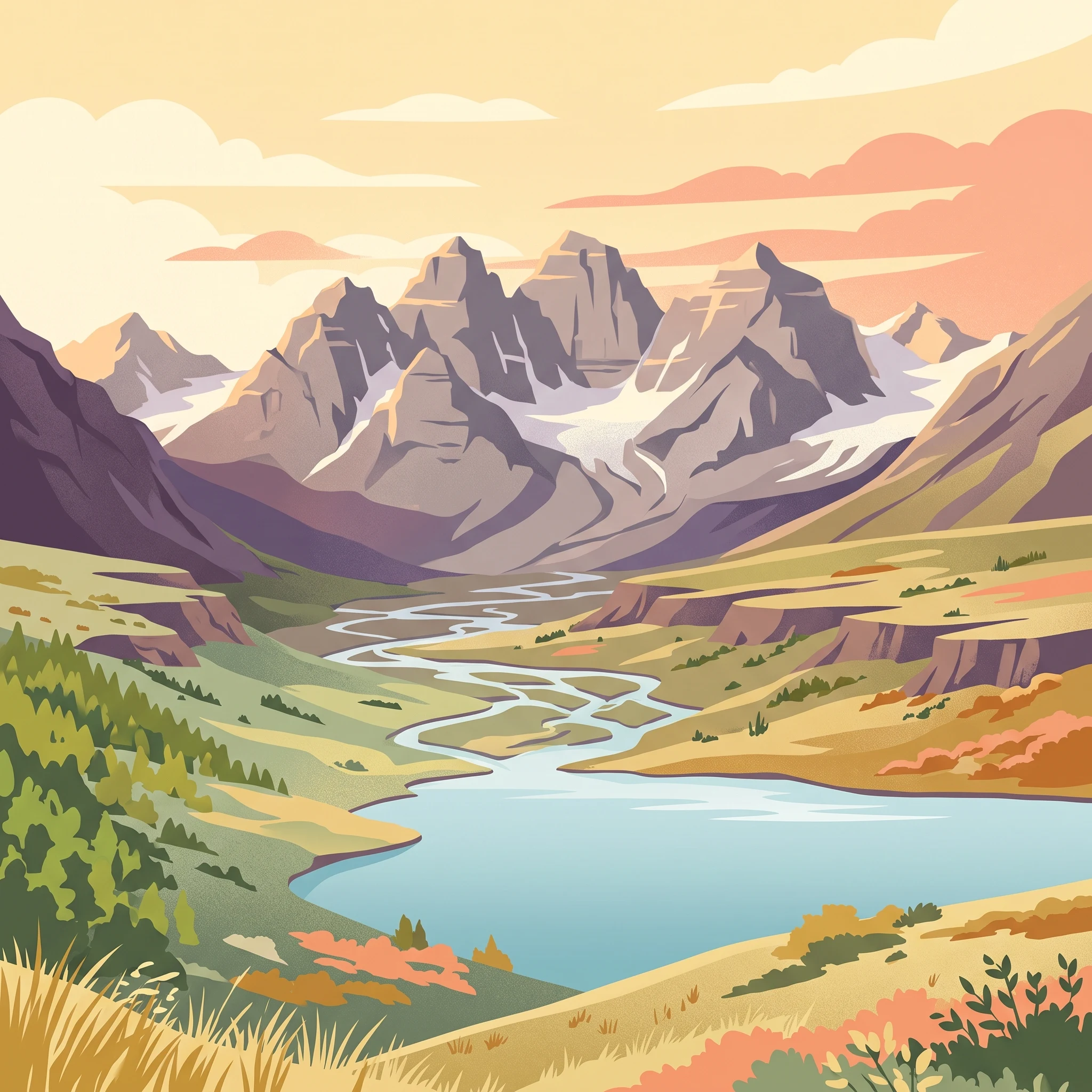
The park's landscape is defined by the imposing presence of Tavan Bogd, a five-peaked granite ridge that forms the highest terrain in Mongolia with summits exceeding 4,300 meters. The massif's peaks, named Nairamdal, Malchin, Bürged, Öngö, and Altan, are the remnants of ancient granite domes sculptured by Pleistocene glaciation into the sharp arêtes and deep cirques visible today. Below the permanent snowline, the terrain descends through a series of nested glacial valleys, many still bearing the scalloped walls and terminal moraines of past ice advances. Three large lakes, Khoton, Khurgan and Dayan, occupy basins carved by glacial action and now fed by snowmelt from the surrounding peaks. The lakes are connected by the Khovd River system and are surrounded by marshy meadowland that supports the park's diverse bird populations. The southern portions of the park transition into more open terrain where rolling steppe meets the mountain front, creating a complex mosaic of habitats across a gradient of over 2,500 meters of elevation.
Altai Tavan Bogd National Park ecosystems, habitats, and plant life
The ecological character of Altai Tavan Bogd reflects its position at the juncture of several biogeographic provinces, combining Siberian taiga elements with Central Asian steppe and High Asian alpine fauna. The park spans multiple ecological zones from the cold desert-steppe of the lake basins through subalpine shrubland and forest to true alpine tundra and permanent snowfields. The vegetation communities include alpine meadows dominated by sedge and grass species in moisture-receiving valleys, dwarf birch and Siberian juniper scrub on sheltered slopes, and sparse lichen-covered rock communities at the highest elevations. These diverse habitats support a remarkable concentration of large mammals, with the park serving as one of the last strongholds for snow leopards in Mongolia alongside populations of ibex, argali sheep, red deer, and moose. The lakes and wetlands provide critical breeding habitat for waterfowl including whooper swans and various duck species, while the cliffs and rock faces host breeding populations of golden eagles and the secretive snow cock.
Altai Tavan Bogd National Park wildlife and species highlights
The mammal fauna of Altai Tavan Bogd represents one of the most significant assemblages of large alpine species remaining in Central Asia. Snow leopards persist in the high rocky terrain above the treeline, though they remain elusive and difficult to survey with certainty. Ibex navigate the steep cliff bands with remarkable agility and are the park's most commonly observed mountain ungulate. Argali sheep, the largest wild sheep species in the world, occupy the more open alpine slopes and have been the focus of conservation efforts to maintain viable populations in the face of hunting pressure. Red deer and moose inhabit the forest-steppe transition zone in the park's southern reaches, while the smaller beech marten represents the park's complement of mesocarnivores. The avian community includes the golden eagle, venerated in Kazakh falconry traditions and still trained by local hunters, along with the snow cock which inhabits the alpine rock fields. The three lakes support populations of native fish and serve as staging areas for migratory waterfowl moving between breeding grounds in the Russian Altai and wintering areas further south.
Altai Tavan Bogd National Park conservation status and protection priorities
Altai Tavan Bogd holds IUCN Category II designation as a national park, reflecting its primary mandate to protect natural ecosystems while allowing for sustainable use by local communities. The park's exceptional biodiversity values, particularly the presence of snow leopard and argali populations, have drawn attention from international conservation organizations working to secure viable populations of these threatened species across their Central Asian range. The parallel protection of the Petroglyphic Complexes of the Mongolian Altai as a UNESCO World Heritage Site, with its component zones falling within the park boundaries, creates a unique dual mandate for both natural and cultural heritage preservation. Management challenges include the remoteness of the site, the needs of traditional Kazakh herding communities who hold grazing rights within the park, and the pressures exerted by illegal hunting and wildlife trade that threaten species like the snow leopard. The park's inclusion within the broader transboundary Altai region creates opportunities for international cooperation in wildlife monitoring and habitat connectivity, though the actualization of such cooperation remains limited.
Altai Tavan Bogd National Park cultural meaning and human context
The cultural landscape of Altai Tavan Bogd reflects millennia of continuous human presence in these high mountain valleys, preserved most visibly in the extraordinary rock art complexes that constitute one of Central Asia's greatest archaeological treasures. The Tsagaan Salaa rock paintings, featuring over 10,000 figures distributed across 15 kilometers of river valley, document a remarkable sequence of artistic traditions from the Neolithic period through the Bronze Age and into the Turkic era of the first millennium. These images depict hunting scenes with bowmen pursuing ibex and deer, astronomical symbols, and anthropomorphic figures that provide rare visual documentation of the spiritual beliefs and daily life of ancient peoples inhabiting these remote highlands. Additionally, the park contains numerous Turkic standing stones, or balbals, arranged in lines or circles near burial sites that mark the presence of medieval Turkic nomads. Contemporary Kazakh communities maintain seasonal herding camps throughout the park's lower valleys, continuing traditions of livestock husbandry that have shaped the landscape for generations and maintaining cultural connections to the land that encompasses their ancestral territory and sacred mountain.
Top sights and standout views in Altai Tavan Bogd National Park
Altai Tavan Bogd stands as one of Mongolia's most comprehensively significant protected areas, combining the drama of the Altai's highest peaks, the ecological richness of a biogeographic crossroads, and the profound human heritage preserved in thousands of years of rock art. The five granite peaks of Tavan Bogd rising above glacial valleys and pristine lakes create an iconic mountain landscape recognized as sacred by local communities. The Tsagaan Salaa petroglyphs, with their tens of thousands of ancient images, constitute one of the largest and most important rock art complexes in Eurasia and anchor the park's World Heritage designation. The presence of snow leopard, ibex, and argali in the park's high terrain represents a rare opportunity to observe some of Central Asia's most emblematic wildlife in a relatively intact alpine ecosystem.
Best time to visit Altai Tavan Bogd National Park
The most favorable season for visiting Altai Tavan Bogd spans from late June through early September, when the alpine weather stabilizes and the high mountain passes become accessible. Summer temperatures in the valleys reach comfortable levels while the higher elevations remain cool, and the long daylight hours allow extended exploration of the park's remote terrain. The summer months coincide with the brief flowering of alpine meadows and the active season for wildlife observation, though snow leopards remain elusive regardless of season. The shoulder seasons of May and October offer possibilities for those seeking fewer visitors and the dramatic atmosphere of early winter conditions settling over the mountains, though many trails and facilities are closed during these transition periods. Winter access to the park is extremely limited due to harsh conditions and the practical challenges of reaching the remote western region during the snowbound months.