

Mori Atlas logo
National parkCerro Azul Meámbar National Park

Discover the mapped boundaries and regional geography of this national park in Honduras.

Cerro Azul Meámbar National Park: Protected Landscape and Geographic Atlas Entry

Cerro Azul Meámbar National Park represents a significant protected landscape within the national geography of Honduras. This page serves as an atlas-focused entry point, detailing the park's mapped boundaries and its place within the broader Central American region. Users can explore its protected-area identity and understand its role in the country's natural landscape context through structured geographic data.

cloud foresthighland protected areaCentral American national parkHonduran parksmontane ecosystemspine-oak forest

Cerro Azul Meámbar National Park

National park

Park overview

Structured park overview, official facts, and landscape profile for Cerro Azul Meámbar National Park

Cerro Azul Meámbar National Park park facts, protected area profile, and essential visitor context
Review the core facts for Cerro Azul Meámbar National Park, including designation, size, terrain, visitor scale, habitats, and operating context in one park-focused overview.

About Cerro Azul Meámbar National Park

Cerro Azul Meámbar National Park occupies a significant position in Honduras's protected area network as one of the nation's larger mountain parks. The park's location in the Sierra de Sulaco places it within a mountain range that forms part of the broader Honduran highland system, creating a cool, humid environment distinct from the surrounding tropical lowlands. The cloud forest that characterizes much of the park's vegetation develops as moisture from the Caribbean coast rises along the mountain slopes, creating persistent cloud cover and high humidity at these elevations. This moisture regime supports dense vegetation including epiphytes, ferns, and mosses that are characteristic of cloud forest environments throughout Central America. The park's establishment in 1987 reflected Honduras's growing commitment to environmental protection during the 1980s, a period when several national parks and biological reserves were designated throughout the country. The 300-square-kilometer protected area provides a substantial core zone for conservation, while the surrounding landscape includes agricultural land and communities whose activities interface with the park boundaries.

Quick facts and research context for Cerro Azul Meámbar National Park

Cerro Azul Meámbar National Park is located in Cortés Department, central Honduras, within the Sierra de Sulaco mountain range. The park was established in 1987 and covers 300 square kilometers of highland terrain at elevations between 1,800 and 2,047 meters. It is classified as an IUCN Category II protected area, reflecting its national park status. The park's cloud forest environment receives significant precipitation from Caribbean moisture sources, creating humid conditions that support specialized highland vegetation including pine-oak forests and cloud-adapted plant communities.

Park context

Deeper park guide and search-rich context for Cerro Azul Meámbar National Park

Cerro Azul Meámbar National Park history, landscape, wildlife, and travel context
Explore Cerro Azul Meámbar National Park through its history, landscape character, ecosystems, wildlife, conservation priorities, cultural context, and seasonal travel timing in a structured park guide built for atlas discovery and search intent.

Why Cerro Azul Meámbar National Park stands out

The park is notable for its high-elevation cloud forest environment, which supports a distinctive montane ecosystem that differs substantially from the tropical lowland forests found in much of Honduras. The pine-oak forest communities at these altitudes represent a critical habitat type in Central America, supporting species adapted to cooler, more humid conditions than the tropical forests below. The protected area also serves an important watershed function, protecting headwater streams that feed into the Ulúa River system which is vital for agricultural communities in the Sula Valley.

Cerro Azul Meámbar National Park history and protected-area timeline

Cerro Azul Meámbar National Park was established on January 1, 1987, as part of Honduras's expanding protected area system during the late twentieth century. The park's creation reflected growing recognition of the ecological importance of Honduras's highland forests, which had been subject to logging and agricultural conversion throughout the twentieth century. The establishment of the park provided formal legal protection for the cloud forest ecosystems of the Sierra de Sulaco, creating a designated conservation area where extractive activities would be regulated. The park was assigned to IUCN Category II, classifying it as a national park with the primary objective of protecting natural ecosystems while allowing for limited compatible uses. The acronym PANACAM has become the common shorthand for referring to the park in official and informal contexts within Honduras, facilitating communication about the protected area in administrative, scientific, and community settings.

Cerro Azul Meámbar National Park landscape and geographic character

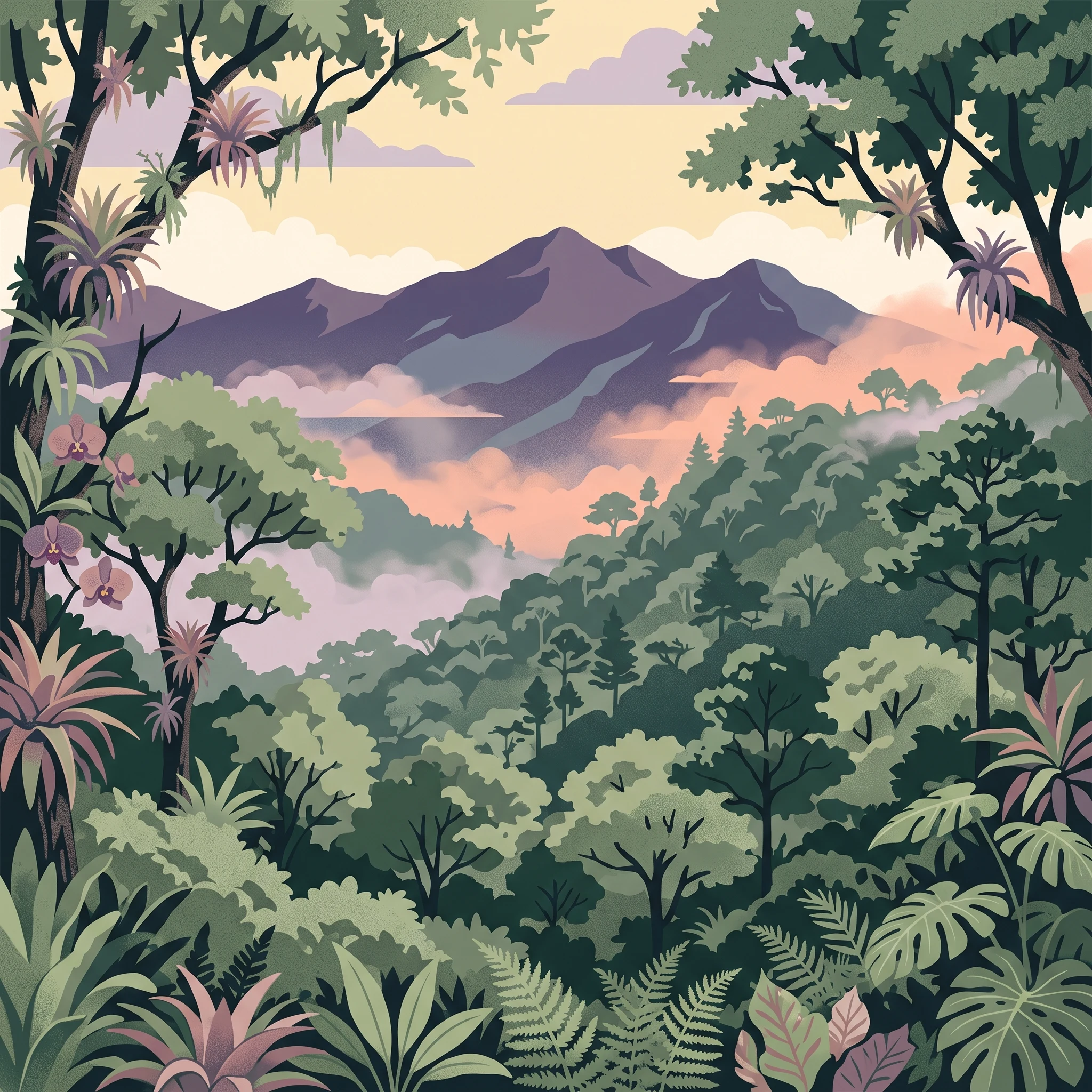
The terrain of Cerro Azul Meámbar National Park consists of rugged mountainous topography characteristic of the Sierra de Sulaco, with steep slopes and narrow valleys descending from the highest ridges. The park's elevation range of 1,800 to 2,047 meters places it in the montane zone, where temperatures are noticeably cooler than the surrounding lowlands and seasonal temperature variation is reduced. The landscape is marked by forested slopes, ridgelines, and drainage channels that carry water from the highland zone toward larger river systems. The combination of high rainfall, steep terrain, and forest cover creates a landscape with significant watershed value, with the park's streams feeding into the Ulúa River basin that provides water for extensive agricultural activity in the Sula Valley. The visual character of the park is dominated by dense forest cover, with the cloud forest creating a often misty atmosphere that is visually distinctive from the clearer, drier conditions found at lower elevations.

Cerro Azul Meámbar National Park ecosystems, habitats, and plant life

The ecological character of Cerro Azul Meámbar National Park is defined by its cloud forest environment, a habitat type that develops when moisture-laden air masses encounter mountain slopes and condense as mist or low cloud. This moisture input supports vegetation communities that differ from both the tropical rainforests of the lowlands and the pine forests found at the highest elevations in Honduras. The cloud forest within the park features dense tree cover with abundant epiphytes, including orchids, bromeliads, and ferns that grow on tree branches and trunks, taking advantage of the constant moisture. The understory typically features dense shrub layer vegetation and the forest floor is often covered with a carpet of mosses and fallen leaves. These forests provide habitat for numerous species adapted to highland neotropical conditions, including many bird species whose distributions are tied to montane forest environments.

Cerro Azul Meámbar National Park conservation status and protection priorities

Cerro Azul Meámbar National Park serves as an important conservation unit within Honduras's protected area network, preserving a habitat type that has been significantly reduced across Central America through logging, agriculture, and development. The cloud forests of the Honduran highlands harbor biodiversity that is increasingly rare as lowland and mid-elevation forests are converted for agricultural use. By protecting this highland area, the park contributes to the conservation of species with restricted elevational ranges that depend on montane forest environments. The watershed function of the protected area adds an additional conservation dimension, as the forests help regulate water flow and maintain water quality for downstream users. The park's Category II status provides a framework for long-term protection while recognizing the importance of maintaining the area as a natural ecosystem.

Cerro Azul Meámbar National Park cultural meaning and human context

The area surrounding Cerro Azul Meámbar National Park is inhabited by communities whose livelihoods are closely tied to the agricultural landscape of the Cortés Department highlands. The town of Meámbar, located near the park boundary, provides a local population center whose residents have traditional connections to the surrounding land. The park's establishment created a protected zone that limits certain land uses within its boundaries while allowing for the continuation of traditional activities that are compatible with conservation objectives. The name Cerro Azul, meaning Blue Hill in Spanish, reflects the visual impression created by the mountain when atmospheric conditions or vegetation create a bluish cast to the ridgeline, a phenomenon noted in the naming of similar features throughout Central America.

Top sights and standout views in Cerro Azul Meámbar National Park

Cerro Azul Meámbar National Park protects one of the most significant highland cloud forest areas in Honduras, preserving montane ecosystems that are increasingly rare in Central America. The park's 300-square-kilometer extent provides a substantial conservation area within the Sierra de Sulaco, protecting watersheds that feed into the Ulúa River basin. The elevation range of 1,800 to 2,047 meters creates conditions for distinctive cloud forest vegetation with abundant epiphytic growth. The protected area represents Honduras's commitment to preserving highland biodiversity and watershed functions within its national park system.

Best time to visit Cerro Azul Meámbar National Park

The cloud forest environment of Cerro Azul Meámbar National Park is accessible year-round, though visitors should expect humid conditions regardless of season. The period from May through November corresponds to the rainy season in Honduras, when precipitation is most abundant and the cloud forest is at its lushest, though trails may be more difficult to navigate. The dry season from December through April tends to offer more comfortable conditions for hiking, though mist and morning clouds remain common in the highland environment. The park's high elevation ensures cooler temperatures than the lowlands, so visitors should prepare for temperate conditions rather than the tropical warmth found in much of Honduras.
Park location guide

Geography guide, regional context, and park location map for Cerro Azul Meámbar National Park

Cerro Azul Meámbar National Park park geography, regions, and map view in Honduras
Understand where Cerro Azul Meámbar National Park sits in Honduras through a broader geographic reading of the surrounding landscape, nearby location context, and its mapped position within the national park landscape.

How Cerro Azul Meámbar National Park fits into Honduras

Honduras, officially the Republic of Honduras, is a Central American nation with a predominantly Mestizo population. It gained independence in 1821 and operates as a unitary presidential republic. The country faces significant economic challenges, with over 70% of its population living in poverty, though it possesses valuable natural resources including minerals, coffee, and tropical fruits.

Wider geography shaping Cerro Azul Meámbar National Park in Honduras

Honduras is located in Central America, bordering Guatemala to the west, El Salvador to the southwest, Nicaragua to the southeast, the Pacific Ocean to the south at the Gulf of Fonseca, and the Caribbean Sea to the north at the Gulf of Honduras. The terrain includes mountainous regions and coastal lowlands.

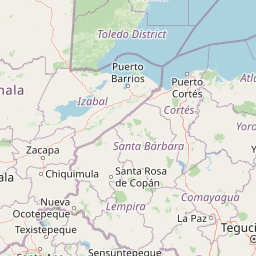
Map view of Cerro Azul Meámbar National Park

Use this park location map to pinpoint Cerro Azul Meámbar National Park in Honduras, understand its exact geographic position, and read its mapped placement within the surrounding landscape more clearly.

Pigeon | © OpenStreetMap contributors
Park atlas

Trace the Regional Geography of Protected Landscapes and Montane Cloud Forests Across Central Honduras

Explore Other National Parks and Protected Areas Near Cerro Azul Meámbar National Park
After exploring Cerro Azul Meámbar National Park, delve into other national parks and protected areas situated within Honduras's significant cloud forest and mountainous terrain. Comparing these protected landscapes helps in understanding the broader regional spread of conservation efforts and the distinct montane ecosystems across Central America.
National parkHonduras

Montaña Santa Bárbara National Park: National Park Geography and Protected Landscape

Mapped boundaries and regional landscape context in Honduras.

Delve into the protected landscape identity of Montaña Santa Bárbara National Park, a significant national park situated in Honduras. This entry provides atlas-focused details on its geographic footprint, mapped terrain, and its role within the nation's protected areas. Understand the park's environmental setting and its importance in the context of Honduran geography for structured exploration.

Area
121.3 km²
Established
1987
IUCN
II
Relief
Mountain
National parkHonduras

Pico Pijol National Park: National Park within the Honduran Geographic Atlas

Explore its mapped boundaries and protected landscape context.

Pico Pijol National Park stands as a protected area within Honduras, offering critical insight into the nation's natural landscapes. This detail page provides essential context for understanding its geographic positioning and mapped boundaries, serving as a foundational element for broader atlas-based exploration of protected regions in Central America. Discover the park's unique identity as a national park and its contribution to regional geographic understanding.

Area
122.1 km²
Established
1987
IUCN
II
Relief
Mountain
National parkHonduras

Montaña de Comayagua National Park: Honduras National Park and Protected Area Geography

Explore mapped boundaries and natural terrain within Central America.

Montaña de Comayagua National Park stands as a vital protected area, contributing significantly to the geographic tapestry of Honduras. This national park offers a focused perspective for atlas exploration, allowing users to trace its mapped boundaries and comprehend its role within the regional landscape. Delve into the park's protected identity and its unique position in the mapped geography of Central America.

Area
184.8 km²
Established
1987
IUCN
II
Relief
Mountain
National parkHonduras

Cusuco National Park: Protected Landscape and Geographic Atlas in Honduras

Explore mapped boundaries and regional natural terrain.

Cusuco National Park represents a crucial protected area within Honduras, offering rich detail for geographic exploration. This entry focuses on its identity as a national park, detailing its mapped boundaries and its contribution to the broader landscape context of Central America. Users can discover the specific protected lands and natural terrain that characterize this significant conservation site, building a foundational understanding for atlas-based study.

Area
234.4 km²
Established
1959
IUCN
II
Relief
Mountain
National parkHonduras

Montaña de Yoro National Park: Honduran National Park Atlas and Protected Landscape Exploration

Understanding its mapped boundaries and regional geography.

This card details Montaña de Yoro National Park, a designated national park in Honduras, offering a focused look at its protected landscape. It provides essential geographic context, helping users to understand the park's mapped boundaries and its significance within the broader atlas of Honduran protected areas. Explore the specific terrain and regional setting that define Montaña de Yoro National Park.

Area
154.8 km²
Established
1987
IUCN
II
Relief
Mountain
National parkLempira Department

Celaque National Park: Mapped Protected Landscape within Lempira Department

National Park Protected Area & Geographic Context

Celaque National Park represents a key protected landscape situated in the Lempira Department of Honduras. This entry offers detailed atlas information, focusing on the park's identity as a national park and its mapped geographic extent. Users can explore the protected boundaries and understand its place within the regional terrain, providing essential context for geographic discovery.

Area
266.31 km²
Established
1987
IUCN
II
Relief
Mountain
National parkHonduras

Cerro Azul de Copán National Park: Honduras's Highland Cloud Forest Protected Area

Explore mapped geography and montane landscape context.

Cerro Azul de Copán National Park, located in the highlands of western Honduras, is a national park defined by its mountainous terrain and distinctive cloud forest environment. Rising to elevations of over 2,200 meters, the park preserves a crucial highland ecosystem known for its biodiversity and role in watershed protection. Its mapped geography offers insight into the unique montane forest structures and the broader natural landscape of Central America. Discover the protected land's specific environmental characteristics and its place within the region's atlas.

Area
154.6 km²
Established
1987
IUCN
II
Relief
Mountain
National parkAtlántida Department

Punta Izopo National Park: Honduran National Park with Defined Protected Boundaries

Explore the geographic setting of this protected landscape.

Punta Izopo National Park is a protected natural area situated within the Atlántida Department of Honduras. As a national park, it represents a significant entity for exploring Honduran geography and mapped conservation lands. This park detail page provides context on its protected boundaries and its role within the regional landscape atlas.

Area
112 km²
Established
1992
IUCN
II
Relief
Lowland

Common questions about visiting, size, designation, and location context for Cerro Azul Meámbar National Park

Cerro Azul Meámbar National Park FAQs for park facts, access, geography, and protected area context
Find quick answers about Cerro Azul Meámbar National Park, including protected-area facts, park geography, trail and visitor context, and how the park fits into its surrounding country and regional landscape.
MoriAtlas Explorer

Continue Your Protected Areas Search Across the Global Atlas

Deepen your exploration by continuing the structured search for national parks and protected areas worldwide. Utilize the comprehensive filtering capabilities to compare different conservation landscapes and refine your understanding of global park geography. Discover more about the distribution and characteristics of protected natural areas.

Global natural geography