Mori Atlas logo
Nature reserveRezerwat przyrody Długosz Królewski w Łęczynie

A focused botanical protected area situated within the peatland forests of Pomeranian Voivodeship

Rezerwat przyrody Długosz Królewski w Łęczynie Nature Reserve Geography and Protected Landscape

Rezerwat przyrody Długosz Królewski w Łęczynie preserves a vital population of royal fern within the wet, acidic woodlands of northern Poland. This small floristic reserve offers insights into the peatland-influenced ecosystems of the Puszcza Wierzchucińska forest complex. By mapping its protected boundaries, visitors can better understand the microhabitat requirements of this rare fern species within the broader glacial lowland terrain of the Pomeranian region.

nature reservefloristic reserveroyal fernOsmunda regalispeatland forestPuszcza Wierzchucińska

Rezerwat przyrody Długosz Królewski w Łęczynie

Nature reserve

Park overview

Structured park overview, official facts, and landscape profile for Długosz Królewski w Łęczynie Nature Reserve

Długosz Królewski w Łęczynie Nature Reserve park facts, protected area profile, and essential visitor context

Review the core facts for Długosz Królewski w Łęczynie Nature Reserve, including designation, size, terrain, visitor scale, habitats, and operating context in one park-focused overview.

About Długosz Królewski w Łęczynie Nature Reserve

Długosz Królewski w Łęczynie Nature Reserve is a small but ecologically targeted protected area in the northern part of Poland, situated in the Pomorskie Voivodeship and administered as part of the country's broader network of nature reserves (rezerwaty przyrody). Its 2-hectare footprint places it firmly in the category of compact, species-focused reserves that exist primarily to safeguard particular plant communities rather than to preserve sweeping landscapes.

The reserve occupies a section of Puszcza Wierzchucińska, a forest complex known for its peatland-influenced (torfowiskowy) character. This setting is critical to the reserve's purpose, because the species at the center of its protection, the royal fern, depends on exactly this kind of moist, acidic, organic-rich substrate. By siting the reserve within these forest peatland conditions, the protected area preserves one of the regional habitats where this fern can sustain viable populations.

Administratively, the reserve falls within Gmina Gniewino in Powiat Wejherowski, and the underlying forest land is managed by Nadleśnictwo Strzebielino. The nearest settlements include Łęczyn Dolny and Wysokie, indicating that the reserve is in a sparsely populated, forest-dominated part of the Pomeranian countryside. The reserve is open to visitors, who can walk along marked paths delineated by fencing, allowing controlled public access without compromising the strict protection of its core flora.

Although small, the reserve exemplifies a focused model of biodiversity protection. Its priority species, the royal fern, is protected strictly in Poland, and the reserve is also home to other partially protected plants associated with similar wet forest habitats. Together with its peatland context within Puszcza Wierzchucińska, this makes the site a meaningful, if compact, contributor to plant conservation in the Pomeranian region.

Quick facts and research context for Długosz Królewski w Łęczynie Nature Reserve

Długosz Królewski w Łęczynie is a floristic (florystyczny) nature reserve in northern Poland, in the Pomorskie Voivodeship, Wejherowski County, and Gmina Gniewino. The reserve occupies a small parcel of forest land within the broader peatland landscape of Puszcza Wierzchucińska and is administered by Nadleśnictwo Strzebielino.

It was established on 21 July 1977 by order of the Minister of Forestry and the Wood Industry. The reserve's defining purpose is the protection of royal fern (Osmunda regalis), and it also hosts additional partially protected plant species typical of wet, acidic habitats.

Protection and recognition

Explore terrestrial protection records, management scope, and official designation facts.

Rezerwat przyrody Długosz Królewski w Łęczynie Protection Status and Recognition

Documented protection status and terrestrial management scope define the conservation framework for Rezerwat przyrody Długosz Królewski w Łęczynie. Structured records aggregate official designation details and international recognition sources to support accurate atlas research.

Protection details

Protection scope
Terrestrial
Park context

Deeper park guide and search-rich context for Długosz Królewski w Łęczynie Nature Reserve

Długosz Królewski w Łęczynie Nature Reserve history, landscape, wildlife, and travel context

Explore Długosz Królewski w Łęczynie Nature Reserve through its history, landscape character, ecosystems, wildlife, conservation priorities, cultural context, and seasonal travel timing in a structured park guide built for atlas discovery and search intent.

Why Długosz Królewski w Łęczynie Nature Reserve stands out

The reserve is best known for protecting one of Poland's protected populations of the royal fern (Osmunda regalis, długosz królewski), a large and visually distinctive fern species whose European populations are concentrated in damp, acidic, peatland-edge woodlands. The reserve's identity is built around the conservation of this single flagship species, alongside related wetland-edge flora. Because the site is small and ecologically focused, its significance lies less in scenic grandeur and more in preserving a specific botanical community within a larger northern Polish forest landscape. Its floristic reserve designation underscores that the primary value is botanical rather than landscape-scale.
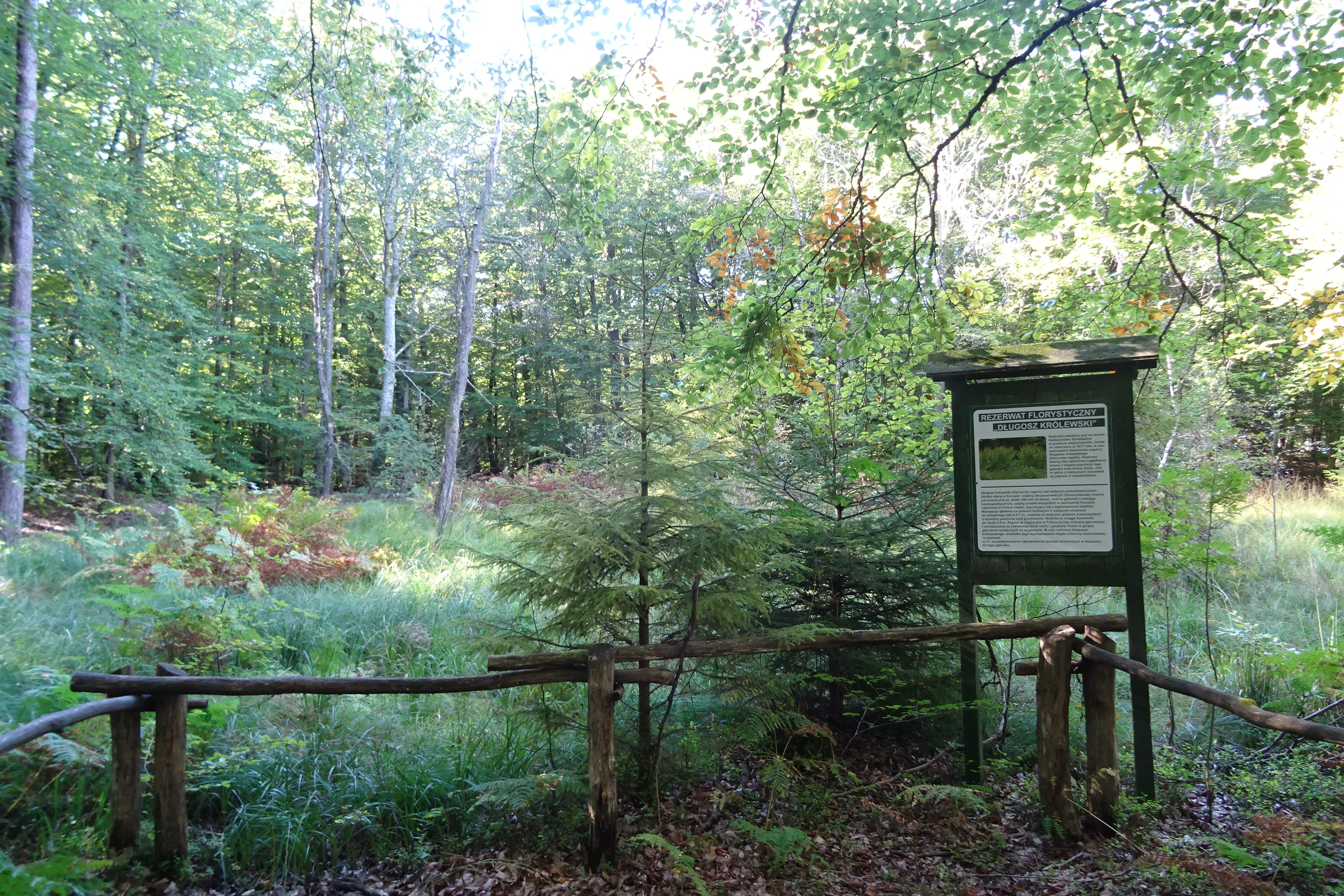
A wooden informational sign stands at the edge of a lush, wooded peatland area with a simple rustic wooden fence in the foreground.
An informational sign marks the entrance to the Długosz Królewski Nature Reserve in Łęczyn, Poland.

Długosz Królewski w Łęczynie Nature Reserve history and protected-area timeline

The reserve was established on 21 July 1977 under an order issued by the Polish Minister of Forestry and the Wood Industry. The founding legal act was published in the Polish legal monitor (Monitor Polski, 1977 issue 19, item 107), and the protection order is referenced in paragraph 4 of that legislation.

The reserve was created specifically to preserve documented locations of the royal fern, reflecting the broader late-1970s Polish approach of designating small, purpose-built reserves around significant plant sites. Although it does not currently have a formal protection plan (plan ochrony), the reserve operates under active protection tasks that define ongoing conservation management, making it an actively managed (ochrona czynna) site rather than a passive one. The slight discrepancy between the original nominal area in the founding act and measurements from the managing forest district reflects the typical pattern of small reserves being re-measured over time as forest management data is updated.

Długosz Królewski w Łęczynie Nature Reserve landscape and geographic character

The landscape context of Długosz Królewski w Łęczynie Nature Reserve is shaped by its placement within Puszcza Wierzchucińska, a forest complex that includes significant peatland environments. Although the reserve itself is very small, the surrounding terrain is dominated by northern Polish lowland forest on peaty, moisture-retentive soils, with acid-tolerant woodland species mixed with bog-edge and mire vegetation.

The reserve is not a scenic landscape feature in the mountainous or coastal sense; instead, its terrain consists of forested peatland-influenced ground, with the gentle topography typical of the glacial lowlands of the Pomeranian region. Royal fern populations in such landscapes typically occupy wet depressions, stream edges, and seepage zones that are sheltered by the canopy of surrounding trees, and the reserve is positioned to capture precisely these microhabitats.

The general environment is quiet, forested, and water-influenced. Because the reserve is open to walking along designated paths, its landscape is experienced at the small scale: short walks through damp woodland with the characteristic vegetation of peatland forest edges.

Długosz Królewski w Łęczynie Nature Reserve ecosystems, habitats, and plant life

The reserve's ecological identity is defined almost entirely by its botanical character. It is a floristic (florystyczny) reserve, meaning its purpose is the protection of specific plant species and the habitats that sustain them rather than broader wildlife communities.

The dominant ecological substrate is peatland forest. The combination of moist soils, acidic conditions, and shaded canopy found in such habitats supports a narrow set of specialized plants, including the royal fern, which is the primary subject of protection. Partially protected species recorded in the reserve include clubmosses such as Lycopodium annotinum and Diphasiastrum tristachyum (widłak jałowcowaty and widłak goździsty, which in older sources may be referred to differently) and bog rosemary (Rhododendron tomentosum, bagno zwyczajne), each reflecting the acidic, wet, peat-forest conditions.

From a habitat perspective, the reserve contributes to the conservation of small peat-forest refugia within Puszcza Wierzchucińska. Such microhabitats are widely recognized as ecologically valuable across northern Europe, and protecting them at the reserve level helps maintain plant diversity at landscape scales that would otherwise be lost to forestry or drainage changes.

Długosz Królewski w Łęczynie Nature Reserve wildlife and species highlights

The source material does not provide detailed wildlife information specific to this reserve. As a small floristic reserve whose formal objectives focus on plant species, detailed fauna descriptions cannot be reliably supported. While such wet forest environments typically host typical lowland forest fauna ranging from common forest birds to small mammals and amphibians, the available sources do not contain enough specific detail to build a substantive wildlife profile, so this section is left intentionally undeveloped rather than filled with generic speculation.

Długosz Królewski w Łęczynie Nature Reserve conservation status and protection priorities

The reserve exists to protect documented populations of the royal fern (długosz królewski), a species that is subject to strict protection under Polish law. The reserve's designation is, in itself, a conservation statement: the Polish nature reserve system designates such sites specifically because they contain protected elements of natural value that warrant legal safeguarding against disturbance, forestry changes, or habitat loss.

Beyond the flagship royal fern, the reserve also protects partially protected plant species associated with northern peatland forest environments. The fact that the site has no current formal protection plan but operates under defined active conservation tasks (zadania ochronne) indicates that conservation management is applied as a continuing practice. The reserve's small footprint, targeted scope, and placement within a larger forest complex all reflect a complementary role in the regional conservation network: protecting thin, specialized botanical communities that may otherwise be vulnerable within broad-scale forest management.

Top sights and standout views in Długosz Królewski w Łęczynie Nature Reserve

The standout feature of this reserve is its strict botanical focus: a small, dedicated protected area whose existence is justified by the presence of the strictly protected royal fern. This gives the reserve a clear, single-objective identity that distinguishes it from larger, multi-purpose national parks or landscape parks.

Its placement within Puszcza Wierzchucińska adds ecological context, situating the reserve within a larger forest landscape known for peatland conditions. For visitors interested in plant-focused natural heritage in northern Poland, the reserve offers exactly the kind of focused, easily walkable site where a single species and its associated habitat can be observed in a managed setting.

Best time to visit Długosz Królewski w Łęczynie Nature Reserve

Because the reserve is a small floristic site dominated by ferns and associated peat-forest vegetation, the late spring and summer growing season is the natural time when royal fern fronds are fully developed and most visible. The cool, damp conditions typical of peatland forests also make warmer, drier months more comfortable for walking the short paths through the reserve.

For visitors interested in observing the characteristic vegetation at its peak, the main growing season offers the richest experience. Off-season visits remain possible as the reserve is open year-round along designated paths, but the visual signature of the royal fern is most apparent during the leafy months.

Monthly climate preview

Long-term monthly temperature and precipitation rhythm for Rezerwat przyrody Długosz Królewski w Łęczynie

Rezerwat przyrody Długosz Królewski w Łęczynie Climate Normals and Annual Temperature Patterns

Representative coordinate records show measured multi-year temperature ranges and precipitation rates across twelve distinct months for Rezerwat przyrody Długosz Królewski w Łęczynie. Detailed monthly normals provide deeper analytical context for long-term climate patterns within the protected reserve geography.
Annual mean8 °C
-1 °C18 °C
Jan-1°
Feb-1°
Mar
Apr
May11°
Jun15°
Jul18°
Aug18°
Sep14°
Oct
Nov
Dec
Warmest month
August

17.8 °C

Coolest month
January

-1.4 °C

Wettest month
July

2.7 mm/day

Driest month
April

1.3 mm/day

Park location guide

Geography guide, regional context, and park location map for Długosz Królewski w Łęczynie Nature Reserve

Długosz Królewski w Łęczynie Nature Reserve park geography, regions, and map view in Poland

Understand where Długosz Królewski w Łęczynie Nature Reserve sits in Poland through a broader geographic reading of the surrounding landscape, nearby location context, and its mapped position within the national park landscape.

How Długosz Królewski w Łęczynie Nature Reserve fits into Poland

Poland, officially the Republic of Poland, is a Central European country spanning from the Baltic Sea in the north to the Carpathian Mountains in the south. It borders Germany, Czech Republic, Slovakia, Ukraine, Belarus, Lithuania, and Kaliningrad Oblast. The country has a temperate climate, diverse landscapes, and is known for its rich history, cultural heritage, and strong economic position within the EU.

Wider geography shaping Długosz Królewski w Łęczynie Nature Reserve in Poland

Poland occupies 312,696 km2 in Central Europe, extending from the Baltic Sea coast in the north to the Sudetes and Carpathian Mountains in the south. It borders Germany to the west, Czech Republic and Slovakia to the south, Ukraine and Belarus to the east, and Lithuania and Kaliningrad Oblast to the northeast. The landscape includes lowland plains, uplands, and mountain ranges.

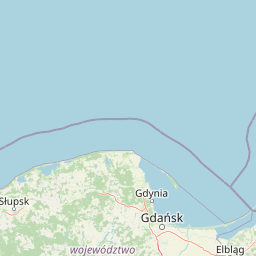
Map view of Długosz Królewski w Łęczynie Nature Reserve

Use this park location map to pinpoint Długosz Królewski w Łęczynie Nature Reserve in Poland, understand its exact geographic position, and read its mapped placement within the surrounding landscape more clearly.

Pigeon | © OpenStreetMap contributors

Location context for Długosz Królewski w Łęczynie Nature Reserve

Pomeranian Voivodeship

Visual reference collection showcasing wet woodland habitats, rare fern species, and northern lowland terrain.

Rezerwat przyrody Długosz Królewski w Łęczynie Photos and Protected Forest Landscape Scenery

Examine detailed photographs capturing the damp peatland forest environment and specialized botanical communities thriving within Rezerwat przyrody Długosz Królewski w Łęczynie. Visual documentation reveals the distinct lowland terrain and moisture retentive soils that shelter protected flora across the Pomeranian region.

A wooden informational sign stands at the edge of a lush, wooded peatland area with a simple rustic wooden fence in the foreground.

Park atlas

Compare nearby lowland forest reserves and regional protected landscapes across northern Poland.

Parks Near Rezerwat przyrody Długosz Królewski w Łęczynie And Surrounding Protected Areas

Browse other protected areas and forest reserves located near Rezerwat przyrody Długosz Królewski w Łęczynie. Comparing adjacent lowland habitats expands regional ecological context and botanical discovery.
Nature reservePomeranian Voivodeship
About 21 km away#1 closest

North

Długosz Królewski w Wierzchucinie: Mapping a Protected Floristic Peatland Reserve in Pomerania

Floristic nature reserve and bog ecosystem in northern Poland

This protected area in Gmina Krokowa preserves critical peatland habitats, including rare stands of royal fern and interrupted clubmoss. Its geography captures the history of the Wierzchucińska Forest, showcasing a complex environment of moist woodlands and bog mosaics characteristic of the Baltic coastal landscape in Poland.

Area
1.482 km²
Established
2003
Relief
Lowland
Climate
Temperate
Nature reservePomeranian Voivodeship
About 24 km away#2 closest

Northwest

Mierzeja Sarbska Nature Reserve: Protected Coastal Dunes and Barrier Landscape Mapping

Coastal geography within the Pomeranian Voivodeship

Mierzeja Sarbska Nature Reserve preserves a significant sandy barrier along the Baltic coast of northern Poland. The site features active parabolic dunes, interdunal deflation hollows, and unique relict wetland plant communities that provide critical insight into the regional landscape evolution of the Pomeranian Voivodeship.

Area
5.47 km²
Established
1976
Relief
Lowland
Water
Major water bodies
Watercolor illustration of sand dunes, tall grasses, pine trees, and distant mountains under a soft sky
National parkPomeranian Voivodeship
About 26 km away#3 closest

West

Slovincian National Park: Moving Dunes and Baltic Coast Protected Landscape Exploration

Discover its unique geography and mapped terrain.

Slovincian National Park is a protected area in Pomeranian Voivodeship, Poland, celebrated for its impressive moving sand dunes and coastal wetland ecosystems. These dynamic dunes, some reaching 30 meters high, migrate inland, creating an ever-changing landscape. The park also features large shallow lakes like Łebsko and Gardno, vital for migratory birds. Explore the mapped boundaries and geographic context of this significant protected area, a Ramsar site and UNESCO biosphere reserve.

Area
186.18 km²
Established
1967
IUCN
II
Visitors
319K annual
A horizontal watercolor illustration depicting rolling green hills, patches of tall grass, a small cluster of pine trees, and dunes under a soft, light-filled sky.
National parkPomorskie Voivodeship
About 26 km away#4 closest

West

Słowiński Park Narodowy: Mapping the Baltic Sand Dunes and Wetland Geography

Coastal landscapes of the Polish Pomorskie region

Słowiński Park Narodowy protects a vital mosaic of moving sand dunes, raised bogs, and coastal lakes along the Baltic shoreline. This atlas entry focuses on the physical landscape dynamics of the Gardno-Łeba lowland, highlighting the interaction between dune belts, water bodies, and coastal forest habitats within the Pomorskie Voivodeship.

Area
327.44 km²
Established
1967
Visitors
319K annual
Relief
Lowland
Nature reservePomeranian Voivodeship
About 27 km away#5 closest

South

Rezerwat przyrody Jezioro Turzycowe: Wetland Protected Area in Pomeranian Voivodeship

Kashubian Lake District bog forest and dystrophic lake atlas

Rezerwat przyrody Jezioro Turzycowe protects a concentrated mosaic of post-glacial wetland environments, including a dystrophic lake and raised bog habitats. This nature reserve offers deep insight into the specific hydrological and botanical conditions defining northern Polish wilderness corridors.

Area
0.114 km²
Established
1959
Relief
Upland
Climate
Temperate
Nature reservePomeranian Voivodeship
About 37 km away#6 closest

East

Mechelińskie Łąki Nature Reserve: Coastal Geography and Protected Baltic Wetland Atlas

Pomeranian Voivodeship coastal dune and marsh landscape exploration

Investigate the protected topography of Mechelińskie Łąki Nature Reserve, where saline meadows meet the Baltic shoreline of Puck Bay. This faunistic reserve preserves an essential mosaic of dunes, marshes, and reedbeds in northern Poland, serving as a significant habitat for nesting shorebirds and rare amphibian species within the Pomeranian Voivodeship.

Area
1.135 km²
Established
2000
Relief
Lowland
Climate
Temperate
A horizontal watercolor illustration showing a gentle river landscape with soft green meadows, trees, and rolling hills in the background.
Nature reservePomeranian Voivodeship
About 40 km away#7 closest

East

Kacze Łęgi Nature Reserve: Mapped Protected Woodland and River Valley Geography

Riparian floodplain forest in the Pomeranian Voivodeship of Poland

Kacze Łęgi functions as a crucial nature reserve that maintains an unusually well-preserved fragment of elm and alder floodplain forest. Nestled along the Kacza River valley in Gdynia, this site offers a concentrated look at the original vegetation of Baltic river valleys. It remains a key component of the regional protected landscape, providing a deep study of moisture-loving woodland within the larger context of the Pomeranian coastal lowlands.

Area
0.09 km²
Established
1983
Relief
Lowland
Scope
Terrestrial
Protected landscapePomeranian Voivodeship
About 44 km away#8 closest

Southeast

Trójmiejski Park Krajobrazowy: Protected Landscape and Glacial Geography in Pomerania

Exploring the forested moraine upland near the Baltic coast

Covering nearly 20,000 hectares, Trójmiejski Park Krajobrazowy forms an essential green belt along the Kashubian moraine. Its terrain is defined by dramatic erosion, including 80-meter deep ravines and extensive pine-beech forests that host rare relic plant species and protected peatland habitats.

Area
199.3 km²
Established
1979
Relief
Upland
Climate
Temperate

Common questions about visiting, size, designation, and location context for Długosz Królewski w Łęczynie Nature Reserve

Długosz Królewski w Łęczynie Nature Reserve FAQs for park facts, access, geography, and protected area context

Find quick answers about Długosz Królewski w Łęczynie Nature Reserve, including protected-area facts, park geography, trail and visitor context, and how the park fits into its surrounding country and regional landscape.
MoriAtlas Explorer

Continue Your Protected Areas Search Across the Global Atlas

Deepen your exploration by continuing the structured search for national parks and protected areas worldwide. Utilize the comprehensive filtering capabilities to compare different conservation landscapes and refine your understanding of global park geography. Discover more about the distribution and characteristics of protected natural areas.

Global natural geography