Why Gunung Mulu National Park stands out
Gunung Mulu is best known for its extraordinary cave systems and karst landscape. The park contains the Sarawak Chamber, one of the largest natural underground chambers in the world by volume, capable of accommodating multiple Boeing 747 aircraft. Deer Cave is the largest cave passage in the world, with an entrance measuring 120 to 150 meters in diameter and housing approximately three million wrinkle-lipped free-tailed bats. Clearwater Cave extends over 226 kilometers, making it the longest cave system in Southeast Asia and the seventh longest globally. The limestone pinnacles of Mount Api form a dramatic landscape of knife-edge ridges and towering karst towers rising from the rainforest, while the nightly emergence of millions of bats from Deer Cave creates one of nature's most spectacular wildlife displays.
Gunung Mulu National Park history and protected-area timeline
The history of exploration and protection at Gunung Mulu spans nearly two centuries, beginning with early European accounts of the region's dramatic limestone landscapes. The first documented reference to the Mulu caves appeared in 1858 when Spenser St. John, the British Consul in Brunei, described the area's limestone formations with their caverns and natural tunnels. Subsequent attempts to ascend Mount Mulu by Charles Hose in the Raj of Sarawak and by Spenser St. John himself failed due to the impenetrable limestone cliffs and dense vegetation.
The first successful ascent of Mount Mulu was achieved in 1932 by Edward Shackleton during an Oxford University Expedition, guided by the Berawan rhino hunter Tama Nilong who had discovered the southwestern ridge route. In 1961, G.E. Wilford of the British Borneo Geological Survey conducted the first systematic survey of the Deer Cave and Cave of the Winds, correctly predicting that many more caves awaited discovery. The year 1974 marked a turning point when the Sarawak government gazetted Mount Mulu and its surroundings as a national park, establishing the legal framework for protection.
The landmark Royal Geographical Society Expedition of 1977-1978 brought over 100 scientists to the park for 15 months, the largest such expedition ever mounted from the United Kingdom. This expedition surveyed 50 kilometers of caves including Clearwater Cave, Green Cave, and Wonder Cave, establishing Mulu as a world-class destination for cave exploration. Subsequent British expeditions in 1980 discovered the Sarawak Chamber, in 1988 linked Clearwater Cave with Cave of the Winds creating a 58-kilometer system, and in 1991 connected Blackrock Cave to extend the system to 102 kilometers. American expeditions between 1995 and 2000 explored Gunung Buda, leading to the discovery of Deliverance Cave and the eventual creation of adjacent Gunung Buda National Park in 2001. The park received UNESCO World Heritage designation in 2000 and continues to be the focus of ongoing exploration and scientific research.
Gunung Mulu National Park landscape and geographic character
The landscape of Gunung Mulu National Park presents an extraordinary diversity of landforms shaped by geological processes over millions of years. The park is dominated by three major mountains forming a dramatic backdrop: Mount Mulu rises to 2,376 meters as a massive sandstone peak, while Mount Api at 1,750 meters and Mount Benarat at 1,858 meters are composed of limestone that has been carved into some of the world's most spectacular karst formations. These mountains are separated by deep gorges, most notably the Melinau Gorge which cuts between Mount Benarat and Mount Api, creating a landscape of extraordinary vertical relief.
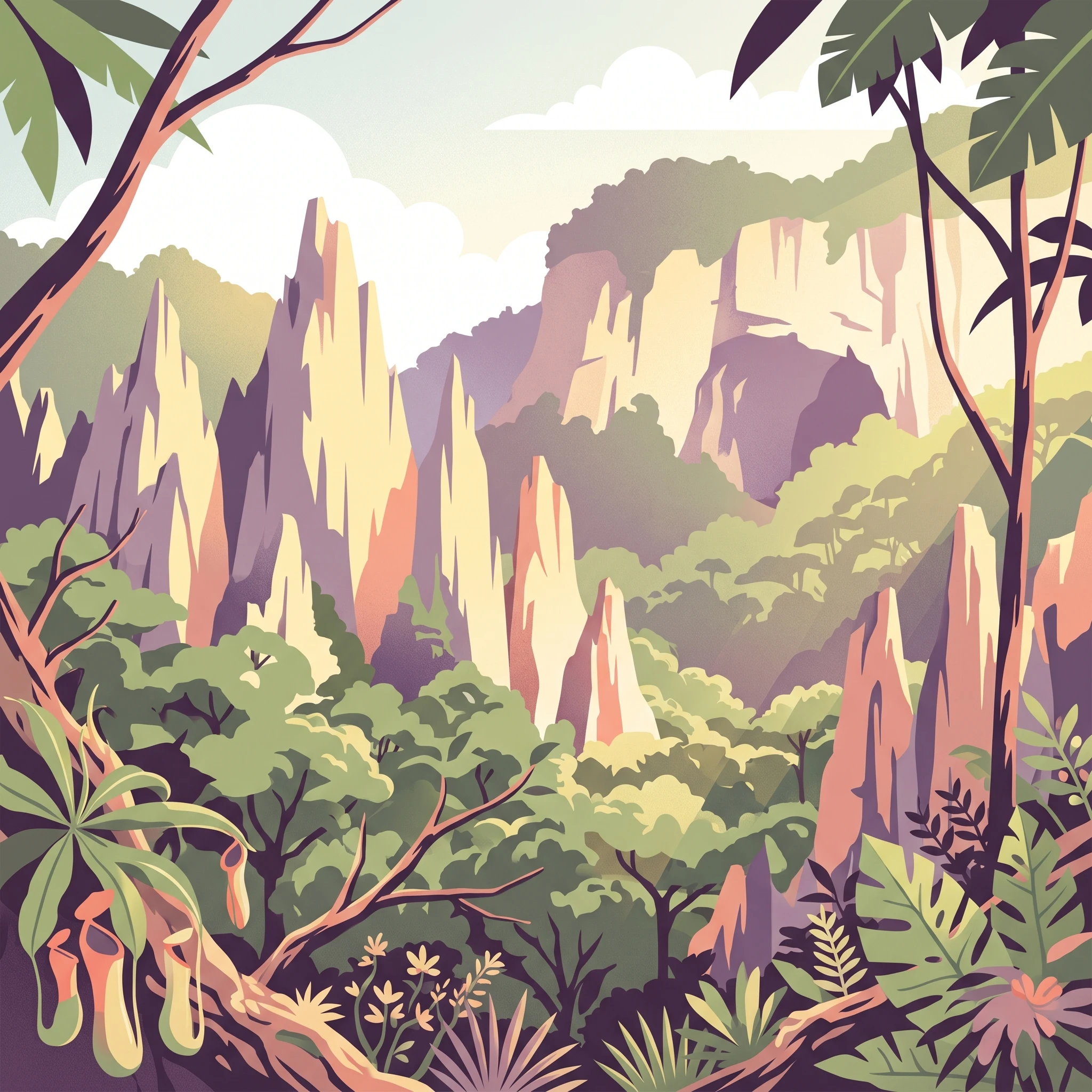
The limestone pinnacles of Mount Api represent perhaps the park's most visually striking feature, a forest of razor-sharp, vertically stacked rock formations rising hundreds of meters above the forest floor. These pinnacles are the result of extreme weathering of the limestone over millions of years, creating a landscape that resembles a field of stone blades. The park contains over 295 kilometers of explored caves, with passages ranging from walkable show caves to complex vertical shafts and massive chambers. The Sarawak Chamber, accessible only through the Gua Nasib Bagus passage, measures 600 meters in length, 415 meters in width, and at least 80 meters in height, with an unsupported roof span of 300 meters.
The terrain encompasses rugged summits, steep ridges, sheer cliffs, deep gorges, karst towers, caves, terraces, hot springs, floodplains, and waterfalls. The western side of the park consists largely of lowland areas while the eastern side features mountain ranges of limestone and sandstone. The Tutoh and Mendalam rivers with their tributaries drain the park, flowing toward the Limbang River system. The Melinau Gorge provides a natural boundary between mountain blocks, while Medalem Gorge separates Mount Buda from Mount Benarat.
Gunung Mulu National Park ecosystems, habitats, and plant life
The ecological diversity of Gunung Mulu National Park is extraordinary, with seventeen distinct vegetation zones supporting an exceptional concentration of biodiversity. The park's elevation gradient from lowland swamp to summit creates multiple habitat types, each supporting specialized species communities. The lowland forests, covering approximately 40 percent of the park, include peat swamp forests with their characteristic dome peat formations and heath forests on podzol soils. Mixed dipterocarp forests dominate the slopes up to 800 meters, characterized by towering emergent trees of the Shorea, Durian, Garcinia, Calophyllum, and Eugenia genera.
Above 800 meters, the vegetation transitions through lower montane forests dominated by Quercus species to upper montane forests between 1,200 and 2,170 meters. The upper montane zone features stunted trees and abundant epiphytes, with a canopy reduced to 10-20 meters. Moss forests cover the summit of Mount Mulu, where cool, wet conditions support specialized species. The limestone forests on Mount Api, Mount Benarat, and Mount Buda contain unique assemblages of calcareous plant species adapted to alkaline substrates, including endemic palms and the distinctive scree, cliff, and cave vegetation communities.
The park supports exceptional fungal diversity with over 8,000 species recorded, as well as more than 1,700 mosses and liverworts, 442 pteridophytes, and 3,500 vascular plant species including 1,500 flowering plants and 109 palm species in 20 genera. The diversity of habitats from swamp to summit, combined with the complexity of karst topography, creates the conditions for this remarkable plant richness.
Gunung Mulu National Park wildlife and species highlights
Gunung Mulu National Park supports remarkable faunal diversity, with over 20,000 invertebrate species and significant populations of mammals, birds, reptiles, amphibians, and fish documented within its boundaries. The park is particularly notable for its bat populations, with 28 species recorded including approximately three million wrinkle-lipped free-tailed bats that roost in Deer Cave. Each evening, these bats emerge in a spectacular exodus to feed, while swallows and swiftlets simultaneously enter the cave, creating a dramatic natural spectacle that has become one of the park's signature experiences.
Eight species of hornbill have been recorded in the park, representing one of the highest concentrations of these spectacular birds anywhere in Borneo. The rhinoceros hornbill, wrinkled hornbill, and helmeted hornbill are among the most distinctive, with the helmeted hornbill notable for its massive solid casque. Other mammals include the Sunda pangolin, tufted ground squirrel, silvery gibbon, Malayan sun bear, maroon leaf monkey, and yellow-throated marten. The reptile fauna includes 25 snake species such as the reticulated python and banded Malayan coral snake, while amphibians include several species known only from the park, such as the Borneo squat frog and the Gunung Mulu stream toad. The park's avifauna comprises 270 species, 81 mammal species, 55 reptile species, 76 amphibian species, and 48 fish species.
Gunung Mulu National Park conservation status and protection priorities
Gunung Mulu National Park represents one of Southeast Asia's most significant conservation areas, recognized both as an ASEAN Heritage Park since 1984 and a UNESCO World Heritage Site since 2000. The park's conservation value stems from its exceptional combination of geological significance, biological diversity, and the relatively intact nature of its ecosystems. The designation of 90 percent of the park as Totally Protected Areas, closed to general public access, reflects a commitment to maintaining ecological integrity while allowing limited sustainable use of designated areas.
The park faces conservation challenges from surrounding land uses, including logging and agricultural expansion. In 2019, local Penan and Berawan communities staged protests against logging activities on lands adjacent to the park, raising concerns about potential impacts on the park's ecological integrity. These communities maintain traditional hunting rights within designated areas and hold deep cultural connections to the landscape. Management strategies emphasize the importance of buffer zones, with proposals to extend protection to include adjacent Gunung Buda National Park and the Labi Forest Reserve in Brunei to strengthen ecological connectivity. The park serves as a critical reference site for tropical karst ecosystem research and as a model for balancing conservation with controlled tourism through carefully managed access to show caves and trekking routes.
Gunung Mulu National Park cultural meaning and human context
Gunung Mulu National Park is embedded within a landscape of significant indigenous cultural heritage, with local communities maintaining deep connections to the land that predates formal protection. The primary ethnic groups in the area include the Orang Ulu, Kiput, Kenyah, Kayan, Mulut, and Penan peoples, each with distinct traditions and relationships to the forest and cave systems. The Penan people, originally nomadic hunter-gatherers, have increasingly settled in semi-permanent communities at Batu Bungan and Long Iman in the southwestern portion of the park, though a small number maintain hunting privileges including rights to hunt pigs and deer at designated grounds.
The Berawan people similarly maintain traditional hunting rights within the park boundaries. Traditional cultural practices persist among these communities, including the wearing of feather hats, loincloths, and distinctive tattooing on arms, chests, and necks, with some women having earlobes elongated through traditional practices. Archaeological evidence from the Cave of Winds has revealed artifacts and human remains dating from 500 to 3,000 years ago, indicating long-term human presence in the cave systems. These cultural dimensions add depth to the park's identity beyond its geological and ecological significance, representing the ongoing relationship between indigenous communities and the landscapes that now form part of a World Heritage Site.
Top sights and standout views in Gunung Mulu National Park
Gunung Mulu National Park offers multiple outstanding highlights that distinguish it among the world's protected areas. The Sarawak Chamber stands as one of the largest underground chambers on Earth, a vast space capable of holding multiple aircraft that was discovered in 1980 and remains accessible only through the narrow Gua Nasib Bagus passage. The nightly emergence of millions of bats from Deer Cave creates one of nature's most spectacular wildlife displays, a phenomenon that has fascinated visitors for decades. The limestone pinnacles of Mount Api represent an iconic karst landscape, razor-sharp formations rising hundreds of meters through the rainforest canopy. Clearwater Cave, stretching over 226 kilometers, forms the longest cave system in Southeast Asia and ranks among the longest in the world.
Beyond the caves, the park offers challenging trekking routes including the Pinnacles Summit Trek requiring rope climbing, the Headhunter's Trail following traditional Kayan routes, and the Gunung Mulu Summit Trek to the 2,376-meter peak. The Canopy Skywalk provides access to the forest canopy 480 meters above the ground. The park's biodiversity includes eight hornbill species, endemic pitcher plants, and thousands of other species. Management limits access to preserve ecological integrity, with only four show caves open to general visitors while research continues to reveal new passages and species.
Best time to visit Gunung Mulu National Park
The climate of Gunung Mulu National Park is influenced by monsoon patterns, with the northeast monsoon bringing rain from December to March and the southwest monsoon affecting the period from May to October. Annual rainfall ranges from 4,000 to 5,000 millimeters, creating consistently humid conditions throughout the year. Temperature in the lowland areas ranges from 23 to 26 degrees Celsius, while the summit of Mount Mulu experiences much cooler conditions between 14 and 18 degrees Celsius. The park can be visited year-round, though visitors should be prepared for rainfall regardless of season.
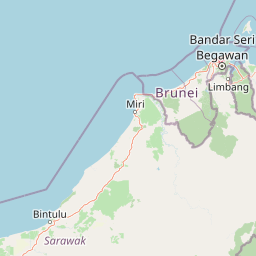
The dry season from May to October generally offers slightly more comfortable conditions for trekking and outdoor activities, though rain can occur at any time. The wetter months from December to March may make some trails more challenging but also contribute to the park's lush appearance and full waterfalls. The bat exodus from Deer Cave occurs every evening regardless of season, providing a consistent highlight for visitors. Temperature differences between the lowland base and mountain summits mean that those attempting the summit trek should prepare for significantly cooler conditions at higher elevations. The park's accessibility by air from Miri, Limbang, or Bandar Seri Begawan provides year-round options, though boat access may be affected by water levels during extreme seasons.